Other stories
-
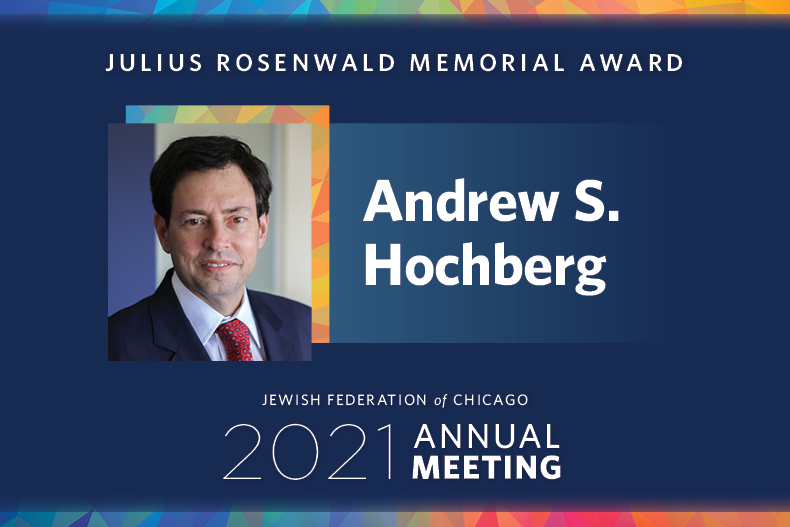
Meet Andrew S. Hochberg, 2021 Julius Rosenwald Memorial Award recipient
Celebrate Andy Hochberg at the virtual Annual Meeting on Sept. 14
Read more -
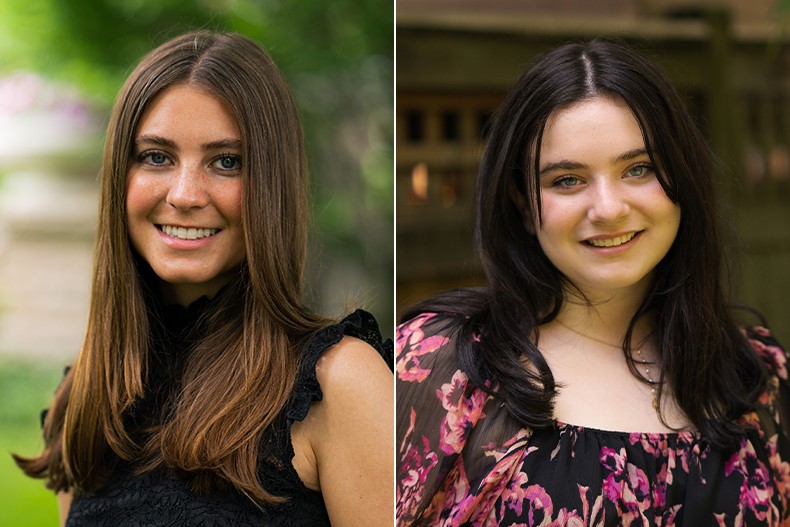
Two local teens win national recognition
Recipients of the annual Diller Teen Tikkun Olam Awards
Read more -
Celebrating six young award winners cultivating the community
Introducing young adult award winners
Read more
On Sunday, May 31, Jewish Community Center (JCC) Chicago welcomed community members, staff and agency leadership to the grounds of the Lake County Jewish Community Campus (LCJCC) at 23280 N. Old McHenry Rd., Lake Zurich, IL. A ribbon-cutting ceremony was held to celebrate the opening of JCC’s Early Childhood Center at LCJCC, the newest early childhood learning center in Lake County.
The Lake County Jewish Community Campus was built in 2008 to provide a warm, welcoming and inspiring environment for children to develop and grow, and for families to build community. The new early childhood center replaces the Jacob Duman JCC Early Childhood Center in Buffalo Grove, which permanently closed in June 2014. The transition to a new building enables JCC Chicago to bring to life the strongest aspects of its pedagogy, as the new space features child-centered learning materials, natural finishes and a color palette that represents the topography of Israel.
“The new space has become a model for JCC Chicago Early Childhood Centers, and renovations are planned for additional centers in the coming years,” said JCC Chicago Chief Advancement Officer, Addie Goodman.
Outdoor classrooms and expansive outdoor learning spaces inspire children’s creativity and further establish JCC Chicago as a leader in experiential learning. JCC’s Early Childhood Center at LCJCC is nestled amongst 37 acres of fields, nature areas, playgrounds and the Garoon Gateway to Science, the only outdoor science center in North America that integrates a Jewish component. LCJCC is also home to the Elaine Frank Apachi Day Camp, which welcomes nearly 500 campers every summer.
“It’s great to be on the same site with the Elaine Frank Apachi Day Camp and Garoon Gateway to Science so we can give families a richer, year-round experience,” said Trudi Krames, director of Early Childhood at LCJCC.
This year, JCC’s Early Childhood Center at LCJCC welcomed 120 children. Enrollment is expected to reach its capacity of 164 children within a few years, serving children age six weeks through kindergarten. The Campus at-large offers early childhood services, summer camp, family programs and events, sports, aquatics, community learning and more.
“Our staff is energized, the community is excited, and our children are growing intellectually and socially. We’re looking ahead to many more years of partnership in nurturing future generations,” said Kyle Freimuth, JCC Chicago Board President.
SAS Architects and Planners designed the JCC Early Childhood Center at LCJCC at an estimated cost of two million dollars.
For more details on the Lake County Jewish Community Campus (LCJCC), including the Elaine Frank Apachi Day Camp and Garoon Gateway to Science, please visit our website here .
To learn more about the JCC Early Childhood Center at LCJCC or to schedule a tour, please contact Trudi Krames at [email protected] or 847-901-0621.
Other stories
-
Meet Andrew S. Hochberg, 2021 Julius Rosenwald Memorial Award recipient
Celebrate Andy Hochberg at the virtual Annual Meeting on Sept. 14
Read more -
Two local teens win national recognition
Recipients of the annual Diller Teen Tikkun Olam Awards
Read more -
Celebrating six young award winners cultivating the community
Introducing young adult award winners
Read more
A little can go a long way … and make a big difference in the life of a community.
For the fifth time in four years, the Jewish Federation of Metropolitan Chicago’s South Suburban Mini-Grant Program will provide the financial boost that will bring a wide array of Jewish cultural programming to the Southland. Over the coming year, 13 cultural, religious and educational projects will share small grants totaling $15,700.
Programs range from biblical to contemporary, and will appeal to many ages and interests. This year’s events include sessions on traditional topics such as holidays and ritual objects, but also branch out into ecology, human trafficking, theater, cinema, campus anti-Semitism and the politics of water.
All were selected from proposals submitted by area Jewish organizations and reviewed by a group of local residents – the South Suburban Mini-Grant Kehillah – which awarded the grants.
The full list of programs, which begin this summer, includes:
- BBYO Great Midwest Region Hanukkah Party – presented by BBYO Great Midwest Region, Chaverim BBG and Barney Ross AZA
- Mezuzah Project – presented by Beit AmiChai School of Jewish Education
Students and their families will learn about and make a mezuzah to hang in their home.
- Kibbutz Lotan: Promoting Ecology and Tikkun Olam in the Israeli Desert – presented by B’nai Yehuda Beth Sholom
Alex Cicelsky will discuss “green” Torah study, water issues in the Middle East, eco-village living, and looking at the calendar from a “green perspective.” Students will make seed balls.
- Campaigning Against Anti-Semitism on Campus – presented by B’nai Yehuda Beth Sholom
Educate participants of the newest developments in anti-Semitism, including BDS (Boycott, Divest and Sanction).
- Continuum Theater Presents the Chicago Jewish Play Reading Festival 2016 – presented by B’nai Yehuda Beth Sholom
- Sharing Water Across Borders in the Middle East and the Great Lakes – presented by B’nai Yehuda Beth Sholom
Discuss strategies for sharing, protecting and distributing water equitably across political boundaries.
- Biblical Mysteries – presented by Congregation Am Echad. Oct. 11, Nov. 22 and Dec. 6, 2015.
Answers interesting questions about how the Bible was written and early Jewish and Christian history.
- A Light Unto The Nation – presented by Zahava Deborah Hadassah
- Chicago Festival of Israeli Cinema in Southern Suburbs – presented by JCC Chicago. Nov. 15, 2015.
Presents two acclaimed Israeli films with facilitated discussion, at the Marcus Theater, Chicago Heights.
- Trip to the Illinois Holocaust Museum & Education Center – presented by the Pvt. Sam Nievelt Jewish War Veterans Post #407. Oct. 8, 2015.
- An Anti-Trafficking Seder: The Freedom Haggadah – presented by National Council of Jewish Women South Cook Section. March 30, 2016.
Raises awareness of how people can become part of the solution to human trafficking by performing tikkun olam .
- Remembering at 70 Years: Holocaust Education & Dialogue Initiative – presented by Temple Anshe Sholom
Holocaust remembrance and educating future generations to capture its stories and lessons.
- Christianity, Islam and Buddhism: How Much Do You Really Know About Them? – presented by Congregation Am Echad. Oct. 8, Oct. 25 and Nov. 1, 2015.
Mini-grant proposals were reviewed and selected for the South Suburban Mini-Grant Kehillah by Janet Herbstman and Dr. David Gottlieb (co-chairs), Gayla Cahan, Bonnie Ribbet, Dan Greenberg and Robert Zitter.
For more information, contact Alene Rutzky, Jewish Federation South Suburban Office coordinator, at (708) 798-1884 or [email protected] .
Other stories
-
Meet Andrew S. Hochberg, 2021 Julius Rosenwald Memorial Award recipient
Celebrate Andy Hochberg at the virtual Annual Meeting on Sept. 14
Read more -
Two local teens win national recognition
Recipients of the annual Diller Teen Tikkun Olam Awards
Read more -
Celebrating six young award winners cultivating the community
Introducing young adult award winners
Read more
JUF Breakthrough Fund awards $1.27 million to encourage smart growth and innovation
STEFANIE PERVOS BREGMAN
Through its Breakthrough Fund, The Jewish United Fund of Metropolitan Chicago is once again helping fund innovative and leading-edge local programs and initiatives that meet local human needs, engage Chicagoans Jewishly, and strengthen Jewish communities in Israel and overseas.
This summer, a total of $1.27 million will be awarded to programs that focus on a range of themes such as inclusion programming for those with disabilities, connecting with diverse audiences, strengthening schools and students, and building and healing our community.
Some $687,000 will fund 13 new initiatives with grants ranging from $13,000 to $100,000; an additional $588,000 will support six programs in their second year of multi-year grants awarded last year.
Encouraging smart growth and innovation in the Jewish nonprofit sector are the goals of the Breakthrough Fund, which launched in Fall 2013 and has awarded a total of $2.3 million in grants to 40 local initiatives.
“With this second full cycle of Breakthrough Fund grants, we are proud to support programs that reach out and welcome diverse populations within our community and strengthen our existing organizations with creative new initiatives,” said David Sherman, chairman of the Breakthrough Fund review committee. “We have already seen the impact of past Breakthrough Fund recipients and know that these new programs will positively influence this community’s future in immeasurable ways.”
New Grants
Three of the programs focus on inclusion programming and programs for individuals with disabilities:
JCC Chicago : Aquatics Inclusion Program is an innovative swim program that will enable children and adults diagnosed with autism spectrum disorder to learn water safety and swim skills in an inclusive environment.
Jewish Child & Family Services: Encompass Synagogue Inclusion Project is a year-long collaborative project with JUF’s Synagogue-Federation Commission to conduct research and planning in order to better understand barriers to participation in the synagogue space for individuals with disabilities and their families.
JVS Chicago: Ready4Work Customized Employment Program builds on the Breakthrough Fund planning grant awarded last year and allows JVS to provide Customized Employment services to adults with intellectual and developmental disabilities in Chicago’s Jewish community.
Two of the programs focus on older adults and their families:
Beth Emet The Free Synagogue: HaDerekh-Paths to Jewish Caregiving develops and pilots a replicable, faith-infused caregiver training program that integrates Jewish traditions and stresses strategies for self-care, communication, and emotional well-being, as well as facilitating improved relationships, help-seeking, and support.
CJE SeniorLife: Chicago Virtual Senior Center allows CJE to fully launch its Virtual Senior Center, which uses videoconferencing to offer interactive, real-time bridge club, armchair yoga, museum “visits,” Jewish text study, and other programs to older adults who find it difficult to leave their homes due to limited mobility or chronic health conditions.
Two programs focus on building and healing our community:
Jewish Council on Urban Affairs: Or Tzedek, Teen Institute for Social Justice will hold three retreats for high school students and use these experiences to create a core, customizable social justice retreat curriculum that can engage multi-denominational and unaffiliated teens across Chicago in social justice training and education. The curriculum will focus on the root causes of poverty and racism in Chicago, and how to engage in these topics through a Jewish lens.
The JUF TOV Volunteer Network will launch three new initiatives–a concierge service to create customized volunteer opportunities for individuals and families, Good Deeds Day, and the Day School Project.
Two programs focus on strengthening schools and students:
Associated Talmud Torahs: REACH-Collaborative Problem Solving supports REACH (Resources for Educational Achievement, Collaboration and Health) and ATT staff becoming certified collaborative problem solving (CPS) trainers so they may train Chicago day school staff on using CPS to address social, emotional and behavior challenges in the classroom.
Jewish United Fund: Israel Children’s Zone® expands the Israel Children’s Zone® program by adding Youth Futures mentors in two additional schools, addressing students’ educational needs, emotional needs, behavioral issues, and learning difficulties, in addition to improving teacher preparation and mitigating school-wide challenges such as violence and bullying.
The remaining programs focus on reaching more diverse audiences:
A Wider Bridge Chicago creates new leadership development and community-building opportunities for Chicago LGBT Jews by hosting at least four local community programs and also providing an opportunity for five Chicago Jewish LGBT leaders to participate in A Wider Bridge’s LGBT mission to Israel.
Moishe House Chicago: Blue Line will open a new House in the Jewishly-underserved Wicker Park/Bucktown/Logan Square region, using a proven peer-led, home-based and pluralistic model of community building to address the area’s need for dynamic Jewish opportunities for 20-somethings.
Pushing the Envelope Farm will create two Jewish Food Justice Cohorts (teen and family) and a volunteer steering committee to create and engage in programs that connect Jews in the western suburbs to the Jewish community by exploring the Jewish connection between the land and the environment.
SHALVA will hire a part-time outreach coordinator to conduct education and foster dialogue about intimate partner abuse, domestic abuse in the Jewish community, local resources and services for Jewish Chicagoans ages 25-39.
Renewed Grants
CJE Senior Life: A Medication Abuse and Misuse Measure will create the first ever validated assessment tool to identify medication abuse and misuse by older adults.
GIFTS (Gratitude, Inspiration, Family, Tzedakah, and Service), a program administered by the Jewish United Fund/Jewish Federation of Metropolitan Chicago, provides grandparents with tools to connect with their grandchildren around Jewish values and philanthropy, including access to a donor advised philanthropic fund they can manage jointly.
Jewish Child and Family Services : Synagogue-Community Partnership expands JCFS’ successful model to the Lakeview neighborhood and west suburban Naperville, deploying JCFS staff to local Jewish sites and bringing social and support services, consultation, information/referral, and educational programming to community members.
Jewish Child and Family Services : Jewish Center for Addiction will work with Response to implement youth prevention and support programs in a Jewish context, including educational programs, individualized case management and referral, support groups, and recovery retreats for youth and young adults in recovery.
Mishkan Chicago: Going Broad Going Deep supports expansion of lay and professional leadership opportunities, creates the Neighborhood Captain program, increases programming outside the Lakeview neighborhood, and expands worship opportunities, volunteer involvement, classes, and workshops.
UpStart: Chicago will establish a network of support for approximately 20 local Jewish project leaders; provide R&D assistance to 6-10 emerging Jewish social entrepreneurs; and model “intrapraneurship” opportunities in Chicago’s mature Jewish communal organizations.
For more information about the Breakthrough Fund or to learn how you can apply to be a future recipient of a Breakthrough Fund grant, contact Sarah Follmer, Senior Planning Associate, Strategic Partnerships at (312) 357-4547, email [email protected] or visit www.juf.org/grants/breakthrough.aspx.
Other stories
-
Meet Andrew S. Hochberg, 2021 Julius Rosenwald Memorial Award recipient
Celebrate Andy Hochberg at the virtual Annual Meeting on Sept. 14
Read more -
Two local teens win national recognition
Recipients of the annual Diller Teen Tikkun Olam Awards
Read more -
Celebrating six young award winners cultivating the community
Introducing young adult award winners
Read more
Pit masters bring the love to the second annual Chicago Kosher BBQ contest
LAURA FRANKEL
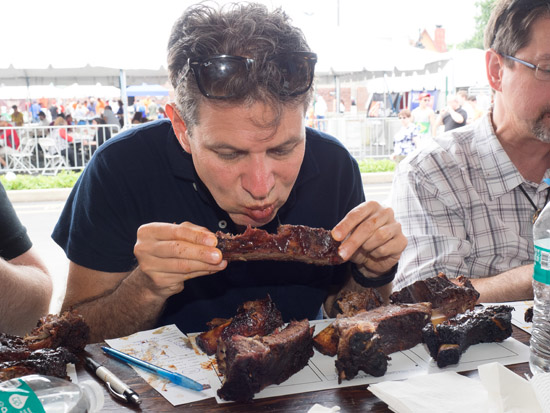
Judges taste the BBQ beef ribs at the Chicago Kosher BBQ Festival and Competition. (Photo by Ralph Schatz)
Things got very steamy at the Second Annual Chicago Kosher BBQ Competition and Festival, held at Anshe Emet Synagogue in Lakeview on Sunday, June 14.
The preparations began the Saturday night before with a thunderstorm and several inches of rain that only the heartiest of barbecue enthusiasts could possible endure. The Chicago Jewish community is made up of tough stuff and these pit masters sloshed through a Chicago summer thunder storm all night long while preparing their kosher delicacies.
Host sponsors for the contest were Milt’s Barbecue for the Perplexed, Anshe Emet Synagogue, and the Bernard Zell Anshe Emet Day School; the media sponsor was JUF News ; and the presenting sponsors were The Private Bank, Viva Vantage, and the Jeffrey F. Kahan Memorial Fund.
With 13 teams competing, trophies were awarded in the following categories: Best Brisket, Best Ribs, Best Chicken, Best Beans, Most Original Team Name, Best Booth Decoration, and Grand Champion. RaBBI-Q, under the leadership of Rabbi Mendel Segal, won almost every food category-and was named Grand Champion. “Uncle Mordy, John and the MEATzva Girls” won the award for best brisket. “ Burnt Offerings” won awards for best booth décor and most original team name. The Chicago Rabbinical Council supervised the contest.
In addition to the BBQ competition, events included pickle and hot dog-eating contests, and live entertainment featuring the Chicago Boyz Acrobatic Team, a DJ, and Hi-Five Hoops Basketball, and NFL Flag Football clinics. Milt’s also served food from its food truck. A $5 donation went to his year’s designated charity, Maot Chitim.
As a chef, I was curious about what these meat marathoners brought to the game. A representative from the “Dukes of Chazzer” excitedly told me their secret weapon was one Liam Jankelovics. Indeed, the newly graduated 8 th grader looked completely cool and calm while doling out brisket samples. In fact, the entire rain soaked team all looked fresh and eager to send their samples to the judges.
I wanted more. I asked for specifics. Another representative from the Dukes explained that it wasn’t just the curry in the sauce that made their BBQ special, it was the TLC! These BBQ teams showed great passion and care in their offerings.
The “Meat is Murder” team told me that nutmeg in their beans was the ace in the hole. They extolled the virtues of less chilies and more herbs in the chicken. Debbie, a spokesperson for the team, echoed the Dukes refrain of “lots of love.”
The technique of adding “love” was heard over and over again from the “Caught Smokin” to “Bris-Cut BBQ” teams. I can tell you that, as a chef, I tell my staff that one of the keys to turning a great dish into an amazing dish is putting love into it. I wasn’t surprised to hear that the love extended to great sportsmanship and teams covering other teams’ backs.
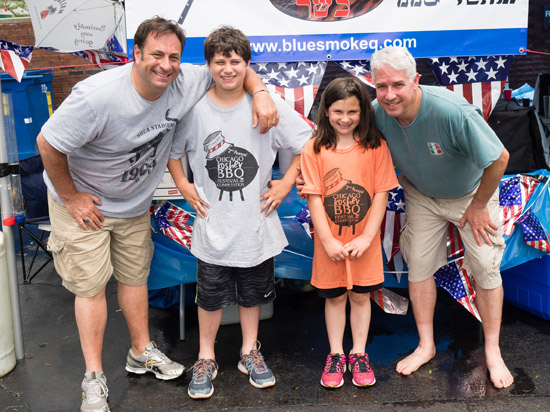
Unfortunately, the team of “Uncle Mordy, John and the MEATzva Girls” had a sudden death in Uncle Mordy’s family, and had to fly back to their home in New York before the contest. Other teams including “Rib Roastin’ Rabbis” covered the food for Uncle Mordy. Such is the spirit of community at the Kosher BBQ Competition.
I admit I was surprised to hear that several competitors had really put their all into the competition and had been practicing their craft to the point of being on Lipitor! After some thought, I realized that putting your all into great food and loving what you are doing is what it’s all about.
The large pool of judges, under the guidance of the representatives from Kansas City Barbecue Society (KCBS), eagerly dove into their boxes of BBQ.
Rabbi Mendel Segal, Executive Director at Kansas City Vaad and BBQ enthusiast, instructed the judges on their criteria. He zealously explained that the Holy Grail of kosher BBQ is brisket. Perfectly cooked brisket should have a melting texture with a drop of pull and, above all, should be moist!
There are often-always-times when we Jews don’t agree on things. In the case of BBQ, we all agree on one thing-that we all love to eat. The BBQ competition, as Milt’s owner Jeff Aeder explained, is about “welcoming the guest” and “inclusivity.” Indeed the dining tent was overflowing with Jews of all denominations and non-Jews alike, all elbow to elbow, enjoying BBQ and the festival.
Laura Frankel is a noted Kosher Chef and owner of Pickled Tongue Catering and Foods. Her book Jewish Slow Cooker Recipes: 120 Holiday and Everyday Dishes Made Easy will be released in paperback on Aug. 11. Check out her website at www.cheflauraskosher.com.
Other stories
-
Meet Andrew S. Hochberg, 2021 Julius Rosenwald Memorial Award recipient
Celebrate Andy Hochberg at the virtual Annual Meeting on Sept. 14
Read more -
Two local teens win national recognition
Recipients of the annual Diller Teen Tikkun Olam Awards
Read more -
Celebrating six young award winners cultivating the community
Introducing young adult award winners
Read more
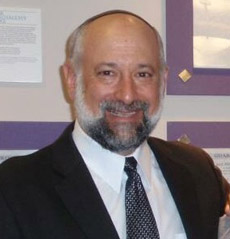
The Community Foundation for Jewish Education of the Jewish United Fund of Metropolitan Chicago has hired Richard S. Moline to serve as Director of Israel Education.
Moline is a Jewish educator with an outstanding track record in developing and managing youth initiatives and engagement programs in North America and Israel. Highly experienced in all facets of Jewish communal life and a lifelong Chicagoan, he has earned a reputation as a trusted and respected leader in Jewish and Israel education.
“Rich brings a breadth and depth of experience in almost every Jewish educational setting,” said CFJE Executive Director Rabbi Scott Aaron. “His mission is to plan and implement a strategic and sophisticated program of support for Israel education across the entire spectrum of our Chicagoland Jewish community.”
As CFJE’s Director of Israel Education, Moline will oversee all aspects of Israel education and strategy including curriculum development; oversight and leadership of the Ta’am Yisrael trip and its professional team as well as its pre- and post-trip components; and teacher training, including work with pre-K through 12 educators across the spectrum to support their Israel education efforts.
“Richard will make a significant contribution to increasing the quality and quantity of Israel education in every part of our community, including supplementary education. We are thrilled to welcome him aboard,” said Debbie Berman, chair of the CJFE Board.
Moline, of Chicago, is a graduate in Psychology and Jewish Studies from the University of Illinois. He has held a variety of major positions in the areas of Jewish and Israel education and youth engagement with the United Synagogues of Conservative Judaism. A fellow of the Wexner Heritage Foundation, he received the Exemplar of Excellence Award from Hillel International and the Or Zarua Award from the Jewish Educators Assembly. He has served as President of Solomon Schechter Day School of Chicago and National President of the Jewish Youth Directors Association.
“After my family, my number one passion is Israel,” Moline said. “I’m thrilled to share my passion with students, educators and members of the community by helping them develop their own personal relationship with the people and the land.
“I’m excited to join the CFJE team as we explore Israel, strengthen curriculum at every grade level, and connect with Israelis. We will give our students and educators the tools to explore Israel’s complexities by examining real accomplishments and real challenges. It doesn’t get much more exciting,” he said.
Other stories
-
Meet Andrew S. Hochberg, 2021 Julius Rosenwald Memorial Award recipient
Celebrate Andy Hochberg at the virtual Annual Meeting on Sept. 14
Read more -
Two local teens win national recognition
Recipients of the annual Diller Teen Tikkun Olam Awards
Read more -
Celebrating six young award winners cultivating the community
Introducing young adult award winners
Read more
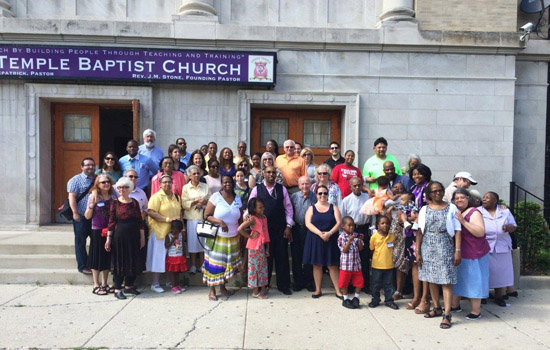
The tour group in front of Stone Temple Baptist Church in North Lawndale.
More than 50 people from the Jewish and African-American communities gathered together on Sunday, June 14, to tour historical sites in North Lawndale, a neighborhood that was once a central hub of Jewish life in Chicago.
The tour, organized by JUF’s Jewish Community Relations Council (JCRC) in partnership with Stone Temple Church, enabled leaders to see up close the shared history of both communities in the North Lawndale area. Attendees viewed various historical sites including the former Sears, Roebuck & Co. headquarters where Julius Rosenwald was a part-owner; the Dr. Martin Luther King, Jr. Legacy Apartments, where Dr. King resided in 1966 when he moved to Chicago to advocate for fair housing; and several former synagogues and other notable Jewish landmarks.
Dr. Irving Cutler, a decades-long resident of Lawndale, professor emeritus of urban geography and award-winning author co-led the tour with Matt Cole, the program coordinator for NHS Redevelopment Corporation at Neighborhood Housing Services of Chicago.
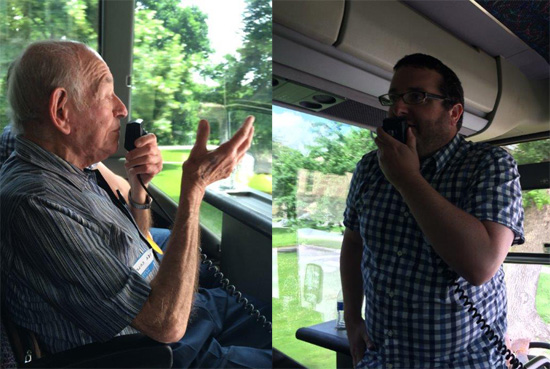
Tour guides Dr. Irving Cutler (left) and Matt Cole.
Prior to the tour, participants joined together for a fellowship luncheon at Stone Temple Church, the former site of the First Romanian Jewish Congregation.
The Stone Temple community also warmly welcomed members of the Jewish community to their Sunday morning prayer service, which was led by Bishop Derrick M. Fitzpatrick and featured remarks by Rabbi Wendi Geffen of North Shore Congregation Israel.
In her remarks, Rabbi Geffen noted that the most common commandment in the Bible, appearing 365 times, is “fear not,” or “do not fear.” She extolled attendees that no matter what you want to do, do not hold back because you are afraid, “just get going.” Bishop Fitzpatrick echoed her comments in his sermon and reflected about how the tour is one way for our communities to “just get going” together.
JUF is working in communities throughout Chicago, including North Lawndale with Jewish Federation partners Jewish Child and Family Services and Sinai Health System, to improve the lives of people of all religions. JCRC in particular works with communities of different faiths and ethnicities on important social issues.
For more information about similar programs in the future, email [email protected] or call (312) 357-4770.
Other stories
-
Meet Andrew S. Hochberg, 2021 Julius Rosenwald Memorial Award recipient
Celebrate Andy Hochberg at the virtual Annual Meeting on Sept. 14
Read more -
Two local teens win national recognition
Recipients of the annual Diller Teen Tikkun Olam Awards
Read more -
Celebrating six young award winners cultivating the community
Introducing young adult award winners
Read more
Chicago Jewish community expresses shock and outrage at Emanuel African Methodist Episcopal Church murders
On behalf of the entire Chicago Jewish community, the leaders of the Jewish Community Relations Council of the Jewish United Fund of Metropolitan Chicago have expressed shock and outrage at the horrific attack at the Emanuel African Methodist Episcopal Church in Charleston, South Carolina on June 17.
“We extend our deepest condolences for the victims, their families, and the entire Charleston community,” wrote JCRC Chair Skip Schrayer in a letter to the church . “This attack is an unspeakable crime that can only be described as an act of hate. We stand with you and express our solidarity with your community during this most challenging of times.”
“As a community and people of faith, we deplore any act of violence but particularly one that is perpetrated in a community’s sacred space where people gather for prayer. There is no place for such violence in our society. In this most difficult time of mourning, your community is in our thoughts and prayers” wrote JCRC Executive Director Emily Sweet.
It is in the interest of every American to heal the rifts of hatred that can lead to such terrible events. An attack on any person because of their race, religion or ethnicity is an attack on all people of good conscience, and an assault on the common values that bind our nation together.
Other stories
-
Meet Andrew S. Hochberg, 2021 Julius Rosenwald Memorial Award recipient
Celebrate Andy Hochberg at the virtual Annual Meeting on Sept. 14
Read more -
Two local teens win national recognition
Recipients of the annual Diller Teen Tikkun Olam Awards
Read more -
Celebrating six young award winners cultivating the community
Introducing young adult award winners
Read more
Advisor to prime ministers, Israel’s National Security Council speaks to JCRC
JESSICA HOCHBERG
There is a given reality that Dr. Dan Schueftan would like people to accept–that “peace” is not a feasible outcome for the conflict in the Middle East. Rather, there are structural problems that will persist and not allow for an effective diplomatic solution. Israelis must cope with the broken structural problems by strengthening the Israeli society and fostering a vital relationship with the United States.
On Tuesday, June 16, Schueftan, who was visiting Chicago, spoke about this reality on behalf of the American Society of the University of Haifa to several local Jewish leaders at a breakfast, sponsored by JUF’s Jewish Community Relations Council, held at JUF headquarters.
In his political career, Schueftan acted as an advisor to Israel’s National Security Council, and to former Prime Ministers Yitzhak Rabin and Ariel Sharon. Internationally, he has briefed senior political leaders and officials in the United States and Europe.
Schueftan is the Director of the National Security Studies Center at the University of Haifa, where he also serves as a senior lecturer at the university’s School of Political Sciences. He has also taught at the Israel Defense Forces National Security College and the IDFS Command and Staff College.
During his lecture, he highlighted that the problems in the Middle East cannot be solved with a new policy or with dialogue between nations. While these approaches are theoretically productive, they are ineffective, he said. The issues in the Middle East are structural, and will not be resolved with a focus on “peace” or the creation of a “solution.”
He said the inefficiency of diplomacy in that the area is “violent, unstable…a hatred of Israel, even if you have an agreement between Israel and some political elites, you have a very deeply felt resentment against Israel.” The fundamental sentiments of hostility would render the agreements between nations inconsequential. Schueftan added that the current Arab political culture in the Middle East does not allow for successful “solutions.” Israel’s focus, instead, should be on coping with the circumstances of the nation. Israel persists by effectively utilizing her assets, which include promoting a prosperous Israeli society and garnering support from the United States.
The Israeli society is a flourishing democracy, he said, with a successful economy that has one of the lowest unemployment rates in the world and lucrative innovations.
Another tenet of Israel’s success-in spite of its tumultuous circumstances-stems from the relationship between the United States and Israel. Without this friendship, Israel would not only struggle financially but, more importantly, struggle in an international context. The underlying causes of the successful relationship lie in the similar values the two countries possess and America’s political importance. The U.S. and Israeli governments have an ethical bond and share values. They both have resilience that propels them to persevere.
The Israeli and American mindset share five attributes: They are both “strong, stable, responsible, pro-American, and determined/resilient,” Schueftan said. Also, the U.S. acts as a crucial ally for Israel, and defends Israeli actions to many countries that may display hatred towards the country. America’s role as a strong international presence assists Israel in accumulating support for the country’s existence.
Jessica Hochberg is a 2015 Lewis Summer Intern.
Other stories
-
Meet Andrew S. Hochberg, 2021 Julius Rosenwald Memorial Award recipient
Celebrate Andy Hochberg at the virtual Annual Meeting on Sept. 14
Read more -
Two local teens win national recognition
Recipients of the annual Diller Teen Tikkun Olam Awards
Read more -
Celebrating six young award winners cultivating the community
Introducing young adult award winners
Read more
JUF launches new initiative to improve and expand teen programming, beginning with immersive Spring Break
This summer, the Jewish United Fund of Metropolitan Chicago launches a new initiative to increase the depth and quality of programming for Chicagoland Jewish teens – including the creation of an immersive Spring Break program to pilot next year.
The new initiative was made possible by a five-year, $3.19 million challenge grant from the San Francisco-based Jim Joseph Foundation. The grant was awarded within the framework of the Jewish Teen Education and Engagement Funder collaborative, comprised of national and local funders working together to expand and deepen community-based Jewish teen education and engagement.
“We are profoundly grateful to the Jim Joseph Foundation and our local funders for enabling us to delve deeper into this important aspect of Jewish learning,” said JUF President Steven B. Nasatir. “Providing meaningful Jewish learning experiences to the next generation is critical to ensure that our vibrant Jewish community will flourish for years to come, and we are proud to be partners in this effort.”
Funds from the Jim Joseph Foundation will be matched by a consortium of local funders, including Crown Family Philanthropies and JUF.
“This approach is the result of a community planning process that involved more than 100 clergy, professionals, parents and teens,” said Hallie Shapiro Devir, JUF’s Assistant Vice President of Israel Experience and Youth Initiatives. “This initiative will benefit the whole community by increasing opportunities for teen engagement, deepening our knowledge of Chicagoland Jewish teens and enabling organizations to provide enhanced programming to better meet their needs.”
To spearhead the new efforts, former consultant Sarina Gerson signed on last month as Director of JUF’s Teen Engagement Initiative. A graduate of Indiana University and The University of Maryland’s Robert H. Smith School of Business, Gerson brings over ten years of experience in the non-profit and commercial sectors to the position.
A lifelong supporter of immersive Jewish experiences, Gerson said she looks forward to working with community partners to create exciting programs that will provide Jewish teens with new entry points for Jewish education and engagement – particularly the all-new hallmark Spring Break experience.
“We believe that Spring Break represents a unique opportunity to create a new entry point for Jewish teen engagement,” said Gerson. “We are excited to provide teens with a low cost, fun, immersive experience where they can explore a new topic or develop new skills while connecting with other Jewish teens and mentors through a Jewish lens. In doing so, we will increase the number of teens engaged in Jewish activities who have a deep appreciation for Jewish values and tradition.”
JUF also plans to hire a new community educator to assist with capturing insights about programming and creating more continuity between current programmatic offerings.
The Funder Collaborative began two years ago following the release of the Jim Joseph Foundation’s report, “Effective Strategies for Educating and Engaging Jewish Teens.” Other grants within the Collaborative framework have been awarded to Combined Jewish Philanthropies of Boston; Rose Community Foundation in Denver/Boulder; UJA-Federation of New York; and the Jewish Federation of Greater Los Angeles, totaling nearly $32.8 million. Over the next 8-10 years, it is projected that these initiatives will collectively reach and engage tens of thousands of teens in meaningful Jewish experiences. Total investment by the Collaborative’s end date over that same period may reach as much as $70 million.
As part of the overarching mission to create more effective Jewish learning experiences, the Jim Joseph Foundation awarded a total of nearly $24 million to 13 organizations and institutions. The Foundation focuses on creating effective and compelling Jewish learning experiences for youth and young adults in the United States.
“JUF’s talented team identified Spring Break as an untapped opportunity to offer immersive Jewish learning experiences to Chicago area teens” said Al Levitt, President of the Jim Joseph Foundation, which seeks to create effective and compelling Jewish learning experiences for youth and young adults in the U.S. “We are excited to work closely with JUF as this initiative evolves and as more community partners lend their support and creative minds.”
For more information on JUF’s programming for Jewish teens, visit juf.org/teens.
Other stories
-
Meet Andrew S. Hochberg, 2021 Julius Rosenwald Memorial Award recipient
Celebrate Andy Hochberg at the virtual Annual Meeting on Sept. 14
Read more -
Two local teens win national recognition
Recipients of the annual Diller Teen Tikkun Olam Awards
Read more -
Celebrating six young award winners cultivating the community
Introducing young adult award winners
Read more