This past spring, the new reality of quarantine and distance learning made us educators step out of the classrooms and rethink education and social interactions. We were forced to adapt to Zoom and maintain nearly all relationships remotely.
We scoped out forums for our students to continue growing their social skills, and to find ways to interact not only with their peers in their school and their hometowns, but also with those who live across the world.
With travel restrictions, we lost out on our annual opportunity to have JUF Diller Teen Fellows from JUF’s Partnership Together region of Kiryat Gat, Lachish, and Shafir visit us at Stevenson High School. However, no flying restrictions could stop us from building those bridges and fostering lasting relationships.
JUF and Stevenson partnered to create the virtual connections in which students from the Partnership region in Israel and Stevenson students were able to connect through Zoom, WhatsApp, and FaceTime throughout the summer to share a series of virtual experiences.
“My partner and I got a chance to interact and learn more about each other, although there was a barrier of time and location,” said Abigail Rabin, a junior at Stevenson High School. “With the help of WhatsApp, we had gotten to know about each other’s interests, family, societal differences, and education systems.”
The exchange was a special experience for the Chicago students to witness how their Israeli counterparts overcame similar challenges. It was important for the students to still have an opportunity to forge friendships, especially when so many camps and travel programs were canceled.
For Rayna Finn, a Stevenson senior, the project was the beginning of a friendship that continues to grow-despite the distance and language barriers: “Despite the world being thrown into chaos from the pandemic, I managed to make new connections across the sea. …Even though my Hebrew wasn’t very proficient, and Hila struggled a little with English, we automatically connect on a whole other level… This experience wasn’t a project, but the building of a friendship.”
Anna Gorbikoff is a Hebrew teacher at Stevenson High School in Lincolnshire.
Other stories
-
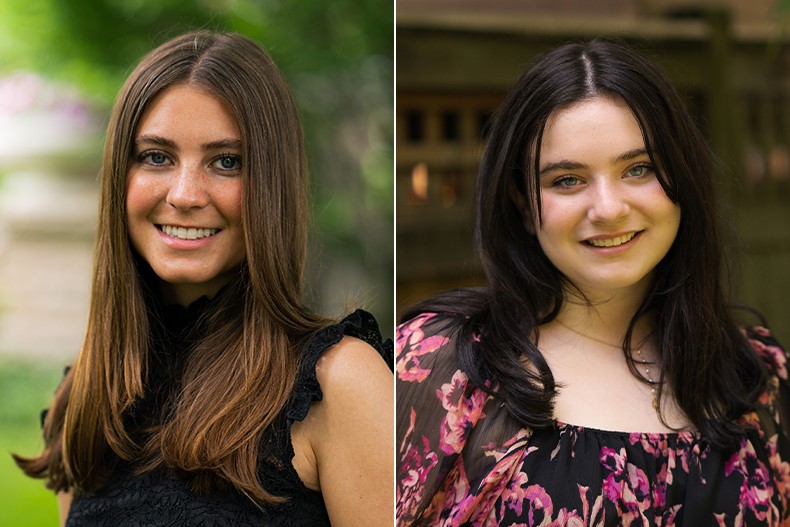
Two local teens win national recognition
Recipients of the annual Diller Teen Tikkun Olam Awards
Read more -

Celebrating six young award winners cultivating the community
Introducing young adult award winners
Read more -

Dan Sharon served for over 35 years- from 1971 to 2008-as Senior Reference Librarian of the Asher Library at the Spertus Institute for Jewish Learning and Leadership. He died on June 22 at the age of 77.
Sharon “touched the lives of many students and researchers,” recalled Kathy Bloch, the Library’s collection manager. “Dan was widely read, and an endless source of information on all aspects of Jewish religion, history, and culture. Dan took great joy in sharing his knowledge with others.”
In a 1995 Chicago Tribune profile on Sharon, library director Michael Terry called Sharon “a treasure,” adding “at a time when information is becoming standardized through technology, he provides it in a very personal way.”
“I try to show [callers] the different points of view within Judaism,” Sharon once said. “There are many currents of thought within the Jewish world today.”
Sharon fielded questions on Jewish topics from the Spertus staff and faculty, the local Jewish community, and the general public around the country. He estimated that he received 20-30 questions a day, once as many as 80.
Over the years, Sharon answered questions from students, congregations, and the Israeli consulate. He helped a priest start to learn Hebrew, shared a Jewish prayer recording with Protestant divinity school employee, and directed a Pakistani Muslim person to a translation of the Talmud.
Robbin Katzin, now the librarian at Hillel Torah Day School, worked with Sharon for a decade. “Dan is in the acknowledgements of so many books,” she said. When Sharon was asked a question, she remembered: “He would answer to the best of his ability, but follow up even a month later if he found more relevant information. He even did this with some questions he’d received before he retired. He was like a bird dog.”
Despite his reputation, he admitted he was “regularly stumped…you learn how much you don’t know.”
After retiring, Sharon joined the board of directors of the Chicago Jewish Historical Society. After Sharon’s passing, the Society’s president, Walter Roth, wrote in its newsletter: “A student of history as well as library science, Dan was my most dependable resource…”
Sharon was raised in “an intensely Jewish home,” according to the Chicago Tribune, by parents who imbued him with “a love for Jewish history, the Bible, the Hebrew language, and Jewish culture.” They had met in pre-state Israel.
Sharon was born in Louisville and lived in St. Louis and New York City before settling in Chicago.
He earned his bachelor’s and master’s degrees in history from Roosevelt University. While in graduate school, he also substitute-taught high school history in public school and secular subjects to Bais Yaakov Hebrew Parochial School, earning his teaching certificate. Sharon then switched his focus to library science, receiving his master’s degree from Rosary College in 1971.
Spertus’ library hired him that same year.
Sharon was the son of the late Moshe and Rachel Sharon. He was the brother of Timna Liberman, and uncle to Michale Wacks, Elana Chaya, and Akiva Liberman. Funeral arrangements were made by Mitzvah Memorial Funerals.
Other stories
-
Two local teens win national recognition
Recipients of the annual Diller Teen Tikkun Olam Awards
Read more -
Celebrating six young award winners cultivating the community
Introducing young adult award winners
Read more -
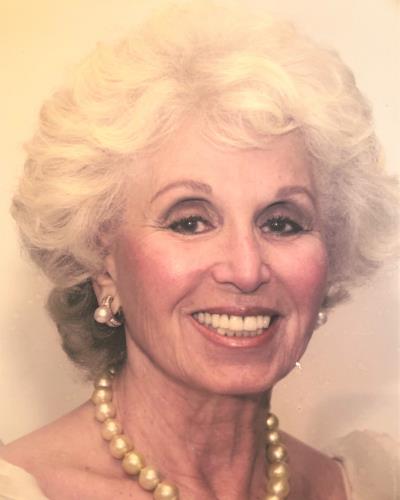
“You should own your things, but they should never own you.” This was one of many pieces of wisdom Joan Holland taught her family. Born in 1929, she grew up in Albany Park. She died on Sept. 8 at 91.
Holland was wide-ranging in her Jewish philanthropic interests, giving her time and other resources to Hadassah, ORT, North Suburban Synagogue Beth El, and FREE, the refugee organization.
She was a Golden Giver to JUF, having contributed to more than 50 consecutive Annual Campaigns, and had made a Lion of Judah Endowment at the Emerald level. She frequently hosted JUF Snowbird events at her home in Palm Springs, Calif.
“Joan Holland was an elegant lady whose lifelong commitment and advocacy for her Jewish community, for Israel, and for Jewish education was legendary and inspirational,” said Steven B. Nasatir, Executive Vice Chairman of JUF.
Holland regularly visited Israel and was active in many Israeli philanthropies, from the Israel Philharmonic Orchestra to the Israel Tennis Association. For many years, her son Ed said, his parents would sponsor the university educations of two IDF soldiers who had completed their military service-many of whom came by to thank them in person.
Holland was especially active in Israel Bonds, becoming the first Women’s Board chair for Israel Bonds in Chicago. Through that organization, she personally met Israeli leaders Golda Meir, Yitzhak Rabin, Abba Eban, and David Ben-Gurion. “She knew every Israeli ambassador to the U.S.,” recalls her daughter-in-law Ann Dee Holland.
Holland had “come from very little,” Ed said, and did not have the chance to attend college. Instead, she was “self-educated” by reading classics and biographies.
The only child of Edward and Dot Hyman, she married Marvin Holland, a plastics distributor, in 1950; they were married for 44 years. After he died, she married Eli Glassman in 1998. They were married for 16 years until his passing.
“She buried two husbands and two children,” he said. “But she had a positive attitude and lived life to the fullest. She would say, ‘Not if, but when, you fall, you have to get back up.'”
Another saying of Holland’s was: “Never confuse privileges with entitlements.” She was always charitable, her son said. When he was growing up, he said, “Our home was an open house for charities…My mother used to give five dollars when that was harder to come by than a thousand dollars is now.”
Joan H. Holland (nee Hyman) was the beloved wife of the late Marvin Holland and the late Eli Glassman. She was a loving mother to Jeffrey, Ed (Ann Dee), Philip (Sue) and David (Carrie Thomas) Holland and Laura (Richard) Argosh, and the late Bennett and Devorah Holland, and to Eli’s children, Gary (Joan Branham) and Stephen (Sarah Elgart) Glassman and Marci (Richard) Gollis. She was the adored grandmother of Bradley (Elana), Stuart (Rachel Plotnick), Joel (Liz), Michael and Alex Holland, Jori (Danny) Leeb, Lindy (Aaron) Resnick, Hilary (Scott) Stevens, Mar Argosh, Jessica Sissom, Manya Branham-Glassman, Zev and Daisy Gollis, Zola and Sylvie Glassman… and the proud great-grandmother of 12. The devoted daughter of the late Edward and Dot Hyman, she was the cherished sister-in-law of the late Irving (late Leanore), Sol (late Millie) and Marty (late Belle) Holland, and a treasured aunt, great-aunt, great-great-aunt, and cousin to many. Memorials may be made to JUF or North Suburban Synagogue Beth El. Arrangements were made by The Goldman Funeral Group.
Other stories
-
Two local teens win national recognition
Recipients of the annual Diller Teen Tikkun Olam Awards
Read more -
Celebrating six young award winners cultivating the community
Introducing young adult award winners
Read more -

Less-than-perfect? Perfectly fine: The lesson of the three-walled sukkah
RABBI LEONARD MATANKY
Every year, my synagogue builds a magnificent sukkah, four walls of wood, greenery galore for its roof, and enough space to seat 150 people or more. But not this year.
Because due to the concerns of COVID and the need to provide for greater air circulation, this year, we’ve decided to build a sukkah of just three walls, to leave one side wide open so that those who sit in our sukkah will be safer.
But is a three-walled sukkah “kosher?”
According to the Code of Jewish Law (OC630:2), not only is a three-walled sukkah kosher, but even a two-walled sukkah with just a portion of a third wall is perfectly fit. Of course, that is, as long as the roof, with its greenery ( schach ), still offers more shade than sunlight.
How can that be? Would just three cups of wine on Passover be enough? Would three fringes on a tallit be sufficient? Of course not! So why would three walls be perfectly good-even by the strictest of standards?
According to the Jerusalem Talmud (Sukkah 1:1), the answer is found in verse from Isaiah (4:6), which describes three functions of a sukkah, ergo the three walls. This is also the position of the rabbis in the Babylonian Talmud (Sukkah 6b).
But there may be another reason why a missing wall is not a problem, one which harks back to a Talmudic debate over the reason for this holiday. According to the second-century sage, Rabbi Eliezer, we observe Sukkot as a remembrance of the “clouds of glory” which escorted and protected the Jews through their 40 years of wandering. On the other hand, the famous Rabbi Akiva said that we observe Sukkot to commemorate the huts the Jews lived in during their years in the desert (Sukkah 11b).
Asked the nineteenth-century sage, Rabbi Yechiel Michel Epstein (Aruch HaShulchan OC 625); according to Rabbi Eliezer, we can understand the reason for Sukkot – to remember the God’s miraculous protection of our people. But according to Rabbi Akiva, why establish a holiday to remember structures in which we lived?
The answer he wrote explained that remembering how we lived in the desert is a tribute to the faith of the Jewish people, who, despite the dangers, despite the uncertainty, were willing to follow Moses for 40 years.
According to Rabbi Akiva, Sukkot celebrates the miracle of faith, a miracle of a people who, despite all that they lacked, despite never knowing what the next day would bring, nor where they would be the next day, had faith.
This is symbolized by a sukkah – not a perfect structure, but an imperfect one. For this reason, a sukkah of three walls is perfectly fit to be used, not in a de facto sense, but de jure. Because the sukkah celebrates our faith despite uncertainty and reminds us that while life may be imperfect, it must still be celebrated.
For, in reality, no one has all four walls of life intact. In varying degrees, we all experience measures of sorrow or failure, loss, or disappointment. No one is exempt; no one is alone; because in life, a three-walled sukkah is the rule and not the exception.
This is a lesson we must recall in these unusual times when our world has been turned upside down, and we find ourselves living lives very different than we ever imagined. On the one hand, we could mourn the loss of our fourth wall – of social interactions that are now limited, and the health risks we must face. Or we can remember the message of Sukkot, which our Torah identifies as zman simchateinu (a holiday of joy), and celebrate the three walls that are still intact, the imperfect world in which we live.
For me, this year’s three-walled sukkah will be a sight for sore eyes. It will be a sign that we remember but an opportunity to celebrate that God will protect us if we continue to move forward with faith and confidence that even in the uncertainty of these times, God will “spread His sukkah of peace over us and of His nation Israel.”
Rabbi Leonard A. Matanky, Ph.D., is the Dean of Ida Crown Jewish Academy.
Other stories
-
Two local teens win national recognition
Recipients of the annual Diller Teen Tikkun Olam Awards
Read more -
Celebrating six young award winners cultivating the community
Introducing young adult award winners
Read more -

“I never imagined that I would take a gap year,” said two Chicago high school graduates who faced a difficult decision when the pandemic struck.
Hannah Frazer and Elai Spector are among thousands who are choosing to spend the next semester or year in Israel and defer their college admissions.
Programs from Masa Israel Journey, a leading provider of Israel experiences for young adults, have seen a 30% increase in registration in North America, according to Rachel Moses, Director of Gap Year Recruitment.
“I’ve never seen enrollment that high” in Masa’s two most popular gap year programs this year, the Young Judea Year Course and Aardvark Israel, Moses said. These programs offer well-rounded experiences, including trips around Israel, study in a variety of subjects, work, and volunteering.
Although Israel’s borders are currently closed to travelers, Masa program participants are allowed in under a special visa program. During their time in Israel, participants get as full an experience as possible while maintaining social distancing guidelines, and each trip has changed its itinerary to work around a two-week quarantine.
Frazer is looking forward to the real-life experience she would have missed at Harvard University. When she heard that her campus would only be allowing freshmen and all classes would be online, she started exploring options until a friend introduced her to Aardvark. She is looking forward to studying Hebrew, exploring Tel Aviv’s museums and night life, and working at an internship.
She is also excited about the opportunity to meet participants from around the world and connect with them through her nonprofit, Question Connection, a card game that helps people form interpersonal relationships.
“I’m really excited about bringing that to Israel,” she said. “With school buildings being shut down, I felt like me and my peers had a lot of trouble staying connected and quarantine was so isolating.” This was part of what made e-learning “very difficult for me as a senior,” she said, and she looks forward to building connections in real life.
Like Frazer, Spector was not keen on taking online courses during his freshman year of college. Instead of matriculating at Indiana University’s Kelley School of Business, he chose to go to Israel on a Masa Young Judea year course program. During his stay, he will reside in Tel Aviv and Jerusalem, where he will take classes about Israel, learn Hebrew, and work at an internship.
“I chose to do the gap year so I could have four normal years of college,” he said. “If things go back to normal in fall 2021, which hopefully they will, I’ll be able to have four years of the full in-person college experience.”
As more universities switch to virtual classes, Moses is hearing from more and more people with similar mindsets. “We’re still getting a lot of people interested in programs, including ones starting this week!” she enthused, noting that while some programs are full, others are available, including second-semester trips.
For additional information or to be connected to a Masa Israel program, reach out to Alissa Gaon at [email protected].
Other stories
-
Two local teens win national recognition
Recipients of the annual Diller Teen Tikkun Olam Awards
Read more -
Celebrating six young award winners cultivating the community
Introducing young adult award winners
Read more -

In every other year, Chicago’s Jewish Federation has held its Annual Meeting in a grand hall, packed with community members and leaders, professionals and volunteers, donors and students, award recipients, and dignitaries local and international.
This year, the COVID-19 pandemic made such a gathering impossible. The 120th Annual Meeting, instead, was held in many locations, connected by both the Internet and a shared sense of purpose.
Federation’s first virtual Annual Meeting–held in September–focused on both the challenges and successes of the past year, including the pandemic and JUF’s response to it.
Even under these circumstances, speeches were still delivered, awards were still bestowed, and Board members were still inducted. The Federation recognized a new reality, grappled with its new obstacles–and got the job done. Just as it has during historic crises large and larger, for 120 years.
“This virtual annual meeting may be a first, but a sense of virtual connection is nothing new for the Jewish people,” said Linda Becker Ginsburg, the 2020 Annual Meeting Chair. “As Jews, our sense of community runs deep. When we pray, we know Jews around the world are reciting the same prayers. When we light Shabbat candles and say kiddush, we remember the family members who came before us–and dream about those who will come after us. We care for fellow Jews in need, wherever they may live; we know that whether or not we ever meet, we are family. And that’s the work that brings us here today.”
Kim Shwachman was inducted as the Chair of the 2021 JUF Annual Campaign. And after the new Board members were elected, the 2018-2020 Board Chair Andrew S. Hochberg passed the gavel to incoming Board Chair Pam Friend Szokol.
“Our Federation has ‘Together for Good’ as its motto. In my belief, that is a challenge at this time,” Hochberg said. “Our country faces a divisive election in November. In Israel, political turmoil reigns. We need to remember that not only does Jewish tradition suggest a financial commitment to keep our community strong, but it also challenges us to look at each other with love, respect, and to give each other the benefit of the doubt. When I accepted the gavel two years ago, I referred to the concept of achdut , which in Hebrew means ‘unity.’ When we are united and generous, we succeed; when we are not, we fail. I encourage you to remember that, as we assess social media postings, conduct socially distant meetings, or engage in Zoom meetings.”
In what was only his second Annual Meeting as Federation’s President, Lonnie Nasatir used his State of the Federation address to outline JUF/Federation’s response to today’s twin epidemics of COVID-19 and antisemitism. He offered words of unswerving resolve in the face of unnerving reality.
Michael H. Zaransky received the 57th annual Julius Rosenwald Memorial Award, the Federation’s highest honor. The award– named for Chicago’s own historic business icon and philanthropist– recognizes a lifetime of outstanding dedication to Chicago’s Jewish community.
Other awards presented at the Annual meeting included:
-The Shofar Award, to 2020 JUF Annual Campaign Chair Marc Spellman.
-The Davis, Gidwitz, and Glasser Award, for outstanding lay leadership, to Katie Berger.
-The Samuel A. Goldsmith Award, for outstanding professional leadership, to Elyse Saretsky and Emily White.
Over 1,000 people attended this year’s meeting, in the same place, if not in the same room. Members of our Jewish community sat isolated, if only by mere space. But we stood together, as always. Separated by distance, but united in spirit.
From the 2020 State of the Federation Address
Lonnie Nasatir, President
“We are in the midst of what may be the defining moment of our lifetime–and JUF has been able to step up, because you stepped up. Now the world is forever changed, and so are we. We discovered we have deep reserves of strength that we didn’t know we had–and we saw that our Jewish values will always provide us the roadmap forward. Jewish values aren’t just what we do–they are who we are. If we ground ourselves in those values, there’s no challenge we can’t overcome, from a still-unfolding pandemic to resurgent antisemitism and systemic racism.
At a time when society is more divided than ever, the world needs our unity.
At a time of great need, the world needs our generosity.
And at a time of great challenge, the world needs our spirit of innovation.”
Remarks from Honorees
– Michael H. Zaransky, Julius Rosenwald Award winner
Former JUF/Federation Board Chair, 2013 Annual Campaign Chair
“To my generational or near generational peers, teach your kids and grandkids to be kind….to be a mensch. You may not realize it, but someone is watching, waiting to be inspired. This pandemic has given us an opportunity to focus on what really matters in life. Our tradition has taught us that we are the people that always, always, always, sees the light within the darkness. In the darkest of times, we always choose life. And to the younger generations who have joined us today: We look with hope to the future because of you. We hand you a community and tradition that is full of meaning and purpose. Walk upright and proudly because of who you are. Feel the pride of the legacy that is now yours. It is your turn to enter the miraculous story of our people. Step up and be a part of the story.”
– Katie Berger, Davis, Gidwitz & Glasser Young Leadership Award winner
JUF/Federation Board Member. Former YLD Campaign Chair. Helped establish the Ben Gurion Society Advisory Council. Current Jewish Women’s Foundation committee chair.
“Miriam is my mom’s Hebrew name. And like biblical Miriam, she is a special kind of leader,” Berger explained. “She has shown me the power of listening, maintaining calm in the midst of chaos, and how leadership is best done through connection. For anyone who knows her, you know exactly how I ended up making this speech here today. While we, as Jews, can be universally inspired by these women, my personal connection–my Ruth, my Devora, my Miriam–their stories fuel me. I feel lucky to be recognized as a leader in this community, but I wouldn’t be here today without the women who taught me so much.”
-Samuel A. Goldsmith Award winners
-Emily White
Director, JUF Israel Education Center
“It would be easy to let the pain of the Jewish story define the Jewish experience. To let the golden star on the breast of the condemned cast its pallor across the faces of us all. But why would we? Why would we allow the legacy of the Jewish people be decided by our detractors? We can’t, and we shouldn’t. Our story is one of strength, of smarts, and tenacity. Our steely determination to exist. Our story is a story of the flow of ancient sand. Of Nobel prizes, of loyalty, and of love. Love for our god, for our children, and for each other. Our blood flows thicker than the water that separates us from our long-ago, and never-forgotten, home.”
-Elyse Saretsky
Director, Young Leadership Division
“Upon graduation, I joined the Teach for America Corps of 2012. I spent time on Chicago’s South West side as a first grade teacher which opened my eyes to many things, but most importantly the importance of living life guided by a sense of humility and one full of community. When I left the classroom after two challenging years, with as much longing at age 24 as I felt at age 12, I found myself seeking out a Jewish community . . . Fast forward to today–the home I knew I wanted has turned into the career I never knew I needed.”
Other stories
-
Two local teens win national recognition
Recipients of the annual Diller Teen Tikkun Olam Awards
Read more -
Celebrating six young award winners cultivating the community
Introducing young adult award winners
Read more -
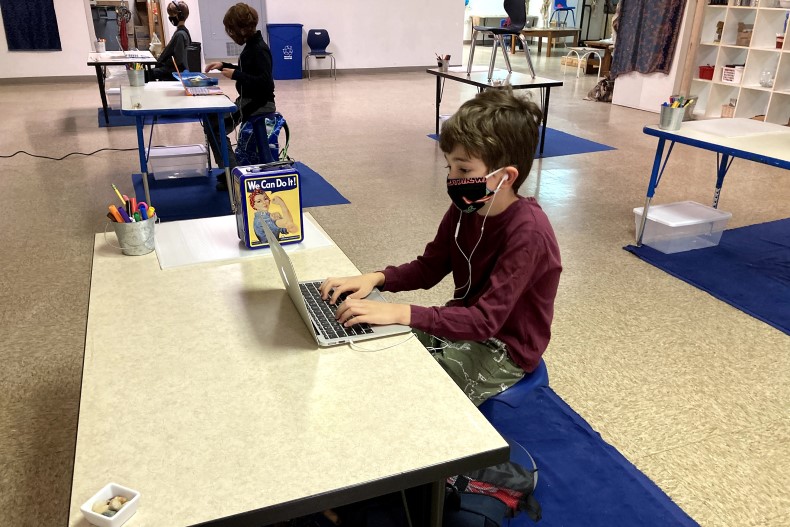
For many children and families, Jewish learning helps forge a connection to Jewish life. During the pandemic, synagogues and religious schools are doing their best to keep their pupils engaged, even at a distance.
Anshe Emet’s teachers and professionals have built a unique “hi-flex” model through which online and socially distanced, in-person classes take place simultaneously.
“Families have so many variables to deal with in this time, we felt it was important that parents, students, and faculty were able to make the choices that work for their own set of circumstances while continuing the highest level of Jewish education for our community,” said Laurie Goldberg Orenstein, Religious School Principal for Anshe Emet Religious School in Chicago.
Moriah Congregation in Deerfield is working with a similar hybrid model of virtual and in-person learning. “We were looking for something that would meet the needs of our learners and community that was thoughtful and took Jewish education seriously,” said Lori Kramer, Moriah’s Director of Education. This included brainstorming creative ideas for adapting their traditional study methods like chevrutrot (study pairs), and finding educational programs that work well in person and online.
For in-person learning, much of which has been taking place outside, Moriah staff have drawn inspiration from camp activities and materials, like using pool noodles and hula hoops to help with social distancing. At home, students work with classroom materials delivered by the school to every child.
“When all the children have the same materials, that fosters dialogue among the children, as they can share ideas about how they’re using the materials,” said Rabbi Rebecca Milder. She is the Founding Director of Jewish Enrichment Center, an independent school that also distributed classroom items to students. Collaboration like this has been a major focus of the Jewish Enrichment Center, whose educational model is to “raise the child’s voice in Jewish life.”
“That can happen whether we’re in person or online,” said Milder, who has worked hard to ensure students have a place to share their ideas. While bulletin boards work in person, she has found solutions online, including virtual whiteboards and Zoom chat during lessons. Students can also share art projects and other non-electronic work by uploading pictures of their creations, and get inspired to make more crafts with weekly ideas provided on the Center’s website.
Innovating online learning has also been a crucial part of the religious school at Am Shalom in Glencoe. Like at Moriah, Hebrew learning has pivoted to one-on-one, and Am Shalom has added supplemental classes to help students connect. At a weekly Tefillot Dance Party on Zoom, students do activities that are difficult to complete in a one-on-one setting and play games with their peers.
For Rabbi Phyllis Sommer, Director of Congregational Learning at Am Shalom, the pandemic provided many opportunities to create programs beyond the traditional curriculum. This includes the ” La’Briut : To Our Health and Wellness” program from the Jewish Education Center of Cleveland that Sommer helped to develop. With La’Briut , families learn “how we can take our Jewish values and traditions and use them to help us find meaning during these times.”
JUF is supporting all these schools and many more with technological platform training, curriculum design, mentoring faculty, and other resources to “move congregational education to a current-needs scenario for the modern family,” said Rabbi Scott Aaron, Associate Vice President, JUF Education.
With the modern Hebrew school system “designed with a different set of social and cultural assumptions about what the community is from the mid-20 th century, as the years go on, it gets less effective and relevant to modern families, so we’re really pushing to create innovation and systemic change,” he said. “Because of COVID-19, everyone got thrown into the pool together. That’s been a great benefit because they’re realizing that while they were hesitant before, they have to change now, and they’re more capable than they realized.”
Other stories
-
Two local teens win national recognition
Recipients of the annual Diller Teen Tikkun Olam Awards
Read more -
Celebrating six young award winners cultivating the community
Introducing young adult award winners
Read more -
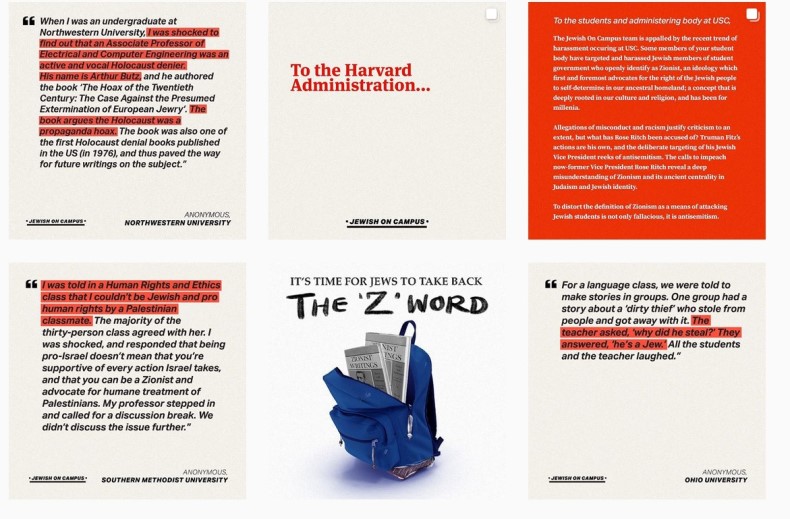
“The teacher asked, ‘why did he steal?’ They answered, ‘he is a Jew.’ All of the students and the teacher laughed.”
“When I saw your last name, I was worried you might be Jewish, but you’re not, right?”
“When I got to my next class, I noticed that someone had put a piece of paper with a swastika and “burn dirty Jew” on it in my backpack.”
Reading the above accounts, it is easy to imagine that they reflect sentiments and experiences of years gone by–that they are the prejudices of generations past.
Sadly, they’re not.
These stories, and hundreds more just like them, were shared on a new Instagram account called Jewish On Campus as recently today.
Founded and led by a team of Jewish college students from across the United States, Jewish On Campus was created to “provide a safe space for Jews of all backgrounds to speak up against antisemitism on college campuses.” Since launching in July, Jewish on Campus has acquired over 28,000 followers, and given over 200 Jewish college students a safe and supportive platform to–anonymously or publicly–share their experiences.
“Unfortunately, wherever Jewish people are, there is antisemitism,” and that includes virtual spaces, said Melissa Dworkin, Strategic Initiatives Consultant at JUF. Due to the coronavirus pandemic, most colleges are starting the 2020-2021 academic year with predominantly online learning. As a result, said Dworkin, “Jewish students are facing increased online harassment and antisemitic incidents,” which can be incredibly difficult to navigate. “These experiences are already isolating,” continued Dworkin. They become even more so when students are in quarantine and do not have physical access to their usual support networks.
As a platform, Jewish On Campus not only encourages students to share their experiences; it helps to cultivate a virtual community that “lets them know that they are not alone” and that their Jewish identity is something to treasure.
“We want to be loud and proud of our Jewish pride movement,” says University of Chicago student and Jewish On Campus leader, Julia Jassey, in an interview with J. The Jewish News of Northern California via JTA and cited by The Times of Israel .
Part of that movement is a call for action from the universities through which these anti-Semitic incidents occur. JUF is proud to provide students with support and skills trainings in this area through Hillels of Illinois and the Israel Education Center.
“JUF is everywhere that college students are,” Dworkin said. “We are very much at the forefront of college student engagement, of building Jewish community on college campuses…engaging students virtually and in-person…we are working around the clock to support students, to provide leadership training, and to provide resources and support for mitigating antisemitism.” We want to help students be “the strongest student leaders that they can be, and know that their Jewish identity and their Zionist identity is a part of that.”
In a matter of months, Jewish On Campus has elevated hundreds of student voices and helped to create an involved and empathetic virtual community for Jewish college students. The Jewish On Campus team is now considering applying for non-profit status, according to Jassey. Doing so will enable them to fundraise and broaden the breadth of their work to “defend Jewish students whose voices aren’t being heard.”
Reading through the Instagram entries, one thing is abundantly clear: while antisemitism remains a painful reality on college campuses, the students behind Jewish On Campus prove that, in the face of adversity, Jews will always be a source of support and strength for one another.
Jenna Cohen is a development professional and freelance writer living in Chicago.
Other stories
-
Two local teens win national recognition
Recipients of the annual Diller Teen Tikkun Olam Awards
Read more -
Celebrating six young award winners cultivating the community
Introducing young adult award winners
Read more -
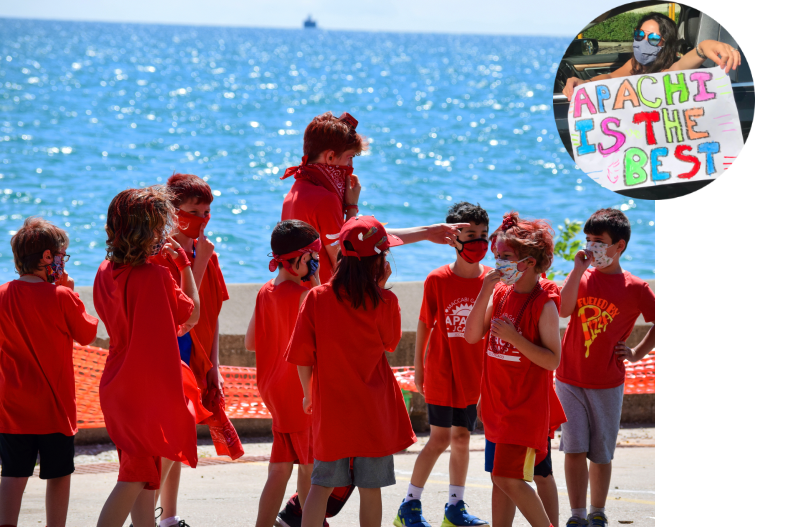
The last day of camp during any summer is a messy mix of emotions – happiness, pride, sadness, longing for just a few more precious days before the stress of the school year begins. This summer, though, our emotions were on overload. The first day of Apachi J Camp brought familiar faces, excited campers, and counselors, and a whole new set of to-dos. Temperature checks. Small groups. Face coverings. A shorter session.
But through it all, smiling eyes above the masks were proof that we squeezed in every last bit of Apachi fun. We owned it. Summer 2020 was AMAZING!
The success of this unusual Apachi summer was truly a team effort fueled by a community cheering us on, parents who are true partners, and the most resilient group of campers who came ready every single day to embrace this summer fully.
We are grateful to our community partners who stepped up in a big way to make sure we could deliver a true Apachi summer. Apachi Old Town and Apachi Northside relocated to Chicago Jewish Day School and Emanuel Congregation, respectively, and Apachi Rogers Park spread out to a second site at Ida Crown Jewish Academy. Also, in Northbrook, ‘Z’ Frank Apachi Day Camp worked with Winkelman Elementary School, who kindly allowed us use of their parking lot for camper drop off, temperature screenings, and pick-up. It takes a village, and these partners really showed up for the community and for our kids.
And speaking of our kids, after months of being at home and away from friends, Apachi campers came ready for a summer filled with happiness, new friends, and new activities. While many of their parents thanked us for giving them the summer their kids so badly needed, we are the ones who want to say thank you. We are so proud, so grateful, and so inspired by our Apachi campers-not only following new safety rules but for bringing their love, their unbridled enthusiasm, their kindness, their open hearts, and their smiling faces to camp every day.
With summer now a wonderful memory and an unusual school year upon us, trust us when we say we can learn a lot from these kids. We know that we are strong, united, and flexible. Together we made summer happen. Together, we can do anything.
~With an attitude of gratitude from JCC Chicago and Apachi J Camps
Elizabeth Abrams is the Director of Program Marketing and Communications for JCC Chicago.
JCC Chicago is a partner with the Jewish United Fund in serving our community.
Other stories
-
Two local teens win national recognition
Recipients of the annual Diller Teen Tikkun Olam Awards
Read more -
Celebrating six young award winners cultivating the community
Introducing young adult award winners
Read more -
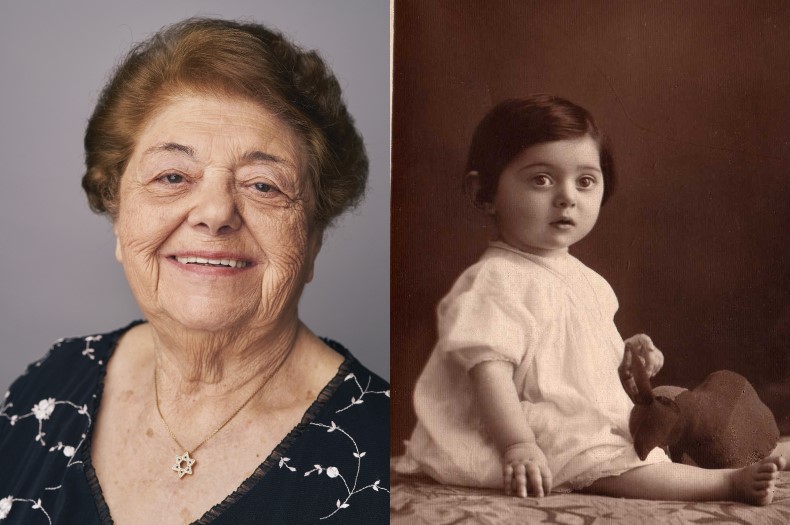
A survivor of Auschwitz-Birkenau, Brown was a longstanding member of the Illinois Holocaust Museum’s Speakers’ Bureau, on a mission to share her survival story with as many people as possible.
By the time of her passing on July 7 at age 93, Brown had reached over 100,000 people around the world, from one-on-one interviews to speeches in packed auditoriums.
She was born Magda Perlstein. On her 17th birthday, she was deported from her home in Miskolc, Hungary to Auschwitz-Birkenau, where her parents and most of her extended family died in the gas chambers. She was among 1,000 Jewish Hungarian women from Birkenau chosen to work at one of Germany’s largest munitions factories.
In March 1945, she was sent on a death march to Buchenwald concentration camp. Brown and several prisoners were able to escape, hiding in a nearby barn. She was eventually liberated by the Sixth Armored Division of the U.S. Army. After the war, relatives in the U.S. sponsored her immigration to Chicago.
For 40 years, Brown worked in a physician’s office as a Certified Medical Assistant. She was the beloved wife of the late Robert Brown, mother of Rochelle and Bruce, and the adored grandmother of many.
Although it was painful to remember her horrendous experiences, Brown believed her story-as well as the stories of other survivors-must be told. In October 2018, she was scheduled to speak at Chatham University in Pittsburgh. The tragic shooting at the Tree of Life synagogue took place the day before, but she didn’t hesitate to board the plane, saying, “Now the world needs to hear the message even more. Let’s go.”
Despite the horrific experiences of her formative years, Brown was known for her sunny disposition as well as her determination.
“There was nothing better than when Magda walked into the Museum and gave you her signature ‘grandma hug & kiss,'” said Susan Abrams, CEO of the Illinois Holocaust Museum. “And everyone knew better than to try and talk her out of something. Nothing was going to keep her away from a speaking engagement, not weather, her health, or even an act of terrorism.”
The Illinois Holocaust Museum & Education Center has posthumously given Magda Brown the 2020 American Association for State and Local History Award of Excellence, an award that recognizes leaders in collecting, preserving, and interpreting history to make lessons of past more accessible and meaningful to all.
In lieu of flowers, the family has requested donations to the “Magda on a Mission” fund at Illinois Holocaust Museum and Education Center, a donation for a brick in her honor on the Museum’s tribute pathway or to the Hebrew Immigrant Aid Society (HIAS).
Other stories
-
Two local teens win national recognition
Recipients of the annual Diller Teen Tikkun Olam Awards
Read more -
Celebrating six young award winners cultivating the community
Introducing young adult award winners
Read more -