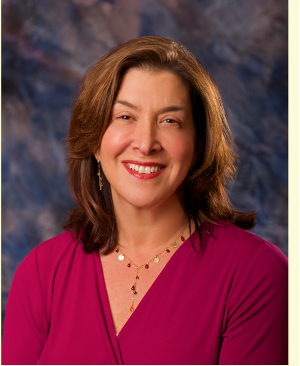
Holocaust Museum’s virtual event to feature a former white nationalist
ROBERT NAGLER MILLER
When Highland Park’s Mally Zoberman Rutkoff is honored at the “What You Do Matters 2020 Risa K. Lambert Chicago Virtual Event,” a Sept. 15 online gathering sponsored by the United States Holocaust Memorial Museum (USHMM), she will share the spotlight with University of Chicago graduate student R. Derek Black, the event’s keynote speaker.
On the surface of it, the two are a most unlikely pair.
Rutkoff, the daughter of Holocaust survivors, served as chair of Chicago’s Holocaust Community Services Leadership Committee. She was also the first chair of the USHMM’s Chicago Children of Survivors group and launched the National Children of Survivors programs and trips to Washington, D.C. Long involved with the Jewish elderly-first as a geriatric social worker, later as a lay leader-Rutkoff served as chair of the CJE SeniorLife and has been a longtime board member. She has also been a JUF board member and JUF Women’s Board member for many years.
Black, on the other hand, is the son of Southern Florida white nationalists, Chloe and Don Black, and the godson of David Duke, the former grand wizard of the Knights of the Ku Klux Klan (KKK) who continues to espouse racist, antisemitic, and neo-Nazi theories. Don Black, who was also active in the KKK and the American Nazi Party, co-hosted a white nationalist radio program with R. Derek, who fully embraced his parents’ and godfather’s beliefs in white superiority.
Blame college and a group of classmates for R. Derek Black’s appearance at a Holocaust-related event.
After a childhood of homeschooling-his parents “loudly complained” about the diversity of the schools in Palm Beach County, he said-and two years at a community college, Black headed off to Sarasota’s New College of Florida, the small, elite honors college of the State University System of Florida, where he began undergoing a transformation.
As The Washington Post’s Eli Saslow recounted in his 2018 book about Black, Rising Out of Hatred: The Awakening of a Former White Nationalist, Black encountered a group of bright students from various backgrounds who, through casual discussion and vigorous intellectual debate, challenged, often unwittingly, his firmly held views about Black people, Jews, immigrants, and members of other minority groups. Among the most influential members of his student cohort was a classmate Matthew Stevenson, an Orthodox Jew, who began inviting Black to his weekly Shabbat dinners with a diverse group of students.
Black, who said that he had come to New College with “an extreme sense of confidence” in his white nationalist ideology, a belief system in which he had maintained that “we had the science correct,” found himself questioning everything he had once accepted as gospel. Eventually, in an email he sent to the Southern Poverty Law Center, which promotes racial justice and tracks hate crimes, he renounced white nationalism, dissociated himself from racist and antisemitic groups, and apologized for the harm he had done to people of color and to Jews.
That was in 2013. Today, Black, who is a doctoral student in European history at the University of Chicago, where he is writing his dissertation on “how medieval ideas were responsible for creating racist ideas,” such as slavery, said that his relationship with his parents remains “extremely strained.”
Newly married and now based in Baltimore, where his wife is a clinical psychologist, he speaks frequently about his background and his liberation from racism and antisemitism in the hopes of helping others break free from hateful speech and actions.
Just as his own transformation began on a micro level-Shabbat dinners and student give-and-take-he said, the most effective way of getting through to others is through sharing thoughts and ideas with “the people in our lives who listen to us.”
“Personal relationships feel insignificant,” he continued, “but they’re how you change the world.”
The “What You Do Matters 2020 Risa K. Lambert Chicago Virtual Event” starts at noon. It is free, but registration is required at ushmm.org.
Robert Nagler Miller is a journalist and editor who writes frequently about arts- and Jewish-related topics from his home in Chicago.
Other stories
-
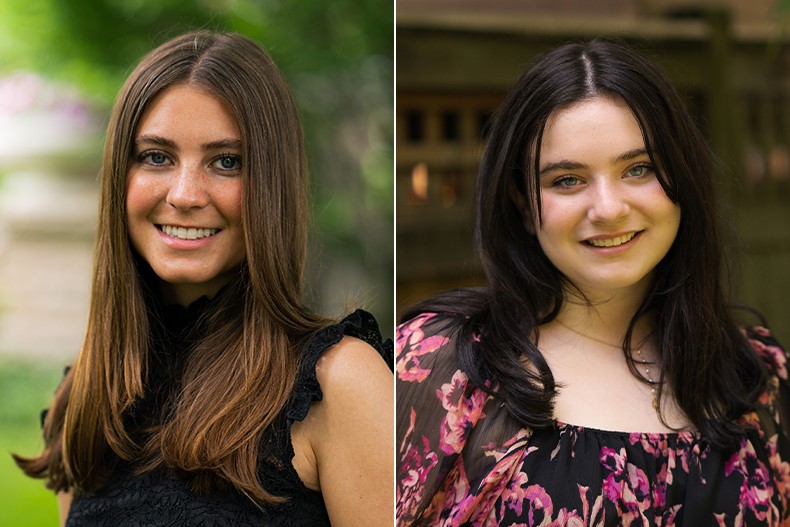
Two local teens win national recognition
Recipients of the annual Diller Teen Tikkun Olam Awards
Read more -
Celebrating six young award winners cultivating the community
Introducing young adult award winners
Read more -

In the early days of the pandemic, my youngest child made bedtime even longer than usual with marathon discussions about any topic he could imagine in order to keep me by his side as he fended off sleep. Sometimes I found myself nodding off to the rhythm of his voice. But one night he jolted me into full focus when he asked: “Mommy, which was scarier, 9/11 or coronavirus?”
On September 11, 2001, I found myself on the roof of CNN’s New York studio staring south at the burning towers, watching the first building collapse before my eyes, as the sound of exploding concrete and steel reverberated for miles. My colleagues at the network and I worked round the clock, vetting stories of loved ones missing amidst the rubble; first responders who went inside and never came back out. I bore witness to images of people jumping from the burning towers on raw footage I was tasked with viewing upon its arrival into our office. We chose not to air that particularly painful video, but to this day I still cannot unsee it.
When Erev Rosh Hashanah arrived just six days after the planes struck the World Trade Center, I felt guilty leaving my co-workers for the holiday, but secretly relieved to get the break. Looking back, that Rosh Hashanah did not just serve as a respite from the daily intensity of the moment, but also as a time for reflection, rekindling my hope we would emerge from that crisis and regain our strength as a nation.
During the month of Elul, Jews around the world recite Psalm 27 during daily prayers as we ready ourselves for the upcoming high holy days. “Hope for the Lord, be strong, and God will give your heart courage, and hope for the Lord,” reads the final verse of this psalm, the repetition emphasizing how hope is an act of faith that brings us strength.
This year, the act of hope feels all the more essential as we make our way into a Rosh Hashanah like none other. Even during the aftermath of the 9/11 terrorist attacks, Jews could collectively pray and celebrate the new year. Amid a pandemic that keeps us apart, gathering in the usual ways to observe Rosh Hashanah may be challenging. Yet, we can still honor our traditions and take time away from the daily stress of our current climate.
Rabbi Jonathan Sacks, the former chief rabbi of the United Kingdom, writes: “To be a Jew is to be an agent of hope in a world serially threatened by despair.”
Rosh Hashanah marks a new beginning, a time to ask God and others for forgiveness, and a time to reflect on how we can improve ourselves and the greater world around us.
High holiday services will look different this year, whether being streamed or even for those synagogues finding ways to open their doors to congregants. While we may not be able to pray together in the typical fashion this Rosh Hashanah, there are still many ways to connect with our own inner agents of hope. We dip apples into honey and recite the blessing for a sweet new year; with the tashlich ceremony, we throw bread into a local body of water, symbolically discarding our sins; we can make a festive meal with loved ones inside our “bubbles.”
The holiness of the High Holidays gives us an excuse to set aside our electronics and take a break from the anxiety provoking headlines that constantly bombard us. By observing the traditions of Rosh Hashanah, even when all our customs may not be accessible, we engage as agents of hope that in the midst of this pandemic despair, we will emerge stronger and sweeter than ever.
Mimi Sager Yoskowitz is a Chicago-area freelance writer, mother of four, and former CNN producer. Connect with her at mimisager.com .
Other stories
-
Two local teens win national recognition
Recipients of the annual Diller Teen Tikkun Olam Awards
Read more -
Celebrating six young award winners cultivating the community
Introducing young adult award winners
Read more -
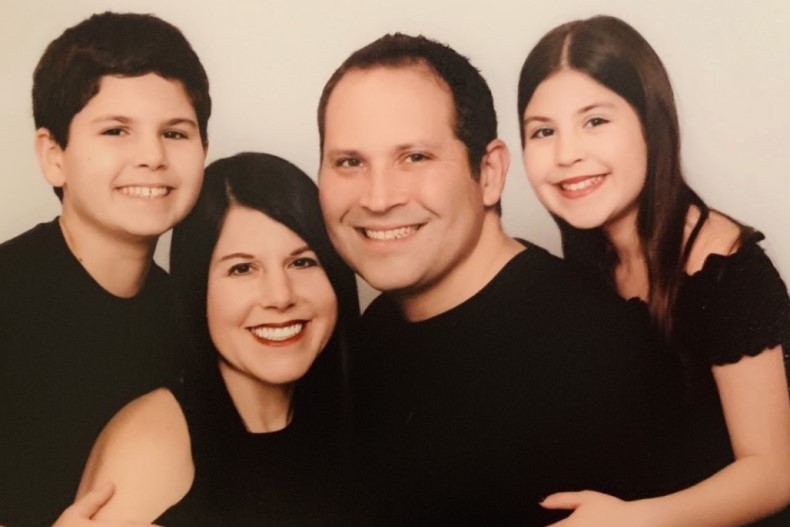
It’s been a year full of challenges, but with Rosh Hashanah and the year 5781 just around the corner this is your chance to refresh! The new Jewish year is the perfect opportunity to take a moment to reflect on the year behind us and make new wishes for the year ahead. Here are what some Jewish Chicagoans are hoping for next year…
Richard Moline:
“May our masks fit snugly and our voices be strong. May our bodies distance and our spirits draw near. May we wash our hands and cleanse our souls. May we stay close to home and be open to the world. May we be brave and be careful. May we be online and be offbeat. And in the wise words of Bob Dylan, may we stay forever young.”
Becca Wander (13) and Jacob Wander (9):
“To have a healthy year and have everything go back to normal.”
Carter Liebman:
I’m hopeful that 5781 will be a transformative year. It’s the year that I graduate with my bachelor’s, and a pivotal year for the world at large. I’m preparing for interconnectedness and empathy, compassion, and activism. Let this year bring about a sense of change, and center on uplifting underrepresented voices. More than anything, I want it to mark a turning point in my life and the lives of those around me.
Marcey Barichello:
“I am wishing in the new year for a vaccine or medications so we can control the spread of this virus and our lives can return to normal. With that, [I hope to] be able to meet with people and friends again-and give hugs.”
Pamela Baskin Greenfield:
“This year may look different as we may not gather all together, but my wish is for good health, happiness, and the opportunity for our community to focus on tikun olam, or ‘repairing the world,’ and reflect on the role we all play in our families and communities.”
Dena Levy:
“My biggest wish for the new year is for tranquility, healing, and a brighter tomorrow for my children.”
Lauren Deer:
“I wish for my family and friends to stay healthy throughout this new year to come.”
Emma Bliwas
“I wish that more people would have a positive mindset throughout these times of uncertainty. During this quarantine, I have had quality time with my family and the opportunity to take a step back from my busy life. I have started to appreciate the little things and the simple moments. I hope that everyone will try a new hobby, hug their family a little closer, and reach out to old friends during the coming year.”
Other stories
-
Two local teens win national recognition
Recipients of the annual Diller Teen Tikkun Olam Awards
Read more -
Celebrating six young award winners cultivating the community
Introducing young adult award winners
Read more -
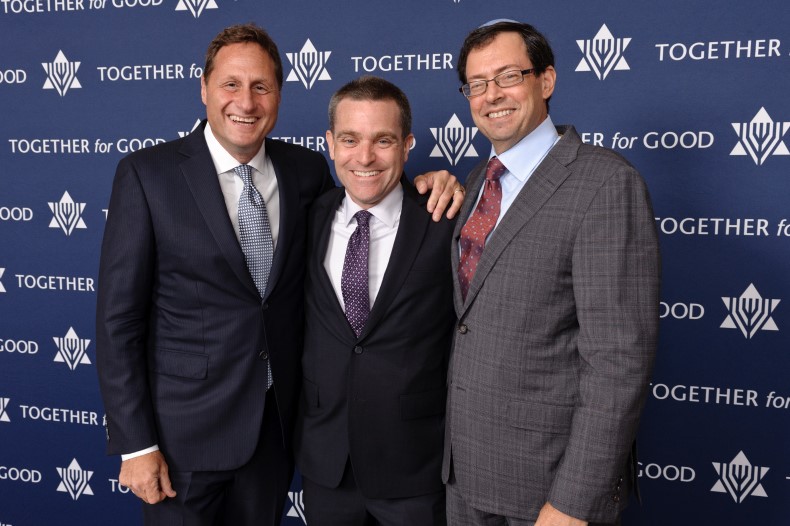
Outgoing JUF Chairman of the Board Andy Hochberg was at the helm of Chicago’s Jewish community from 2018 to 2020, possibly the most eventful term in modern history. JUF News sat down with Hochberg and asked him to share some insights about his momentous two years as Chairman.
Q. Andy, one month after you took office, the most lethal antisemitic attack in U.S. history took place at Pittsburgh’s Tree of Life synagogue. How did you respond?
A. We responded to the Tree of Life attack in various ways. First, we worked with our community leaders to immediately secure our communal institutions. We quickly engaged with the national Secure Community Network to assess best practices. We also provided moral support to Pittsburgh’s Jewish communal leaders. Finally, we launched a security fund to provide matching grants to encourage community institutions to invest in their security. Many institutions took advantage of this program, which leveraged $4 million to enhance security at 88 Jewish schools, synagogues, community centers, camps, and agencies across our community.
When Lonnie Nasatir became JUF President in July 2019, you became the first JUF Chairman of the Board in 40 years to partner with a new chief executive. How did you help ensure that transition was so seamless? What made you and Lonnie such a great team?
Lonnie is a dynamic leader who distinguished himself at the Anti-Defamation League fighting antisemitism and hate. He is doing an excellent job of leading our community. He is a great communicator; we have been clear and honest with each other in every interaction. Since he came aboard in the middle of my term, he quickly bought into some of my priority objectives, such as intensified focus on adults with developmental disabilities. As I have 25 years of service to this Federation, I had institutional memory and experience that I think he found useful, including my role as Campaign Chair. I was pleased to join in advancing his goals and objectives as well. We communicate very well-we have a standing call every day to check in and catch up.
COVID-19 has been a crisis of momentous proportions; JUF has been responding to the pandemic in profound ways from the beginning. Tell us how JUF’s bold response unfolded.
The crisis obviously came quickly and furiously. Lonnie and I knew that we were going to have to make swift decisions, so we convened a COVID-19 Task Force, including chairs of major committees and professionals from Planning & Allocations. We called every member of the Executive Committee personally and then got the Board involved in making important allocations and operational decisions, from cancellation of Israel trips to community support for human needs. We advanced money to organizations to support operations and enable them to accelerate delivery of emergency financial aid, food, and medical care. We provided PPE to institutions, too. We weren’t afraid to have skin in the game: JUF leveraged resources from not just the annual campaign, but also our endowment and access to additional credit. And Lonnie and Steve [Nasatir] were instrumental in the important stage of raising the COVID-19 relief fund from major donors.
What were some of the other challenges you faced during your Chairmanship? What are some of the challenges-and opportunities-you believe are most important for our community to focus upon in the years to come?
We must work on engaging the next generation in Federation life and connection to Israel. I think we know that the younger generations have passion, but it is often directed toward non-Jewish issues and decentralized Jewish community activity. One thing we learned during the pandemic is the importance of infrastructure; namely, larger institutions that can move quickly and powerfully to address crises. Look closely at what Federation does, and you will see that we work every day to achieve the tikkun olam and societal change that so many seek. Relating to Israel requires a discussion of its own; put simply, the organized Jewish community has to work to interest our young while at the same time understanding the community’s relevance to modern Israel. Our leadership has to adjust to a new reality where the relationship is a true partnership, with agreements and disagreements, that goes beyond the donor-donee relationship it was in previous generations.
Have your community priorities shifted during your time as Chairman? What are the issues or programs that are closest to your heart?
Yes. After the attack at Tree of Life, we had to be concerned primarily with community safety; that priority has morphed for now to health, safety, and financial sustainability. One of the ways we are helping agencies navigate in this unprecedented time is through our Technical Assistance Collaborative. It enables agencies to access wide-ranging professional expertise, from fundraising, finance, and marketing to technology, human resources, and employment law. It meets a new need and is an important way Federation adds value to the community. Also, I am very committed to Jewish education, both day school and supplementary. We must continue to find ways to make Jewish life affordable.
Engaging the next generations in Jewish life is critical to Jewish continuity. What are some of the strides that have been made, and what do you think comes next?
We have developed and are developing a tremendous number of programs oriented at the next generation. Models are changing in camp, synagogue, and day school life, even Hillels-and we are embracing and pioneering some of that change. Every year, we connect more young people to Israel, Jewish life, and one another. We are seeing thousands of young Jews participating in Jewish life today, but we want to see tens of thousands of young people “doing Jewish” tomorrow. And we must continue to make day school education more affordable and engage families in Jewish life. We also must ensure the financial sustainability of Jewish organizations during and post pandemic.
You were the first JUF Chairman in history whose mother, Barbara, served as Chairman of the Board. In addition, your father, Larry, served as Chairman of the JUF Annual Campaign. How did your unique family legacy shape your leadership style? And how do you view your own legacy?
Mom and Dad were and are great examples who stressed the importance of giving both time and money to the community. They modeled tenacity and persistence and a sense that we are here for something more than ourselves. Dad always looks for the hard jobs, taking on a challenging but successful effort to increase pro-Israel activity in Europe. Mom, it has been over 20 years since she passed away, but she had an unforgettable way of working with people that challenged them but always made them feel good about their work and importance to the team. Our home was not particularly religious, but very Zionistic. The observance level of my family, and my sister Amy’s, is much more than when I was growing up, and we are proud of the connection and observance level of our kids.
Is there anything we haven’t asked that you’d like to share with our community?
History has shown that when the Jewish people are unified, great things happen-and when they are not, disaster strikes. I am deeply concerned about the lack of civility in our society and our community. Sinat chinam , causeless hatred, is blamed for the fall of the Temple. Today’s partisan and denominational splits are concerning. Social media has made it easy and acceptable to attack others without ever really engaging them. I have been very proud of my efforts to keep the community together, and to reinforce that JUF is the home for every Jew and potentially every citizen of Chicago. I am grateful for the support of my wife, Laurie, my family, my business partners, and JUF’s amazing volunteers and staff.
Other stories
-
Two local teens win national recognition
Recipients of the annual Diller Teen Tikkun Olam Awards
Read more -
Celebrating six young award winners cultivating the community
Introducing young adult award winners
Read more -
For many Jews, the High Holidays are a time of unity. Even during a pandemic, local synagogues are working harder than ever to help Chicago Jews feel the togetherness of the new year.
“Even in a normal year, it’s a lot of work to prepare for the holidays, and this year we’re doing it without the playbook,” said Rabbi David Wolkenfeld of Anshe Sholom B’nai Israel Congregation (ASBI) in Lakeview. “The synagogue is a counter-cyclical institution–when times are harder, people need us more. The challenge is that people need us more, but we have all these barriers to serving them and supporting one another. But that’s what’s fueling all this effort and creativity.”
Synagogues across Chicago are working hard to provide options to their congregants. For some, the process started with reframing how they think about services. Rabbi Karyn D. Kedar, Senior Rabbi of B’nai Jehoshua Beth Elohim (BJBE) in Deerfield, encourages thinking of her congregation’s planned Zoom services as “digital,” not “virtual.”
“‘Virtual’ has a connotation of not being real, and there is nothing more real and raw than the experience that we’re going through right now,” she said. “We will, as a community, engage in this experience digitally, but it’s definitely going to be real.”
The clergy team of BJBE hopes to “provide an experience that is at once transcendent and intimate, that is familiar but also uses the beautiful advantages of an online medium,” Rabbi Kedar said. With everyone having a front-row seat to their computer and more ways to interact–including screen-sharing during participatory elements like lighting candles–she hopes to provide a meaningful service.
Other synagogues, like Temple Har Zion in River Forest, are blending online services with in-person services with limited seating. During Rosh Hashanah and Yom Kippur, there will be six services, each of which can host up to 50 people, the current state-mandated limit. Participants will sign up online, answer a series of health-related questions, and be matched with a service with space for them. On the day itself, temperatures will be taken at the door, masks will be mandatory, and congregants will be spaced out across a large sanctuary.
They are currently preparing for the High Holidays by hosting Shabbat services with fewer people–starting at 10 and working their way up. Jay Michaels, the Temple Har Zion’s Vice President of Building & Administration and head of the COVID task force, is working hard to think of everything that could get in the way of meaningful participation and eliminate those barriers.
For example, during the Torah service, there will be aliyahs (Torah honors) for people physically in the sanctuary as well as people on Zoom. “For the people present, we have a large projecting screen so we will project the Zoom service on that screen. That way, when people are doing an [online] aliyah , the people in the congregation can see them,” Michaels said.
For other synagogues, like ASBI, the concern arises of what can be done without using technology on holy days. In addition to hosting services with 50 people spread across a 600-person sanctuary, the congregation plans to lend out machzorim (High Holiday prayerbooks) and offer preparation sessions.
“We are going to roll out a series of educational initiatives focusing on the liturgy and prayers so people have the opportunity to study, contemplate, talk, and learn about the less-familiar liturgy in preparation for spending these days without being in shul,” said Wolkenfeld. Holding these sessions on weekdays in the weeks leading up to Rosh Hashanah works around the problem of not using technology on the actual holidays.
In the end, what matters most is creating a spiritual experience for Jews in Chicago, no matter their denomination. “It’s indeed a special sort of challenge,” Wolkenfeld said, “but we’re really dedicated to supporting our community.”
Other stories
-
Two local teens win national recognition
Recipients of the annual Diller Teen Tikkun Olam Awards
Read more -
Celebrating six young award winners cultivating the community
Introducing young adult award winners
Read more -
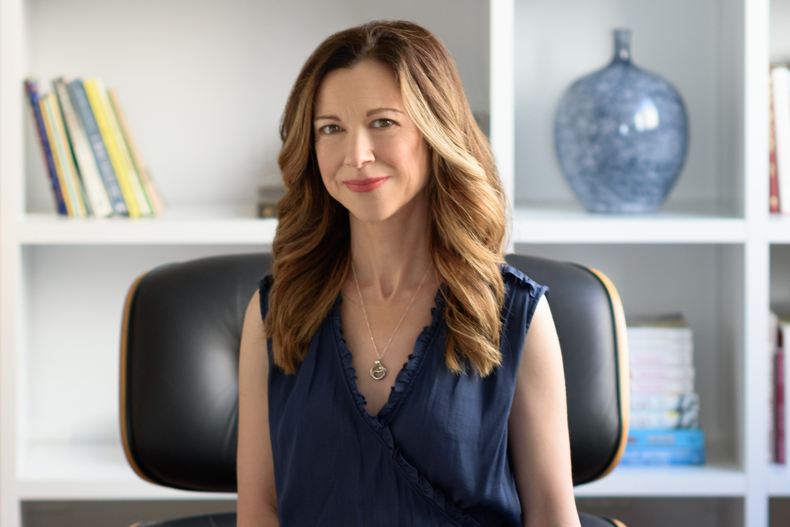
When Lori Gottlieb’s bestselling book on psychotherapy– Maybe You Should Talk to Someone- -came out last year, she never could have predicted that a global pandemic would strike a year later. Now, the entire human population, it seems, could use a therapist to help us through these unsettling times. Gottlieb, a Jewish writer and psychotherapist based in Los Angeles, will headline the virtual JUF Women’s Division 2021 Lion Luncheon on Thursday, Oct. 15.
In her book–equal parts self-help and memoir–she invites readers to take a seat on the therapy couch alongside four of her clients, as well as in Gottlieb’s sessions with her own therapist.
A former film and TV executive for shows like Friends and ER , Gottlieb switched professional paths when she discovered that as much as she enjoys crafting fictional dramas, she loves helping people work through their real-life dramas even more.
She is also a contributing editor and weekly “Dear Therapist” columnist for The Atlantic . Her book is currently being adapted into a TV series starring Eva Longoria. I caught up with Gottlieb on a break from filming the show.
Q. Why did you write the book?
A. We can learn so much about ourselves through the lens of other people’s stories. A lot of us feel very alone in our struggles, so I wanted to bring people into the therapy room to get people to see what I get to see.
The title of the book Maybe You Should Talk to Someone isn’t just a nod toward ‘maybe you should see a therapist,’ but it also means that maybe we should talk more to one another .
What is the most common thread you see in your clients?
Disconnection. There are so many people who are married to the person that they want to be married to, and they have family and friends–but they’re not really connecting. People are ships passing in the night. A lot of couples are co-computing at night, on their devices, and even their children are running around to a million different things.…We’re not being nourished by the people who we really want to connect with.
How does COVID make your book more relevant to people’s lives now?
I’m getting so much mail from readers now saying the book is the balm they needed because it addresses so many of the themes that people are experiencing: loss, grief, mortality, and connection. These themes permeate the stories in the book.
Do you have advice for people in coping with the pandemic?
What people often do is push down those feelings and say, ‘Well I don’t have COVID or I have a roof over my head, and I didn’t lose my job.’ Instead of making the feelings go away, they come out in other ways: in insomnia, in short-temperedness, or in too much food or wine…. It doesn’t really address this issue–it just makes it worse. I really would encourage people to use their feelings as a guide to start to take care of their psychological immune system.
There is a point in the book where you ask your therapist what he thinks of you and he said you have a good ‘neshama’–Hebrew for ‘soul’ or ‘essence.’ Why did you include that anecdote?
It’s a question we all have-what does my therapist really think about me since I’m coming in here and being so vulnerable? And what he said is, ‘I [like you], but not for the reasons I think you want. You want me to think you’re smart or funny or interesting.’ Rather, he says, ‘I like your neshama.’ When we talk about appreciating other people, can we see their essence? The concept of neshama is so powerful as we redefine what it means to love and be loved.
Why did you decide to reveal so much about yourself and your own therapy?
I write in the book that my most significant credential [as a therapist] is that I’m a card-carrying member of the human race. One of the things I really wanted to do is break down the barrier between being the ‘expert,’ and just being a person in the world. I use my humanity in the therapy room all the time…I use the fact that I know what it’s like to struggle-to help other people with their struggles.
What you need to know…
Women who make an individual gift of $5,000 or more to the 2021 JUF Annual Campaign are invited to attend the 2021 Lion Luncheon. The cost of the event is $36 or $72 with lunch. (For the lunch option, a kosher lunch will be delivered to your home in the Chicagoland area.) To inspire future generations and to ensure the continuity of our tradition of tzedakah , guests are encouraged to invite their daughters, daughters-in-law, and/or granddaughters to this event.
To register for the Lion Luncheon on Oct. 15, and to sign up for a one-time, optional virtual discussion of Maybe You Should Talk to Someone on Oct. 7, visit juf.org/2021LionLuncheon or call Vivienne Henning at (312) 357-4823.
Other stories
-
Two local teens win national recognition
Recipients of the annual Diller Teen Tikkun Olam Awards
Read more -
Celebrating six young award winners cultivating the community
Introducing young adult award winners
Read more -

Three outstanding young leaders will be recognized for their service to Chicago’s Jewish community at the Jewish Federation’s Annual Meeting on Sept. 17.
Katie Berger will receive the Davis, Gidwitz & Glasser Young Leadership Award, presented to volunteers 40 and under who have demonstrated exemplary dedication and have made significant contributions to Chicago’s Jewish community.
- Berger, who has been described as “passionate about building a stronger Jewish community,” is on the JUF/Federation Board and three major commissions and committees. After holding key roles with the Young Leadership Division, including a stint as Campaign Chair, she was a prime mover in creating the Ben Gurion Society Advisory Council, which strengthens NextGen leaders’ engagement with JUF. She also chairs the Jewish Women’s Foundation’s Economic Security/Legal Reform Subcommittee.
Emily White of JUF’s Israel Education Center and Elyse Saretsky of JUF’s Young Leadership Division will receive the 32nd annual Samuel A. Goldsmith Young Professional Award, honoring Jewish professionals whose exemplary performance at a Jewish agency in the Chicago area has benefited the entire Jewish community.
- White guides JUF’s programs and response to antisemitism and Boycott, Divestment & Sanctions efforts on campuses across Illinois and beyond, while also helping shape strategies nationally. Her work was a major factor in shifting federal government response on campus antisemitism and has tangibly helped make campuses safer for Jewish students, faculty, and staff.
- In less than two years as YLD Director, Saretsky has introduced a “change-positive mentality” that has reshaped programming, strengthened staff and lay leadership, expanded the Division’s outreach to new audiences, and envigorated collaboration among departments within JUF. She also has taken on leadership roles defining core organizational priorities throughout JUF, and is described by one supervisor as “one of the fastest rising young leaders in our organization.
For more information, visit here .
Other stories
-
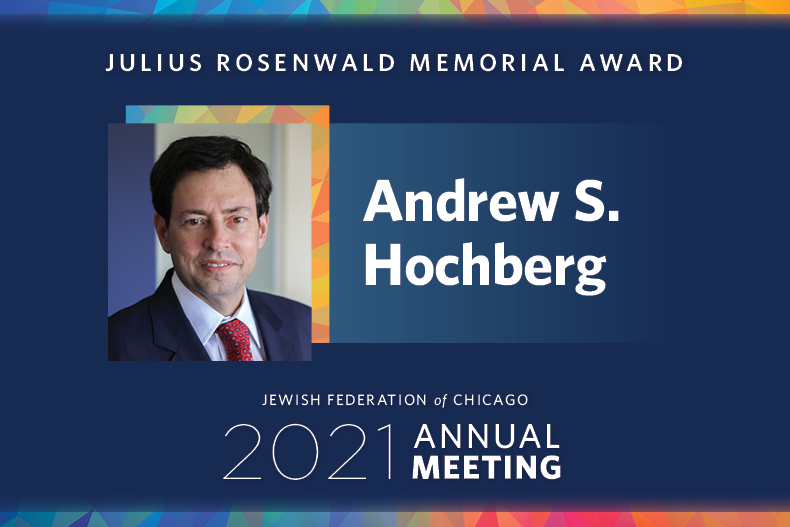
Meet Andrew S. Hochberg, 2021 Julius Rosenwald Memorial Award recipient
Celebrate Andy Hochberg at the virtual Annual Meeting on Sept. 14
Read more -
Two local teens win national recognition
Recipients of the annual Diller Teen Tikkun Olam Awards
Read more -
Celebrating six young award winners cultivating the community
Introducing young adult award winners
Read more
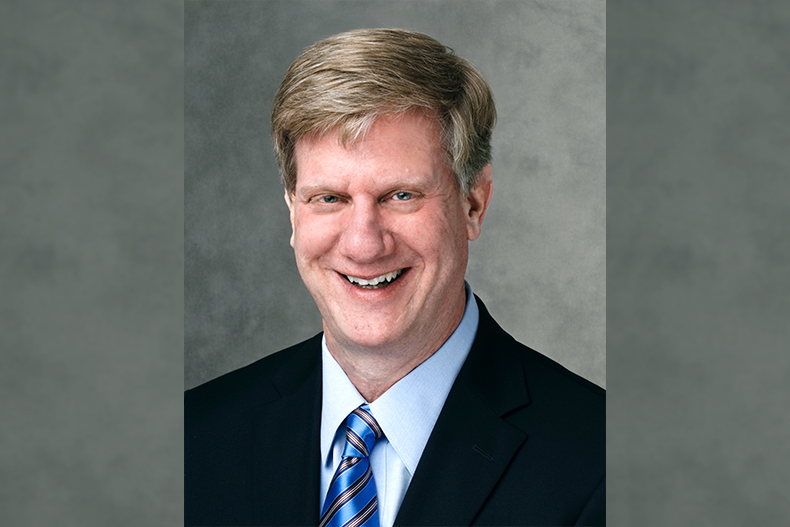
On Sept. 17, Jewish Chicago will come together-just as it has throughout the COVID-19 crisis-for the Jewish Federation of Chicago’s first-ever virtual Annual Meeting. Michael H. Zaransky, a longtime leader in Chicago’s Jewish community, will receive the 57th annual Julius Rosenwald Memorial Award, the Jewish Federation’s highest honor.
The award, presented each year at the Federation’s Annual Meeting, goes to an individual who has demonstrated a lifetime of outstanding dedication and service to the Federation and the entire Jewish community. It is named for Julius Rosenwald, the iconic Chicago business leader and philanthropist of the early 1900s.
Zaransky has an extensive record of leadership both within and beyond Chicago’s Jewish community. He chaired the JUF/Federation Board from 2016-2018, the JUF Annual Campaign in 2013, and has also chaired a wide range of JUF committees, as well as JUF’s Real Estate/Building Trades Division.
Zaransky is a past president and lifetime board member of Congregation Beth Shalom in Northbrook and is a board member of the Michael Reese Health Trust and the National Multifamily Housing Council. He’s a member of the National Apartment Association, Urban Land Institute, and the Young Presidents Organization (YPO-Gold Chicago). In 2009, Zaransky received the Community Leadership Shin Award from the Jewish Theological Seminary, and he is a graduate of the Wexner Heritage Foundation program for Jewish Communal Leaders.
Professionally, Zaransky is founder and managing principal of MZ Capital Partners and Co-CEO of Prime Property Investors, Ltd. He has authored two books on commercial real estate investment and is a well-known industry speaker on real estate investment in multi-family properties.
He and his wife Barbara live in Northbrook. They have two children, a son-in-law and daughter in law, and five cherished grandchildren.
For more information, click here .
Other stories
-
Two local teens win national recognition
Recipients of the annual Diller Teen Tikkun Olam Awards
Read more -
Celebrating six young award winners cultivating the community
Introducing young adult award winners
Read more -
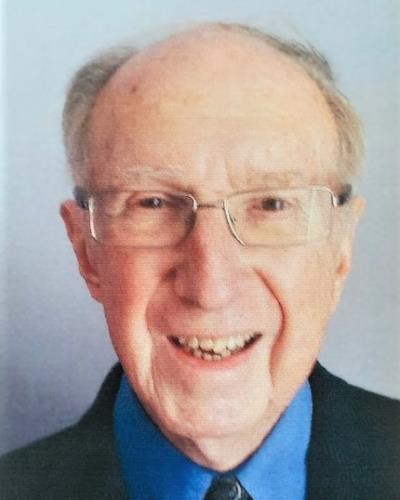
Arthur L. “Art” Berman served in the Illinois state legislature from 1969-2000- one of the longest tenures in its history- and won 22 elections for public office in his career. He died on June 6 at 85.
Known as “The Education Senator,” Berman championed improved schooling for the children of Illinois as Chairman of the Senate Education Committee. He served in both houses of the Illinois General Assembly; in the Illinois House of Representatives from 1969 to 1976, and then in the Illinois Senate from 1977 until 2000.
“Art Berman was a terrific Jewish legislator, and a legendary leader,” recalled Dr. Steven B. Nasatir, JUF’s Executive Vice Chairman. “Among his many strong commitments, Art was a champion for improved education for all citizens. His concern for the Jewish people was always apparent and deeply appreciated.”
Berman served on the JUF Board of Directors from 2006-2012. He and his wife, Barbara, were Golden Givers to the JUF Annual Campaign, with 50 or more consecutive annual gifts.
“The first time I met Art Berman, he came to speak to my eighth-grade class in 1972,” recalled Jeff Schoenberg, former Ill. State Senator. “After he retired, he remained active in JUF’s Government Affairs Committee, and participated in its annual pilgrimage to Springfield. He still commanded respect in the state capital. One of my favorite parts of the year was the visit from the Jewish delegation; we had a dinner that would feel like a Seder.”
Berman also served on the boards of the Anti-Defamation League, the Decalogue Society of Lawyers, Emanuel Congregation, and many other civic, legal, legislative, educational, and Jewish organizations and committees.
“I believe that Senator Berman’s commitment to quality education was an illustration of his deep Jewish values,” said Ill. State Representative Sara Feigenholtz. “He has given Jewish caucus members enduring lessons on the value of education and things that matter most to our community.”
Greg Hinz, writing for Crain’s Chicago Business, noted that Berman “laid the groundwork for a total remake of how the state funds public schools” but that he “back[ed] not only education reform but gun control, abortion rights, and civil rights protections for gays and lesbians.”
Born in 1935, Berman was a lifelong resident of the Rogers Park and Edgewater neighborhoods. He attended public schools and Senn High School, the University of Illinois at Urbana-Champaign, graduating in 1955. In 1958, he earned his law degree at Northwestern University Pritzker School of Law, where he served as editor of the Law Review.
Berman’s legacy continues to inspire a new generation of Jewish legislators, including Ill. State Representative Bob Morgan, who began his first term in January 2019.
“Art Berman was a legend within the Jewish community,” he said, “and every single Jewish legislator in Illinois knew him.”
Berman is survived by Barbara (nee Dombeck), his wife of almost 30 years, and by his children, Adam (Robyn) Berman and Marcy (Joe) Padorr. He was the adored “Pop Art” of Josh (Zoie) and Alex Berman, Amanda (Drew) Schwartz, and Jake and Jeremy Padorr. The son of the late Morris and Jean Berman, he was the brother of the late David and Steven Berman; the brother-in-law of the late Kenny (Janice Glenn) Dombeck, and an uncle of many. The graveside service was private, with arrangements by The Goldman Funeral Group. Memorials may be made to JUF or to the A Silver Lining Foundation.
Other stories
-
Two local teens win national recognition
Recipients of the annual Diller Teen Tikkun Olam Awards
Read more -
Celebrating six young award winners cultivating the community
Introducing young adult award winners
Read more -
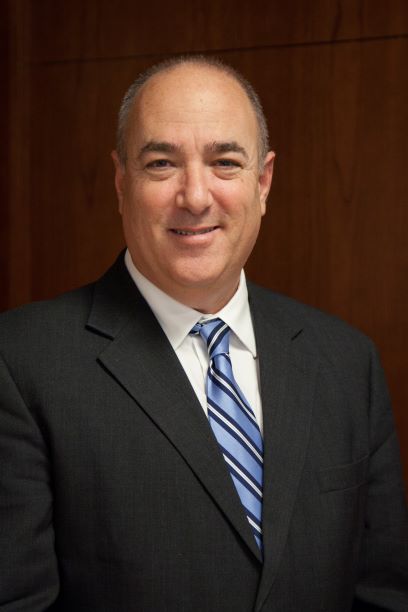
As a veteran of the Israeli Foreign Service, I sometimes speak to new diplomatic recruits and cadets. I believe that the older generations have a responsibility to transmit our experiences, warts and all, to those taking their first steps into the international arena, educating about the State of Israel.
Recently, I spoke to the latest batch of cadets at the end of their cadet course. Most will be leaving on their first diplomatic posting abroad this summer, dispersed around the world like modern-day Jewish nomads. They will spend three or four decades, representing Israel, making formal and informal connections, advocating for it, battling for its very legitimacy, negotiation on its behalf, and perhaps, hopefully, making peace with our enemies.
Speaking to them, I found myself answering their questions about the changing face of diplomacy in an age of immediate communication and technology. Having grown up in a diplomat’s home, I remember my father using telex cables in the early 70s and reading three morning newspapers to bring himself up to date on events from 24 hours earlier. I recall his amazement when he told me, in 1979, that he had witnessed a machine called a facsimile spew out an exact replica of a hand-written note sent minutes earlier from the other side of the world. How far the diplomatic profession has come!
I told the cadets that technology has made their lives that much easier, but also that much more complicated than it was in my father’s time-and even in my own days as a diplomat.
I explained that today’s news cycle is measured in seconds, not days. That an attack on Israel in the media will not wait for tomorrow’s retort in the back page of a newspaper and needs to be addressed immediately on social media. They must be on top of the news cycle, quick on their feet, and able to respond to any event without waiting for instructions.
Social media and the advent of the internet also enables our diplomats to reach their target audience swiftly and without the filter of sometimes biased or ill-informed traditional media.
In my early days, I had to write a well-argued article and convince an editor to run it in a newspaper, and, even then, I only reached a select audience of those particularly interested in Middle Eastern affairs.
Today’s diplomat has a range of social media outlets at his or her fingertips to reach millions of young people, professionals, politicians, and opinion-makers without the need for the favors of an editor or a correspondent. Social media is an amazing tool, but also a double-edged sword that can be used just as effectively by those wishing to damage Israel.
But one thing, I stressed, has not changed, in 72 years of Israel’s existence. The country is still shunned by many (though fewer than in the past), still threated on a daily basis by a myriad of terror organizations, and still living under the threat of annihilation by a country pursuing a homicidal nuclear option with one target in mind.
Today’s Israeli diplomats, much like their predecessors of decades past, still need to defend so much: the very idea of Zionism, the right of the Jewish people to a state of their own, the right of Israelis to defend themselves against ongoing onslaughts taking a range of shapes and forms, from terror attacks to delegitimization efforts, from divestment to boycotts, and from biased resolutions in international fora to blatantly unjust actions in the International Court of Justice.
Our new diplomats are better prepared for the battle they face using the most modern tools, while also trained to bring Israeli innovation, arts, and culture to new audiences around the world. The tools of the trade are modern, but the mission of Israeli diplomats is as old as the country itself: to defend and promote Zionism and the Jewish nation.
Herzl and Ben-Gurion could not have imagined Israel’s many successes of the past several decades. Many more successes are within our reach-and Israel’s next generation of diplomats will help us achieve them.
Ofer Bavly is the Director General of the JUF Israel Office.
Other stories
-
Mother’s Day, Father’s Day, and the Jewish way
Let us pause and consider what it means for us to truly honor our parents
Read more -
Each time we study Torah, we experience the revelation
The mystical tradition of Judaism that lifts up the number 600,000 from the Exodus
Read more -