Resolution critical of Israel passes preliminary Modern Language Association vote
JTA and JUF News staff
Delegates to the Modern Language Association’s annual convention upheld a resolution accusing Israel of keeping Palestinian academics from entering the West Bank, but rejected another expressing solidarity with academics that boycott Israel.
After an hour or so of acrimonious debate in Chicago on Saturday, the MLA’s delegate assembly in a 60-53 vote approved a resolution calling on the U.S. State Department to”contest Israel’s denials of entry to the West Bank by U. S. academics who have been invited to teach, confer, or do research at Palestinian universities.”
The resolution goes to the MLA’s executive committee for consideration next month. If the executive committee approves it, it goes to the full membership.
“The presenters of the resolution may have claimed at the beginning of the discussion of it that they regarded it only as a narrowly-framed expression of support for fellow academics, but as the discussion developed it became clear that many of its supporters were driven by an anti-Israel animus and had the broader goal of hurting Israel,”said Michael C. Kotzin, JUF’s senior counselor to the president.
Another resolution referred to a vote last month by the American Studies Association to boycott Israeli universities, and its aftermath, in which over 180 American universities have rejected any such boycott.
That resolution, defeated 59-41, “condemns the attacks on the ASA and supports the right of academic organizations and individuals, free from intimidation, to take positions in solidarity with the Palestinian struggle against racism.”
The resolution did not specify what intimidation the ASA had suffered as a result of its vote.
“Academic freedom guarantees the right of academics to debate issues with passion,” said Geri Palast, the director of the Israel Action Network, which helped lead pro-Israel activities around the conference. “Statements made in the public sphere attracting public debate and controversy is not the equivalent of attacks and intimidation.”
JUF, in consort with the Jewish Federations of North America’s Israel Action Network (IAN), has been working to counter the movement–at the MLA convention and elsewhere–to single Israel out and unfairly impose boycott, divestment, and sanctions against the Jewish state.
The MLA convention this year featured, among about 800 events, a panel of scholars who favor the boycott; another panel opposing the boycott, convened too late to be included in the official program, was held in a nearby hotel.
Speakers at the alternative panel, titled “Perspectives Against Academic Boycotts” (which IAN helped organize), included Cary Nelson, MLA member and University of Illinois professor as well as past president of the American Association of University Professors; Russell Berman, Stanford University professor and a past president of MLA; Gabriel Brahm, MLA member and professor at Northern Michigan University; and Ilan Troen, Director of the Schusterman Center for Israel Studies at Brandeis University and a professor at Ben-Gurion University.
Troen highlighted the ease with which foreign teachers enter the West Bank, that Israeli-Palestinian and other non-Jewish enrollment at several Israeli universities is increasing and how Palestinian and Israeli institutions are working collaboratively.
“Israeli higher education makes a large and significant contribution to the education of Palestinians,” Troen said. Any boycott “would manifestly injure the very population the MLA panelists claim to represent.”
Nelson and some other MLA members also wrote a detailed argument against the resolution regarding entry to the West Bank, prior to the vote by the MLA Delegate Assembly.
The spotlight turned to the MLA convention in large part due to the recent American Studies Association vote calling for an academic boycott of Israeli universities. An editorial by JUF’s Michael C. Kotzin places these MLA issues within their larger context.
“There was a striking bifurcation in the MLA’s business meeting,” Kotzin said. “First came a series of thoughtful, sophisticated remarks in a discussion segment focused on the desire to advance recognition of the value of the Humanities in American society today and to enhance the image of their association in connection with that. And then came the divisive, at times out-of-control debate of the partisan, ideology-driven resolution unfairly critical of Israel. The Delegate Assembly’s passage of that resolution, albeit by a narrow margin, was troubling enough. If the MLA’s Executive Committee and then total membership follow suit (as it is predicted they will not), then, despite the wishes of the speakers in the first segment, this organization will surely have marginalized itself and severely harmed its image in the public eye.”
Other stories
-
Meet Andrew S. Hochberg, 2021 Julius Rosenwald Memorial Award recipient
Celebrate Andy Hochberg at the virtual Annual Meeting on Sept. 14
Read more -

Two local teens win national recognition
Recipients of the annual Diller Teen Tikkun Olam Awards
Read more -

Celebrating six young award winners cultivating the community
Introducing young adult award winners
Read more

There’s still time. But not much.
JUF’s 2013 Annual Campaign is just days away from closing. But those who haven’t yet made their 2013 gift still can be counted, simply by donating online at www.juf.org/donate, or calling (312) 357-4805.
What difference does beating the deadline make? All the difference in the world, to the 300,000 people in the Chicago area who get critical help from JUF-supported agencies. And to the two million Jews in Israel and around the globe aided by JUF’s international partners.
The budgets of more than 70 local agencies that feed, shelter, counsel, educate, and care for those in the greatest need in our community depend upon the support they get from JUF. That’s why it is critical that the Campaign reaches its goal.
Even as some see signs of an improving economy, the lines of those seeking help continue to grow.
“The support this community has shown so far is amazing,” said Michael H. Zaransky, who chairs the 2013 Campaign. “But even with the tens of thousands who have said ‘Count me in,’ we aren’t yet where we need to be.”
“In these last few days of the Campaign, we need everyone to step up and make a difference in the lives of those who need help,” said End-of-Year chairs Adam and Debbie Winick. “Just as Chicago’s Jewish community always has.”
Other stories
-
Meet Andrew S. Hochberg, 2021 Julius Rosenwald Memorial Award recipient
Celebrate Andy Hochberg at the virtual Annual Meeting on Sept. 14
Read more -
Two local teens win national recognition
Recipients of the annual Diller Teen Tikkun Olam Awards
Read more -
Celebrating six young award winners cultivating the community
Introducing young adult award winners
Read more
In Chicago, during the week leading up to Thanksgiving and Chanukah, more than a dozen volunteers participated in the Jewish Community SNAP Challenge. Participants pledged to live on just $31.50 for an entire week, the equivalent of $1.50 per meal, the average food budget of a food stamp recipient. While not all participants were able to adhere to all of the requirements of the Challenge, all emerged with a better understanding of what life is like for millions of Americans living on food stamps. Through the SNAP Challenge, participants found a meaningful way to demonstrate their personal commitment to understanding hunger in the United States.
The Chicago community will take on the Jewish Community SNAP Challenge again on March 7-13, 2014, as part of the JUF Hunger Awareness Project. Read on to learn about the experiences of four of the participants who took on the Challenge this past fall.
To learn more about the SNAP Challenge and other hunger-related programs, visit www.juf.org/hunger. You can also email Stephanie Sklar, director of Domestic Affairs for the Jewish United Fund’s Jewish Community Relations Council, at [email protected] or call (312) 357-4770. For more frequent updates, follow @ChicagoJCRC on Twitter.
From Awareness Comes Action
By Ellen Hattenbach
Hunger is everywhere, from grocery stores desperately trying to fill local food pantries, to victims of natural disasters with nothing to eat, to those down on their luck with no income and children to feed, to the elderly who desperately need our help. Hunger transcends geography, race, religion, gender, education, and even class.
But while hunger is everywhere, the solution is right here too. There is sufficient food in America and in Chicago to feed all. As Jews, we are commanded to let all who are hungry come eat. We are commanded to end hunger.
As chair of the JUF Hunger Awareness Project, I agreed to take on the Jewish Community SNAP Challenge.
In the week leading up to Thanksgiving, I had to radically change the way my family ate. Grocery shopping for three of us for under $95 to last a whole week was not easy. Scouting for on-sale items and using coupons was a must, but we still couldn’t afford meat or kosher products. To meet the budget restriction, I skipped breakfast altogether.
Lunch posed a different set of challenges. While business lunches were usually quite lavish, the SNAP Challenge denied me this luxury. Instead, I browned-bagged my lunch and drank water.
For dinner, my family ate small portions with no seconds. Needless to say, our pantry felt paltry.
Socially, I felt more isolated. No Shabbat dinner with friends. No dinner out on Saturday night. No girl-talk over lattes at Starbucks. I attended an event at Spertus but I couldn’t eat. I imagined what a mother on food stamps would say if she were there, “May I have a container to go? I need to feed my child.”
And then came Thanksgiving. How can anyone serve a Thanksgiving meal for under $15? I knew that if I were on food stamps, I would have had to seek out free food at a food pantry, such as EZRA Multi-Service Center or The ARK. People who look just like me must do just that.
Participating in the SNAP Challenge left me with a heightened sensitivity to the hunger pains, isolation, humiliation, and sadness that those who are hungry experience daily. Taking the Challenge is only a start to understanding a situation that must end. First comes understanding, and then comes action.
Let’s set the table together, keep our hungry neighbors nourished, and let all who are hungry come eat.
Ellen Hattenbach is theChair of the JUF Hunger Awareness Project, a JCRC Vice Chair for Domestic Affairs and is theDirector of Strategic Marketing at Frost, Ruttenberg & Rothblatt, P.C.
The SNAP Challenge in Challenging Times
BySuzanne Strassberger
Food generosity is grounded in the goodness of the world. So, why is it that SNAP, formerly known as food stamps, was cut in November and will likely be cut again? One reason is that spending for SNAP has grown over the past four years as more Americans became poor. Also, the Farm Bill, including SNAP, is up for reauthorization this year and has become a target for budget hawks. Finally, there is a public perception that the program is too generous.
I am testing out that theory by taking on the Jewish Community SNAP Challenge.
A week on the SNAP Challenge means shopping in the neighborhoods where the only available discount grocery stores are stocked with sad vegetables and junk food. I would have had to skip my stockpile of coffee beans, wine, and frozen chocolate chip cookies, a dinner party, and two work-related meals.
Shopping for a family of three on a weekly budget of $94.50 ($31.50 per person) equated to rice, potatoes, oil, generic peanut butter, mac and cheese boxes, frozen OJ, milk, eggs, cheap bread, and elderly-looking carrots. Dinner is built around what the Dining section of the newspaper calls comfort dishes. Six days into SNAP, we are gaining weight. Maybe that is why so many people coming out of the discount grocery store are obese. And yet at times, I’m still hungry because I can’t afford a snack in between small meals.
My dad grew up poor in the Depression. He never talked about those days, though it seemed to be the reason he always chose the cheaper option: a secondhand car or a small house with one bathroom. But his cardinal rule was never to skimp on food. For him, being rich meant rich enough to buy whatever food he wanted.
The almost 48 million children, seniors, disabled, and working poor Americans who rely on SNAP will never be “rich enough” as long as they depend on SNAP. Even in families where the adults are working full time, SNAP isn’t enough because their food allotment is carefully ratcheted down for every extra dollar earned. And even with SNAP benefits, many families run out of food early in the month, which means one or two weeks of food pantries, soup kitchens, and empty stomachs every month.
Food insecurity, buried deep in their consciousness, will always be part of their psyche, just as it was for my dad.
Those who say that the SNAP program is too generous should try it for a week.
Suzanne Strassberger is theAssociate Vice President for Government & Community Partnerships at the Jewish Federation of Metropolitan Chicago.
Taking the SNAP Challenge as a Team
By Mark Cahill & Lindsey Bissett
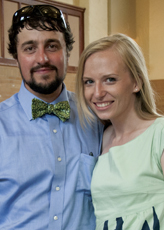
Mark and Lindsey, a local couple, decided to take the SNAP Challenge together. Here is what they had to say about the experience:
Mark: Lindsey and I are both creative, pragmatic, and thoroughly enjoy cooking. When you combine these particulars, you will understand our approach to the SNAP Challenge. To us, the most practical and cheapest way to meet this challenge would be to buy nothing pre-made and make multi-purpose items ourselves. In addition to keeping our costs down, it also meant our meals were a little healthier. With flour, which is cheap, we could make loaves of bread, pizza dough, soups and stews.
Lindsey: Mark makes this sound so perfect! He failed to mention that he’d never made bread before without a machine. I actually looked at the finished loaf and said, “Oh, you’re not going to bake it?” But that was it, a flat disc of… bread?
Mark: Had we bought only a loaf of sandwich bread, we would have been out twice the amount of money, with an item that had only one use.
Lindsey: But our taste buds would have remained intact.
Mark: At the end of the week, we found that we were actually quite successful. However, we also knew that we were very fortunate, since we knew how to make these meals and were a short walk from affordable and healthy food.
Lindsey: There was only one day where I found myself hungry, but I didn’t want to overeat and then not have enough another time, or then be eating a portion of Mark’s food. So I was really hungry and cranky. During the week, I made several sacrifices, like declining a lunch invitation with friends, and not grabbing a coffee in the afternoon, but to truly not be able to do those “simple” things all the time was unfathomable for me.
Mark: Despite what we thought was a success, we still felt a bit psychologically drained. The largest take away from the experience was that it – outside of work – consumed the majority of our day. We spent all evening chopping and stirring and then thinking about what we’d make the next day. We spent an entire weekend afternoon baking bread. One week of living off the average food stamp budget was an interesting challenge, but after that it’s just a burden. Neither of us could imagine doing it all the time, like the millions of Americans on food stamps do every single day.
Lindsey Bissett is an Associate Production Manager for JUF News Publications. Mark Cahill is an Architectural Designer at Kaufman O’Neil Architecture.
Other stories
-
Meet Andrew S. Hochberg, 2021 Julius Rosenwald Memorial Award recipient
Celebrate Andy Hochberg at the virtual Annual Meeting on Sept. 14
Read more -
Two local teens win national recognition
Recipients of the annual Diller Teen Tikkun Olam Awards
Read more -
Celebrating six young award winners cultivating the community
Introducing young adult award winners
Read more
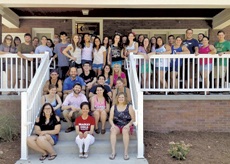
Bradley University Hillel offers a multitude of programing options and opportunities for Jewish students to embrace their Judaism, from Friday night Shabbat Services led by Rabbi Daniel Bogard, and Shabbat dinner prepared by a dedicated group of student chefs, to Sunday Bagel Brunches, Challah for Hunger, and so much more. Bradley Hillel extends its reach as far as possible to the Bradley and Peoria communities. The amazing element of Hillel’s accomplishments is that they are all student inspired and orchestrated.
Walking through the door on a Friday night, Bradley Hillel will greet you with cheerful chatter, and the mouth-watering aroma of a home-cooked meal straight from one of the two kosher kitchens. The students of Hillel thoroughly appreciate these amenities, and take advantage of the opportunity to engage in kosher practices. Nora Cook, sophomore psychology major from Louisville, Kentucky, and Bradley University Hillel’s food manager, enthusiastically volunteers every Friday to lead the preparation of the meal.
“Cooking at Hillel is the best part of my week. It’s a great place to be with my friends and be part of the Jewish community,” Cook said. “This has been a great opportunity to learn what it means to cook in a kosher kitchen.”
Preparations for Friday night feasts are not the only uses for the kosher kitchens. In the 2013 spring semester, junior Jessica Rubens, a public relations major from Lake Zurich , and the Hillel Board began a creative program: Challah for Hunger. Students, Bradley faculty, and the Peoria-area Jews may order fresh-baked challot and receive them for Shabbat. By purchasing a challah they are helping prevent hunger in Peoria. Half of the proceeds from the sales go back to maintaining this beneficial service program, while the other half is donated to the Peoria Area Food Bank. Patrons order online, and a quality challah and a good feeling from doing a mitzvah are both guaranteed.
Supporting Bradley Hillel’s Challah for Hunger Program is not the only way people find happiness at Hillel. Students who take advantage of everything Hillel offers attest to the benefits they savor each time they walk through the door. Junior Rachel Vass, psychology major from Northbrook, and the Hillel Intern, is often one of the first people to arrive at Hillel, and one of the last to leave. “Hillel is a great place for people to hang out or study and it’s always so welcoming!” exclaims Vass. “I love spending time with all the amazing people and I always have a great time.”
All of Hillel’s successes are truly a product of the people who have the passion to help Hillel grow. Dr. Seth Katz, Bradley Hillel’s Executive Director, attributes so much to student involvement. He explained, “It is larger than just a Hillel thing: we foster connections with Bradley administration, alumni, the student activities office, and help support recruiting and admissions. We work with Hillels of Illinois and the Chicago JUF. And we regularly partner on programs and events with the Jewish Federation of Peoria and the local congregations. We all support each other’s missions.”
Hillel’s mission is to enrich the lives of Jewish students so that they may enrich the Jewish people and the world. Hillel’s vision is of a world where every student is inspired to make an enduring commitment to Jewish life, learning and Israel. Bradley University Hillel makes every effort to emulate Hillel’s global mission and vision, and this is a major factor in the successes of this small-but-mighty Jewish student organization. n
Bradley University Hillel is part of the department of Campus Affairs and Student Engagement at Jewish Federation of Metropolitan Chicago/Jewish United Fund and a partner of Hillel: The Foundation for Jewish Campus Life.
Ellie Silver is a junior at Bradley University majoring in Junior Health Science and minoring in Biology.
Other stories
-
Local campus administrators convene on hate speech, bias
JUF and ADL brought together 17 student safety, diversity and inclusion and student affairs administrators and Hillel representatives from various Illinois campuses to discusses issues of hate speech and bias.
Read more -
Engaging students about Israel on campus
Too often we hear about difficulties facing Jewish college students on Illinois campus, but to focus solely on the politics gives only one piece of the complex narrative that is Jewish life on campus.
Read more -
Hillel International launches fellowship initiative to train young Jewish professionals
The Springboard Fellowship will train cohorts of young Jewish professionals in highly-valued skillsets and place them at local Hillel campuses for two years.
Read more