
When Marc first called to ask me to dinner, I didn’t know what to expect. Was it a date? An attempt to reconnect and rejuvenate our friendship? We had seen each other a few weeks before at Café Lalo on New York’s Upper West Side.
But that wasn’t the first time we met.
That lucky encounter came 10 years earlier when we both had just entered adolescence, spending our summers on the green landscape of Jewish summer camp in Wisconsin’s North Woods. Back then, he wore glasses and sported braces. I was growing out my late ’80s bangs and had yet to discover eyebrow waxing. Still, Marc always made me laugh, and memories of us hooking arms and throwing our heads back in hysterics rushed back to me as we spoke on the phone that December day, only weeks before the new century began.
By the time we finished dinner at a neighborhood Italian restaurant a few nights later, I had a feeling friendship wasn’t the path we would be taking. However, I wanted to play it cool. I called to thank him just before heading to the airport to meet up with my extended family for our annual Florida get together.
“You’re going to marry him,” my cousin said to me, as we all gathered for dinner on the eve of Y2K.
“How do you know? All we did was have dinner,” I replied, somewhat incredulous at her suggestion. My cousins and brother had all attended the same camp, so Marc was no stranger to this crowd.
“You know, he was my counselor,” my brother piped up.
“Wait, was he the counselor who was there for you when Papa died?” my father asked, remembering the young man that had comforted his son the summer our grandfather succumbed to Alzheimer’s Disease.
That’s the thing about Jewish camp. No matter the actual experience, whether you loved camp like Marc, or felt more lukewarm about it as I did, the connections you made were lifelong.
For our second date, Marc made me Shabbat dinner, and I learned that his father was a rabbi. It’s funny how as much as we learn about people at camp, they don’t have to share the details they would rather leave back home. At camp, he didn’t have to be the rabbi’s son. He could just be Marc, a kid who loved basketball and all other sports. A kid who cracked jokes and was beloved by campers and counselors alike. Summer is short, but it’s intense, and my memories of our shared experiences at camp infused our growing relationship in Manhattan as it went from dating, to boyfriend and girlfriend, to a marriage proposal 10 months after that first dinner date.
By modern day standards, our courtship was quick, but the foundation of Jewish camp that we brought to our relationship gave us a strong base upon which to build our love. We understood from the start that we shared similar values and wanted Judaism to be a central force in our lives.
Rabbi Maurice Lamm writes when Jews marry, they enter “the world of the Jewish community, of concern for the survival of the Jewish people, and of care and responsibility for total strangers.”
Jewish summer camp teaches the young people in its midst all these aspects of Judaism, a dress rehearsal of sorts for Rabbi Lamm’s description of marriage. How was I to know back then that my beshert was with me the whole time, waiting in the wings? Now 18 years and four kids into this show, I feel fortunate to be sharing it with someone who was handed the same script for life.
Sager Yoskowitz is a Chicago-area freelance writer, mother of four, and former CNN producer. Her work has been featured on various sites including Kveller, Brain, Child Magazine, and in the anthology, “So Glad They Told Me.” Connect with her at mimisager.com .
Other stories
-
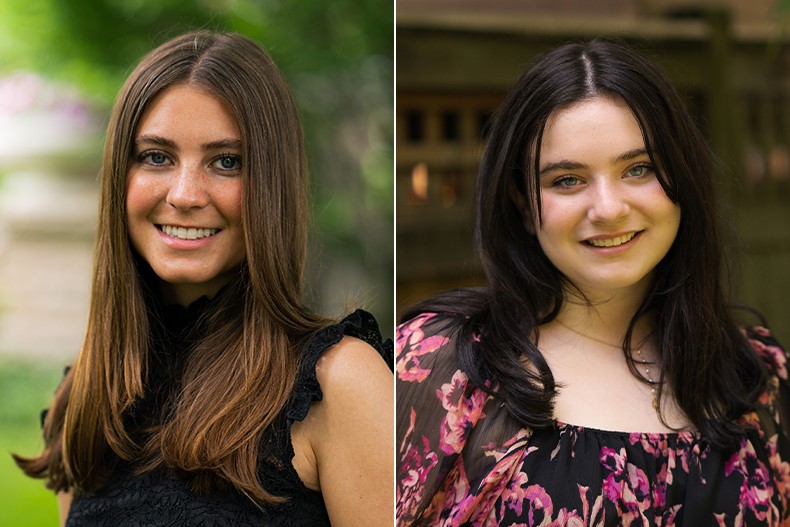
Two local teens win national recognition
Recipients of the annual Diller Teen Tikkun Olam Awards
Read more -
Celebrating six young award winners cultivating the community
Introducing young adult award winners
Read more -

Recently, I participated in a tour of Palestinian population centers for which the words of Rabbi Abraham Joshua Heschel rang true: “The principle to keep in mind is to know what we see rather than to see what we know.” Over four days, I didn’t stroll through Mahane Yehuda, experience the “Start-Up Nation,” or worship at the Kotel. Instead, I toured the West Bank and eastern Jerusalem, spending my nights in Bethlehem and Ramallah as the guest of Encounter’s Intensive Seminar.
Encounter is an American Jewish non-profit that curates tours of Palestinian population centers for Jewish communal leaders in order “to expand their view of the Israeli-Palestinian conflict.” Their trips are neither intended to open a dialogue with Palestinians, nor change our commitment to Israel; rather, we were asked to directly hear and try to understand their reality, and to layer a deeper appreciation of the Palestinian story within our Zionist DNA.
I accepted this free trip expecting to learn more, while also steadfastly holding true to my nearly five decades of commitment to Israel and Zionism, forged by my family, working at JUF, AIPAC and Israel Bonds and eight other trips to Israel.
I was right on both counts.
I’ve been asked if my experience made me optimistic that a real peace – satisfying the national aspirations of both the Israelis and the Palestinians – can be achieved. Unfortunately, I returned home mostly more pessimistic than before; but there were moments when I thought, maybe…just maybe…
On our first day, we visited Bayt Sakarya, a tiny, 400-year-old Palestinian village near Gush Etzion, and met with one of the village leaders on a mosque’s rooftop. He was asked if he was familiar with a local rabbi seeking common ground between Israelis and Palestinians.
The village leader said he was aware of the rabbi but didn’t have time for interfaith dialogue given the more urgent matters of building a kindergarten, installing solar panels, and completing the village’s mosque–all of which he said the IDF was blocking.
I do not know if the IDF is in fact blocking his efforts or why, but what was striking is how, unlike most of the Israel-Palestinian discourse here in the U.S., he wasn’t interested in one state or two, BDS, or whether the Palestinians should hold new elections. He simply wanted to make his neighbors’ lives better. I left Bayt Sakarya wishing we could find ways to help those seeking to build people up, rather than tear people down, because they are the people to lead the region to peace.
Almost on cue to eliminate such modest optimism, we visited the Aida refugee camp outside Bethlehem. There we were met with an oversized sculpture of an old house key, symbolizing the keys to homes in Israel thousands of Palestinians fled in 1948, and to which they (or, in most instances, their descendants) dream of returning. There, another Palestinian community leader made clear his vision for the future: one state–Palestine–in which Jews are “welcome to visit,” and live as a respected religion, but without national rights.
One of our last Palestinian interlocutors was a PLO representative. Thanks to her casual references to Israel’s “apartheid roads,” Israel’s efforts to “make Palestinians invisible,” and Israel’s “colonialism,” it seemed one of the trip’s last experiences was bound to be utterly disheartening.
Then she shocked me. She had spoken at length about the PLO’s desire for a two-state solution based on the pre-Six Day War borders, but during our final conversation atop Mt. Scopus on Hebrew University’s Jerusalem campus, she said she hoped to one day live in the Jaffa home her family abandoned in 1948. I asked if that meant in her version of a two-state solution, that Jaffa would be part of a Palestinian state.
She said that she assumed if she were living in Jaffa, it would be under Israeli rules and laws, which would be OK with her, as long as she was treated equally to Israeli Jews. As heartening as this comment was, I now wonder if she was just saying what she knew a group of American Jews wanted to hear, or if she was playing a more insidious demographic “long game,” whereby Palestinians believe it’s only a matter of time before they outnumber Israeli Jews, thereby ending Jewish self-determination.
It was important for me to hear and see Palestinians hold to their narrative with the same determination that Jews do when it comes to Israel’s history. Back here in the comfort and safety of Chicago, it is easy–even tempting–to discount their narrative. But doing so does not move us closer to peace.
If I’ve come away from the Encounter experience with just one understanding, it is that those of us who live in the Diaspora and wish to play a role in resolving the conflict between Israelis and Palestinians must do more than know ourselves; we must better know the other. We don’t have to agree, but we must be able to meet with, debate and engage in difficult conversations.
Echo chambers are safe and secure, while meeting your opponents is unsettling and frightening, but as Moshe Dayan said in 1977, “If you want to make peace, you don’t talk to your friends. You talk to your enemies.”
I am proud that JUF’s leadership encouraged my participation in Encounter and that they support us having difficult conversations about hard issues with intellectual honesty and transparency. Middle East peace won’t emerge from Chicago, but we can always learn more, empathize more and prepare for the hopeful day when circumstances over there ripen, and play our many important supportive roles as our Israeli brothers and sisters seek peace with their Palestinian neighbors.
Daniel Goldwin is Executive Director of JUF’s Jewish Community Relations Council/Public Affairs.
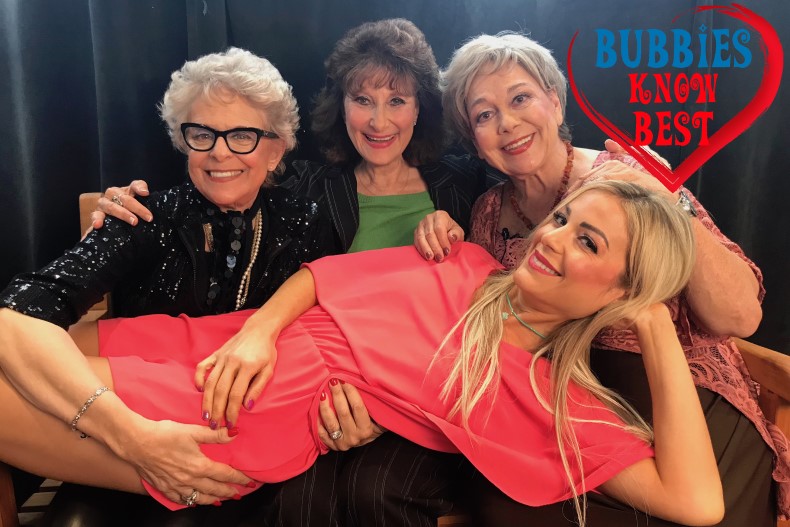
Singles have no need to despair if they’re chosen to appear on the TV show, Bubbies Know Best — these Jewish grandmothers will help them find a great first date.
“I think of it as an America’s Got Talent panel with three bubbies as judges,” said Erin Davis, the show’s host.
Each episode, she and the bubbies interview three potential suitors, then debate who will make the best match. The bubbies watch and comment during the couple’s date, and then return to the studio to debrief.
Executive Producer Brad Pomerance, who also serves as Senior Vice President of Programming at Jewish Life Television/JLTV, co-created the show. “Whether you’re Jewish or not Jewish, everyone knows what a bubbie is,” he said. “There’s a sense in culture that bubbies have wisdom.”
The bubbies have appeared on Access Hollywood, TMZ, and Steve Harvey. During a recent interview with Zach Galifianakis, the bubbies “tried to set him up with Bubbie Bunny , who is single, and grilled him about circumcision,” Pomerance said.
“We had so much fun meeting Zach and putting him through the ringer — the conversation took on a life on its own,” said Linda Rich, known on the show as the sage Bubbie Linda. Rich also was the first female cantor ordained by the Conservative movement.
Sandra J. Mendelson, known as the sassy Bubbie Sj, was a recent fan favorite on America’s Got Talent . She was inspired by her own bubbie, a Brooklyn matchmaker. “I basically got it from her. I have the matchmaking gene in me,” she said.
Kathleen Bubbie Bunny Gibson, one of the original dancers on American Bandstand , grew up Catholic–and didn’t know she was 50 percent Jewish until she took a DNA test.
“When the audition came up, I wanted to honor this new discovery of who I was,” she said. “The world needs more love, and if I can be a part of making that happen, I feel that that is one of the best things I can do with my life.”
Dating Tips from The Bubbies
Erin Davis, host:
- Dating isn’t a chore! Stop filtering with checkboxes like age and height.
- If your first date is a blind date, keep it short. One hour, one drink or coffee is enough.
Sage Bubbie Linda:
- Stop before you schtup ! Get to know a person before you get physically involved with them.
- Get to know your date’s friends and family. You can tell a lot about a person from who they hang out with.
Sassy Bubbie S.J.:
- Meeting in person is the best. If there’s someone you think is attractive or interesting, just go up to them. What’s the worst they’re going to say? I met my husband in the bank!
- Look at a date as a job interview. Ask them questions, and if they’re not interested in a relationship in six weeks, kick them to the curb because it ain’t gonna go any further.
Sweet Bubbie Bunny:
- First, you should love yourself! Work on being 100 percent of what you could be, so then you can meet someone who’s 100 percent. Two whole people getting together will have the biggest chance of being successful.
Watch Bubbies Know Best at 7 p.m. and 10 p.m. on Mondays on Comcast Channel 686 and DirecTV Channel 325-1. For more information, visit jltv.tv .
Other stories
-
Two local teens win national recognition
Recipients of the annual Diller Teen Tikkun Olam Awards
Read more -
Celebrating six young award winners cultivating the community
Introducing young adult award winners
Read more -
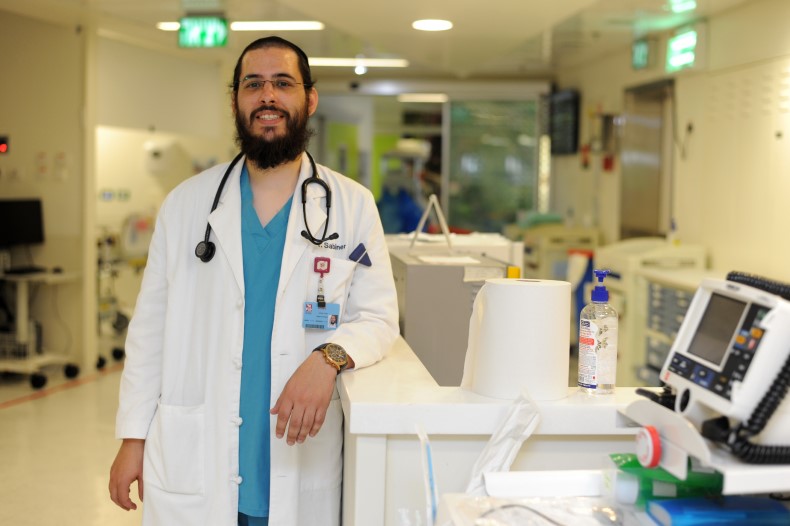
Yehuda Sabiner first remembers going to a doctor when he was 4 years old. He’d never met anyone like this physician, and the experience stayed with him throughout his childhood.
“My pediatrician was compassionate and professional,” Sabiner recalls. “Later, I saw the meaning of the job– that I could help a lot of people.” Now, at 29, Sabiner is the first Israeli-born Haredi doctor.
His road to a medical degree was challenging. HIs yeshiva education had given him the fortitude to study complex topics for hours at a time; however, his schoolwork did not include much math, physics, or English–which he spoke at home with his Brooklyn-raised mother, but never learned to read. He needed to be proficient in those subjects to be accepted to medical school.
Sabiner’s smarts and determination, however, led the Technion (Israel Institute of Technology) to take a chance on him. In 2011, at age 20, he was accepted to their mechina , an 18-month academic boot camp that brings promising students up to speed. Sabiner was among only 17 of 67 students to complete the course and bridge the academic gap.
He was accepted into Technion in 2013, earned his bachelor’s degree in 2016, and completed medical school last summer. He soon begins his six-year internship at Israel’s largest hospital–Sheba Medical Center in Tel Aviv.
While he first considered pediatric surgery, Sabiner decided on internal medicine. “I enjoy the big picture aspect of it, and how it’s multi-disciplinary.”
Even before he began his odyssey, Sabiner had to win approval from his wife, Rachel, and his community. Medical school required a formidable time commitment. The couple would have to relocate to Haifa from Bn’ei Brak with their three young children. And he would have to convince his community’s leaders that he would not assimilate into the secular world.
Sabiner is especially appreciative of his wife’s support during his studies. Rachel was working on her own certifications in architecture and interior design, yet they both stayed up late to finish his homework. They were up at all hours anyway, she explained, as their third child had just recently been born.
Now, Sabiner’s goal is to pay his community back.
“My dream,” he said, “is to be a professional doctor in a hospital and also work in public health in my community. We need more preventive medicine–vaccinations, mammograms and colonoscopies.” Today, only half of Haredi women over age 40 receive regular mammograms for early detection of breast cancer.
To help others follow his footsteps, Sabiner established Haredim in Medicine. He hopes to foster the ambitions of future Haredi doctors and solve the medical, cultural, and halachic problems of Haredim that impact their health.
Other stories
-
Two local teens win national recognition
Recipients of the annual Diller Teen Tikkun Olam Awards
Read more -
Celebrating six young award winners cultivating the community
Introducing young adult award winners
Read more -
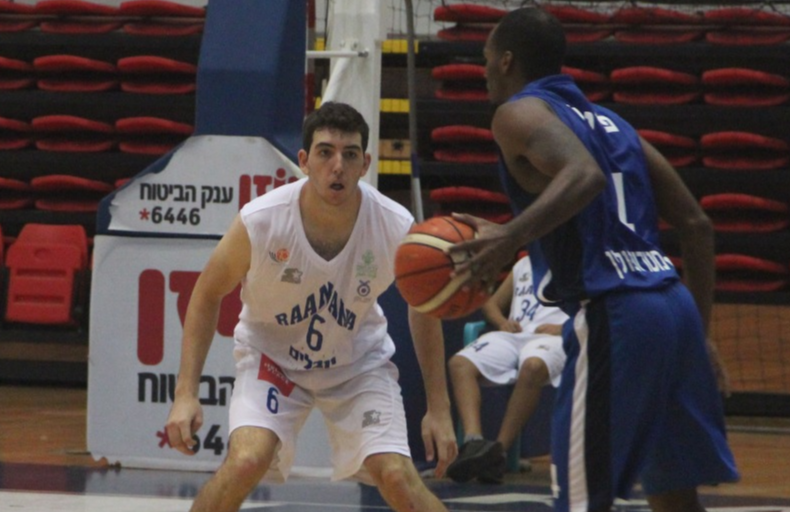
Ryan Clamage grew up in Lake Forest, but always had his sights set on making aliyah, moving to Israel. His unusual path to getting there: professional basketball.
While attending high school at Lake Forest Academy, he excelled in both academics and athletics, playing basketball, golf, and baseball.
But hoops were his passion.
After a career-high senior year-earning him Third Team All-American honors from National Association of Basketball Coaches and selection as UAA Player of the Year-it was basketball that led him to the University of Rochester, New York. He graduated last spring with degrees in business and political science-and with an offer to play professional ball with Maccabi Raanana, a Division 2 program near Tel Aviv.
An added bonus to signing Clamage is that he can apply for Israeli citizenship. While European and Israeli league rules limit the number of non-citizens per team, “I would count as a native due to my Jewish heritage.”
Clamage says playing at the professional level will be challenging.
“The game is faster with a 24-second shot clock versus a 30-second (shot); the game is much more physical as well,” he said. By contrast, “the college game promotes freedom of movement, as the defense is rarely allowed to touch the offense.”
Off the court, Clamage is adjusting to life off the court in a foreign country.
“The biggest adjustment is meeting people. I am working on my Hebrew,” he said.
After his playing days, he hopes to use his business degree and get involved with venture capital–and what better place to start than the Startup Nation.
Other stories
-
Two local teens win national recognition
Recipients of the annual Diller Teen Tikkun Olam Awards
Read more -
Celebrating six young award winners cultivating the community
Introducing young adult award winners
Read more -

What is love anyway? Is it like poetry, which you cannot define, but know when you see it?
The entire Torah has only two cases of romantic love: Isaac and Rebecca (but only after they’ve been married), and Jacob and Rachel, love at first sight.
There are about 250 uses of the word ahava -love-in all of TaNaKh. Approximately 15 of those references describe a love relationship between two persons: husband and wife, parent and child, in one or two cases friends, and in one case, a mother-in-law and daughter-in-law. All other uses of love are either inspirations to love justice and righteousness or the stranger, or indictments of ancient Israel for loving false gods and bad attitudes and behaviors.
Arguably, the single most famous expression of love in the Western world is found in the Torah: Love thy neighbor as thyself. Why can’t I just like my neighbor? Like is not bad. Imagine a world in which everyone liked everyone else. I love my family, but my neighbor!? Why love?
Every verse has context. The context of this one is a surprise. “Love they neighbor as thyself” is found at the end of a set of verses that starts with “Don’t harvest your field from one end to the other, leave some over for the poor.” In the run up to “Love thy neighbor as thyself,” the Torah commands: don’t steal, don’t deceive, don’t defraud, don’t rob, don’t withhold wages, don’t corrupt the justice system, don’t gossip, don’t stand with your arms folded over anyone’s peril, don’t take vengeance. Only then does it say, “Love your neighbor as yourself.”
“Love your neighbor as yourself” is a summary. It is defined by the previous verses.
In the most important love verse in the Torah, love is not a feeling or an emotion. It has nothing to do with romance. Love is in the details. The Torah prefers right behavior over sympathetic emotions. The Torah is suspect of those whoever love in words and don’t translate love into action.
There is a love verse that describes love as action. It is not as well-known as “Love your neighbor,” nor as famous as “And you shall love the Lord your God.”
For the LORD your God is God supreme and Lord supreme, the great, the mighty, and the awesome God… upholds the cause of the fatherless and the widow, and befriends the stranger, providing him with food and clothing. — You too must befriend the stranger, for you were strangers in the land of Egypt. (Devarim 10:17-19)
In these verses, the Torah defines love. Love is feeding hungry people and clothing naked people, not feeling for their plight.
The Torah does not command the obvious. The Torah doesn’t instruct that a person should get up in the morning, be productive, contribute to society, and support family. The Torah doesn’t command parents to love children, and husbands and wives to love each other. These are natural to the human experience. The Torah commands love where love is least likely to be found. And where the Torah commands and demands love, it isn’t looking for an emotion or a sentiment. It is instructing behavior.
Some would argue that love as a feeling ought to come first and lend its emotional sincerity to the behavior. The Torah takes the opposite position. Emotion, thought, conviction, and sentiment are the product of right behavior and just deeds. You will feel love for the stranger and the alien only when you obey the commandment to provide the stranger and the alien with food and clothing.
Loving behavior stirs the heart to love.
Rabbi Yehiel Poupko is Rabbinic Scholar at the Jewish United Fund.
Other stories
-

Mother’s Day, Father’s Day, and the Jewish way
Let us pause and consider what it means for us to truly honor our parents
Read more -
Each time we study Torah, we experience the revelation
The mystical tradition of Judaism that lifts up the number 600,000 from the Exodus
Read more -

The future is one step closer.
The Jewish Federation’s Fund for the Future, a major commitment to fuel a next-generation renaissance in Jewish life, has raised nearly $60 million since its launch last year.
Now the Fund, part of the Federation’s Centennial Campaign, has announced its first round of grants, all geared to stimulate robust connections with children, teens, college students, young adults, and young families. Additional grants will be made every three months, expanding on those and a wide array of other innovative efforts.
The initial distributions from the Fund, which is chaired by Bill Silverstein, will invigorate nearly a dozen and a half programs and projects, including:
• For Children – JUF Camping Initiative, Jewish Day School Guaranty Trust Fund, B’nai B’rith Beber Camp, Chicago Jewish Day School, and JUF Education’s Early Childhood Collaborative and CHIdush programs, which provide professional development and support for early childhood educators – all to make sure that every child is welcomed through vibrant Jewish learning and experiences.
• For Teens – Voices: The Chicago Jewish Teen Foundation – to provide every teen a unique pathway to build their Jewish identity and engage in local Jewish life.
• For Young Adults – Silverstein Base Hillel, Moishe House, Israel Education Center, Lewis Summer Intern Program, AEPi Foundation and Encompass – to assure that every emerging adult, in college and beyond, is embraced by and excited to be part of the Jewish community.
• For Every Young Jew – Israel Now/Ta’am Yisrael and Birthright Israel – to welcome every young Jew to Israel, again and again.
• For Young Families – PJ Library and JUF Right Start – to provide every young family with abundant resources to build an enjoyable, meaningful Jewish home, and to connect to community.
In future quarterly rounds, many of those efforts will receive additional financial support, and will be joined by other exciting initiatives such as “Z” Frank Apachi Day Camp, Write On For Israel, the Norton & Elaine Sarnoff Center for Jewish Genetics, a national expansion of Israel Now/Ta’am Yisrael, Honeymoon Israel and One Happy Camper scholarships, to name just a few.
“The future of tomorrow’s Jewish community depends on how well we engage today’s young Jews,” said Dr. Steven B. Nasatir, JUF’s executive vice chairman. “JUF has been an innovator in that space for years. Now, with the Fund for the Future, we have the resources to take that to an entirely new level.”
To help fuel that future, contact Merle Cohen, [email protected].
Other stories
-
Two local teens win national recognition
Recipients of the annual Diller Teen Tikkun Olam Awards
Read more -
Celebrating six young award winners cultivating the community
Introducing young adult award winners
Read more -
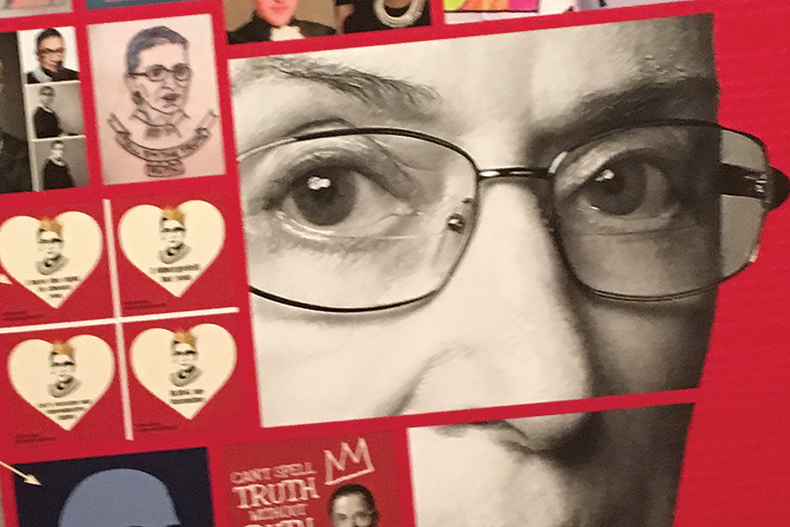
The life and legal career of Supreme Court Justice Ruth Bader Ginsburg are being spotlighted in the first-ever retrospective about the famed jurist and American cultural icon, a traveling exhibit opening Feb. 9 at the Illinois Holocaust Museum & Education Center, 9603 Woods Dr., Skokie.
Organized by the Skirball Cultural Center, Notorious RBG: The Life and Times of Ruth Bader Ginsburg is based on the New York Times bestseller and was created in partnership with the book’s co-authors, Irin Carmon, a senior correspondent at New York magazine, and attorney Shana Knizhnik, who founded the popular Tumblr that earned Justice Ruth Bader Ginsburg internet fame. It features diverse media and interactive exhibits to bring Ginsburg’s story to life.
“You can connect in so many ways to this exhibition. Whether you’re a fangirl or a legal scholar, there’s something here for you,” said Susan L. Abrams, Museum CEO.
“A key part of our mission at the Museum is teaching universal lessons to combat hatred, prejudice, and indifference,” Abrams said. “Few people convey these lessons more vividly than Ruth Bader Ginsburg,” which makes this a powerful story for the museum to tell.”
Historical artifacts, modern art, interviews, recordings, photographs, and movies tell Justice Ginsburg’s story as a student, Jew, wife, mother, lawyer, feminist, and Supreme Court Justice.
The exhibit includes artifacts from Justice Ginsburg’s personal life, from a re-creation of the Ginsburg family living room and kitchen to Ruth and Marty Ginsburg’s wedding album and some of their family movies. Visitors can hear recordings of Justice Ginsburg’s incisive legal arguments from landmark cases that include her dissenting opinions during her long career on the Supreme Court.
In addition, visitors can try on Supreme Court robes and Justice Ginsburg’s famous collar or pose for selfies behind a model Supreme Court bench, a light-hearted ending to a thought-provoking and engaging exhibit.
Notorious RBG: The Life and Times of Ruth Bader Ginsburg will run at the Illinois Holocaust Museum & Education Center Feb. 9 – Aug. 16.
In conjunction with the exhibit, the museum is holding special events that include:
- A conversation with authors of Notorious RBG , Irin Carmon and Shana Znizhnik, who will share how a Tumblr blog inspired by RBG sparked a cultural obsession (Feb. 9, 2:30-3:30 p.m.)
- A performance by Justice Ginsburg’s daughter-in-law Patrice Michaels (March 8, 2-4 p.m.)
- Jump for Justice! – a family program featuring exercise circuits inspired by RBG’s fitness regime (March 15, 2-3:30 p.m.)
- Growing up with Ruth & Marty: An Afternoon with Jim and Jane Ginsburg , RBG’s children (April 26, 2-3:30 p.m.)
- The Role of Judges, Attorneys and Bar Associations During the Holocaust (May 21, 6:30-7:45 p.m.)
- Commemoration of 155th Anniversary of Juneteenth: An Evening with Sherilynn Ifill, President and Director-Counsel of the NAACP Legal Defense Fund (June 10 6:30-8 p.m.)
- Live Entertainment RBG After Dark – Rock to social justice anthems and wear your RBG inspired robes and collars! (June 18, 7-9:30 p.m.)
- Movie Double Feature: RBG and On the Basis of Sex (July 21, 12:30-2:30 and 3-5 p.m.)
- We Dissent! – the Women who Stood with RBG . A conversation with The Honorable Judge Carol Kamin Bellows (Aug. 2, 2-3:30 p.m.)
For more information, visit ilholocaustmuseum.org or call (847) 967-4800.
Yvette Alt Miller, Ph.D. lives with her family in the northern suburbs of Chicago.
Other stories
-
Two local teens win national recognition
Recipients of the annual Diller Teen Tikkun Olam Awards
Read more -
Celebrating six young award winners cultivating the community
Introducing young adult award winners
Read more -
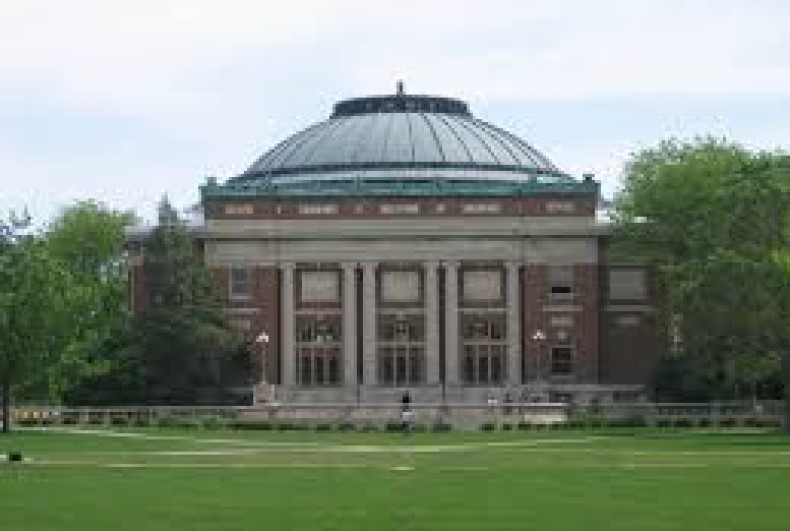
Throughout January and early February, nearly 1,000 staff and paraprofessionals from University Housing at the University of Illinois at Urbana-Champaign are receiving in-depth training on recognizing and responding to antisemitism. The training follows several antisemitic incidents on campus.
Attendees include full-time staff and undergraduate paraprofessionals, such as resident advisors and multicultural advocates. Undergraduate students especially have visible leadership roles on campus and can help amplify the training to thousands more.
The training, written and delivered by JUF Campus Affairs staff Emily White and Emily Briskman, already has been delivered to nearly 1,500 Jewish and non-Jewish individuals in Chicago and across the country.
“Antisemitism is on a steady rise nationally, and is particularly acute on college campuses,” Briskman said.
Antisemitic hate messages originate from across the political spectrum. The training incorporates lessons on how to recognize antisemitic speech, from traditional antisemitic tropes to antisemitism related to Israel; explores when criticism of Israel moves from political speech to antisemitism; and concludes with actionable steps everyone can take to mitigate the harmful effects of antisemitism.
“We know all too well that hate targeting the Jewish community never ends there,” Briskman said. “This training is about raising awareness of a largely misunderstood topic and one that has dangerous repercussions.”
“It is critical that non-Jewish people understand Judaism and the Jewish people in order to fully understand the oppression we face,” said White, a social worker by background. “That deeper awareness leads to true allyship and the ability to stop that oppression in its tracks.”
This training was the first in a series of anti-bias trainings University Housing will conduct.
Erez Cohen, executive director of the Cohen Center for Jewish Life at the University of Illinois at Urbana-Champaign, said “This another important step in building a strong and safe Jewish environment at the University of Illinois.”
Other stories
-
Two local teens win national recognition
Recipients of the annual Diller Teen Tikkun Olam Awards
Read more -
Celebrating six young award winners cultivating the community
Introducing young adult award winners
Read more -
Reading a parsha, or portion, a week, it takes a year to complete reading the Torah, after which we celebrate with the holiday of Simchat Torah.
But the Talmud is much, much longer. To enable more people to study it completely, a practice was established in 1923, called “Daf Yomi” or “A Page a Day.” At that rate, reading and studying each of the Talmud’s 2,711 pages still takes more than seven years. There is a celebration after that, too, called a siyum, from the Hebrew word for “completion.”
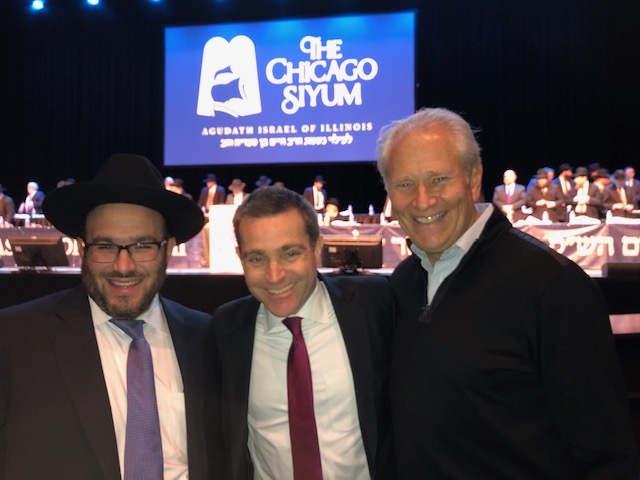
And, on Jan. 5, Chicago celebrated a Daf Yomi siyum. Similar celebrations were held in other cities worldwide, marking the 13th time the Daf Yomi cycle has been completed and restarted.
Chicago’s celebration of the siyum- the culmination of a weekend of events that took around Chicago- was held at the Rosemont Theatre. It was attended by the hundreds of Daf Yomi “graduates,” as well as some 3,000 family and community members .
One was JUF Board Member Elliott Robinson, who both helped plan the siyum and helped found the Daf Yomi class at Skokie’s Congregation Or Torah 17 years ago. Robinson called this year’s siyum a “planetary party.”
Altogether, as many as 1 million people celebrated the siyum globally, estimates Rabbi Shlomo Soroka, of Agudath Israel of Illinois which spearheaded Chicago’s siyum.
“I found it incredibly inspiring to walk into a packed room of thousands who were celebrating the strength and conviction of their Jewishness,” said JUF President Lonnie Nasatir, who attended Chicago’s siyum. “At a time when our community is understandably feeling vulnerable, this event was a powerful reaffirmation of our commitment to our Jewish values and identity.”
Chicago’s siyum featured remarks by Rabbi Asher Weiss, the head of a Kollel (institute for Talmud and rabbinic literature institute) in Israel; Rabbi Chaim Dov Keller, co-founder and co-rosh yeshiva of Telshe Yeshiva Chicago; Rabbi Shmuel Fuerst, a dayan (judge) for Agudath Yisrael bet din (rabbinic court) in Chicago; Rabbi Yona Reiss, head of the) of the Chicago Rabbinical Council bet din, and several other major leaders of Chicago’s Jewish community.
“Every Jew should celebrate the completion of this incredible journey,” said Robinson. He has participated in Daf Yomi sessions in many locales worldwide, including Gibraltar, and “of course, Israel.”
JUF’s Executive Vice President Jay Tcath commented that the siyum was “part educational, part celebration, part dance party, and 100% inspirational.”
The objective of the Daf Yomi remains the same as it was when it began nearly 100 years ago: to make sure that, at least in this way, Jews around the world remain “on the same page,” literally.
Other stories
-
Two local teens win national recognition
Recipients of the annual Diller Teen Tikkun Olam Awards
Read more -
Celebrating six young award winners cultivating the community
Introducing young adult award winners
Read more -