The first retrospective exhibition on Supreme Court Justice Ruth Bader Ginsburg.
Training female medics as first responders.
Sexual harassment awareness for companies and universities around Israel.
These are just a few of the 30 projects that will be supported in the year ahead by the Jewish Women’s Foundation of Metropolitan Chicago (JWF), which awarded its annual grants for 2019 in December.
The total distributions of $425,550-the largest in JWF’s history-include $307,000 in grants to 20 different projects in Chicago, Israel and around the world, along with 10 additional grants totaling $118,550 through JWF’s Ellie Fund, established by founding lifetime trustee Ellen H. Block. Sixteen grants represent new funding and 14 are renewal grants. See the full list here.
“JWF is proud to be part of a national funding movement to invest in the unique and urgent needs of women and girls,” said Ellen Carmell, Executive Director.
An independent project of JUF, JWF brings together more than 370 women as its trustees, including 50 multigenerational families.
“Each and every JWF trustee has a seat and vote at our philanthropic table, enabling the foundation to collectively effect positive, lasting social change for Jewish women and girls,” said JWF Chair Sheri Hokin. “It is thanks to their enormous generosity that, since its founding in 1997, JWF has awarded more than 400 grants totaling nearly $4.7 million to projects striving to transform the lives of women and girls.”
This year’s new grant recipients include:
Economic Security/Legal Reform
- Adva Center: Empowering the Empowerers
Provides the requisite support and skills to enable mayoral advisors on gender equality to advance tangible changes.
- Ma’ase Center Association: Women’s Leadership Training from Pre-Army to College Age
Lends structure and support to marginalized Israeli teens to increase their economic mobility.
- Olim Beyahad: Employment, Empowerment, and Leadership for Ethiopian Israeli Women
Helps integrate Ethiopian Israeli university graduates into the forefront of the workforce.
Education/Leadership Development
- Holocaust Memorial Foundation of Illinois: Notorious RBG: The Life & Times of Ruth Bader Ginsburg
The first retrospective exhibition on Ruth Bader Ginsburg, with related programs.
- Metro Chicago Hillel: Women and Judaism
Expands Silverstein Base Hillel’s Women and Judaism pilot learning series.
- The Rosh Pina Mainstreaming Network (dba Kaleidoscope): Early Childhood Educators as Leaders of Diversity Education
Fosters cultural acceptance among students, parents, and educators in Arab and Jewish school communities across Israel and around the world.
- Yaacov Herzog Center: Midreshet Roni-A New Tzahali Program Prepares observant young Jewish Israeli women for successful army service.
Health & Well-Being
- Tahel-Crisis Center for Religious Women and Children: Digital Infrastructure for Victim Support Services
Capacity-building for a customized database to enable more in-depth tracking, sophisticated interventions and streamlined services.
- The Eden Center: General Operating Support
Advances tolerance, mutual responsibility, and inclusiveness at the mikveh and connects women to medical resources within the Jewish community.
- United Hatzalah of Israel: Women Helping Women-Promoting Community-Based Volunteer Citizen-Responders
Increases the number of female volunteers trained as medics.
The Ellie Fund
- Hasharon Sexual Assault Crisis Center: It’s Your Business
Expands workplace sexual harassment and awareness program to additional companies and universities around Israel.
- UIC John Marshall Law School: Family Law & Domestic Violence Clinic
Prepares law students to represent survivors seeking orders of protection, immigration relief, and family law assistance.
- Itach Maaki Women Lawyers for Social Justice: City For All
Develops women’s groups in the municipalities of Acco, Carmiel, and Haifa to advance women’s issues.
- Midwest Access Coalition: Helping Women Access Safe and Legal Abortions Financial support for women throughout the Midwest who are seeking abortions, as well as advocacy surrounding reproductive justice and access.
- Organization for the Resolution of Agunot (ORA): Agunah Prevention Initiative
A multifaceted campaign to provide Jewish women and girls in Chicago with the knowledge and support to protect themselves against get-refusal.
Other stories
-

Two local teens win national recognition
Recipients of the annual Diller Teen Tikkun Olam Awards
Read more -

Celebrating six young award winners cultivating the community
Introducing young adult award winners
Read more -
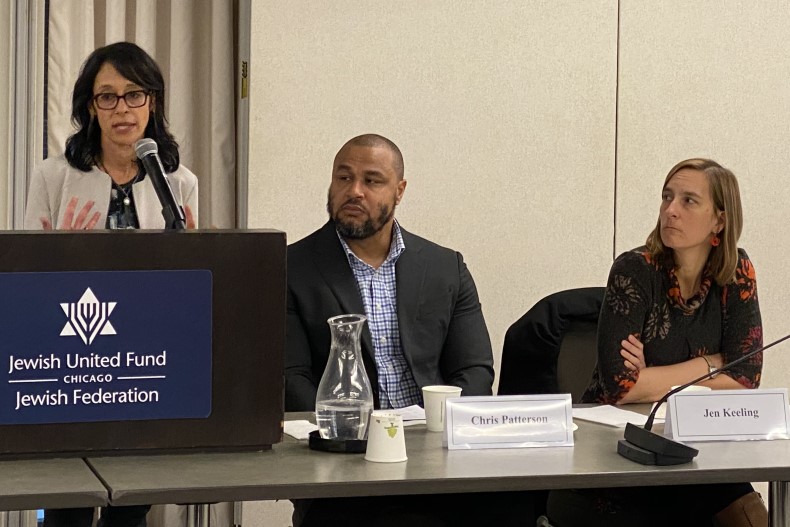
Gun violence in Chicago, and how to curb it, was the focus of the latest session of JUF’s Jewish Community Relations Council quarterly meeting.
In her remarks, Keeling noted that by the end of the month the city of Chicago will have seen about 500 homicides in 2019. Most of this violence occurs in about 15 neighborhoods throughout the city’s South and West sides. Chicago CRED (Creating Real Economic Destiny) is dedicated to a transformative reduction of gun violence in Chicago. Chicago CRED’s intervention strategy focuses on finding full-time employment for program participants, who are the most at risk for becoming a victim or perpetrator of gun violence. Programs such as READI, through the Heartland Alliance, and others provide opportunities in neighborhoods with a history of disinvestment and increase overall safety in some of the most violence-stricken communities in Chicago.
Keeling emphasized that current efforts are largely supported by private funding. State and city governments need to increase their investment in violence prevention and intervention strategies because “private money cannot be the solution to a public safety issue,” Keeling said.
The Partnership for Safe and Peaceful Communities, a collective of more than 50 foundations and individuals formed in 2017, has been primarily focused on addressing both skyrocketing gun violence and supporting a stronger police-community partnership, as well as advocating for gun safety legislation, Wilen said. PSPC has also supported more than 500 grantees in 21 neighborhoods for summer and fall events, programs and services bringing neighbors together, providing rich experiences for youth, and building bridges between police and community. The Summer Fund has allocated more than $3 million in the last three years.
Chicago’s Austin neighborhood has seen a 60 percent reduction in shootings from 2016 to 2019, Patterson said. However, many community members still do not feel safe in their daily lives. Patterson’s organization, the Institute for Nonviolence Chicago, uses Kingian nonviolence principles (a set of maxims developed by Dr. Martin Luther King Jr.) to engage neighborhood residents in the work of reducing gun violence. The institute connects people to the resources they need, including therapy, jobs, conflict mediation and other support services.
All three speakers agreed that multipronged approaches have been most effective in combating gun violence, but emphasized that a lot of work remains. Recent commitments by the City of Chicago and State of Illinois leaders to dedicate public money to gun violence prevention, reduction and intervention strategies already at work will lead to greater strides in achieving an ambitious goal: Ending a year in Chicago with fewer than 400 homicides, a level not achieved since 1965.
Other stories
-
Two local teens win national recognition
Recipients of the annual Diller Teen Tikkun Olam Awards
Read more -
Celebrating six young award winners cultivating the community
Introducing young adult award winners
Read more -
We are told of a time when the Dalai Lama visited Jerusalem and asked a group of rabbis a critical question: “What is the secret to maintaining your national identity, your faith, and your unique way of life across so many continents and so many thousands of years?”
The Dalai Lama explained: “Like your people, my people, the Tibetan Buddhists, are oppressed. Many have gone into exile. We are still trying to understand how to live our national religious Tibetan Buddhist culture when we no longer live in our homeland. You, the Jewish people, know how to do this. What is the secret?”
Younger rabbis referred him to the use of technology to bind his people together. Educator rabbis recommended developing adult Jewish education curricula. Others urged building Tibetan Buddhist community centers and Temples in the Tibetan Buddhist diaspora. The Dalai Lama listened before motioning to a heretofore silent rabbi, asking, ‘What do you think?’ This rabbi said, “Make a Tibetan Buddhist cookbook.”
This was met with embarrassed silence. The other rabbis and Jewish scholars could not believe their ears. One of the world’s greatest spiritual figures had asked how to maintain his people in exile, and this rabbi had recommended a cookbook? And worse, the Dalai Lama’s learned and scholarly retinue started laughing. That’s the key to continuity when you lose your homeland? What does a cookbook have to do with anything?
The Dalai Lama giggled-as he does when he likes something-and nodded to the rabbi to go on. The rabbi explained that immigrant children growing up in a strange land lose their traditional foods faster than anything. They become assimilated into the food culture of BBQ, pizza, hot dogs, and hamburgers. There is a Tibetan Buddhist sacred calendar with Holy Days and Festivals, each with special foods, readings and meditations. A cookbook could be organized according to this calendar, with menus and recipes fit for each Holy Day-along with the holiday’s readings and meditations. The result would be a book that sets the Tibetan Buddhist family table, fills the exiled Tibetan home with the aromas of Tibet, and keeps Tibetan Buddhism in the warm embrace of food and family.
The laughing ceased. They got it: A cookbook would make Tibetan Buddhism portable.
How did this young rabbi come up with such an idea? In 1975, Rabbi Menachem Mendel Schneerson, the legendary Rebbe of Lubavitch and spiritual leader of Chabad, launched a campaign for kashrut observance. Inspired by the Rebbe and this campaign, a group of women from Crown Heights instinctively understood that if someone was going to keep kosher, they needed a cookbook overflowing with easy and attractive recipes. They assembled such a cookbook in the way that so many synagogues societies and institutions do, cheaply printed and loosely bound. They presented it to the Rebbe, who examined it and said that since a cookbook can have such a profound influence on a Jewish family’s life, “it needs to be externally beautiful.” The Rebbe advised them to consult a variety of popular cookbooks available in bookstores.
The result is the Kosher living classic, Spice and Spirit: The Complete Kosher Jewish Cookbook . Published by Lubavitch Women’s Cookbook Publications, this cookbook-which has gone through several printings-is a monumental work that launched the explosion in the kosher cookbook market. Spice and Spirit provides a culinary journey through the celebration of the Jewish calendar, Shabbat and the various holidays through the year. It weaves together food, family, fun, and 3,000 years of Jewish experience.
And not only did it revolutionize the publication of American Jewish cookbooks over the past half century, the Rebbe’s cookbook also gave birth to the Dalai Lama’s cookbook.
Other stories
-

Mother’s Day, Father’s Day, and the Jewish way
Let us pause and consider what it means for us to truly honor our parents
Read more -
Each time we study Torah, we experience the revelation
The mystical tradition of Judaism that lifts up the number 600,000 from the Exodus
Read more -
Are you a vegan yet? Wait, I think you need to stop eating vegetables and eat more fat. That’s not right, you need to eat like they did in the Paleolithic area and don’t forget to fast.
If you visit the nutrition aisle of a library or bookstore (they still exist), there are countless diets from blood type to vegan, and the internet is littered with opposing views. Does anyone else find it odd that many online sources tell you to eat more protein to gain weight, and then suggest eating more protein to lose weight?
If there was an easy way to lose weight, you would know about it. Most nutritionists (which I am not) suggest eating fewer calories than you burn to drop weight and doing the opposite to gain weight. That’s essentially how apps like Weight Watchers (I think they go by WW now) work. I like WW and myfitnesspal, where you can enter your food and track activity level.
My first step with clients trying to drop weight, is to log their meals. It’s not revolutionary, but it’s easy to list on your phone or a piece of paper what you’re scarfing down. Most of my clients lose weight just from doing that, but if that doesn’t work, you find trends.
When I logged my food, I realized I snacked way too much. I was always eating, more out of habit then hunger! Now I try and have bigger meals and instead of hitting the candy bowl, I try and eat:
-
Turkey jerky (I get mine at a butcher, it tastes great and doesn’t have all the fillers)
-
Pumpkin seeds with a piece of fruit
-
Carrots and celery are cut on Sunday nights and brought with me to work
-
Hummus and cucumbers
-
Avocado toast (I’m not technically a millennial but I love this snack)
-
Lightly salted almonds with a piece of dark chocolate
-
Peanut butter ball (they take me 10 minutes to make: 12-ounce jar of peanut butter, ¼ cup of honey, teaspoon of chia seeds, ½ cup of oats, cinnamon, and ½ cup dark chocolate chips)
-
Greek yogurt, frozen berries, and granola
-
Hardboiled eggs
The hardest part of my diet is avoiding sweets. I love a good cookie, or something with peanut butter and chocolate, or almonds and chocolate. Did I mention cookies? I will never recommend cutting sweets or anything for the matter but try and eat less of the sugary treats. Cut one soda out of your week, order the mac cheese with a salad and eat half, or split the treat with your friend.
My last suggestion: Don’t count on self-control. A warm cookie, or just about any cookie is difficult to pass up. Limit what you buy, don’t keep ice cream in the house, or put it in the freezer in your basement or garage. Your office does not have to be the candy office; people will still stop by. Stock up on healthy food, and that’s what you’ll eat. I’ve never done a clinical trial but if your office has an apple and a scone in it-the scone will probably disappear first. In summary, shop smart, log your food, and save treats for special occasions.
Ron Krit is senior director of the Legacies and Endowments department of the Jewish United Fund and a Wellness Consultant.
Other stories
-
Mother’s Day, Father’s Day, and the Jewish way
Let us pause and consider what it means for us to truly honor our parents
Read more -
Each time we study Torah, we experience the revelation
The mystical tradition of Judaism that lifts up the number 600,000 from the Exodus
Read more -
Auschwitz-Birkenau Foundation Director General: Preserving history is critical for future generations
Jake Chernoff
On October 23, Wojciech Soczewica, Director General of the Auschwitz-Birkenau Foundation, discussed the importance of preserving history during a presentation at the Illinois Holocaust Museum and Education Center.
The Auschwitz-Birkenau Foundation was established by the Polish government in 2009 to educate future generations on what transpired there by preserving the architecture and artifacts of the Auschwitz-Birkenau Memorial Site without altering history. Over the years, the foundation recovered almost 1,000 personal items of prisoners, Soczewica said.
Nearly 75 years after the end of the Holocaust, the Foundation educates about the fight against Nazi Germany’s plan to extinguish Jewish life in Eastern Europe, and counteracts those who deny the Holocaust. Soczewica said the Foundation’s mission is more critical now than ever, with the rise of global antisemitism coupled with a resurgence of populist leaders – foreboding signs that history could repeat itself.
Unfortunately, hardline right-wing elements within the Polish government have actively engaged in Holocaust distortion. Last year’s proposed amendment to the Act on the Institute of National Remembrance would have effectively criminalized use of the terms “Polish death camp” and “Polish concentration camp.” It was felt that these terms asserted the willing involvement of the general Polish population in the Holocaust, while deniers claimed that those atrocities were committed against the will of the Polish people.
The consensus of historians and survivors, however, is that many Poles were in fact complicit, and even active participants, in perpetrating the Holocaust.
Following international outcry, the amendment received only a slight revision that modified the criminal offense against the “good name” of Poland to a civil offense.
Soczewica, said the Foundation was not consulted on the law. “While some of our ancestors did heroic things, it is important to acknowledge that many of them have also committed horrible acts,” he said.
Jake Chernoff is a program associate, JUF Public Affairs.
Other stories
-
Two local teens win national recognition
Recipients of the annual Diller Teen Tikkun Olam Awards
Read more -
Celebrating six young award winners cultivating the community
Introducing young adult award winners
Read more -

With the snip of a giant scissors, Bernard Zell Anshe Emet Day School celebrated the opening of its new building, which added 25,000 square feet to its campus.
“For 73 years, this school has served as a beacon in the community,” said Head of School Gary Weisserman during the ceremony. “This incredible new facility builds on that foundation of excellence and provides the resources and environment required for the education of 21st-century learners who aim to not only be the best in the world, but the best for the world.”
The Oct. 27 celebration was attended by 600 community members, including State Representative Sara Feigenholtz, 46th Ward Alderman James Cappleman, and JUF President Lonnie Nasatir, himself a Bernard Zell parent.
The new facility houses an administrative office suite; an in-the-round sacred space for prayers and Jewish celebrations; a 700-seat gymnasium/auditorium; a renovated athletic field; two modular music classrooms; two science classrooms; and an “innovation hub” featuring 3D printers and laser cutters alongside traditional tools, art supplies and technology.
A renovated front entrance includes an entry plaza, outdoor classroom, and light-filled lobby with enhanced security vestibule.
“This school has always been dedicated to nurturing curious and compassionate leaders,” said Dana Hirt, capital project co-chair. “This new facility offers us unlimited potential to continue to advance our educational program, fostering creativity, problem solving, artistic expression, teamwork, community, and spiritual growth.”
Bernard Zell Anshe Emet Day School was founded in 1946. The school launched its Campaign to Transform Bernard Zell, which has an ongoing goal of $23.5 million, in early 2017.
Other stories
-
Two local teens win national recognition
Recipients of the annual Diller Teen Tikkun Olam Awards
Read more -
Celebrating six young award winners cultivating the community
Introducing young adult award winners
Read more -
To my father, food was love.
He loved everything about eating, from dining in fine restaurants to scrambling eggs in our kitchen. His face lit up whenever a dish was pulled from the oven. He beamed at waiters who appeared with plates of food. He damn near cried the first time I made a chocolate cream pie.
I remember him singing to himself in the morning as he put schmear on his bagel (to the tune of Beautiful Brown Eyes): “Beautiful, beautiful cream cheese; I’ll never love butter again.”
It should go almost without saying that my father battled his weight for much of his life; in his retirement, he became quite heavy. Periodically, concerned friends and extended family members would take me aside and tell me he should lose weight. Beyond being irritated-I mean, did they think he didn’t know he was fat? And if they were so concerned, why didn’t they talk to him themselves?-it seemed almost cruel to ask him to curb the most reliable source of pleasure in his life.
Dad and his family escaped Nazi Germany, but growing up as refugees in the U.S. was tough. His grief-stricken, frightened parents were perpetually on edge. Like many immigrants, they spent all their emotional energy mastering English and navigating their new lives in Chicago. Like many people suffering from Post-Traumatic Stress Disorder, they had short fuses and explosive tempers. And like many Holocaust survivors, I suspect they simply felt too guilty for having survived to allow themselves a happy ending with their little boy.
The family’s one consistent source of joy was my grandmother’s cooking. I remember her making impossibly rich chicken soup and matzah balls, ethereal cheese blintzes and German pancakes, silken chocolate pudding and Jello molds with as many tiers as a layer cake. She chopped huge batches of gefilte fish and egg salad by hand, and made legendary apple- or cherry-cake from delicate, yeast-based dough.
When I was a child, as she put down a plate in front me, I remember Grandma resting her hand on my head. I expect she did the same when she served my Dad as a boy. She didn’t always say it, but I could taste her love, and some of the happiest moments of my childhood took place in her kitchen. By this time, she reminisced more than she cooked, but her kitchen was the place where she opened up to me the most. One of my earliest memories is sitting on a stool and helping her shell peas as she told me stories about growing up in Germany, before Hitler came to power.
When we took our places around Grandma’s table for a holiday dinner, the grown-ups argued about politics, the in-laws bickered about slights, both real and perceived, and my brother and I were bored to death. Then Grandma appeared with serving platters, and everyone smiled. The conversation turned to the food. Every time, my grandfather declared that this was the best meal she had ever made. I don’t recall my father’s exact words, but I do remember that as he sang her praises, my grandmother nodded benevolently at him-not as if to say “oh, it was nothing,” but in a gesture that was as close as I ever saw her come to telling Dad that she loved him.
So no, I didn’t tell my dad he should lose weight. Throughout the years, I made him his mom’s chicken soup and my own butternut squash bisque, cooked him everything from roasts to risotto. I learned to master tzimmes, latkes and lokshenkugel. Throughout our own sometimes-tumultuous relationship as adults, I still baked him butter rum cakes and hazelnut sacher brownies.
Because I wanted him, always, to taste the love.
Other stories
-
Mother’s Day, Father’s Day, and the Jewish way
Let us pause and consider what it means for us to truly honor our parents
Read more -
Each time we study Torah, we experience the revelation
The mystical tradition of Judaism that lifts up the number 600,000 from the Exodus
Read more -
The latest round of violence between Israel and its neighboring terror organizations saw 450 rockets launched at Israeli towns and villages within 48 hours, targeting civilians throughout the south of the country and terrorizing hundreds of thousands. The Israel defense Forces (IDF) retaliated by surgically targeting the terrorists and launchers. After two days of violence, three dozen terrorists were killed and a number of Israelis lightly injured. Our anti-missile Iron Dome system once again proved to be a game changer, invalidating the tens of thousands of rockets that terror organizations have used and will likely continue to use against us.
The skirmish followed a more or less “traditional” pattern in which each side played a role which served the strategic interests of both, but at the sad cost of their respective populations.
The terror organizations have a long-term goal and a short-term objective. In the long term, they are looking to destroy the state of Israel and rid the Middle East of all Jewish presence. The idea of the creation of a Caliphate that will engulf the entire Middle East (and later – the world) is as old as Islam itself and its implementation is measured in centuries. It still has many adherents among terror groups and beyond. In the short term, terror organizations must maintain the struggle in which they need to satisfy their society as well as their patrons in Tehran or in the Persian Gulf.
Hamas, Islamic Jihad and the other factions are not looking for all-out war in which they could be wiped out. They need limited campaigns that gain them financial support and global sympathy. For them, Iron Dome serves a purpose of limiting the negative effects of even hundreds of rockets. They know that the rockets will not kill enough Israelis to provoke the ire of the IDF and an all-out campaign to eradicate them. They can maintain the “struggle” indefinitely, assured that if Israel sustains minor damage and little loss of life, they will not be made to pay a price that they cannot afford.
For Israel, too, there are long-term goals and short-term objectives. In the short term, Israel would like to limit the damage inflicted by terror organizations and to allow them to disrupt daily life as minimally as possible. Iron Dome and a widespread distribution of shelters in every home and building ensure that the damage caused by rockets is to a large extent, negligible. Israel’s objective is to deny the terrorists the ability to pressure our leadership into territorial concessions.
The problem is that Israel’s long-term goals are not clear and are subject to the political considerations of whichever government is in power at any given moment. As in every democracy, alternation in power also means that long-term policies are sometimes subject to change. In the absence of a clearly defined and long-range policy on the Palestinian issue, Israel must necessarily conduct a short-term policy of containment and crisis management rather than crisis resolution.
In the absence of a strategic game-changer, Israel follows a tried and tested pattern of action. When rockets are launched at Israel, Iron Dome kicks in, the population heads to the shelters, and the IDF hits terrorist targets in Gaza. The mirror image of the terror organizations’ attempt to limit the damage inflicted on Israel in order to avoid escalation is the IDF’s attempt to limit the damage it inflicts on the terrorists. Often, the IDF warns residents of buildings in Gaza ahead of a bombing in order to avoid casualties. In other cases, the Israel Air Force bombs terror installations in the middle of the night in order to destroy property only. The terrorists need to contain events and avoid escalation, and Israel abides by the unwritten rule that says that too much damage caused to the Palestinians will lead to unwanted escalation.
In this almost scripted play, where one scene follows the other and one act leads to the next, the leadership on both sides follows a pattern that serves short-term goals and delays long-term resolution. The tragedy is that the heaviest price is paid by the population on both sides. The people of Gaza are hostages of homicidal radical groups which pay no attention to the plight of their own citizens. Even worse – for terrorists, civilian casualties represent PR successes to be used against Israel. Sometimes, our surgical strikes either miss their target or harm innocent civilians because of poor advance information. The lack of long-term resolution denies the people of Gaza autonomy, freedom and development.
For Israelis living under almost 20,000 rockets for the past decade and a half, the knowledge that Iron Dome is 90 percent efficient is not enough to bring calm and tranquility. Every single Israeli born after 2005 and living in the south has grown up with weekly and sometimes daily sirens sending them to the shelter, sometimes with as little as 15 seconds to make it to safety. Most children suffer post-traumatic stress disorders (PTSD), their emotional scars permanent. For them, there are no short-term or long-term considerations. They are paying a price that will affect them for life.
Other stories
-
Mother’s Day, Father’s Day, and the Jewish way
Let us pause and consider what it means for us to truly honor our parents
Read more -
Each time we study Torah, we experience the revelation
The mystical tradition of Judaism that lifts up the number 600,000 from the Exodus
Read more -

Emmy-award winning writer and comedian John Mulaney has a famous bit about how canceling plans to stay home and do nothing brings “instant joy.”
But you won’t want to stay at home Saturday, Dec. 14, when Mulaney performs at the 12th annual JUF Young Leadership Division Big Event Fundraiser at the Sheraton Chicago Hotel.
The stage is set for the big night, which will help the Young Leadership Division kick off the 2020 JUF Annual Campaign with a comedy show from John Mulaney followed by an after party featuring popular 80s cover band Sixteen Candles.
“You can spend your Saturday night at home watching John Mulaney specials on Netflix or see him live with 2,000 of your friends,” said YLD president Joanna Greenberg. “It’s an easy choice to spend an evening raising money for our local Jewish community and an organization that provides so much for all of us.”
If you’ve seen any of his Netflix’s specials, you probably know Mulaney is a native Chicagoan and that his wife is Jewish-two topics that often make an appearance in his sets.
Mulaney recently toured the U.S. with his stand-up tour, Kid Gorgeous, which was also released as a Netflix special last year and won the Emmy for Outstanding Writing in a Variety Special. He starred in the Broadway hit, Oh Hello , with Nick Kroll, who he also works with as a writer and the voice of Andrew on Netflix’s Big Mouth . His other well-known Netflix specials include The Comeback Kid and New In Town .
In 2008, he began writing at Saturday Night Live , where he appeared as a Weekend Update correspondent and co-created characters including “Stefon” with Bill Hader.
“What better way could we possibly kick off the 2020 Campaign?” said Elizabeth Kramer, 2020 Young Leadership Division Campaign Chair. “John Mulaney is one of the most popular comedians around, while Sixteen Candles Band gives Chicago street festival-lovers a rare winter performance.
“And the talent is just a bonus! The Big Event Fundraiser is a meaningful night for our YLD community to come together and give back.”
Register online at juf.org/bigevent. For more information, contact (312) 357-4880 or [email protected] .
What you to need to know about the *Big* night:
Tickets to the Big Event Fundraiser are $95. If you are a first-time donor, your attendance requires a minimum gift of $25 to the 2020 JUF Annual Campaign, which is included in your ticket price. Current donors will be asked to match or increase your previous JUF gift, which you will have the opportunity to do during the program. Twenty-five dollars of your ticket price will go toward payment of your 2020 pledge.
This year’s festivities will include the following: First, wine, beer, and snacks, then the fundraiser and comedy show, followed by an after-party with live music, three drink tickets and a cash bar. Dietary laws observed. Ages 21 and over only.
Other stories
-
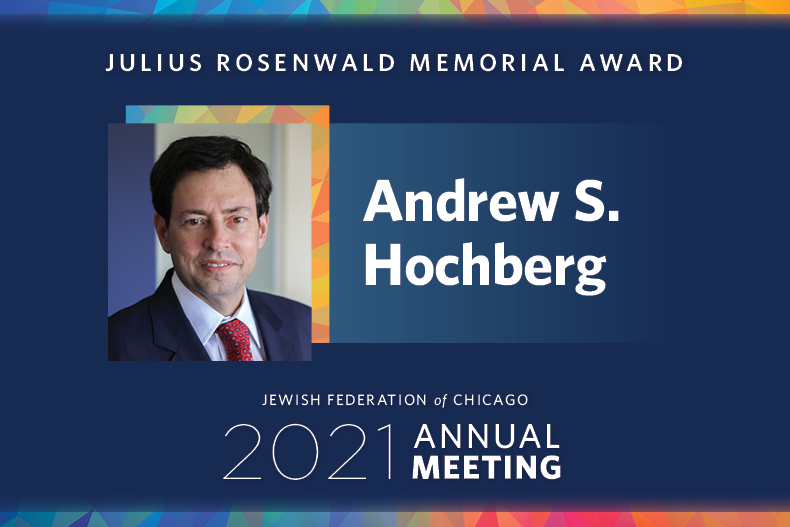
Meet Andrew S. Hochberg, 2021 Julius Rosenwald Memorial Award recipient
Celebrate Andy Hochberg at the virtual Annual Meeting on Sept. 14
Read more -
Two local teens win national recognition
Recipients of the annual Diller Teen Tikkun Olam Awards
Read more -
Celebrating six young award winners cultivating the community
Introducing young adult award winners
Read more
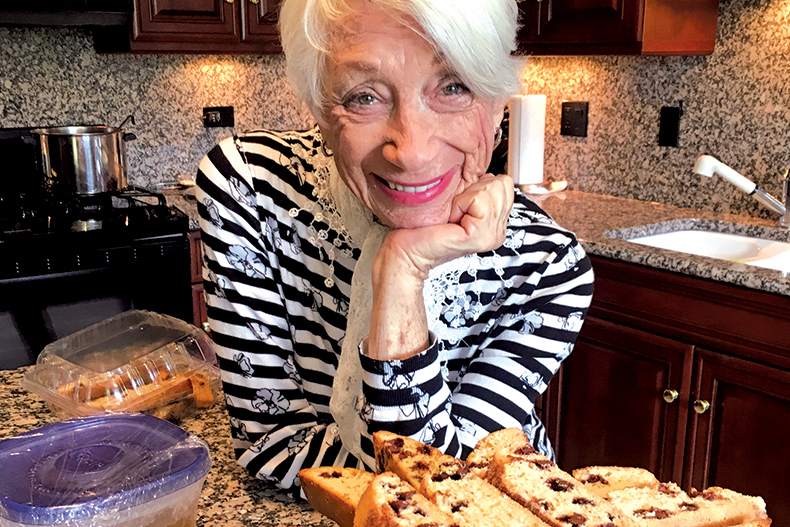
To say that Jews have a special relationship to food is, at the end of 2019, a yawn-out-loud fact, if not an overcooked cliché.
But for Chicago native Marlene Levin, 86, memories of steaming bowls of matzoh ball soup and platters of succulent brisket with a spicy kishke and sweet kugel represent more than nostalgia for the days of Bubbe’s gut-splitting, comforting, food-equals-love meals.
In Levin’s family, food was, first and foremost, a business.
Levin’s mother, Dora “Rae” Perry Endless, was among the first glatt kosher caterers to assume management of the food and beverage service at some of the city’s finer establishments-most notably, beginning in the late 1940s, at Lincoln Park’s Belden-Stratford, where her business, Endless Catering, ran all of the residential hotel’s kitchens for more than a dozen years.
An all-around excellent cook and savvy businesswoman, Dora Endless oversaw thousands of meals that, Levin said, often started with a fresh fruit cocktail and salad, moved on to a chicken Kiev main course with kishke, kugel , and tzimmes on the side, and culminated in her mother’s famous dessert tables of strudel, rugelach, teiglach , honey cake, sponge cake, and fresh fruit.
Though she was too young to work-Levin was still at Von Steuben High School, in Chicago’s Albany Park neighborhood, when Endless Catering began its relationship at the Belden-Stratford-the older Endless siblings and their father, Harry Endless, all became part of the family business.
“Two of my sisters, Anne Strouse and Norma Ripes, helped my mother, and my brother, David Endless, who went on to manage the kosher food and beverage at the Holiday Inn in Evanston and at the Jewish Covenant Club of Chicago, got his start working for my mother,” Levin recounted.
Even Harry Endless, a beloved North Side shoemaker, got into the act.
“My father was the kishke stuffer,” said Levin, a former corporate event planner who worked for a few years with her brother.
But it was clearly Levin’s mother who ran the show.
“She was born way before her times,” said Levin, of Dora. “Her intelligence was innate, as was her ability to relate to people … My mother turned American when she put her feet on the soil [of the United States].”
Dora immigrated to America with her family around 1916, when she was 11. She grew up, like so many of Chicago’s Jewish immigrant community, on the city’s West Side.
“My mother’s story was just like Fiddler on the Roof ,” said Levin, explaining how the Perry clan was kicked out of its Russian shtetl by the tsar’s armies.
Dora, the eldest of six in her family, learned to cook from her own mother, Levin’s maternal grandmother, who also was an excellent chef and baker. Pretty soon, Dora was catering parties and dinners for friends and neighbors in the Douglas Park neighborhood, where the Endless family initially settled.
“People would ask my mother, ‘How do you make that?'” Levin said. “She’d say, ‘I’ll make it for you.'”
Dora Endless’ reputation was well established by the time that Harry Katz, then a co-owner of Belden-Stratford, approached her to take over the catering at the hotel. She’d already opened and run a glatt kosher kitchen at a hotel on the city’s South Side.
Levin said that the legacy of her mother, who died in 1971 at age 76, extends well beyond her business acumen. She helped start the Douglas Park Day and Night Nursery for Jewish children orphaned during the Great Depression. Even after she had moved to the North Side, she remained committed to the organization, serving on its board in many capacities over the years, including as president, and becoming one its most tireless fundraisers.
“She was simpatico with all of the kids,” said Levin. “There were a lot of orphans in her own family.”
The other significant legacy that Dora Endless passed along was a passion for feeding others. Her daughter, Levin, the only surviving Endless sibling, continues to exemplify it.
Those invited to Levin’s condominium in Highland Park, where she lives with her husband of 65 years, Joe, 89, may be greeted with a tower of freshly baked mandelbroit and a cauldron of homemade, just-off-the-stove chicken soup.
Levin has also transmitted her love of cooking to her own daughter, Ellen Robinson, of Deerfield, and is introducing some of the Endless family traditions to her grandchildren-Ellen’s children and those of her son Neal, an Evanston attorney.
“My mother always said, ‘The difference between a great cook and a good cook is the great cook will not take any shortcuts,'” said Levin, who honors her mother’s admonitions against taking the easy way out.
Robert Nagler Miller is a journalist and editor who writes frequently about arts- and Jewish-related topics from his home in Chicago.
Other stories
-
Two local teens win national recognition
Recipients of the annual Diller Teen Tikkun Olam Awards
Read more -
Celebrating six young award winners cultivating the community
Introducing young adult award winners
Read more -