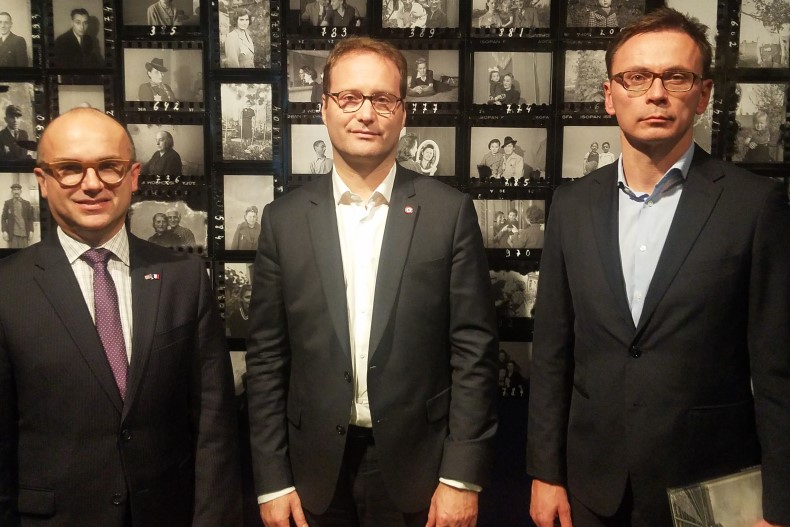
French National Assemblyman discusses defining, criminalizing antisemitism
Steve Dishler
“Dirty Zionist, you’re going to die! Go home to Israel! France is ours!”
This antisemitic tirade was directed at Alain Finkielkraut, a renowned French Jewish intellectual. His assailants were a group of protestors in the Yellow Vest (“gilets jaunes”) movement, which began as a protest on a gas tax, but quickly devolved into an anti-establishment movement. The amorphous nature of the group provided space for French far-right, far-left and extremist Muslims to come together in their shared contempt of the Jewish People.
The assault against Finkielkraut on Feb. 16 in Paris, joined an alarming number of antisemitic incidents in France, which witnessed a 74 percent increase last year. A survey from the European Union, released last December, found that a staggering 95 percent of French Jews saw anti-Semitism as either a “fairly significant” or a “very big problem” (more than any other country in the E.U.)
Confronting global antisemitism was the focus of an Oct. 23 program at the Illinois Holocaust Museum and Education Center, co-sponsored with Friends of the European Leadership Network (ELNET), a non-profit organization dedicated to strengthening relations between Europe and Israel.
The keynote speaker for the evening was Sylvain Maillard, a member of the French National Assembly and chair of the body’s 30-member Study Group on Antisemitism.
I spoke with MP Maillard before the program to discuss how the French government is responding to the assault on the Jewish community.
French Jews have suffered brutal attacks including the heinous murder of Sarah Halimi, an elderly Jewish woman who was beaten and hurled off her balcony. How would you asses the response of the government?
M: “Antisemitism is the original hate and if we accept its existence it will destroy our society. We must act on several fronts. First, we need to define antisemitism so that the police and judges have the tools to confront it. We need to address antisemitism and hate speech on social networks.”
You have called for penalizing anti-Zionism. What has been the response from your colleagues in the Assembly?
M: “My job is to protect Jews in my country. Very often anti-Zionism is antisemitic. We must fight this new antisemitism. That is why I have called on the Assembly to adopt the IHRA working definition of antisemitism.”
The International Holocaust Remembrance Alliance working definition of antisemitism states: “Antisemitism is a certain perception of Jews, which may be expressed as hatred toward Jews. Rhetorical and physical manifestations of antisemitism are directed toward Jewish or non-Jewish individuals and/or their property, toward Jewish community institutions and religious facilities.”
The definition further offers illustrations: “Manifestations might include the targeting of the state of Israel, conceived as a Jewish collectivity,” and “denying the Jewish people their right to self-determination. e.g., by claiming that the existence of a State of Israel is a racist endeavor.”
The French National Assembly debated the proposal in December. Since this interview took place, the National Assembly adopted MP Maillard’s resolution.
President Jacques Chirac, who died on Sep. 26, broke with decades of equivocations by French leaders when he publicly recognized France’s responsibility for deporting some 76,000 French and foreign Jews to Nazi death camps during the German occupation in World War II.
In his remarks at a ceremony marking the 53rd anniversary of the first mass arrests of Jews on July 16, 1995, he said: “These dark hours forever sully our history and are an insult to our past and our traditions. Yes, the criminal folly of the occupiers was seconded by the French, by the French state.”
“France, the homeland of the Enlightenment and the rights of man, a land of welcome and asylum, on that day committed the irreparable… Breaking its word, it handed those who were under its protection over to their executioners.”
What did Chirac’s declaration mean for you and how did it change the discourse in France regarding the Holocaust?
“I was 20 years old and began my official activism with Chirac. Many people’s opinion was if it happened and Jews were deported it was the Jews fault. It was an important statement to make, that it wasn’t only the Nazis, but it was the French People.”
The full document can be read at: https://www.holocaustremembrance.com/working-definition-antisemitism
Steve Dishler is Assistant Vice President, International & Public Affairs for the Jewish United Fund.
Other stories
-
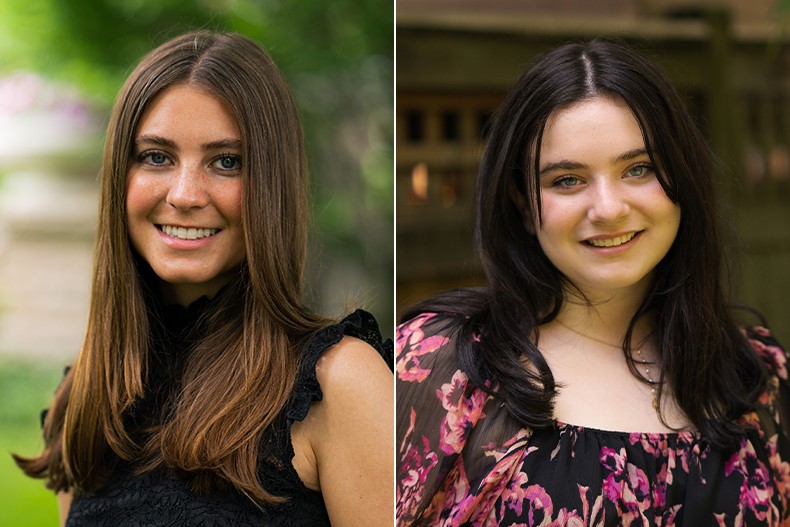
Two local teens win national recognition
Recipients of the annual Diller Teen Tikkun Olam Awards
Read more -

Celebrating six young award winners cultivating the community
Introducing young adult award winners
Read more -
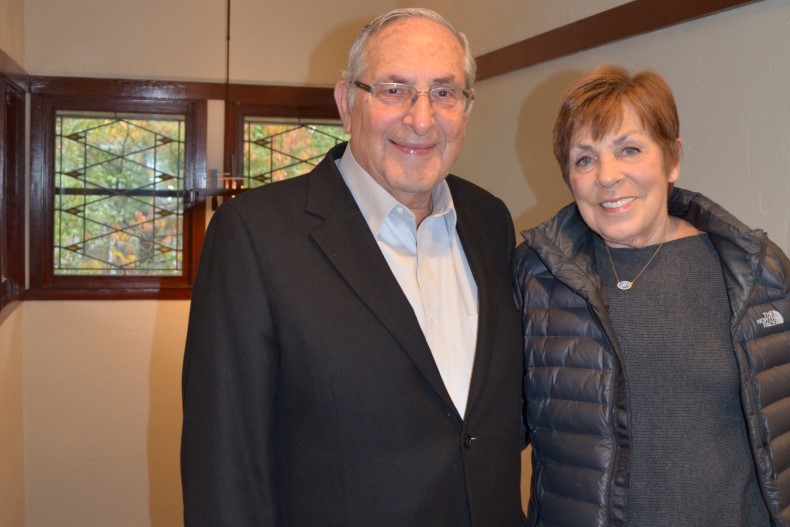
A historic Frank Lloyd Wright home has been saved from the wrecking ball by Chicagoans Gale and Rickey Rothner, who have restored the Prairie Style masterpiece and carefully renovated it to appeal to modern homebuyers.
The house, built in 1906 for rare-book dealer George Madison Millard, stands as one of Wright’s earliest Prairie style houses. Renowned for its 68 original art glass windows, it sits just a block from Lake Michigan in east Highland Park. The National Park Service added the house to the National Register of Historic Places in 1982.
However, a century after it was built, the house had fallen into disrepair-and had languished on the market so long that its owners had received conditional approval from the Highland Park Historic Preservation Commission to demolish it.
“They were at the point of tearing it down-and that’s the point at which I got involved,” Gale Rothner said. She and her husband Rickey purchased the 3,000-square foot house in 2016.
“I thought it would take six months to renovate,” she laughed. “It took three years. Everything that could go wrong did. There had been water damage, and it needed new HVAC, plumbing, electrical-you name it, we replaced it. So now the guts of the house are brand new.”
As beautiful as the home was, it also needed updates to meet the needs of a modern family-but those renovations had to remain true to the original design.
“We had to maximize every square inch of space,” Gale Rothner said. And maximize space she did, turning the cellar into a huge bonus room; converting the sewing room into a master suite; and transforming the maid’s room into a mudroom and laundry room, complete with a pet sink. She recreated the garden wall and added a large garage.
She also added storage throughout the house, copying designs for cabinets Wright had rendered but never executed, tucking built-in dressers into the bathrooms, a china cabinet in the kitchen, and a pantry in the adjoining vestibule. The original plans for the house included a buffet that was never built, “so I built one,” she said. All the built-in cabinetry is cherry.
Gale is most proud of the kitchen, in which she maximized both storage and cooking space, added state-of-the-art appliances and honed granite counters-and opened a wall into the dining room.
In the 1930s, “Wright was the first person to open up the kitchen and dining room,” said John H. Waters, Preservation Programs Manager for the Frank Lloyd Wright Building Conservancy, so it seemed fitting to retrofit the Millard house that way.
According to architect Douglas Gilbert, the biggest challenge with the Millard project was “dealing with the constraints of space. . . and incorporating a garage in a sensitive way that made it feel like it belongs to the house.”
The newly-restored Millard house both honors its unique place in history and offers modern conveniences.
“I think this idea of presenting ways to make these [Wright] houses viable is something we need to promote,” Waters said.
The Rothners are gifting the building to the Jewish Federation, which will ultimately benefit CJE SeniorLife. Gale Rothner has always been grateful for the services CJE provided her widowed grandmother, Yetta Richman, which improved her quality of life immeasurably.
“I said to myself, if I can ever do something for them, I would like to say thank-you,” Gale said.
“We were trying to do two nice things at once: save the house and give to charity,” Rickey said.
Other stories
-
Two local teens win national recognition
Recipients of the annual Diller Teen Tikkun Olam Awards
Read more -
Celebrating six young award winners cultivating the community
Introducing young adult award winners
Read more -
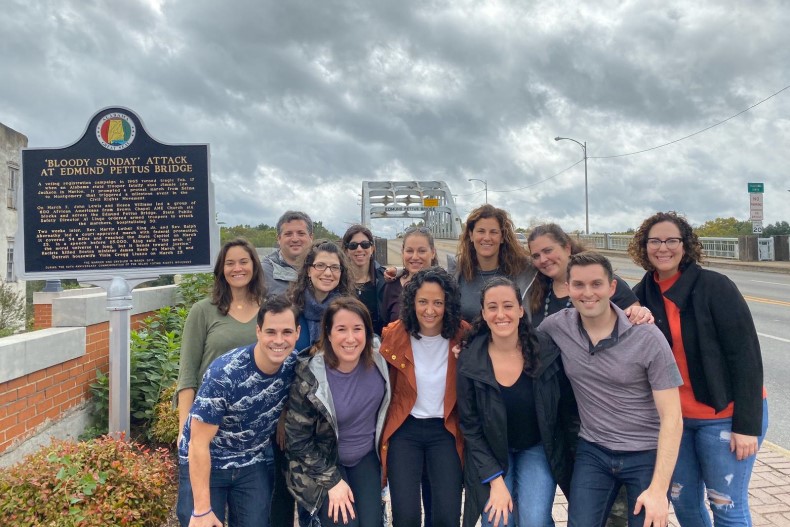
It’s an old basketball court nestled next to a playground in the George Washington Carver Homes complex off Dr. Martin Luther King Jr. Street in Selma, Ala. The blacktop is chipped, and the netting has been cut off the hoop. But to Joanne Bland, it’s sacred ground.
Bland was 11 years old when she stood among a group of voting rights activists who gathered in this spot to start a march from Selma to Montgomery. The marchers crossed the Edmund Pettus Bridge over the Alabama River and were met by white police officers, who brutally beat the activists in what became known as Bloody Sunday, March 7, 1965.
Bland now leads tours of Selma and took a group of Chicago Jewish young professionals to the basketball court as part of the experience during a JUF Civil Rights Journey.
“You are standing where heroes stood,” Bland said. “Take a rock from here, and every time you look at it, think to yourself: ‘I can make change happen.'”
For Abby Solow, mission chair, the Selma experience and meeting Bland were a highlight of the four-day trip organized by JUF’s Next Generation Initiatives in partnership with Etgar 36. In addition to Selma, the group visited Montgomery and Birmingham, Ala., and Atlanta, where they attended Sunday services at the Ebenezer Baptist Church across the street from the King Center.
Solow was inspired by Bland’s admonition to treat the possibility of change like a jigsaw puzzle. If a piece is missing, the picture is not complete — and change cannot happen without every piece in place, Bland said.
“The entire trip was an eye-opening experience,” Solow said. “When I see programs that are about some of this inequality, injustice and segregation, I’ll be more eager to continue learning and taking action.”
In Montgomery, the group visited the Equal Justice Initiative’s Legacy Museum, which traces the history of racial inequality and economic injustice in the United States. Built on the site of a former warehouse where enslaved black people were imprisoned, the museum draws a straight line from slavery through Jim Crow to segregation and mass incarceration.
In 2018, EJI unveiled the National Memorial for Peace & Justice, which honors the memories of Black lynching victims, and identifies every county in the United States where a lynching took place. More than 800 steel blocks engraved with names and dates hang in rows. The walls are a stark reminder of the perpetrators’ inhumanity on plaques that list the purported reasons for the racial terror, such as “refused to run an errand for a white woman” or “reprimanded white children who threw rocks at her.”
“The Museum showcases the continued injustice in our country and the need for action,” Solow said. “The Memorial was quite something. I loved the idea that each county where a lynching happened can have a matching block and begin to acknowledge that history.”
The goal of the trip was to connect civil rights history with current issues in Chicago and in the broader United States. From the rise in hate crimes to continued disinvestment in south and west side neighborhoods, Chicago remains fertile ground for action.
“We walked away not only learning a lot more about this terrifying part of our history, but also inspired to push ourselves to become active allies in the continued fight for civil rights and liberties in our country,” said Doug Winklestein, who participated in the experience with his fiancé Michael Oxman. “Living in Chicago, there is not only a strong need to get involved, but there are also so many opportunities to do so. Knowing that JUF can be our connector to doing our part makes us feel even further invested to all of the great work that we can do together as a community.”
To learn more about similar opportunities in the future, contact Sally Preminger Kudert, JUF Assistant Vice President — Next Gen Initiatives: [email protected] or 312-357-4689.
Jane Charney is the Director of Domestic Affairs at JUF’s Jewish Community Relations Council.
Other stories
-
Two local teens win national recognition
Recipients of the annual Diller Teen Tikkun Olam Awards
Read more -
Celebrating six young award winners cultivating the community
Introducing young adult award winners
Read more -
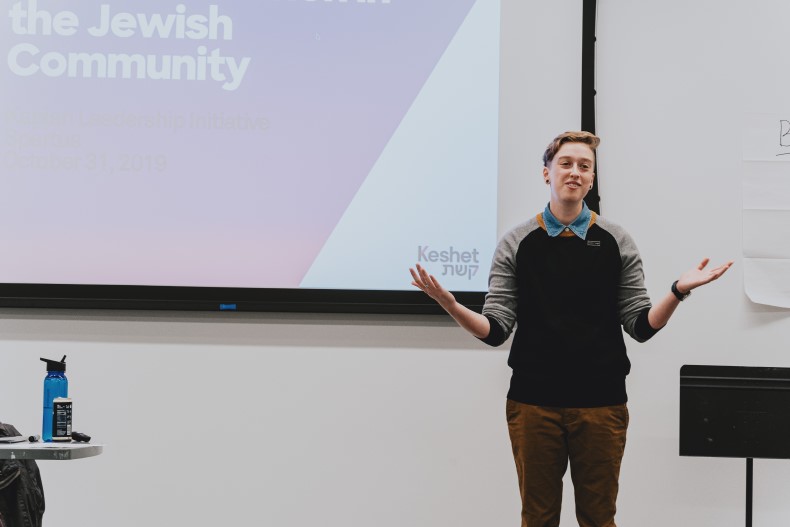
Over the past year Keshet, the nation’s largest organization working for LGBTQ equality in all facets of Jewish life, has launched new teen leadership programs, mobilized a Jewish community campaign to protect the rights of transgender Americans, and offered training to Jewish leaders on how to make their institutions more inclusive.
In Chicago, Keshet recently added a full-time staff member dedicated to advancing LGBTQ equality in the Chicago Jewish community. Essie Shachar-Hill is Keshet’s first full-time Education and Training Manager in Chicago.
“People have this idea that Chicago is such a liberal place, and there aren’t any issues of people not feeling included. Many well-meaning institutions think that saying ‘everyone is welcome here’ is enough. It’s not! I’m excited for Jewish Chicago to continue to do the internal work of meeting the needs of LGBTQ folks, and then explicitly sharing that message,” Shachar-Hill said.
Shachar-Hill helped launch the Chicagoland Keshet Leadership Project, with 22 local organizations participating in the inaugural cohort. The year-long program equips participating organizations to critically examine their policies, programming, and culture and to take tangible steps to becoming more LGBTQ-inclusive in these areas.
To find out more or apply to participate in the next cohort, starting December 2019, visit keshetonline.org/our-work/professional-development-and-community-learning/keshet-leadership-project .
Other stories
-
Two local teens win national recognition
Recipients of the annual Diller Teen Tikkun Olam Awards
Read more -
Celebrating six young award winners cultivating the community
Introducing young adult award winners
Read more -
Seven years ago, when Chicago resident Jeffrey Kane decided to take a simpler approach to life, he began driving for various transportation companies and wondered why there was no alternative for the Jewish community. This was the inspiration for KaLaJu, named for his motto of “whenever you need a ride, it doesn’t matter where to, don’t call just anyone, call a Jew — KaLaJu!”
He began contracting with schools, transporting children to bar and bat mitzvahs, driving to the airport, and taking seniors in the suburbs downtown. “Some seniors aren’t comfortable using an Uber or Lyft app and this is just calling or texting our number which is easier for them…families feel better knowing that their loved ones are with us instead of a random driver,” said Becky Adelberg, founder of Community Connect Consulting, who has been working with KaLaJu on marketing and community outreach.
The business grew to recently include a delivery service from Romanian Kosher Sausage Co. to help people in Chicago and beyond get delicious kosher meat. “KaLaJu was created as a safe, reliable transportation service for the Jewish community, which in today’s times is especially important,” Adelberg said. “I love working with a company that has a give back component. Where else can you find a transportation company that gives $1 of each ride to cancer research?”
As business continued to grow, Jeffrey learned he was fighting cancer once again. His oldest son relocated to Chicago and began driving for the company. Jeffrey passed away last December after fighting cancer for 22 years. His son, David Kane said, “Once my father passed, I felt that it was important to continue the tradition and legacy my father built of helping the Jewish community.”
The company was rebranded into a new entity, KaLaJu Trans, LLC, bolstered by support from community members sharing “wonderful stories” of his father. Although the company’s legal ownership has changed, the mission remains the same: “To give back to the community.” The company is currently looking at creating a 501c3 component.
To that point, KaLaJu partners with different cancer organizations and for every ride, KaLaJu donates $1 to the organization. Some of these charities include Imerman Angels, the Leukemia Research Foundation and Sharsheret. KaLaJu also offers free rides for cancer patients, which eases their financial burden and offers “convenience and comfort” they may not find elsewhere. “Especially in chemo time and treatments, it’s so uncomfortable and painful that to be able to create any level of comfort is a gift, so to be able to offer a high-end premium driver is” a wonderful support, Kane said.
“My goal is to continue on the great legacy my father built of giving back to the community and helping those in need. I feel honored to be able to provide a small part of contributing to making the world a better place,” Kane continued. “I hope my father is in the shamayim (heavens) smiling down on what he’s seen in the last year since he’s passed.”
For more information, visit kalajutrans.com or text or call 847.922.9823 or email [email protected].
Other stories
-
Two local teens win national recognition
Recipients of the annual Diller Teen Tikkun Olam Awards
Read more -
Celebrating six young award winners cultivating the community
Introducing young adult award winners
Read more -
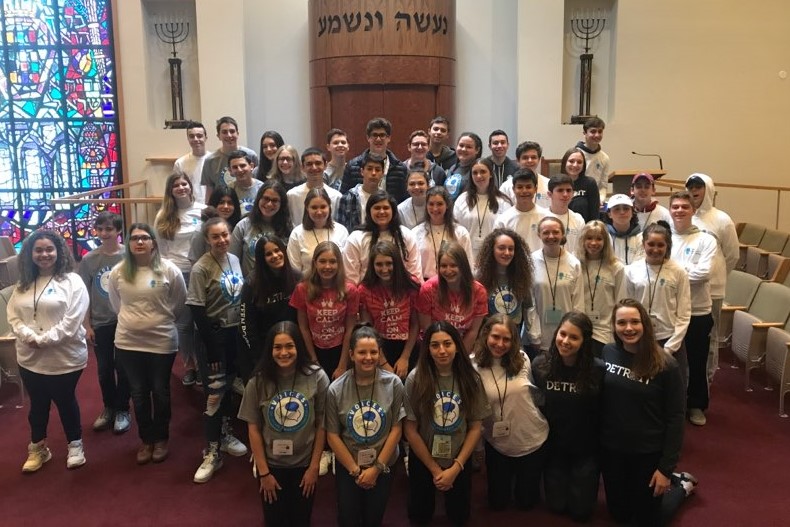
Sixty teens from four major Midwestern cities came together in Chicago for a weekend of learning, teaching, and philanthropy this November as part of the first-ever gathering of Midwest teen philanthropy boards called Tikkun Together .
Board members from JUF’s Voices: The Chicago Jewish Teen Foundation joined their peers at Congregation Rodfei Tzedek in Hyde Park to explore the intersections of Jewish values and philanthropy, plan their own philanthropic journeys, and prepare for the allocation process at the end of their time in Voices.
As members of the 16th cohort of Voices, this year’s teens are in the middle of a year-long program in which they learn the ins and outs of professional philanthropy and grant-making through a Jewish lens and allocate money to the causes they care about most. Run exclusively by teens, the program begins with a grant of $25,000 and the teens then raise additional funds. Over the last 15 years, teens in Voices have allocated over $640,000.
During the conference, Voices participants interacted with peers from other cities, learning what worked best for them in terms of fundraising, programming, and more. The idea for a regional conference to share these successes came from Hallie Shapiro, JUF Senior Associate Vice President of Family & Teen engagement. “After 16 years, it’s exciting to still be bringing new and meaningful experiences to the Voices program,” she said. “It was so inspiring to see our participants interact with Jewish teens from other communities, learning together and sharing their similarities and differences.”
In addition to networking, Voices participants attended Shabbat services with Rodfei Tzedek congregants, led a panel to educate the congregation about teen philanthropy, engaged in activities about Jewish identity and philanthropy, and heard from local philanthropists Dana Hirt and Elizabeth Kramer about their philanthropic journeys.
” Tikkun Together was a great way to broaden my perspective on Jewish lifestyles and practices. It was also a great opportunity to learn more about philanthropy and how decisions you make can affect people in many ways,” said Voices participant Joseph Friedman, a first-year student at Jones College Prep.
The weekend also included a focus on building skills related to philanthropy, such as consensus building and budgeting, that will be useful when making final allocation decisions.
“Being part of Tikkun Together was such a unique experience, not only because it was the first Jewish teen philanthropy regional event of its kind, but also because of the immense dedication, enthusiasm and ruach (spirit) of each and every teen participant,” said Danielle Segal, Senior Program Manager at the Jewish Teen Funders Network (JTFN). “Through this collaborative opportunity, the teens understood the diversity of the Jewish giving experiences across multiple communities.”
At the end of the day, Segal concluded, “all four host organizations (two of which are part of JTFN’s Foundation Board Incubator, generously funded by Laura Lauder and the Maimonides Fund) were shining examples of how meaningful a Jewish teen philanthropy program can be on their participating teens.”
Other stories
-
Two local teens win national recognition
Recipients of the annual Diller Teen Tikkun Olam Awards
Read more -
Celebrating six young award winners cultivating the community
Introducing young adult award winners
Read more -
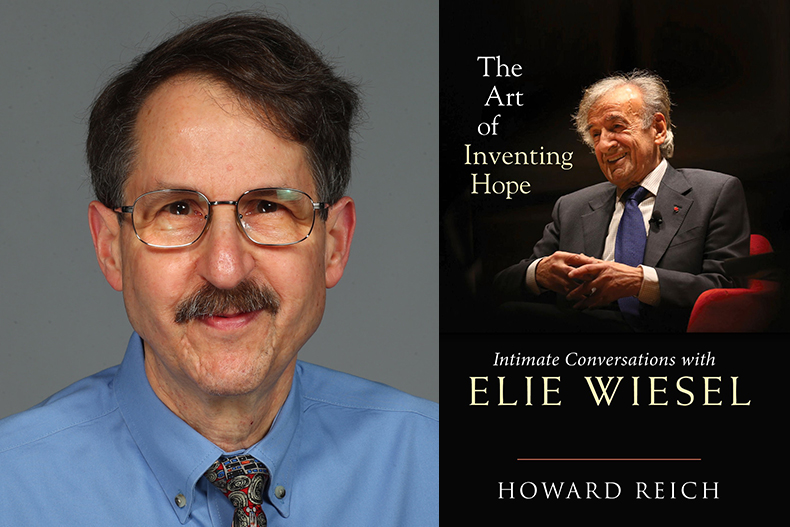
In 2001, Howard Reich’s mother, then 69, ran out of her Skokie house insisting someone was trying to kill her. There was no intruder-the culprit was late-onset PTSD. She was reliving childhood memories from the Holocaust.
That experience prompted Reich, an award-winning journalist, to investigate his mother’s story. His reporting became a Chicago Tribune feature, an acclaimed book, and an internationally distributed film.
Later, on assignment, Reich met survivor and Nobel Peace Prize Laureate Elie Wiesel. An incredible friendship emerged. In his new book, The Art of Inventing Hope, Reich shares his conversations with Wiesel about life, family, and the importance of telling our stories.
“My previous book was about what happened to my parents,” said Reich, whose father was also a survivor. “This book is about trying to understand.”
Below, Reich shares behind-the-scenes insight in advance of his Jewish Book Month talk at Spertus Institute on Dec. 15.
Let’s start with the obvious question: What was it like to meet Elie Wiesel?
I was awestruck. I had no idea what to expect. In all my years as a journalist, I had never had an interview experience like the one I was about to have.
We became friends after about four minutes. I think part of it was timing; it was the right time, for him and for me. He was in his 80s, a time when people look back and reflect. I was looking for answers to the questions I couldn’t ask my parents.
Sometimes I still can’t believe it. Our connection was a profound privilege.
Before your mother’s health issues, you describe being almost “allergic” to engaging with Holocaust issues. What advice would you give to children and grandchildren of survivors who share that hesitation?
I spent the first four decades of my life trying to avoid the Holocaust. The situation with my mother forced me to confront it. And it was terrifying.
I had nightmares before I went to Eastern Europe to find out my mom’s story. I had red splotches all over my body from stress when I wrote the story-that’s how visceral the experience was. But afterward, I knew. There’s something powerful about that.
Once I got the story out, my head was in a different place. Now, a subject that I wouldn’t even whisper about, is something I go around the world talking about. This whole experience has transformed my life.
What does it mean to talk about the Holocaust today, as survivors are dwindling? How do we tell the story in a way that matters?
Wiesel called himself an active pessimist-which means you don’t give up. Our job is to speak about these subjects of concern to us. If people aren’t listening, you talk more. If you don’t protest, who will?
There’s no place I visit where someone doesn’t share an anecdote about the time they heard Elie Wiesel speak. He was out there talking to people around the world. And the focus was often students. What we do by speaking is teach. When I can speak to classes… that is one of the most precious audiences. That is where we make the biggest impact. Speak to students so they won’t just have read a book, but will have heard a speaker. That’s what they’ll remember.
I love the part of the book where you and Wiesel discuss the title principle: the art of inventing hope. Can you share more about that?
This is not a book about the Holocaust-it’s a book about finding hope where there isn’t, whether that’s the Holocaust, the pain of losing a child, or the suffering that comes from an illness. Wiesel felt that it is our duty as Jews to seek hope no matter what.
People have said they feel peaceful after reading Wiesel’s words in this book. There is a measure of peace you get from hearing this great, brilliant man sharing what he learned through such a hard-fought life. It transcends far beyond the Holocaust-he’s speaking to us about how we live.
Wiesel was a humanist. He had great love for humanity in spite of what [was] done to him and to the Jewish people. If he could hold on to hope after all he had been through…we can, too.
Hear Howard Reich at Spertus Institute for Jewish Learning and Leadership, December 15 at 2 pm. He will be interviewed on stage by Alison Pure-Slovin, Midwest Director of the Simon Wiesenthal Center. A book signing will follow the program. Tickets $8 for students and $18 for the public. Purchase tickets at spertus.edu.
Spertus is a partner with JUF in serving our community.
Jessica Leving is Communications and Community Relations Manager for Spertus Institute for Jewish Learning and Leadership.
Other stories
-
Two local teens win national recognition
Recipients of the annual Diller Teen Tikkun Olam Awards
Read more -
Celebrating six young award winners cultivating the community
Introducing young adult award winners
Read more -
“Mifgash” is Hebrew for “encounter.” And that’s just what Israeli students were doing in Chicago this fall- encountering Chicago and American culture.
The Mifgash program at Niles North High School in Skokie is the only public school in the country that currently offers an Israeli-U.S. exchange program, now in its fourth year. Back in March, Niles North Hebrew-language students visited Israel.
Then, in October, 15 of their Israeli counterparts visited Chicago. The students traveled from ORT Kramim high school in the town of Karmiel, Israel, near Tel Aviv. They were hosted by the Hebrew-language students at Niles North and members of its Israel Club, co-run by the National Council of Synagogue Youth (NCSY).
The schools are thousands of miles apart, yet share a connection. The Niles Hebrew program is taught by Anna Raiber, while Raiber’s mother, Mila Perlroizen, teaches at Kramim in Israel.
The Chicago visit aimed to show the Israeli students the scope of American Jewish teenage life-home, school, and things teens do for fun around here.
Their first evening in Chicago, the Israeli students helped build a succah in the school’s courtyard. During their visit, they toured the school and attended a full days’ classes, including some of the school’s special offerings, including music, cooking, engineering, debate, and broadcasting. They also attended a pep rally, a football game, and homecoming.
Outside of school, they enjoyed Chicago’s famous amusements and landmarks, from Six Flags to the Skydeck. They also visited JUF headquarters and Hillel at Northwestern University.
“It’s really cool, hosting Yael,” said Niles student Rachel Phillips. Phillips, who stayed at her home in Israel during Niles’ visit in March, has studied Hebrew since grade school at Arie Crown Hebrew Day School.
The Israelis agreed. “I wanted to see how Jewish people around the world live,” said Israeli student Sofia Glytman, as to why she applied for the mifgash . She noted that the American school was much larger than her own and had many more elective and extracurricular options.
He favorite part of her Chicago visit was pumpkin picking. “America is a beautiful country, with such a variety of people,” Glytman said.
Todd Bowen oversees the Niles high school system’s world languages program. While its Hebrew/Israel exchange is the only one of its kind in the U.S., it grew out of similar exchanges done by the schools’ Spanish-, German-, and Chinese-language classes.
Some American students have visited their newfound Israeli friends on their own, during family trips to Israel. “They develop long-term relationships,” said Bowen. “We really want the students to understand the cultural implications of travel.”
Raiber, Niles North’s Hebrew teacher, grew up in Karmiel. She hopes the excitement of the mifgash program inspires more students to take Hebrew. The students’ lives are changed, she said, not just by visiting another country, but by hosting foreign students at their own homes. “They go beyond the classroom, and really use their Hebrew,” she said.
As for the cost, she noted that many students used money from JUF’s Send-a-Kid-to-Israel Program (SKIP) or Gift of Israel programs. “There was no one who was not able to participate due to lack of funds,” she said.
“If I can change my students’ perceptions of Israel,” Raiber smiles, “then I did my job.”
Other stories
-
Two local teens win national recognition
Recipients of the annual Diller Teen Tikkun Olam Awards
Read more -
Celebrating six young award winners cultivating the community
Introducing young adult award winners
Read more -

Israel is well known for many things: our shawarma and falafel were famous decades before Adam Sandler’s movie, Zohan , made hummus an American household staple; our booming high-tech industry continues to bring innovation and technology to the world, improving the lives of hundreds of millions worldwide; our athletes are reaping medals in judo, sailing, and gymnastics (not exactly your typical Jewish sports); and our apps allow billions to communicate while arriving safely to their destination.
But Israel is also a leader in migration, and not only of the human variety. In 2018, we welcomed record numbers of foreign investment ($22 billion) and tourists (over 4 million). We warmly welcome both even if most of the tourists seemed to flock to my favorite falafel stand making it impossible for me to grab my daily pita. But another kind of visitor arrived in even greater numbers: half a billion birds pass (visa-free) through our skies not once, but twice a year.
Israel is strategically located on the intersection of three continents: Europe, Asia, and Africa. Our unique position has made our land desirable for dozens of conquering empires over the past four millennia, all desirous of controlling the only land passage linking these important trade routes-and migration roads-which connected the known globe until the discovery of the Americas. No wonder we were conquered by the ancient Egyptians, the Assyrians, the Babylonians, the Sumerians, the Mongols, the Mamelukes, the Greeks, the Macedonians, the Romans, the Crusaders, the Muslims, the Turks, the British, and just about every other military power that wielded a sword.
Today, we are flush both with foreign capital and tourists looking not only for the Wailing Wall but also for Moshiko’s falafel, the Jerusalem market’s Marzipan bakery, and the hotspots of Tel Aviv nightlife. With the number of incoming tourists roughly half the size of our population, we host proportionately twice as many tourists as the United States. As varied as the dozens of species of birds coming through our skies, they enjoy the openness and freedom that Israel provides its guests (along with a sometimes-overcharged cab ride).
But the birds who visit us enjoy a different kind of freedom: they see no borders, no international tension, no animosity among human beings. They soar to the skies, fly over Lebanon and Syria, and come to land at Israel’s Hula Valley in the Upper Galilee as they flee the European autumn on their way south, towards the warmth of Africa. Israel’s autumn skies are awash with 500 million eagles, cranes, storks, owls, pelicans, flamingoes, buzzards, and dozens of bird species whose names I never heard. Frankly it sounds to me like they were invented by an overly imaginative child with a dictionary and a box of watercolors. The “Blue-Spotted Fritzenhammer Proust” and the “Red-Bellied White-Tailed Huffalump,” are names I just made up, but you get the idea.
Recently, my family and I visited the Hula Valley, betraying my childhood solemn pledge to never engage in anything as “mundane” as watching birds. Yet there I was, armed with binoculars no less. And we enjoyed it! There were thousands of birds swooping in at sundown, coming to rest for the night at the reconstituted Hula Swamp, their resting place on their long intercontinental journey. Along with birdwatchers from all over the world, we saw flocks of unfathomable numbers converge on a small field. Forty-five thousand cranes had arrived the previous day and everywhere you looked, thousands of them were flapping their wings and screaming. The noise was deafening; the sight marvelous. There they were, standing in the shallow waters next to flamingoes and to a dozen other species which I will never be able to tell apart but apparently mean a lot to real birdwatchers.
In the next few weeks, still millions more will flock to the Hula Valley, their required rest stop in Israel where they are not only protected-they are actually fed by Israeli Park Rangers. They will spend the winter months in Africa, some flying as far south as the southern tip of the continent, only to return to us in the spring as they make their way back to Europe. With the help of high-tech monitoring devices attached unobtrusively to their legs, we can trace their origin and their paths, and conduct research on their migration and habits for their and humanity’s benefit. They will make more noise than the average tourist. But they will take fewer selfies and visit fewer of our holy sites. All told, they are very welcome guests and a tourist attraction of a unique kind-even if I can’t remember their names and have broken a solemn childhood oath.
Ofer Bavly is the director general of the JUF Israel Office.
Other stories
-

Mother’s Day, Father’s Day, and the Jewish way
Let us pause and consider what it means for us to truly honor our parents
Read more -
Each time we study Torah, we experience the revelation
The mystical tradition of Judaism that lifts up the number 600,000 from the Exodus
Read more -
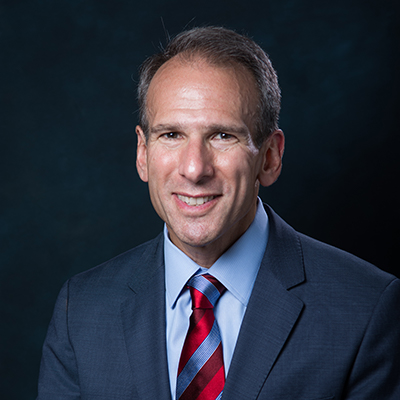
How do you explain the Jewish People to diplomats representing countries from around the world? That is what JUF’s Jewish Community Relations Council set out to do Thursday, Oct. 24.
Bulgaria, Czech Republic, France, Germany, Lithuania, Switzerland and Taipei all sent representatives to the tour, which was also attended by JCRC Vice Chairs Joyce Rabinowitz and Jason Secore.
“Our goal was to help them understand the Jewish People as we understand ourselves,” said Steven Dishler, JUF’s Assistant VP for Global Affairs.
The tour began with a visit to Mount Sinai Hospital, a century-old hospital in North Lawndale, and a JUF beneficiary agency. The diplomats heard from Sinai’s dedicated medical professionals about the crucial services delivered to some of the most underserved neighborhoods of Chicago and they toured the hospital’s Emergency Department, one of the busiest in Chicago.
“As Jews, we have a responsibility to care for those less fortunate, to help new immigrants, since we were once immigrants, to help improve the world,” explained Scott Aaron, Associate VP, JUF Education.
The group then visited Ida Crown Jewish Academy in Skokie, where they learned from Rabbi Leonard Matanky, Dean of the Orthodox Jewish high school, and from Rabbi Yehiel Poupko, JUF’s Rabbinic Scholar, how to understand the Jewish People, Chicago’s Orthodox community, and our relationship with Israel.
The next stop was at Bernard Zell Anshe Emet Day School in Lake View, where the diplomats learned from Gary Weisserman, Head of School, and history teacher Dr. Jeff Ellison, about the school’s approach to pluralistic Jewish education and how they use a cross-disciplinary approach to teaching the Holocaust.
The mission ended with a visit to Anshe Emet Synagogue’s century-old sanctuary, where the diplomats learned from Rabbi Michael Siegel about the evolution of American Judaism, and from Rabbi Poupko about the Jewish community’s focus on interfaith work.
“To have productive relationships, there needs to be a level of mutual understanding,” remarked JCRC Vice Chair Jason Secore. “These foreign diplomats now have a greater understanding of the Jewish People and our community’s priorities, which will benefit our dialogue with them in the future.”
Other stories
-
Two local teens win national recognition
Recipients of the annual Diller Teen Tikkun Olam Awards
Read more -
Celebrating six young award winners cultivating the community
Introducing young adult award winners
Read more -