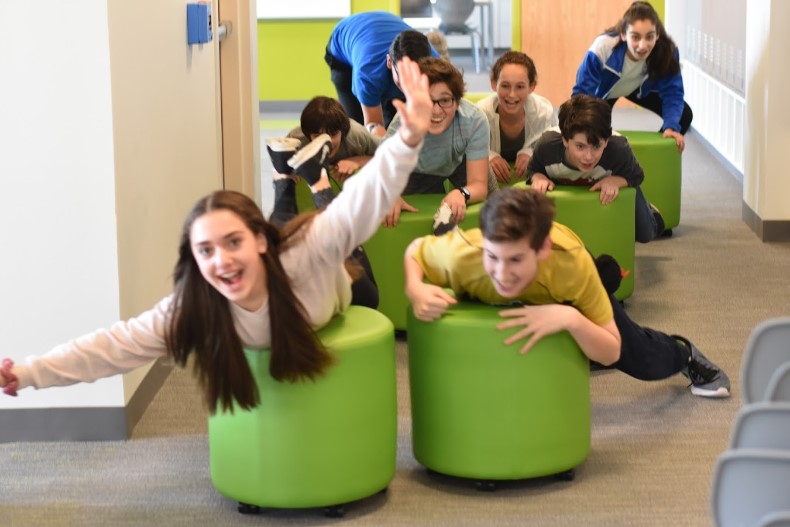
Chicago Jewish Day School has made its long-anticipated move to a new campus in Chicago’s Irving Park neighborhood, a permanent home that includes state-of-the-art classrooms, central worship and learning spaces, and extensive athletic and recreational facilities designed to enhance the school’s commitment to academic excellence.
The multi-denominational, progressive Jewish day school’s new campus spans 2.6 acres of buildings and playlots, encompassing most of the city block on California between Waveland and Grace. It boasts high-tech gear in every classroom and spaces big enough for the whole school to come together to pray and play.
“The new campus is a combination of old and new, as we repurposed an existing property, but added all the bells and whistles one would want in a school setting,” said Anat Geva, president of the CJDS Board of Directors. “We are thrilled to now be able to house this rich school experience in a state-of-the-art facility that enhances the education of our students, producing empowered and engaged citizens.
“We would not be where we are today, were it not for the vision of the school’s founders, the dedication of our faculty, staff, parents, and loyal community supporters,” Geva said. “We are also forever grateful to JUF and lead gifts from the Crown-Goodman family, Betsy Gidwitz, and two anonymous donors.”
A constellation of new buildings is nestled between a ball field and a future playground-which will have a permanent gaga pit. The new facilities feature a library and media center, gym, and beit midrash , which serves as a central gathering space for services and other school-wide activities. Phase Two of the project will feature science and art labs and a food court-style cafeteria.
One of the guiding principles in designing the building was that “the classroom is like another teacher,” said Cortney Stark Cope, director of Admissions.
Collaboration is a major value for students, baked into the very design. School desks, work tables, and chairs are on wheels. Each floor has open spaces with abstract, modular tables and chairs. The front foyer, called the “mercaz”(Hebrew for “center”), is designed to spark ideas and friendships. Walls are covered in corkboards and dry-erase material to help students personalize their space, and students made their own mezuzot , which will be affixed on doorways throughout the campus.
The school has been multi-denominational since its inception; Orthodox, Conservative, and Reform rabbis were all consulted as it developed its curriculum. The secular and religious coursework is “integrated,” meaning that while the history unit focuses on, for example, the Thanksgiving story, the Jewish unit discusses the Torah’s teachings about how Jews are often “strangers in a strange land.”
CJDS opened its doors in 2003 with seven students, and now has more than 220 students enrolled.
The school made the move to the new campus with assistance from the Jewish United Fund/Jewish Federation of Metropolitan Chicago, which provided loan guarantees and helped CJDS negotiate for critical financing to purchase and redevelop the property. JFMC Facilities Corp provided guidance and supervision to the school during construction, including expert consultation on security issues.
The lead gifts were made through the JUF/Federation’s Centennial Campaign, and CJDS is also supported by JUF’s Day School Guaranty Trust Fund.
Former CJDS president Adam Levine serves as New Campus Project Chair, and CJDS Founding President, Wendy Platt Newberger, serves as its Capital Campaign Chair.
“Moving to our incredible new space will not only give us a place to call home, but the campus will enhance the excellent education that we already provide on a daily basis,” said Judy Finkelstein-Taff, CJDS’s Head of School. “We are excited to enter this new chapter and can’t wait to share our new campus with the Chicago Jewish community.”
Check out this video on the first day of school at the new campus .
Other stories
-
Two local teens win national recognition
Recipients of the annual Diller Teen Tikkun Olam Awards
Read more -
Celebrating six young award winners cultivating the community
Introducing young adult award winners
Read more -
Growing up in a household of olim (immigrants) from Ethiopia, Natan Sharansky’s values of Zionism and activism were present throughout my life. I grew up constantly listening to stories about Natan — about his fights for equality, Zionism, his aliyah struggles, and much more that connected my family to his story.
As Natan prepares to receive the Israel Prize — the state’s highest cultural honor — on Israeli Independence Day on April 19, I am proud and honored to share my personal connection to Natan through my family, my work, and my own encounters with him.
My family came to Israel as a part of Operation Moses in 1984. The struggle of being an immigrant in Israel is complex, and my family — especially my parents — decided to take active steps to make Israel a better place for my siblings and I. When I was younger, I recall my father’s conversations about Natan, and the connection he felt to him due to the common ground of being a Jewish immigrant to Israel. Natan’s activism inspired my father to take action and he became more involved in the local struggle towards equality and creating a better society. Today, I feel as if my family’s legacy, which was inspired by Natan, is to stand up for what I believe in and move towards a better Israel for everyone, no matter where you come from.
Today, I serve as a Jewish Agency Israel Fellow to Northwestern University Hillel, as part of a special shlichut (emissary work) initiative that was nurtured by Natan. The Israel Fellows program has expanded to 77 Fellows serving 150 campuses around the world. In 2016-17 alone, the Fellows had one-on-one interactions with 17,000 Jewish students and attracted more than 37,000 students to Israel-education events. The Israel Fellows are the face of shlichut on campus, in a crucial component of The Jewish Agency’s network of more than 2,000 Israelis emissaries worldwide.
I started my shlichut almost three years ago, arriving at an interesting time on campus — a few months after a BDS resolution had passed for the first time in Northwestern’s student government. Since then, the pro-Israel community on campus evolved and now is thriving with five different Israel-related groups, three Israel interns, an Israel education strategic plan for each quarter of the year, different immersive Israel experience programs such as Birthright Israel, NU Perspectives trip, I-Engage Seminar, Onward Israel, and Masa Israel Journey, as well as a visible growth in Israel engagement numbers.
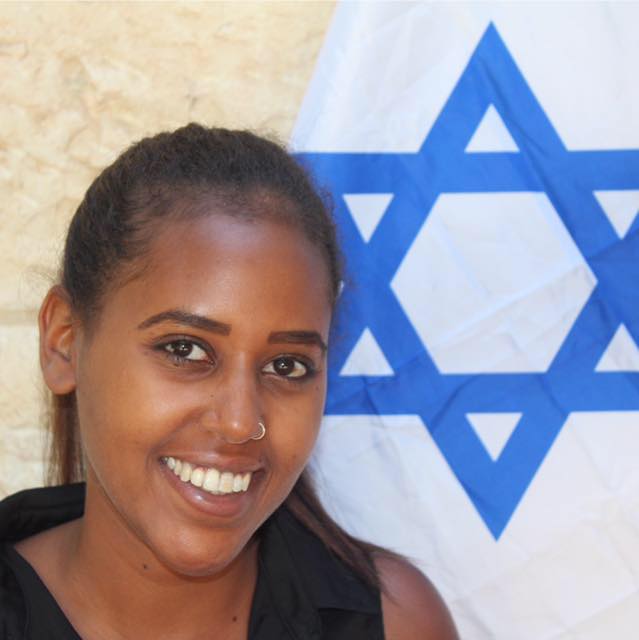
As the Jewish Agency Israel Fellow, I work every day to encourage students to find their own Israel connection. I do that through creating different programs with students so that the Northwestern community can learn about different aspects of Israel. Another aspect of my work is the personal relationships that I’m forming with the students, through one-on-one conversations and interactions about Israel and their personal connection to it. Through these conversations, I am empowering students to explore Israel and find their own connection with the Jewish State, and at the same time I’m evolving and learning from my colleagues and students. During my shlichut , I have found a community that enables me to share my connection with Israel, and to show that community why it is truly OUR Israel. I’m thankful for that.
One moment I’m grateful for was having the honor to attend a March 7 event in New York City that celebrated Natan’s nine years as The Jewish Agency’s Chairman of the Executive. I was so inspired by the people who were in the room honoring Natan — Israeli Prime Minister Benjamin Netanyahu, various Members of Knesset, former U.S. President George W. Bush, CEO of The Jewish Agency Alan Hoffmann, and other Jewish Agency leaders. It was clear that everyone truly admires and looks up to Natan and appreciates his work and contribution to the Jewish people in Israel and around the world. Even though Natan is a well-known leader, I still feel like I can go up to him and say “hello,” and that he will care about what I have to say. It’s humbling, impressive, and unimaginable how relatable and down to earth he is.
Being an emissary, especially in North America during this time on campus, is not an easy job. But with all the challenges mentioned above and the complexity, it is definitely the most meaningful position I could have asked for. Knowing that I’m making a difference with the Jewish people every day, connecting Israel to the Diaspora, and doing it all under the leadership of Natan makes the work particularly fulfilling. The leader that Natan is for the Jewish people, the person that he is, his actions throughout the years in Israel and outside of it, and his strong sense of Zionism all make him well-deserving of the Israel Prize. I’m proud to say that I was privileged to grow up inspired by his values and am now working under his leadership.
Simcha Masala is the Jewish Agency Israel Fellow at Northwestern University Hillel.
Other stories
-
Two local teens win national recognition
Recipients of the annual Diller Teen Tikkun Olam Awards
Read more -
Celebrating six young award winners cultivating the community
Introducing young adult award winners
Read more -
The Chicago area’s 73rd annual collective Holocaust memorial observance will be held at 1:30 p.m. Sunday, April 15, at Skokie Valley Agudath Jacob Synagogue, 8825 East Prairie Road, in Skokie.
The service, sponsored by Sheerit Hapleitah of Metropolitan Chicago, the umbrella organization for local Holocaust survivor groups, traditionally is the largest gathering of Holocaust survivors in the Midwest and one of the largest in the United States. The Jewish United Fund cosponsors the event.
A high point of the service each year is the candle lighting ceremony honoring the six million martyrs, including one and a half million innocent children, who were murdered only because they were Jews. Each candle is lit by survivors or their children and grandchildren, who represent the failure of the Nazis’ ultimate goal.
“73 years after the liberation of the concentration camps, we once again face a world of hatred and injustice against the Jewish people,” said Henry Jelen, president of Sheerit Hapleitah.
“We cannot let the world forget that a modern society, Nazi Germany, was capable of committing such atrocities. Today, many reactionary forces are hard at work to change history and deny that the Holocaust ever happened. We must be vigilant not to allow this to occur.
This year, the memorial service-which has been held annually since the camps were liberated in 1945-will be keynoted by Dr. Rabbi Julian Ungar-Sargon, a major in the Indiana Guard Reserve, author of several medical books, religious lecturer, and the son of a survivor.
Other scheduled speakers include Illinois Lt. Gov. Evelyn Sanguinetti; Israel’s Consul General to the Midwest, Aviv Ezra; Skokie Mayor George Van Dusen; JUF Jewish Community Relations Council Chair Bill Silverstein; and Jelen. Cantor Pavel Roytman will direct the musical ensemble.
As part of the ceremony, a grandchild of survivors will pay tribute to the enormous contribution Holocaust survivors have made to the Chicago community in passing their legacy of courage to future generations
Other stories
-
Two local teens win national recognition
Recipients of the annual Diller Teen Tikkun Olam Awards
Read more -
Celebrating six young award winners cultivating the community
Introducing young adult award winners
Read more -
Jewish Women’s Foundation invites women to ‘Frame the Future’ at pop-up giving circle event May 3
JESSICA LEVING
Are you a fan of the hit TV show Shark Tank ? Want to participate in a philanthropic version right here in Chicago, and select the innovative local Jewish nonprofit that will receive an impactful grant?
The Jewish Women’s Foundation of Metropolitan Chicago (JWF) invites Jewish women for a special “pop-up” giving circle event on May 3-a pitch night featuring live presentations about a select group of nonprofit grant proposals, with the opportunity to vote which one will receive funding. The one-of-a-kind night offers a chance to connect with Chicago-area women of all ages to try out hands-on grantmaking and collective philanthropy in a dynamic environment.
To make it work, each participant contributes a minimum of $500 all of which goes toward JWF’s “Frame the Future” grant, which will be awarded at the end of the night-making this the single largest grant awarded in the Foundation’s 20-year history. In keeping with JWF’s mission, the competing nonprofits all share a common goal of changing the landscape for Jewish women and girls.
The featured organizations include:
- Sharsheret supports Jewish women and families facing breast and ovarian cancer. Their proposed project is to open Sharsheret Chicagoland and make it the expert resource for local Jewish women affected by breast or ovarian cancer as well as their spouses, partners, parents, children, extended family members, and friends; medical and Jewish communal professionals; and the community at large.
- Orot: Center for New Jewish Learning empowers Jews of all backgrounds to discover new entry points into Judaism through mindfulness and immersive learning. This proposed new project engages Jewish women of all ages in answering the question: How might Jewish women, through an intergenerational community, use Jewish wisdom to imagine a revitalized future for Jewish women in the Chicagoland area?
- Sacred Spaces is a Jewish cross-denominational initiative to systemically address sexual and other abuse in Jewish institutions. Their program, new to Chicago, will unite local institutions across the denominational spectrum in a guided process for preventing abuse through comprehensive policy development and education for lay leaders, clergy, staff, and the community.
Want to cast your vote? For more information, visit juf.org/jwf/Frame-The-Future-Grant.aspx.
The Jewish Women’s Foundation is an independent project of the Jewish United Fund/Jewish Federation of Metropolitan Chicago. For more information, visit www.juf.org/jwf/ .
Other stories
-
Two local teens win national recognition
Recipients of the annual Diller Teen Tikkun Olam Awards
Read more -
Celebrating six young award winners cultivating the community
Introducing young adult award winners
Read more -
Israel@70: 10 Israeli Movies (and Their Directors) That Vied for Oscar's Affection
The movies Israel makes, and the directors who make them, definitely have caught the attention of the Academy of Motion Picture Arts & Sciences nominators.
1964 : Sallah / Sallakh Shabati, by Ephraim Kishon
1971 : The Policeman / Hashoter Azulai, by Ephraim Kishon
1972 : I Love You Rosa / Ani Ohev Otakh Rozah, by Moshé Mizrahi
1973 : The House on Chelouche St . / Habayit Birkhov Chelouche, by Moshé Mizrahi
1977 : Operation Thunderbolt / Mivtza Yonatan, by Menahem Golan
1984 : Beyond the Walls / Me’akhorei Hasoragim, by Uri Barbash
2007 : Beaufort / Beaufort, by Joseph Cedar
2008 : Waltz with Bashir / Vals Im Bashir, by Ari Folman
2009 : Ajami / Agami, by Scandar Copti and Yaron Shani
2011 : Footnote / He’arat Shulayyim, by Joseph Cedar
Other stories
-
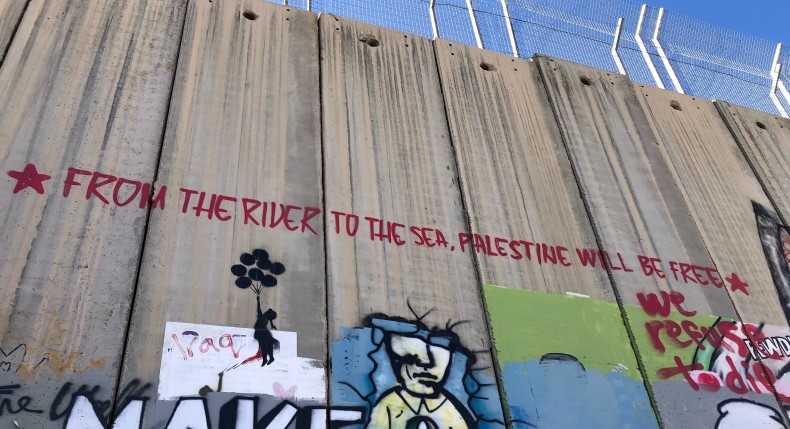
Is there hope?
JCRC’s executive director, Daniel Goldwin, reflects on conversations with Palestinians on a recent trip to Israel.
Read more -
Israel@70: 10 Celebrities Who Got Their Start (in Life) in Israel
Whether stars of cinema, symphony, sports, rock or runway, all were born in the Jewish State.
Read more -
Israel@70: 14 Things You Know That You Might Not Know Were Created in Israel
Flash drives. Waze. And not just tech stuff. Who knew?
Read more
Literature
1966 — Shmuel Yosef Agnon
“For his profoundly characteristic narrative art with motifs from the life of the Jewish people”
Peace
1978 — Menachem Begin
“For the peace treaty concluded between Israel and Egypt ”
1994 – Shimon Peres and Yitzhak Rabin
“For their efforts to create peace in the Middle East”
Economics
2002 — Daniel Kahneman
“For having integrated insights from psychological research into economic science ”
2005 — Robert Aumann
“For having enhanced our understanding of conflict and cooperation through game-theory analysis”
Chemistry
2004 — Aaron Ciechanover and Avram Hershko
“For the discovery of ubiquitin -mediated protein degradation”
2009 — Ada Yonat
“For studies of the structure and function of the ribosome ”
2011 — Dan Shechtman
“For the discovery of quasicrystals”
2013 — Michael Levitt and Arieh Warshel
“For the development of multiscale models for complex chemical systems”
Other stories
-
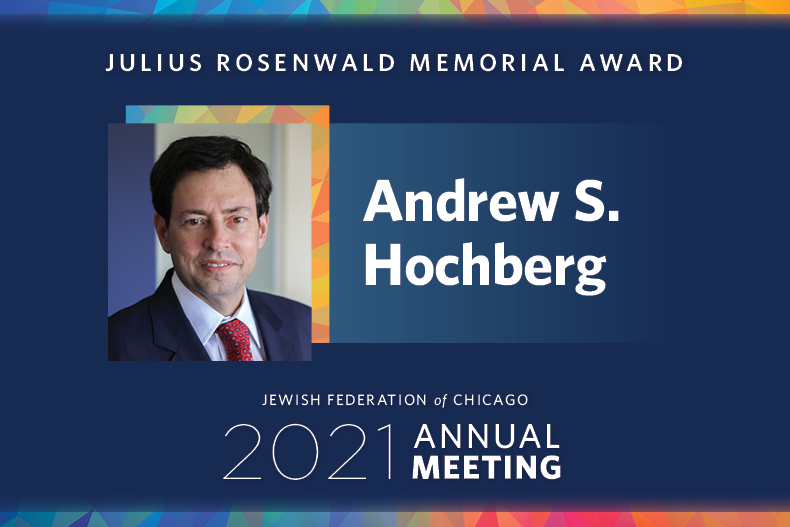
Meet Andrew S. Hochberg, 2021 Julius Rosenwald Memorial Award recipient
Celebrate Andy Hochberg at the virtual Annual Meeting on Sept. 14
Read more -
Two local teens win national recognition
Recipients of the annual Diller Teen Tikkun Olam Awards
Read more -
Celebrating six young award winners cultivating the community
Introducing young adult award winners
Read more
Itzhak Perlman, 72
Gal Gadot, 32
Bar Refaeli, 32 (model)
Gene Simmons, 68
Alona Tal, 34 ( Veronica Mars, Supernatural)
Ricky Ullman, 30 ( Phil of the Future)
Omri Casspi, 29 (NBA, formerly of the Golden State Warriors)
Hillel Slovak (1962-1988. Guitarist, Red Hot Chili Peppers)
Anna Smashnova, 41 tennis player
Other stories
-
Is there hope?
JCRC’s executive director, Daniel Goldwin, reflects on conversations with Palestinians on a recent trip to Israel.
Read more -
Israel@70: 10 Israeli Movies (and Their Directors) That Vied for Oscar's Affection
The movies Israel makes, and the directors who make them, definitely have caught the attention of the Academy of Motion Picture Arts & Sciences nominators.
Read more -
Israel@70: 14 Things You Know That You Might Not Know Were Created in Israel
Flash drives. Waze. And not just tech stuff. Who knew?
Read more
1985 Mexico Earthquake
1988 Armenia Earthquake
1989 Central America Floods
1997 Turkey Fire
2005 U.S. Hurricane Katrina
2010 Haiti Earthquake
2011 Japan Tsunami
2011 Turkey Earthquake
2012 U.S. Hurricane Sandy
2013 Philippines Typhoon
2014 Balkans Flood
2014 Paraguay Flood
2014 U.S. Wildfire
2015 Nepal Earthquake
2015 U.S. Tornado
2016 Italy Earthquake
2016 Canada Wildfire
2016 Cyprus Fire
2016 Ecuador Earthquake
2016 Haiti Hurricane Matthew
2016 Japan Earthquake
2016 Louisiana Flood
2016 UK Flood
2017 Madagascar Outbreak
2017 Mexico Earthquake
2017 Sri Lanka Flood
2017 U.S. (Puerto Rico) Hurricane Maria
2017 U.S. Hurricanes Harvey, Irma
Other stories
-
Meet Andrew S. Hochberg, 2021 Julius Rosenwald Memorial Award recipient
Celebrate Andy Hochberg at the virtual Annual Meeting on Sept. 14
Read more -
Two local teens win national recognition
Recipients of the annual Diller Teen Tikkun Olam Awards
Read more -
Celebrating six young award winners cultivating the community
Introducing young adult award winners
Read more
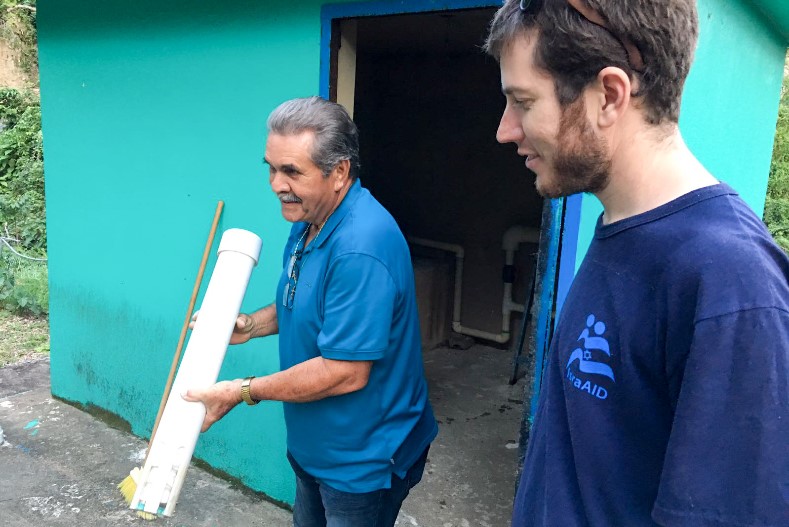
In a tiny corner of a tiny town on the southeast edge of Puerto Rico, Porfirio Fraticelli thinks constantly of water.
For years, the retired police officer has volunteered his time to make sure the 250 or so households in the Barrio Real community of Patillas have safe water to drink. But since Hurricane Maria struck on Sept. 19, there has been none, at least not from the usual sources. Nor has there been the electricity needed to make it safe.
Residents, many elderly or sick, were drinking water from nearby streams, putting themselves at risk of contracting water-borne diseases.
But help has come from some unexpected sources: Israel and Chicago’s Jewish community.
Little more than a week after the hurricane hit, IsraAID, an Israeli NGO that JUF long has worked with to respond to major disasters, had an emergency team in several of Puerto Rico’s poorest areas, providing water filtration, medical, and mental health services. Those efforts are supported in large part by Chicago’s Jewish community, through the Disaster Relief Fund the Jewish Federation created last fall.
In the town of Patillas, IsraAID’s WASH team (Water, Sanitation, Hygiene)-working closely with Fraticelli and students from the Humacau campus of the University of Puerto Rico-first installed hundreds of domestic membrane filters in homes throughout the area, providing immediate access to drinking water. It also offered hygiene workshops for residents and hands-on filter-installation sessions.
Once the immediate needs were met, IsraAID’s water engineer, Mori Neumann, worked with Fraticelli and the community on a detailed assessment to find the best long-range solution to the area’s water issues.
Together, they designed a gravitational water filtration system that does not rely on electricity. Construction of the system, which is being built in partnership with the San German branch of the Inter American University of Puerto Rico, is expected to be completed in August.
“It is really great working with you,” Fraticelli said to Neumann and the IsraAID team. “You have excellent technical knowledge of our water systems and the long-term solutions for our community.” He said he trusts IsraAID not only because its engineers are very knowledgeable, but because they have listened to him and his community’s needs.
Chicago’s Disaster Relief Fund also is supporting IsraAID’s work in other parts of the island, as well as the efforts of Minnesota-based NECHAMA: Jewish Response to Disaster, which is working initially in the town of Loíza. That group, with the help of many volunteers, is repairing homes, cleaning and gutting houses that have not yet received assistance, and removing debris in areas where chainsaw work still is needed.
A group of Chicago-area volunteers, organized by the Jewish United Fund’s TOV Volunteer Network, will travel to Puerto Rico later this year to work with both IsraAID and NECHAMA.
The Federation’s Disaster Relief Fund has supported more than $1 million in efforts to aid the hardest-hit areas of Puerto Rico, as well as Houston, Florida, and parts of Mexico hit by a devastating earthquake.
While Federation partners like IsraAID and NECHAMA often are among the first to respond to major disasters around the globe, aiding the immediate relief efforts, they frequently remain for months or even years, to rebuild devastated lives and communities.
Other stories
-
Two local teens win national recognition
Recipients of the annual Diller Teen Tikkun Olam Awards
Read more -
Celebrating six young award winners cultivating the community
Introducing young adult award winners
Read more -
Voice over Internet Protocol (VoIP)
Babylon computer translation
The Emergency Bandage
The Tomaccio cherry tomato
The Epilator (originally “Epilady”)
The games Rummikub , Mastermind and Guess Who?
Quarks (not so much made as predicted by an Israeli physicist)
(Bonus trivia: The Star Trek character Quark was played by Jewish actor Armin Shimerman)
Other stories
-
Is there hope?
JCRC’s executive director, Daniel Goldwin, reflects on conversations with Palestinians on a recent trip to Israel.
Read more -
Israel@70: 10 Israeli Movies (and Their Directors) That Vied for Oscar's Affection
The movies Israel makes, and the directors who make them, definitely have caught the attention of the Academy of Motion Picture Arts & Sciences nominators.
Read more -
Israel@70: 10 Celebrities Who Got Their Start (in Life) in Israel
Whether stars of cinema, symphony, sports, rock or runway, all were born in the Jewish State.
Read more