A record JUF Annual Campaign shows the good a community can do working together
In good times and bad, the need is always there: For food, shelter, medical care, counseling, Jewish education and so much more.
And when it comes to meeting those needs, Chicago’s Jewish community also is there. In 2017, it committed a record $86.97 million to the Jewish United Fund’s Annual Campaign, more than $2.6 million over last year and the ninth consecutive year of growth since the 2008 recession.
“This is an amazing achievement,” 2017 Annual Campaign Chair Larry Levy said. “Together, we do our best work – Caring for people during times of crisis. Leading efforts to fully include children and adults with disabilities in our community. Encouraging Jewish parents as they navigate the most important job they will ever have – raising their children. Providing opportunities to celebrate our heritage and connect with Israel. Assisting Jews in need around the world.”
Just in the past year, Chicago’s Jewish community, through programs supported by JUF and the Annual Campaign, served over 500,000 people of all faiths in Chicago and millions of Jews in Israel and worldwide. That includes:
- Serving more than 530,000 meals to people in need.
- Delivering medicine, heating fuel and food to 134,000 poor elderly and children throughout the former Soviet Union.
- Helping 26,000 Jews from across the world begin new lives of freedom in Israel.
- Engaging 20,500 people in Jewish life at JUF events.
- Welcoming and mentoring 9,000 families who participated in JUF Young Families programs.
- Providing 3,000 people with Israel experiences, through JUF-sponsored trips.
The Annual Campaign is the most significant element of JUF’s overall fundraising, but substantial additional support comes through bequests, the Centennial Campaign, corporate sponsorships, donor advised funds, support foundations and more .
There also are special emergency relief efforts, which this past year raised $1.4 million to aid victims of the massive hurricanes that struck Texas, Florida and Puerto Rico, as well as those who were devastated by the earthquake in Mexico.
As a major funder of human services addressing the needs of Illinois’ most vulnerable populations, the Jewish United Fund/Jewish Federation of Metropolitan Chicago also receives significant grants – totaling more than $28 million in 2017 – from governments and foundations, and is a beneficiary of the United Way of Metropolitan Chicago.
“We are incredibly proud of and thankful to our Chicago Jewish community,” said JUF Chairman Michael H. Zaransky. “Every individual who contributes to the Annual Campaign has committed to helping those in need and to making the world better. That is a commitment as enduring as the Jewish people. It also is a personal declaration that they are part of both a local and a global community.”
“The Annual Campaign is a massive undertaking, and its success is the direct result of the amazing efforts of countless volunteers, supported by JUF’s professional staff,” President Steven B. Nasatir said. “It is an incredible example of the good that can be accomplished when we work together. Without that, it simply does not happen. We are so grateful, and so appreciate their vision, leadership and commitment to the Jewish people.”
Other stories
-
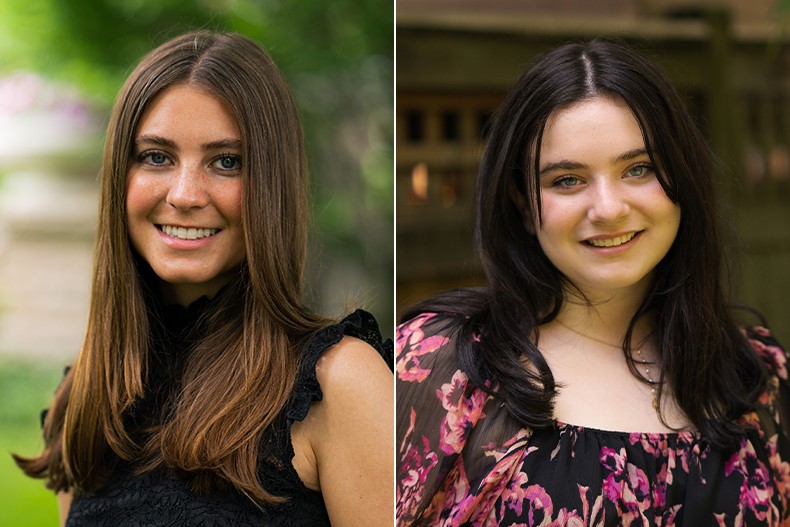
Two local teens win national recognition
Recipients of the annual Diller Teen Tikkun Olam Awards
Read more -
Celebrating six young award winners cultivating the community
Introducing young adult award winners
Read more -
Illinois Holocaust Museum and its Young Professional Committee inspire future generations to ‘Take a Stand’
MICHAEL BREGMAN
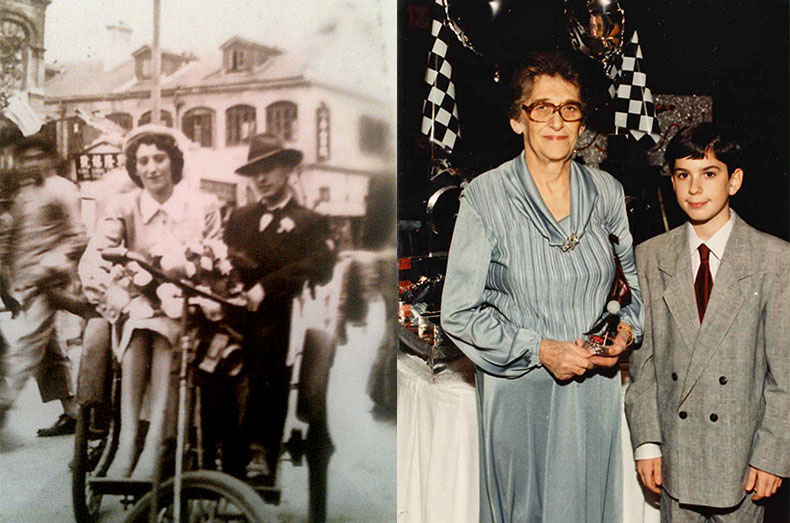
Growing up, every Sunday culminated in a family dinner with my grandmas.
My Grandma Adi-who was born in Vienna and avoided concentration camps by escaping to Shanghai-would regularly share her family’s stories of life in Europe before Nazism, the slow-boat to China, and the nine years she lived in the Jewish Ghetto of Shanghai.
As a typical adolescent boy, I was most curious about the strange things my grandma had to eat to get by in Shanghai-much to the dismay of others at the table trying to enjoy their food. More than one dinner conversation included a string of questioning where I would do my middle-school-science-student best to ask if she ate every species in the animal kingdom during her time in Shanghai.
After my grandma passed away in 2006, I was grateful that I had the chance to hear about our family’s experiences directly from her during her life, even though I have so many more questions today. Tragically, her husband, my grandpa Fred (who had a story of his own harrowing escape from Berlin to Shanghai), died when I was only seven years old-and before I could understand much of anything about the war or the Holocaust, let alone ask questions about it. Of course, I now know many of the larger events of his life leading up to the war and how he, too, escaped to Shanghai where he met and married my grandma.
Still, there is little I wouldn’t trade to be able to sit down with him today and pick his brain. To watch my two-year-old son ask him questions about all he experienced in life. To ask him about his reactions to the horrific and turbulent events taking place around him. To learn just a few more details about his life before the war. To understand a little bit more about his experiences and to put our own lives-and the tumultuous events of our own world today-into perspective.
My family is not alone. Sadly, a time will come when there will be no living witnesses to relate the stories of monumental loss and tragedy to future generations-stories and lessons that are critical to ensuring that the events of the Holocaust never repeat themselves. Volumes of literature and countless hours of interviews have been dutifully written and recorded by the USC Shoah Foundation and others. But there is no substitute for actual interaction with survivors and hearing first-hand the stories that are as important to hear today as ever.
That predicament is just one driving force behind the efforts of the Illinois Holocaust Museum and Education Center to establish the ground-breaking Take a Stand Center, which features the cutting-edge technology of the Abe and Ida Cooper Survivor Stories Experience.
At the premier of the Take a Stand Center, I had the privilege of taking in the Survivor Stories Experience of Aaron Elster, the museum’s first vice president, who as a young boy survived the war by hiding in a Polish family’s attic. First, a video presented Elster’s story of survival. Afterward, participants were invited to ask Elster-who appeared in the theater as a hologram on stage-anything about his life and experiences. I could not help but appreciate the sheer power that this experience will wield in educating future generations about the Holocaust-including the hundreds of school children who make their way through the museum every single day. These children-and someday my own son-will undoubtedly be inspired by Aaron’s story to one day take a stand against the bigotry, hatred, and intolerance that persists in communities around the world today.
It is the invaluable work of projects like the Take a Stand Center that hit home for me and inspire me to be a part of the museum’s Young Professionals Committee (YPC). The Committee strives to accomplish the museum’s twin goals: To serve as a landmark Holocaust museum and education center, while encouraging others to be upstanders in their communities in order to make “Never Again” a reality.
YPC will host an exclusive live performance by singer/songwriter and actor Tyler Hilton at the Park West on Thursday, Jan. 25. For more information and to register, visit www.ilholocaustmuseum.org/ypc/.
Michael B. Bregman is an attorney with Ruff, Freud, Breems & Nelson, Ltd., and Co-Chair of the Young Professional Committee of the Illinois Holocaust Museum and Education Center.
Other stories
-
Two local teens win national recognition
Recipients of the annual Diller Teen Tikkun Olam Awards
Read more -
Celebrating six young award winners cultivating the community
Introducing young adult award winners
Read more -
You can take a veteran out of the service, but you can’t take the service out of the veteran. This is the message of the Jewish War Veterans (JWV), an organization dedicated to helping veterans continue to serve their country and community after being discharged.
In return, members receive the support of their fellow Jewish vets. Being discharged is less an ending than a new beginning. Often, the best people for helping veterans adjust are those who have been there themselves.
A national program since 1896, JWV’s mission is to “support veterans in VA hospitals, uphold the name of the Jew, preserve memories of service, honor our heroic dead, and foster the education of service members.”
The national-level JWV, supported by JUF, distributes funds, offers benefits, and organizes national efforts such as disaster relief.
In the Chicago area, JWV has branches called “posts,” which reflect the distribution of the local Jewish community. Collectively, these posts have some 400 members.
But, say its leaders, there are many more Jewish vets who still lack the services JWV can provide — and JWV needs an infusion of new recruits if it will continue to be able to provide those services. One of the main tasks of JWV now is outreach to those who served in Iraq, Afghanistan, the Persian Gulf, and other more recent conflicts. “We need to try to instill,” said Commander Robert Nussbaum, “a sense of patriotism and national community.”
At a meeting of JWV post commanders in December, the reason was clear; the youngest vets in the room served in Vietnam, and most of the rest — including David Haymes, a member since 1963 now planning his 101st birthday — served in World War II.
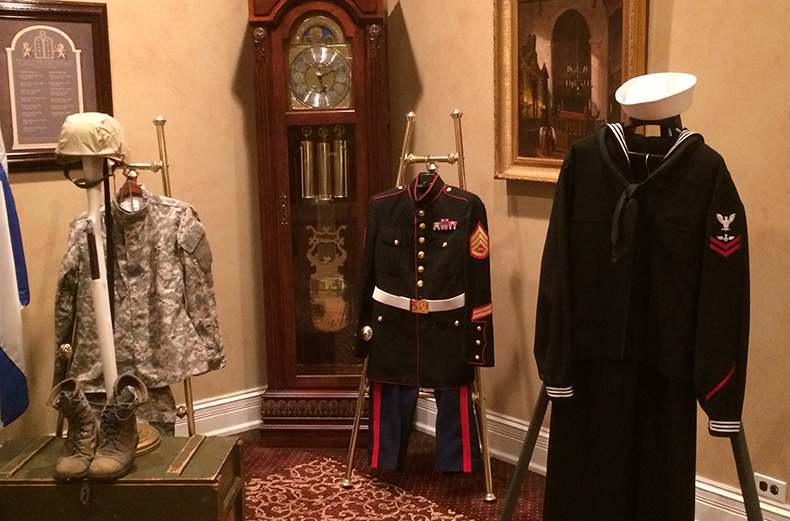
The meeting was held at the Weinstein & Piser Funeral Home in Wilmette; its Community Service Director, Marshall Kayman, is a JWV member. The lobby holds an exhibit of flags and uniforms testifying to the part Jews have played in the defense of America.
On the day of the meeting, an honor guard was in the funeral home’s lobby, there to participate in the funeral of a veteran. Kayman noted that his funeral home also participates in a program called We Honor Veterans, which provides free burials for homeless and indigent veterans.
JWV wants to make it clear that, relative to our percentage of the American populace, Jews do serve in America’s military proudly. “I’m glad I served,” said Haymes. Kayman pointed out that, during World War II, Jews were some 3 percent of America’s population, and 4 percent of its military.
While JWV is itself a non-profit, a much of the discussion at the meeting revolved around other philanthropies. Some held events that JWV was invited to, from dinners for the Simon Wiesenthal Center and Friends of the IDF to Veteran’s Day at synagogues and Pearl Harbor Day at Soldier Field.
JWV arranges transportation for nursing-home residents to visit the Illinois Holocaust Museum and Education Center. They also support Toys for Tots, and an effort to establish a Gulf War memorial in Washington, D.C.; Jewish Eagle Scouts receive certificates from JWV at their ceremonies.
JWV also hosts its own citywide meetings and parties, and bingo nights and holiday celebrations at VA hospitals. They offer information at gatherings like JUF’s Israel Solidarity Day, the Greater Chicago Jewish Folk Arts Festival, and the Illinois State Fair. And they plan outings, like a trip to a private military-memorabilia museum in Michigan.
One fight the veterans still face is anti-Semitism. They discuss events both historic and personal. For Jews who fought for American values, such memories are ever-present.
Another issue is real estate. A “Fisher House” is an apartment-like facility that hosts patients’ families at VA hospitals, and whose property must abut its hospital. JWV is helping a local Fisher House gain an easement to meet this requirement.
Aside from the national entity, the local JWV also participates in group of other, similar veterans’ organizations based on their members’ religion or nationality. And JWV consults with city and state veteran-related departments.
Part of JWV’s mission is to honor the dead. They attend funerals of their fellow Jewish vets, gather volunteers to place flags on their graves on Veterans Day and Memorial Day, and even own several burial plots reserved for those vets who cannot afford their own.
And then there are the less formal, but no less important, functions of the JWV. Once a week, several of its older, single members gather at one of their homes for dinner, just to be together with others who understand.
JUF Executive Vice President Jay Tcath is a JWV Life Member (U.S. Army captain, retired). “American Jews have always played a meaningful role in our beloved country’s armed forces,” he said, “serving in every theatre, in times of war and peace. There is a special bond, a kinship among Jewish soldiers that perseveres long after we turned in our boots. And JWV is the vehicle through which those connections and commitment of service endures.”
JWV is supported as a cultural agency by JUF. To learn more or to join, contact the VFW’s Department of Illinois by calling (847) 390-8762 or (312) 859-7373, emailing[email protected]or visiting www.jwv.org .
Other stories
-
Two local teens win national recognition
Recipients of the annual Diller Teen Tikkun Olam Awards
Read more -
Celebrating six young award winners cultivating the community
Introducing young adult award winners
Read more -
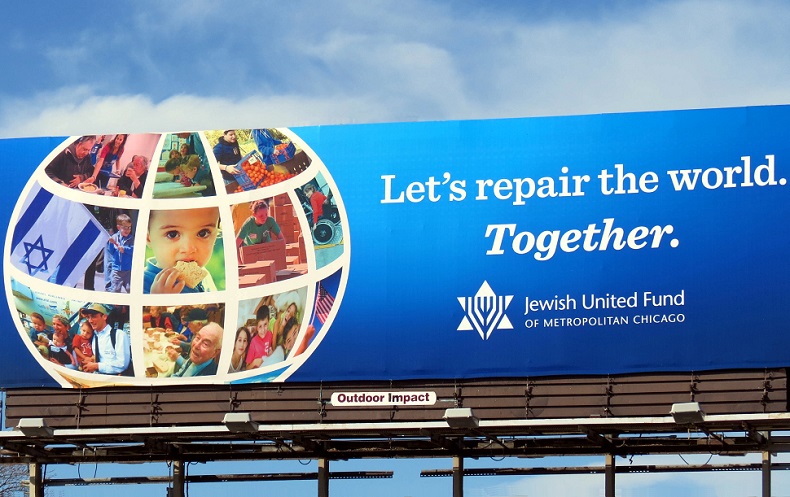
What’s 14 feet tall, 48 feet wide, and does a big mitzvah? A billboard, on Lincoln Avenue, south of Devon Avenue.
Joel Byron runs a Skokie-based company called Outdoor Impact, after the fact that billboards and other such promotional signs are termed “outdoor advertising” by the industry. And, when this particular billboard of his is not advertising the product or services of a paying client, he uses it to advertise JUF.
For free. Were he to charge for the space, the flat rate would cost 2,500 to 3,000 dollars a month.
This particular billboard has two sides, and the JUF message has been posted to both. The billboard is seen more than 78,500 times a week.
A Chicago native, Byron has been donating to JUF for 25 years. He began donating the billboard’s space early last year.
So why is Byron doing all of this for free? At a time of division in our world, he said, “I wanted to do something that sent a positive message.”
The Lincoln avenue billboard is not the first time Byron has donated space to JUF. A few years ago, he recalls, he posted JUF messages on smaller billboards in shopping malls.
After working in radio advertising for several years, he joined an outdoor-advertising firm, and then eventually launched his own.
Byron says he prefers billboards and other such advertising because, as he tells his clients, “it is a very cost-efficient medium, since the outdoors only has one ‘channel’ that everyone sees-and also, you can’t turn off a billboard.”
Other stories
-
Two local teens win national recognition
Recipients of the annual Diller Teen Tikkun Olam Awards
Read more -
Celebrating six young award winners cultivating the community
Introducing young adult award winners
Read more -
Tell me, my daughters,–
Since now we will divest us both of rule,
Interest of territory, cares of state,–
Which of you shall we say doth love
us most?
That we our largest bounty may extend
Where nature doth with merit challenge.
(King Lear, Act 1, Sc. 1)
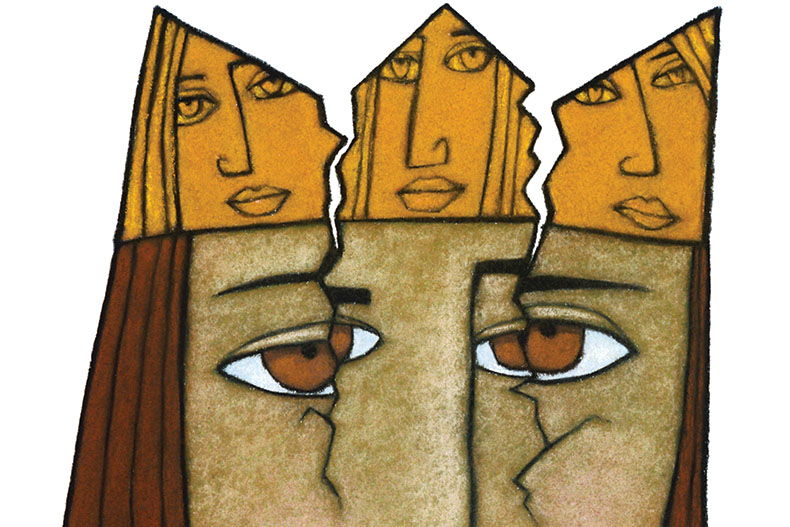
Lear asks his three daughters, “Who loves me most?” Goneril speaks first, Regan second. Each tries to outdo the other in false flattery. Lear turns to Cordelia, his youngest. She replies, “I am sure my love is more richer than my tongue.” (Act 1, Sc. 1) Unable to hear the wisdom of Cordelia’s words, he presses her further. “What can you say to draw a third, more opulent than your sisters? Speak.” He invites her to compete with the empty hyperbole of her sisters. She, in enduring dignity, replies, “Nothing, my Lord.” He disinherits her. The rest of the play’s tragic story is well-known.
Cordelia chose silence to convey that her love for her father is so vast it is inexpressible. Had she read the Torah she would have known of another non-verbal gesture to demonstrate her love, preparing a meal for and feeding her father.
When Isaac is near death and seeks to give bracha (blessing), meaning he wants (like Lear) to bequeath his spiritual and material estate to his children, he summons his older son Esau, and says to him, “My son.” He answered, “Hineini-Here I am.” Isaac says, “I am old now and I do not know how soon I may die. …hunt me some game and prepare a dish for me such as I love…so that I may give you my innermost blessing before I die.” Hearing this, Rebecca persuades Jacob to present himself as Esau to Isaac. She prepares “a dish such as his father loved,” for Jacob to bring to Isaac.
Food and love are linked in this drama. To demonstrate their love for their father so that they he may bless them, both Esau and Jacob prepare food that their father loves. Not rich in emotional language, the Torah is limited in its use of the word ‘love.’ The first mention of love is between Abraham and Isaac, the second between Isaac and his bride, Rebecca. In the drama of Jacob and Esau the word “love” is used four times, each time in association with food.
Food is love. No sooner does the Torah instruct humanity to procreate in love and bring children into the world than the Torah instructs about food and nurturing. Life created in love is nurtured in love. In the act of love that is life creation, implicit is the obligation to feed and nurture the life created. Life is created in love. Life is sustained, fed, and nurtured in the love expressed in the preparation and feeding of food.
“Food is love” is under assault today. Eating away at the fabric of food and love is fast food, hotel food, fancy restaurant food, catered food, take-out food, frozen food, canned food, airline food, diner food, vending machine food, junk food, truck food, food on the run…
Cooking and eating marshal all the senses. Food delights the eyes. Food offers aromas so powerful that smelling is almost like eating. Preparing food with hands is a sensual experience. Food speaks many languages in its origins and in the sounds it transmits during preparation and cooking and eating. The deployment and use of the five senses in the meal preparation and feeding of others is an all-encompassing act of love. The whole person cooks and feeds.
Jewish civilization surrounded families in their homes with cooking and eating. The first national Jewish act is a family meal, the Passover seder. The Jewish people’s first encounter with Shabbat is through the double portion of manna, followed by challah, one for each of the Twelve Tribes of Israel. The three pilgrimage festivals are days when Israel has sacred family meals on the slopes of the Temple Mount whose menu consists of the bounty of the land blessed with the seven species, wheat, barley, dates, figs, olives, grapes, and pomegranates. These are eaten in Jerusalem, which God has chosen as residence for His Name. Where the Name resides, Jewish families eat. Where a family meal takes place, the Presence of God resides.
When the Temple was destroyed, the Jewish family dinner table (especially on Shabbat and holidays) became the place of the loving and sensory experiences of Judaism. As the Jewish people moved about in the lands of their dispersion there was the common experience of food preparation and family meals. The transmission of belief in the One God, of the Torah, of the Mitzvot, was wrapped in the love that is experienced in preparing food, serving food, and feeding others. A family that spends Passover in a hotel surely has a wonderful time, but their home no longer surrounds and envelops its children with Jewish cooking and seder preparation.
If Cordelia had imitated Esau and Jacob and prepared a meal for her father, she would have expressed her love in a sensory way without verbally competing with her sisters. It is time we returned home to food and love.
Rabbi Yehiel E. Poupko is the Rabbinic Scholar of the Jewish United Fund of Metropolitan Chicago.
Other stories
-

Mother’s Day, Father’s Day, and the Jewish way
Let us pause and consider what it means for us to truly honor our parents
Read more -
Each time we study Torah, we experience the revelation
The mystical tradition of Judaism that lifts up the number 600,000 from the Exodus
Read more -
The Jewish United Fund of Metropolitan Chicago’s Create a Jewish Legacy program has been extended for two more years. This program has helped 30 local Jewish organizations raise over $28 million for their endowments and will expand to a new group of organizations in July 2018. The Create a Jewish Legacy initiative trains and supports Jewish communal organizations in the areas of legacy giving and endowments.
Applications for the next round of Create a Jewish Legacy will be accepted through Thursday, March 15.
The Create a Jewish Legacy program includes a comprehensive training curriculum, marketing assistance, JUF staff expertise and guidance, collaboration between organizations, and monetary incentives of $10,000 each year for two years for organizations who meet program goals.
Since 2014, over 1,050 endowment gifts totaling $28.5 million were raised for 30 local Jewish institutions.
These included: Am Yisrael Conservative Congregation; The ARK; Chicago Jewish Day School; Chicago Sinai Congregation; CJE SeniorLife; Hebrew Theological College; Hillel Torah North Suburban Day School; Illinois Holocaust Museum & Education Center; Jewish Child & Family Services; Keshet; North Shore Congregation Israel; North Suburban Synagogue Beth El; Oak Park Temple B’nai Abraham Zion; Solomon Schechter Day School of Metropolitan Chicago; and Temple Jeremiah; Akiba-Schechter Jewish Day School; Arie Crown Hebrew Day School; Bernard Zell Anshe Emet Day School; Beth Emet The Free Synagogue; Congregation Beth Shalom; Congregation Etz Chaim of DuPage County; Ida Crown Jewish Academy; Jewish Community Center of Chicago; Jewish Women’s Foundation of Metropolitan Chicago; Maot Chitim of Greater Chicago; SHALVA; Sinai Health System; Temple Beth-El; Temple Chai; and Temple Sholom of Chicago.
JUF’s Create a Jewish Legacy is part of a national program created by the Harold Grinspoon Foundation to preserve vibrant Jewish life for future generations by ensuring the long-term financial health of Jewish community organizations. JUF’s program is also supported by the Crown Family.
To apply or learn more about the Create a Jewish Legacy program, contact Tamar Wolf at (312) 357-4853 or [email protected].
Other stories
-
Two local teens win national recognition
Recipients of the annual Diller Teen Tikkun Olam Awards
Read more -
Celebrating six young award winners cultivating the community
Introducing young adult award winners
Read more -
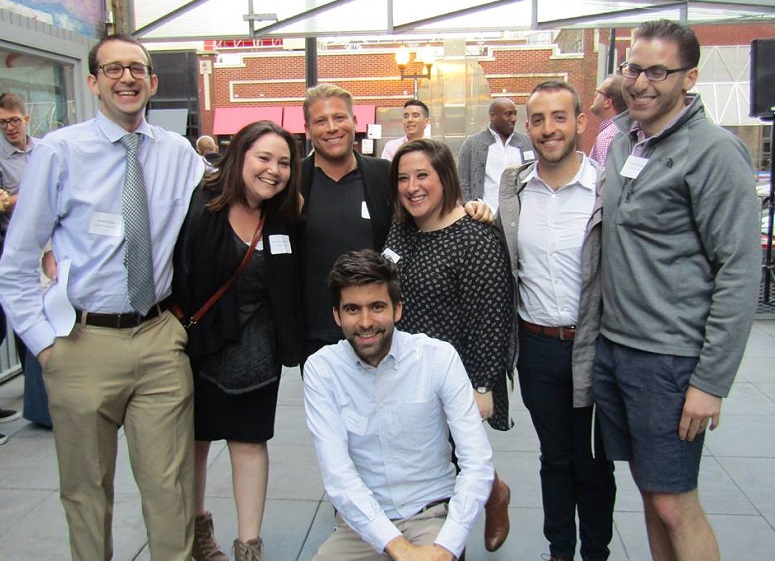
Intersectionality and its impact on the Jewish and LGBTQ communities were explored at a panel hosted by JUF’s Young Leadership Division Pride Committee and JUF’s Jewish Community Relations Council in December at JUF. Stephanie Goldfarb, JUF’s Youth Philanthropy and Leadership program director, Emily Briskman, the Israel Education Center’s executive director, and Emily Sweet, JCRC’s executive director, spoke on the panel.
Intersectionality, a term coined by civil rights advocate Kimberle Crenshaw in 1989, is the theory that every form of oppression is connected.
“Intersectionality is the process of untangling your multiple identities and understanding the way those identities intersect in order to position you in power and oppression,” Goldfarb said. “Everyone has intersectionality and everyone has multiple identities. When we talk about intersectionality, oppression, and privilege, we are talking about the systems that exist to privilege some people over others.”
Briskman explained how intersectionality can be manipulated and weaponized on campus to alienate Jewish students.
“Campus is a microcosm of what is happening in the world,” Briskman said. “We’re seeing a silencing of political Jewish opinions, mostly but not exclusively around Israel, more under the guise of being told to check our white privilege. That becomes complicated because it’s a fundamental misunderstanding of who the Jewish community is and where we come from, which is a significant problem on campus.”
Briskman showed a video from a University of Illinois at Urbana-Champaign event where Hen Mazzig, an LGBTQ activist and writer, was shouted down by anti-Israel students. Those students often have coalitions with other social justice groups on campus, making it difficult for Jewish and pro-Israel organizations to form relationships with those student groups.
Intersectional social justice movements believe that one group’s liberation can only be achieved when every social movement achieves its objectives. For example, gender equality cannot be achieved until classism and ableism are also defeated.
Intersectionality was weaponized against the Jewish LGBTQ community in July when Chicago Dyke March organizers ejected Jewish participants for carrying Pride flags embossed with the Star of David. Because the Dyke March officially stands in solidarity with Palestinian liberation movements, Zionists cannot be welcome in their community, according to the Dyke March’s interpretation of intersectionality.
“This event was created in a response to the feeling that there is a shrinking space for Jews [and] Zionists in progressive movements and spaces, in which the LGBTQ community has always found itself,” said Elaine Ross, YLD Pride chair. “I believe the Chicago Dyke March was a major push for the YLD Pride community to facilitate such dialogue; it is our hope that these such dialogues will continue.”
Other stories
-
Two local teens win national recognition
Recipients of the annual Diller Teen Tikkun Olam Awards
Read more -
Celebrating six young award winners cultivating the community
Introducing young adult award winners
Read more -
After clearing the final hurdle in the U.S. House of Representatives earlier this week, the tax bill has received President Trump’s signature. And the new law could have a sizable impact on nonprofits.
For months, charitable organizations, including JUF and the Jewish Federation of North America, raised concerns about the impact proposed changes would have on charitable giving. In the final bill, itemized deductions for charitable contributions remains in place. However, the doubling of the standard deduction, as well as limits on a number of other itemized deductions including state and local taxes, will likely reduce the percentage of taxpayers who itemize their deductions and benefit from a tax deduction for charitable giving from 30 percent to 5 percent.
These changes will result in what the nonpartisan Tax Policy Center estimates to be an annual loss of $12 billion to $20 billion in charitable giving starting in 2018. JUF, along with JFNA and other coalition partners, had actively advocated for a “universal” or non-itemizer charitable deduction, which would have allowed anyone to get a tax deduction for charitable giving.
“Although we are pleased that Congress chose to preserve the charitable giving deduction, reducing the number of taxpayers who itemize takes away, for some, the incentive to give to charities,” said JUF Government Affairs Committee Chair David Golder. “At a time when federal funding for many health and human services programs is on the chopping block, charitable giving is critical to organizations, including JUF and its affiliated agencies, as they carry out their missions and provide needed services to the most vulnerable people in our community.”
The final bill does not include an earlier proposal that would have weakened the so-called Johnson Amendment by permitting houses of worship and other public charities from endorsing or opposing candidates for public office in the ordinary course of business and if only de minimis expenses were incurred. Protecting the Johnson Amendment was an important advocacy priority for JUF.
Lisa Shuger is JUF’s assistant vice president of Federal Government Affairs and the director of JUF’s Washington D.C. office.
Other stories
-
Two local teens win national recognition
Recipients of the annual Diller Teen Tikkun Olam Awards
Read more -
Celebrating six young award winners cultivating the community
Introducing young adult award winners
Read more -
New Illinois education tax credit for donors, scholarships for students
Zivya Feifel Mosbacher and Mara Ruff
This past summer, the Illinois General Assembly passed the Invest in Kids Act, a new scholarship program designed to support low-income students in private schools. The program will create up to 75 million dollars in state tax credits for Illinois residents and provide 100 million dollars in scholarship funds annually. By donating to the program, Illinois residents can reduce their state tax liability and offer new educational opportunities to students in need.
Illinois residents are now eligible for a 75 percent state tax credit on donations made to a Scholarship Granting Organization (SGO). The Jewish Federation of Metropolitan Chicago’s school network is working closely with the SGO Empower Illinois. Individuals can designate their donation to support a specific Federation school or grouping of Federation schools, but corporations cannot. Corporations can only direct donations to a SGO or region within Illinois.
Before donating to the program, a donor is required to register on the Illinois Department of Revenue website. The Department must first approve the individual or corporation to receive a tax credit, which is issued on a first-come, first-served basis. Once approved, donors have 60 days to submit their donation. The program prohibits a donor from claiming a federal tax deduction when applying the state tax credit.
The Jewish Federation of Metropolitan Chicago did not take a public position on the passage of this legislation but wants to ensure that all potential scholarship recipients and potential donors who want to assist those students be aware of this new program.
If you’re considering being a donor, your tax advisor can help determine the tax implications. For more information on participating schools, visit empowerillinois.org.
If you’re considering applying for a scholarship, contact your child’s Jewish day school.
Zivya Feifel Mosbacher is the director of CBJC Day Schools for the Jewish Federation of Metropolitan Chicago.
Mara Ruff is associate director of State and Local Government for the Government Affairs Department of the Jewish Federation of Metropolitan Chicago.
Other stories
-
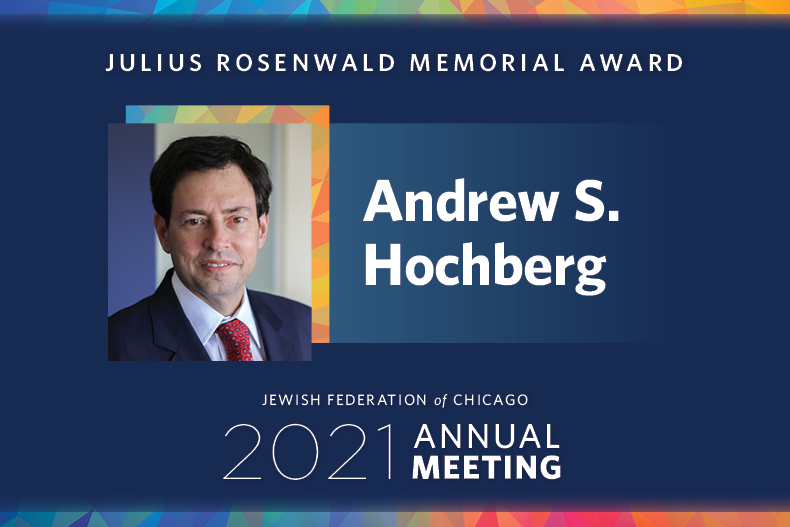
Meet Andrew S. Hochberg, 2021 Julius Rosenwald Memorial Award recipient
Celebrate Andy Hochberg at the virtual Annual Meeting on Sept. 14
Read more -
Two local teens win national recognition
Recipients of the annual Diller Teen Tikkun Olam Awards
Read more -
Celebrating six young award winners cultivating the community
Introducing young adult award winners
Read more
After nearly four decades of service, Hebrew Immigrant Aid Society (HIAS) Chicago has been directed by the U.S. State Department to shut down one of its signature programs, refugee resettlement.
The move, one of dozens of similar closings and consolidations across the country, is a result of decreased numbers of refugees coming to the United States. Earlier this year, the administration set a cap of 45,000, down from 85,000 actual resettlements two years ago.
Since the late 1970s, HIAS Chicago’s program has resettled thousands of refugees from the former Soviet Union, Bosnia, Kosovo, the Democratic Republic of the Congo, Vietnam, Cambodia, Iraq, and Syria. The agency connected them with safe furnished housing, employment opportunities and education for their children, and set them on a path to successful integration into their new community.
“The decision to discontinue resettlement efforts was not ours,” HIAS Chicago and its parent agency, Jewish Child & Family Services, said in a statement. “Significant decreases in arrivals mean fewer programs are needed to support resettlement.
“As saddened as we are to see our program end, we are deeply concerned about those individuals and families awaiting their turns to come to the United States. Those who have been waiting years or even decades will now need to wait even longer to find freedom.”
HIAS Chicago leaders stressed that the agency’s other immigration and citizenship work will continue beyond the anticipated February closing of the resettlement program, “as it has for over a century.”
Welcoming and aiding refugees has been one of the core missions of the Jewish Federation of Metropolitan Chicago since its creation in 1900, and that commitment is unwavering. As part of that, the Federation’s role as administrator for refugee services for the State of Illinois will continue.
Over the past year, the Jewish Federation of Metropolitan Chicago has urged Congress to maintain and fully fund the U.S. refugee resettlement program. Distinct from immigrants, refugees fled from their home country and cannot return because of a well-founded fear of persecution based on religion, race, nationality, political opinion, or membership in a particular social group.
Other stories
-
Two local teens win national recognition
Recipients of the annual Diller Teen Tikkun Olam Awards
Read more -
Celebrating six young award winners cultivating the community
Introducing young adult award winners
Read more -