Isaac Ashkenazi, a renowned international expert on disaster management and community resilience, led a security briefing on preparing for and responding to urban mass casualty incidents at the Jewish United Fund on Aug. 4.
Officials representing over 25 agencies, ranging from FEMA to the Chicago Police Department, attended the lecture. The briefing was part of an ongoing cooperation between JUF, the Jewish Community Relations Council and the Consulate General of Israel to the Midwest.
Ashkenazi’s lecture focused on six topics: extremism, terrorism, community resilience, mass shootings, responding to mass casualty incidents, and the importance of active bystanders.
“JUF maintains a close working relationship with the various security departments in the city and suburbs, which is important to the safety of our community institutions,” said Steve Dishler, JCRC’s assistant vice president of international and public affairs. “We are happy to be able to support opportunities for the exchange of best practices between Chicago and Israel, a relationship which is mutually beneficial.”
Ashkenazi encouraged agencies to work together to address urban terrorism in a speedy and synchronized manner. He also stressed the importance of building community resilience after attacks by restoring life to normal in affected areas as soon as possible.
“If a bus explodes, we take it out within three hours,” Ashkenazi said. “In Israel, we don’t want to leave the scene out for everyone to see. The objective of a terrorist attack is to convince the public that their government can’t protect them. The millions who are watching TV, seeing graphic images on TV after attacks – we want them to see the first responders have taken care of it.”
Active bystanders have played a critical role in saving lives in several major terrorist attacks, such as the 2004 subway bombings in Madrid. Israeli children learn from a young age to be active bystanders during crisis situations through encouragement and first aid training in schools, according to Ashkenazi.
“In Israel, people like to confront problems,” Ashkenazi said. “It is contagious. People want to be helpers. I helped prepare Rio de Janeiro for the Olympics for four years. Every time they told me, ‘Issac, we need more ambulances, let’s pour more money into this,’ I said, ‘No. There is no need for ambulances and more stuff.’ We just have to give citizens the skills to help us and be part of the effort. Bystanders are an asset, not an obstacle.”
Ashkenazi is an adjunct professor at Emory University, the University of Georgia and Ben-Gurion University in Israel. Ashkenazi is the former director of Harvard University’s Urban Terrorism Preparedness Project and previously served as a surgeon general in the Israel Defense Forces. He has represented the IDF and Israel during humanitarian missions across Asia, Africa, South America and Europe.
Other stories
-
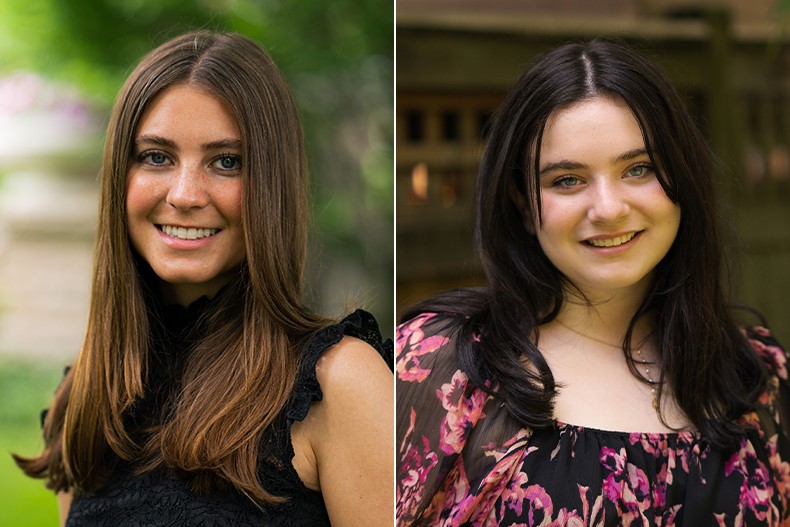
Two local teens win national recognition
Recipients of the annual Diller Teen Tikkun Olam Awards
Read more -
Celebrating six young award winners cultivating the community
Introducing young adult award winners
Read more -
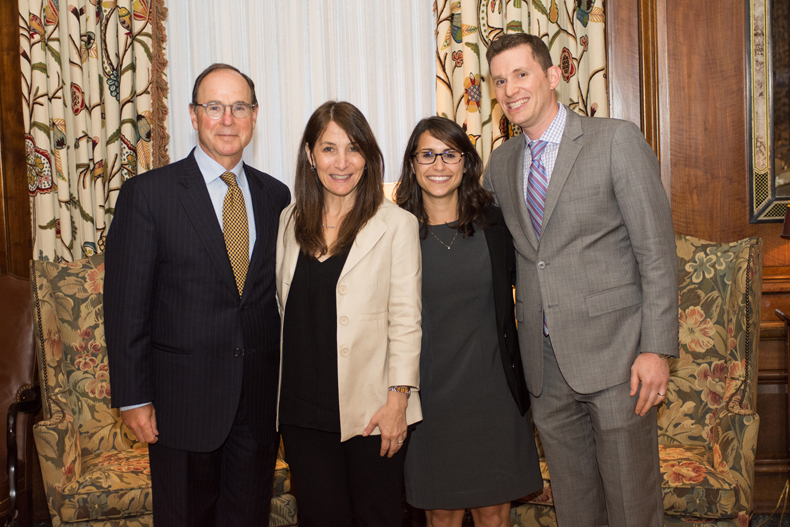
JUF’s Create a Jewish Legacy program helps local organizations raise $25.6 million
TAMAR WOLF
There were no caps and gowns, but several Jewish agencies, synagogues, and day schools celebrated a graduation last month all the same. In July, 24 organizations graduated from two cohorts of JUF’s Create a Jewish Legacy program-a hands-on endowment fundraising training program that has yielded $25.6 million in additional support for participating institutions. This program strengthens the Jewish community by teaching organizations the importance of growing an endowment and coaching them on ways to secure legacy gifts that sustain their Jewish institution in perpetuity.
The Create a Jewish Legacy program has found great success because of the comprehensive training curriculum, the JUF staff expertise, the opportunity amongst organizations to share ideas, and the monetary incentives for organizations who meet the program goals.
“Because of the support we receive, we are more successful in engaging donors and securing legacy gifts,” said Linda P. Foster, CEO/Head of School at Solomon Schechter Day School of Metropolitan Chicago in Northbrook. ” Create a Jewish Legacy motivates us and keeps us on task, helps us overcome our fears of approaching potential donors, teaches us how to prioritize and create strategies, demonstrates the importance of ongoing stewardship, and invokes accountability in our team.”
“The Create a Jewish Legacy program has provided a platform for Jewish institutions to focus on endowments,” said Linda Ginsburg, Steering Committee Chair for the second cohort of JUF’s Create a Jewish Legacy . “Income from endowments provides a steady and reliable source of financial support year after year. Legacy giving is a means to show commitment to an institution, even beyond one’s lifetime, and teaches children the importance of tzedakah .”
JUF’s Create a Jewish Legacy is part of a national program created by the Harold Grinspoon Foundation to preserve vibrant Jewish life for future generations by ensuring the long-term financial health of Jewish community organizations. JUF’s program is also generously supported by the Crown Family. Nationally, the program has helped participants from 36 communities secure more than 14,000 after-lifetime commitments valued at more than a half-billion dollars.
This year, a total of 24 organizations met the goals. JUF will distribute $195,000 in incentive grants.
” Create a Jewish Legacy has provided us with the necessary tools to grow our endowment to the level needed for our sustainability,” said Todd Wiener of Beth Emet The Free Synagogue in Evanston. “We appreciate JUF’s incentive grant and we look forward to our second year, when we will secure legacy giving as a permanent part of Beth Emet’s culture.”
This year’s graduates of Create a Jewish Legacy include:
COHORT 1
1. Am Yisrael Conservative Congregation
2. Chicago Jewish Day School
3. CJE SeniorLife
4. Hebrew Theological College
5. Jewish Child & Family Services
6. North Shore Congregation Israel
7. North Suburban Synagogue Beth El
8. Solomon Schechter Day School of Metropolitan Chicago
9. Temple Jeremiah
COHORT 2
1. Akiba-Schechter Jewish Day School
2. Arie Crown Hebrew Day School
3. Bernard Zell Anshe Emet Day School
4. Beth Emet The Free Synagogue
5. Congregation Beth Shalom
6. Congregation Etz Chaim of DuPage County
7. Ida Crown Jewish Academy
8. Jewish Community Centers of Chicago (JCC Chicago)
9. Jewish Women’s Foundation of Metropolitan Chicago
10. Maot Chitim of Greater Chicago
11. SHALVA
12. Sinai Health System
13. Temple Beth-El
14. Temple Chai
15. Temple Sholom of Chicago
Four simple ways to Create a Jewish Legacy include i) making a gift through a bequest in a will or estate plan; ii) adding or changing a beneficiary designation on an IRA or life insurance policy; iii) giving an outright cash gift to the endowment; or iv) increasing your current income while making a gift through a Charitable Gift Annuity or Charitable Remainder Trust.
To learn more about Create a Jewish Legacy or to make a gift to one of the participating organizations, contact Tamar Wolf at [email protected].
Tamar Wolf is program manager of JUF’s Create a Jewish Legacy.
Other stories
-
Two local teens win national recognition
Recipients of the annual Diller Teen Tikkun Olam Awards
Read more -
Celebrating six young award winners cultivating the community
Introducing young adult award winners
Read more -
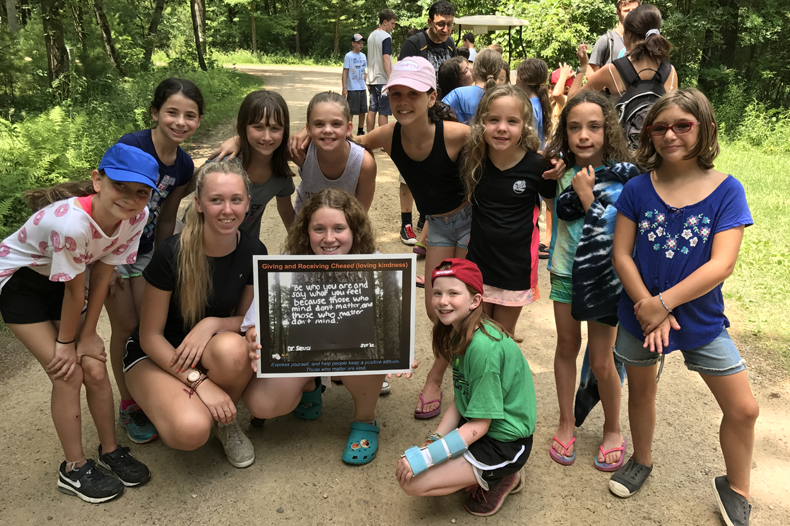
JCC Camp Chi campers tell stories of inclusion and belief through photography
CARLY KLEIN
A picture is worth a thousand words. We hear that often-the notion that a photo can convey the essence of a subject more effectively than a description, but we tend to ignore its meaning. InFocus, a national non-profit, based in North Carolina, gave me the opportunity to implement this saying at Camp Chi-charging campers to take photos that had a voice, pictures that were truly worth a thousand words.
JCC Camp Chi, with the support of Keshet, is nationally-recognized for its inclusive community, where campers of all abilities feel welcome and valued. For the past three weeks, 50 campers used photography to explore inclusion and their beliefs through InFocus, an innovative, community-building program.
The task at hand was challenging and invigorating at the same time. Every other day, I gave the four cabins I was working with a new photo prompt to use to take pictures at the camp. The camper ages ranged from 5th-10th grade. The four prompts varied within connections with Jewish values, inclusion, and love for Camp Chi. After each cabin submitted their three-to-five images and answered the prompt I had given them, we would then have a cabin discussion: “Why was this photo taken?” “How does this photo answer the prompt?” “How does this photo make you feel?”
One of the prompts was, “What does kindness look like? A girls cabin (ages 10-11) submitted a picure of the rafters in their cabin. When asked how this photo answered the prompt, the girls collectively explained that the rafters work together to hold up the roof. The rafters support one another and in return the rafters put a roof over our heads.
Without realizing it the photographers gave human traits to inanimate objects. They came up with the idea of objects having the ability to be kind.
A boys cabin (ages 14-15) answered another prompt: “Show something about camp that makes you proud to be Jewish.” Before every meal at Camp Chi, Hamotzi (blessing over bread) is sung. Singing Hamotzi is a part of the normal routine and can go unnoticed or underappreciated because it becomes so routine. However, the young photographers found meaning behind the shared prayer. They explained that in the photo they took, everyone is coming together, united in prayer. We each have our differences, they explained, but our commonality in rituals, like singing Hamotzi at meals, unites us in being Jewish.
Camp Chi held an InFocus culminating event, showcasing all the photos taken throughout the summer. The campers were able to see their photos and have a chance to tell the stories behind them.
Camp Chi is proud to have been selected as one of two pilot camps for InFocus. This program was made possible by the Joan and Stanford Alexander Family Fund and the Ruderman Family Foundation. Camp Chi is part of the Foundation for Jewish Camp and the Ruderman/Alexander Inclusion Initiative.
JCC Chicago and Keshet are partners with the Jewish United Fund in serving our community.
Carly Klein is a JCC Camp Chi staff member and on-site coordinator of InFocus.
Other stories
-
Two local teens win national recognition
Recipients of the annual Diller Teen Tikkun Olam Awards
Read more -
Celebrating six young award winners cultivating the community
Introducing young adult award winners
Read more -
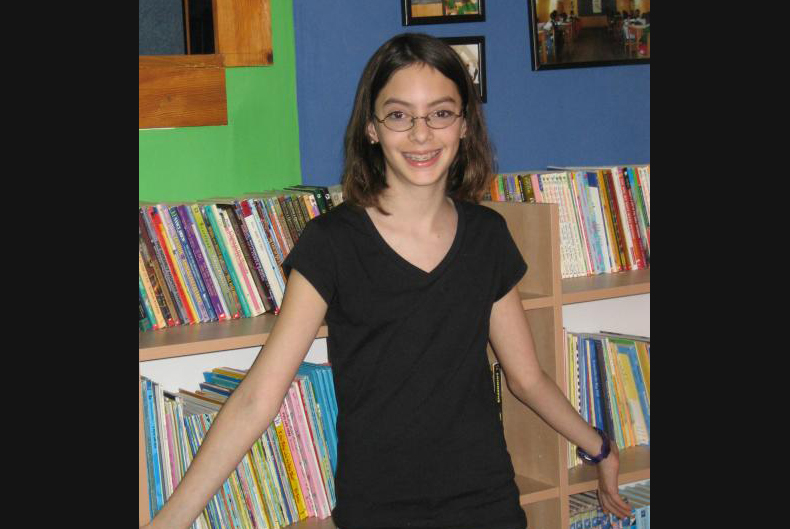
In 2005, the JUF Tween department decided to highlight the mitzvah project from my bat mitzvah. Nearly 12 years later, I work for the same department at JUF, running teen volunteering programs and helping families find their own mitzvah projects. For my bat mitzvah, I collected 1,000 books to send to a small, developing town in Israel. These books were used to kick off an English language library in one of the local junior high schools. It was a worthwhile and meaningful project, but not one I would recommend to anyone else.
Looking back, some of the most helpful advice I give out to families was taken from my own project — mostly, what not to do.
Here’s how not to create a b’nai mitzvah project:
DON’T ship a collection to Israel
It is extremely expensive to ship items to Israel (often more than the value of items being sent). According to my mother, each box of books cost more than $50 to ship! Once in Israel they are processed through customs, often incurring a duty fee or tariff. Customs is located near the Ben-Gurion airport, which means the organizations must send a staff person and often must pay a significant fee to pick up the items.
DO your research
There are so many ways to support Israel through a b’nai mitzvah project, and I recommend raising money to support an organization that you care about. If you want to do a collection drive, think locally! There are so many wonderful organizations in Chicago that would be happy to take your books, sports equipment, canned goods, or other collected or crafted items.
DON’T be a hassle
My mitzvah project was a family affair. While I sorted books and packed boxes, my parents schlepped the books, boxes, and myself around Chicago. They deposited checks, and covered shipping fees when monetary donations slowed. In the end, my parents had generously worked as many hours as I had on the project.
DO thank your team
The old saying goes, “the more the merrier,” and that goes especially for tikkun olam (repairing the world). Your mitzvah project can bring your community together for volunteering, collecting, or fundraising, and the people in your life can be incredible resources to help you and your project succeed. Explain to them why this particular project or organization is important to you, and make sure to show your gratitude for the time and energy they put in to help you complete your project. Don’t forget to thank them often!
DON’T get overwhelmed
I collected over 1,000 books to send to Israel, but I worried about my project constantly. I spent more time concerned about reaching my goal then I did preparing for my bat mitzvah, and I lost sight of the reason for performing a mitzvah project in the first place. Though I eventually met my goal, I was no longer having any fun.
DO your best
Your b’nai mitzvah project should be a lot of fun. Think big and set goals for yourself, but make sure you enjoy yourself. Part of becoming a Jewish adult is taking on responsibility, and your tikkun olam project is a great way of showing you understand that. Make the most of your experience, and know that finishing one mitzvah project will lead you to the next.
Now what?
We want to help you plan an amazing b’nai mitzvah project! Check out JUF’s B’nai Mitzvah Tikkun Olam Manual to simplify the mitzvah project process and to create a lasting love of volunteering and tikkun olam. The guide has over 100 ways for your teen to make a difference for their b’nai mitzvah. And keep a lookout for a new and improved version of the manual this fall!
Ariel Rosen is senior associate for Teen Volunteering and Engagement at the Jewish United Fund of Metropolitan Chicago.
Other stories
-
Two local teens win national recognition
Recipients of the annual Diller Teen Tikkun Olam Awards
Read more -
Celebrating six young award winners cultivating the community
Introducing young adult award winners
Read more -
We arein August and Elul. That means we are in the Book of Devarim /Deuteronomy, which Moses teaches to the Jewish people on the Plains of Moav overlooking the Promised Land to which he will not gain entry. The Book of Devarim can rightfully be called the Book of Love. It is the first of the five books of the Torah in which love-the love of God for the Jewish people and the love of the Jewish people for God-is presented.
Yet, there is a third great love in the Torah. First, there is the love of God found in the Sh’ma: And you shall love the Lord your God with all your heart and with all your being and with all your might.
The second great love of the Torah is from an earlier book, the Book of Vayikra /Leviticus: And you shall love your fellow man as yourself. Both of these loves are straightforward.
Parenthetically, as opposed to the literatures of other religious systems, the Torah does not simply present love as a concept, a feeling, or an abstraction. For Judaism, love is a behavior, an action. How to love one’s fellow man and woman is commanded by the Torah in great detail. In mitzvot, it describes how we must treat the person and the property of another. Love of God is also spelled out in detail. Love of God is expressed in immersion in God the way one is immersed in any great love.
Now we come to the third great and remarkable love.
And now Israel, what does the Lord your God ask of you but to fear the Lord your God, to walk in all His ways, to love Him, and to worship the Lord your God with all your heart and all your being, to keep the Lord’s commands and His statutes that I charge you today for your own good.
The text then takes a surprising turn:
Look, the Lord your God’s are the heavens, and the heavens beyond the heavens, the earth, and all that is in it… For the Lord your God is the God of Gods and the Master of Masters, the great, mighty, and fearsome God…
Well, if God is so great, mighty, and fearsome, and if God is the one who created Heaven and Earth, what should now follow are some pretty amazing powerful examples that only someone that mighty and that awesome can achieve like juggling Jupiter, Mars, and Uranus! That is not what follows. What follows is this verse:
God… doing justice for orphan and widow, and loving the stranger to give him bread and clothing. And you shall love the stranger, for strangers you were in the Land of Egypt.
That last phrase we hear all the time. But the Torah goes a step further. It is really not enough to ground love of a stranger in one’s own personal experience. To ground any mitzvah, ethical or moral, in one’s personal experience relativizes it. It means that the obligation to love the stranger is contingent upon personal experience. It is not an absolute. When the Torah wants to illustrate what it means that God is the Creator and Master of Heaven and Earth, when the Torah wants to describe what it means that God is great, awesome, and mighty, the Torah says, “You know how powerful, awesome, and almighty God is? God loves the stranger.”
God does not just love God’s own chosen people, the Jewish people, God loves all of humanity. The behaviors by which God expresses love for the stranger-food, clothing, shelter-are the basic necessities of life.
This verse presents an idea that is at once radical and simple. It is radical in the following sensense: each of us as individuals, and each people or community, is the sum total of their experiences. Those experiences are recalled in memory. When confronted with a difficult issue, whether it be familial, political, social, or economic, we all draw upon our memories to guide us. As a Jewish people we recall the slavery in Egypt. The Torah asks us to draw upon our memories. We should never oppress the stranger because we were strangers in Egypt. That makes sense.
Many American Jews are still able to recall that they are the children, grandchildren, and great-grandchildren of people who suffered something terrible; of people who were driven out of the great Russian, Prussian, and Austro-Hungarian Empires to these blessed American shores. When American Jews recall the experiences of their grandparents and great-grandparents they are moved to be concerned about other immigrants and other refugees.
However, there is a problem with personal experience as the basis of right behavior. This makes goodness, righteousness, justice, and love dependent upon frail human memory and personal selective recall. Other people have other experiences which are equally valid. What makes this verse so significant is that it goes beyond personal experience as the basis of right behavior. This verse makes loving the stranger an absolute norm of the Torah. One is obligated to love the stranger not just because of Jewish human experience.
One is obligated to love the stranger because God in whose image everyone is created loves the stranger. That is the absolute ground of it. Having established that, the Torah moves from the principle to the quotidian, the simple, and the daily.
Love is not an emotion when it comes to strangers. Love is behavior. God feeds, clothes, and shelters hungry, homeless, naked people. So do we.
Rabbi Yehiel E. Poupko is the Rabbinic Scholar of the Jewish United Fund of Metropolitan Chicago.
Other stories
-

Mother’s Day, Father’s Day, and the Jewish way
Let us pause and consider what it means for us to truly honor our parents
Read more -
Each time we study Torah, we experience the revelation
The mystical tradition of Judaism that lifts up the number 600,000 from the Exodus
Read more -
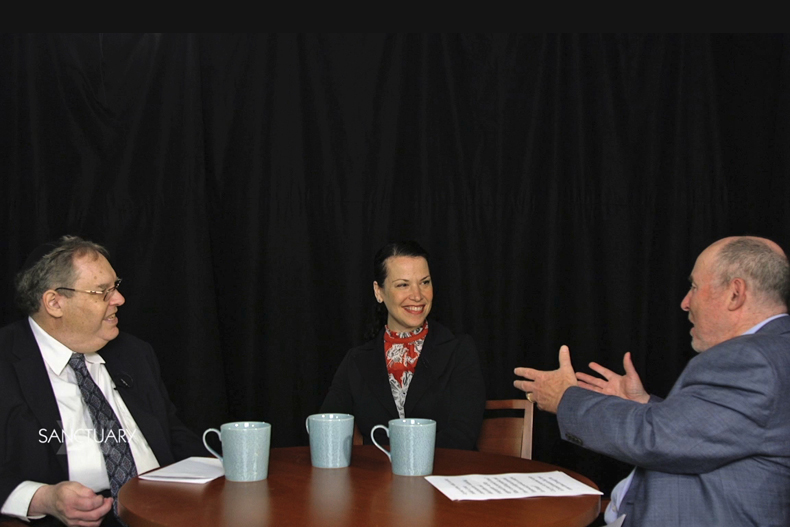
The Jewish High Holy Days, beginning with the marking of the new year, Rosh Hashanah, and concluding with the Day of Atonement, Yom Kippur, are a season of reflection, return and renewal, the most sacred period of the Jewish year. It is a time both intensely personal and introspective, yet also the most communal of the Jewish holidays; a self-examination of our relationship with God, each other, and ourselves.
On the next episode of the public affairs program “Sanctuary,” Rabbi Shoshanah Conover, associate rabbi of Temple Sholom in Chicago, and Rabbi Michael Balinsky, executive vice president of the Chicago Board of Rabbis, discuss the power and impact of this period with moderator Aaron Cohen.
This episode of “Sanctuary” will air at noon every Sunday in August on ABC’s Live Well Network, 7.2. Check local cable listings for the channel. The program also can be viewed any time on the Jewish United Fund website .
“Sanctuary” is a joint production of the Jewish United Fund of Metropolitan Chicago and the Chicago Board of Rabbis, in cooperation with ABC7.
Other stories
-
Two local teens win national recognition
Recipients of the annual Diller Teen Tikkun Olam Awards
Read more -
Celebrating six young award winners cultivating the community
Introducing young adult award winners
Read more -
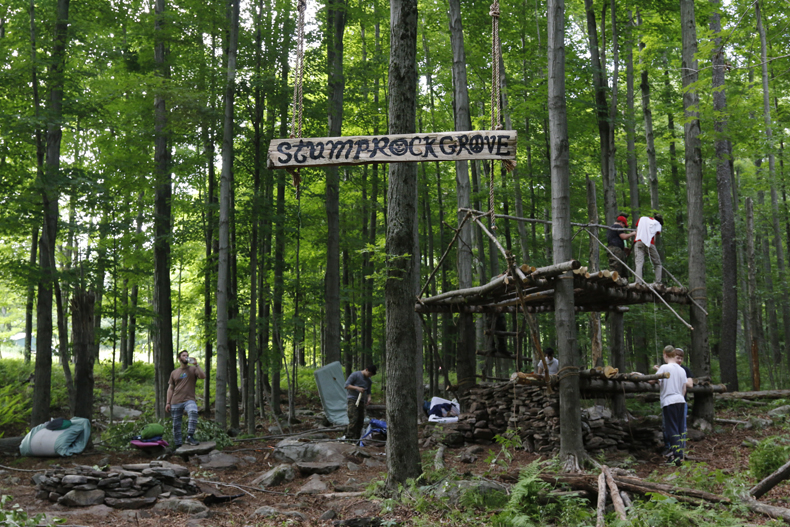
The Hebrew word Gila translates to happiness. But it is a different kind of happiness than other similar Hebrew words like simcha , or osher . Gila is the happiness found through discovery. And that is exactly the kind of happiness Chicago native Rabbi Tani Prero promotes.
Yagilu means “they will be happy through discovery,” which is Prero’s intention at his wilderness camp called Camp Yagilu Wilderness. Through Yagilu , located in Swan Lake, N.Y., Prero works with adolescent Orthodox boys on self-confidence, responsibility, and growth in the great outdoors.
Yagilu aims to help children discover their individual talents and strengths, while uncovering beauty and wonder in the world around us by harnessing the tools in nature.
The camp does this by teaching teenage boys survival skills like fire-making, navigation, how to build a shelter, the art of camouflage, and knife safety. As they learn these skills, the boys become aware of their surrounding and of themselves.
“At the end of the summer, you should see the smiles; you should see their fists raised with happiness, you should hear their cheers,” Prero said.
The model of the camp focuses on challenge and success. Prero explained that success without challenge can make people become cynical. Also, if you have challenge without success, people become discouraged, he said. Yagilu works to empower kids no matter their personal challenges. He reflected that being a teenager is not easy, and he wanted to give teenagers a place to grow and thrive.
Like his campers, Prero did not have much experience in the wilderness growing up. As a West Rogers Park native, there is not much nature to be found.
“I grew up in Chicago. It’s flat. There are no mountains… But I remember going to camp. The first overnight hike I went on was in the Colorado Rockies and I remember [how] it just inspired me in a way I never felt before,” he recalled. “I really wanted to continue doing that and I wanted to also offer that to kids.”
Since Yagilu began in 2013, the camp has grown every year. In its first summer, the camp had about 45 boys, the second summer they had close to 70, last year 80, and this year they have around 100 campers. Ideally, Prero would like to have 200 campers and expand to other locations too.
The rabbi also discussed how the wilderness and Judaism fit together. In fact, he believes they are one in the same. While people today live in human-made environments, the wilderness is exactly how God intended the Earth to be. He added that if a space is natural, anyone can connect to God through the natural energy God puts there. At Yagilu , this energy is so powerful that the boys say prayers over the environment.
“In Judaism, there are certain brachot for things in nature,” Prero said. “We can connect to God through that view…One day if it rains, we’ll spend a day studying the song of the rain. If we’re going by a river, we’ll spend a day studying the song of the river.”
After the summer, Prero sees his campers grow in so many different ways. He sees them grow in self-confidence, their ability to try new things and in their leadership abilities.
“I had one camper, when I first met him, he couldn’t even look me in the face,” he said. “Then, when he came back to school, his teachers noticed he was a different kid. His parents called me after the first parent-teacher conference of the year and said they wanted to thank me. Every single teacher said that this boy is a new kid this year…That’s why I started Yagilu . That’s why I stay up until 2 in the morning working on Yagilu .”
Other stories
-
Two local teens win national recognition
Recipients of the annual Diller Teen Tikkun Olam Awards
Read more -
Celebrating six young award winners cultivating the community
Introducing young adult award winners
Read more -
JUF, Federation designates nearly $175.6 million to social services, community building work in FY 2018
Christine Sierocki Lupella and Joel Schatz
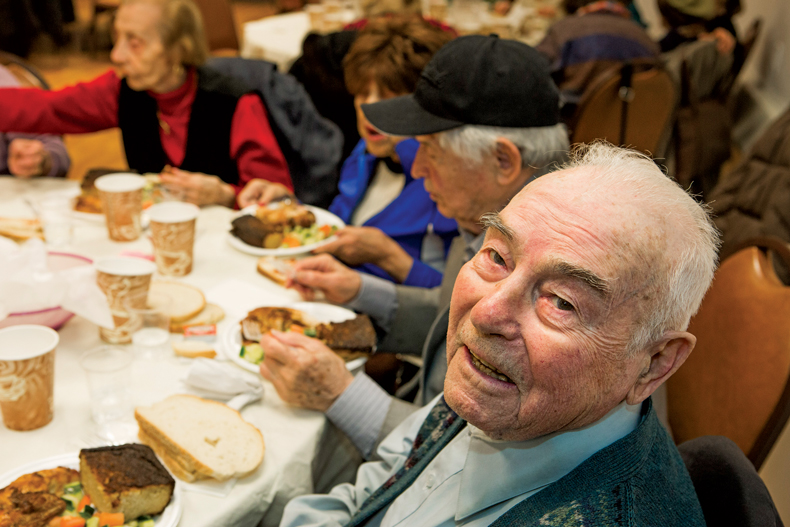
The Jewish United Fund/Jewish Federation of Metropolitan Chicago has allocated nearly $175.6 million so Iris D. will have a place to go for dinner on Monday nights.
And so she will be able to make her own dinner in her apartment on other nights. And have people to talk to. And can get to her doctors’ appointments.
Every year, through its allocations, JUF/Federation and its affiliated agencies help Iris and over 500,000 other Chicagoans of every faith when they most need help, or are searching to connect with Jewish life and community. And around the globe, they do the same for some 2 million Jews in Israel and 70 other countries.
“Our work through JUF/Federation shows the world what it means to be Jewish by caring for the most vulnerable people in our society,” said Michael H. Zaransky, JUF/Federation Chairman. “We’re helping ensure that Jews have their basic needs met anywhere in the world-and we’re building a strong, vibrant community for the next generation.”
The $175.6 million allocation for FY 2018, crafted by lay and professional community leaders working in partnership throughout the year, is more than $6.6 million over FY 2017. The largest funding source is the JUF Annual Campaign, which last year raised $84.3 million. In addition, JUF/Federation distributes funds received from government agencies, foundations, endowments, donor advised funds, the United Way, and other sources.
Members of the Health and Human Services, Israel and Overseas, and Community Building and Jewish Continuity Commissions of the JUF/Federation Overall Planning and Allocations Committee (OPAC) identify needs, assess impact, and recommend allocations for the future.
“I want to thank the wonderful lay and professional leaders who worked tirelessly to achieve a timely and balanced budget,” said Andy Hochberg, OPAC Chairman and a past JUF General Campaign Chair. “This experience gave me a full appreciation for the scope of JUF/Federation’s work that supports, enhances and strengthens our Jewish community, and I am grateful for the opportunity to have served in this capacity.”
For 117 years, the JUF/Federation has led efforts to help Jews and others in need, create Jewish experiences, and strengthen Jewish community connections both locally and globally.
Focusing on human needs
Over $25.4 million will be directed to human services delivered through Jewish Child & Family Services (JCFS), CJE SeniorLife, HIAS Chicago, Jewish Vocational Services, Mount Sinai Hospital Medical Center, the Dina & Eli Field EZRA Multi-Service Center, and The ARK, which are among JUF/Federation’s network of approximately 70 agencies and programs.
“Our leaders have thoughtfully provided their expertise as stewards of these resources. We are grateful for their efforts,” said Deborah Schrayer Karmin, co-chair of JUF/Federation’s Health & Human Services Commission. “Over the past 18 months our leadership and professionals throughout the system have come together to build the framework for measuring the impact of human and community building services on older adults. This initiative is vital to effectively providing service.”
JUF/Federation funding provides emergency financial and medical assistance, supports advocacy and protection programs, promotes inclusiveness for people with disabilities, and makes available numerous other services addressing basic human needs.
“Community-based services were the focus of our work, given the funding challenges in the public sector,” said Hilary Greenberg, Health & Human Services Commission co-chair. “A major concern is that as funding shrinks, services are becoming increasingly limited.”
Assisting Holocaust survivors
Over $3 million-reflecting a $1.4 million increase over last year due to grant funding as well as funds from JUF’s special Defiant Requiem program in the Spring-has been designated for Holocaust Community Services. HCS helps ensure that Chicago’s aging Holocaust survivor community can live independently and with dignity, and addresses the exponentially increasing needs of aging survivors.
Supporting Israel and overseas programs
Nearly $36.6 million will be distributed to assist vulnerable populations in Israel, Ukraine, and elsewhere overseas, providing significant support for Jews in crisis through JUF/Federation partner agencies and programs that include Jewish Federations of North America, American Jewish Joint Distribution Committee, Jewish Agency for Israel, and World ORT.
This funding strengthens overseas initiatives and programs such as Partnership Together, which assists the most vulnerable residents in Israel’s Kiryat Gat-Lachish-Shafir region. JUF Israel Children’s Zone-located in the Partnership region-is the flagship educational intervention program developed by Israeli education experts in cooperation with JUF’s team in Israel, and is available in part in all 17 schools in the region.
Overseas funding also enhances educational programs operated by the Progressive (Reform), Masorti (Conservative), and Modern Orthodox streams of Judaism in Israel. In addition, JUF supports programs in the Former Soviet Union such as the Kyiv Kehilla Project that addresses hunger and supports formal and informal Jewish education programs.
“We continue to provide relief for Jews in need around the world,” said Dana Hirt, Israel & Overseas Commission chair. “In addition, JUF/Federation is investing in the future of our global Jewish community.”
Creating a vibrant community
JUF/Federation ensures a dynamic Jewish community by engaging Jews of all ages through a broad array of programs, initiatives, and service opportunities. Nearly $18.5 million has been allocated to agencies, organizations, and programs that create Jewish experiences and strengthen community connections, thereby promoting Jewish continuity from generation to generation.
Jewish Community Center of Chicago, Associated Talmud Torahs, area Jewish early childhood education programs, 19 Jewish day schools and high schools, Spertus Institute for Jewish Learning and Leadership, and Hebrew Theological College are among the primary agencies and beneficiaries that rely on JUF/Federation for significant funding.
“Educational excellence and engagement is integral to Jewish identity,” said Gita Berk, Community Building & Jewish Continuity Commission co-chair. “JUF is committed to creating learning opportunities for every age, at every stage of life.”
In the area of adult Jewish learning, JUF/Federation has tapped the Spertus Institute for Jewish Learning and Leadership to develop opportunities for collaboration among adult Jewish professionals, through a Federation grant.
“We are excited about the opportunities this grant affords and look forward to the implementation of community-wide educational efforts,” said Lisa Rosenkranz, Community Building & Jewish Continuity Commission co-chair.
JUF/Federation’s allocations reflect the commitment to engage the next generation in Jewish life: JUF Young Families, including jBaby, JUF Right Start, and PJ Library, bring Jewish families together to participate in Jewish life; Hillels of Illinois invites college students on 17 campuses to explore and celebrate their Jewish identities; and young adults have ample social and networking opportunities to build leadership skills and connect with their peers.
Teens and young adults gain knowledge and understanding of the Jewish Homeland through immersive Israel experiences such as Ta’am Yisrael: A Taste of Israel for eighth grade students; Write On For Israel (eleventh grade students); JUF Birthright Israel: Kefiada; OTZMA: Israel Teacher Corps; and Masa Israel Journey. JUF/Federation sponsors missions to Israel throughout the year that provide an opportunity to see the Chicago Jewish community’s impact on the lives of Israelis living in the Kiryat Gat-Lachish-Shafir Partnership Region.
In addition, JUF/Federation’s TOV Tikkun Olam Volunteer Network last year connected over 5,500 community volunteers of all ages-who donated over 13,000 hours of time-with partner agencies and programs, many focused on vulnerable populations.
Other vital funding recipients are JUF/Federation’s Jewish Community Relations Council, which brings together over 40 area Jewish organizations to advocate for the Jewish community with civic and community organizations, government officials, and the media-and Government Affairs Committee, which advocates on behalf of vulnerable populations in Chicago through legislative initiatives and public-private partnerships.
To promote Jewish identity through Israel outreach, advocacy, and cultural connections at the local and national levels, JUF/Federation is allocating $6.1 million. Advocacy initiatives include the Israel Education Center, which combats the Boycott, Divestment, and Sanctions (BDS) movement and other anti-Semitic, anti-Israel agendas that seek to delegitimize Israel’s right to exist. Funding also maintains Israel study programs on college campuses, supports JUF Birthright Israel trips, provides academic scholarships and fellowships, and supports agencies such as the Illinois Holocaust Museum and Education Center.
Additional allocations
Other JUF/Federation FY 2018 allocations reflect distributions from donor-advised funds, community programs and services provided directly by JUF/Federation, support services to affiliated agencies, and operational expenses.
“Our Chicago Jewish community consistently demonstrates generosity, strength, and responsibility for each other-a reflection of our most deeply held values,” said JUF/Federation President Dr. Steven B. Nasatir. “Year after year, we come together to care for and protect those in need locally, in Israel, and around the world-and for this, I am incredibly proud.”
Other stories
-
Two local teens win national recognition
Recipients of the annual Diller Teen Tikkun Olam Awards
Read more -
Celebrating six young award winners cultivating the community
Introducing young adult award winners
Read more -

In 1974, two languages dominated the bar mitzvah speech of my father, Joe Mishell, “Yossi” to his family. One was English, but the other was not Hebrew.
Like many bar mitzvahs, he read from the Torah and gave his bar mitzvah speech. However, the speech, which he wrote for months, was in Yiddish.
Yiddish is Dad’s first language, and he did not learn English until kindergarten. His parents and my grandparents-William and Pola Mishell-were Lithuanian Holocaust survivors. Along with giving his speech in Yiddish, this gave my dad a different insight in what it meant to be a bar mitzvah.
“Growing up, there was always a presence of the family we’d lost in the Holocaust,” Mishell said. I had cousins, an uncle, and grandfathers who were all killed in the war. That made my bar mitzvah even more meaningful to me and my family.”
My grandma, Pola Mishell, survived the Stutthof Concentration Camp along with her female family members. Her father and only brother were killed. My grandpa, William Mishell, survived the Kovno Ghetto and Dachau Concentration Camp. His experiences are chronicled in his memoir, Kaddish for Kovno . William lost his father, many cousins, his niece, and brother-in-law. He survived, as did his mother and sister.
My father, an avid history-lover, grew up listening to stories of his older relatives, granting him a familiarity with previous generations.
Also, his two sisters and female cousins became 12 before it was the norm for girls to have bat mitzvahs. As a result, my dad was the first in his family to even have a bar mitzvah in America.
To his entire family, Joe’s bar mitzvah represented triumph-a positive Americanization of the family. After surviving the Nazis, his family could bar mitzvah a boy in America, the land of opportunity and religious freedom.
“I always felt American, and my parents really loved this country. After the war, my parents worked so hard to integrate into American life, and here it was. A very American-Jewish practice that they could participate in.”
B’nai mitzvahs happened in pre-war Europe, but they did not have the American touch of a party, grandeur, and a speech, which thanked all the guests for coming.
Joe’s parents still felt a strong connection to their Lithuanian-Jewish roots. So they wanted their son to do his speech in English to demonstrate their love of America. But they also wanted him to do another speech in Yiddish, their native language.
This was an unusual occurrence in Joe’s generation at bar mitzvahs in the 1970s. He was on the younger side of being a son of Holocaust survivors. Therefore, Yiddish was the language of his peers’ grandparents and, often, great-grandparents.
“At first, I was a little embarrassed. It was an old language that my friends didn’t hear very often. I thought it might be kind of weird for them to sit through one bar mitzvah speech, and then to have to sit through another one that they couldn’t even understand,” he paused, “Looking back on it, I realized this day wasn’t about my peers. This day was about me and my family.”
And my dad made his family proud. Our family loved America, but they never forgot their roots.
Other stories
-
Two local teens win national recognition
Recipients of the annual Diller Teen Tikkun Olam Awards
Read more -
Celebrating six young award winners cultivating the community
Introducing young adult award winners
Read more -
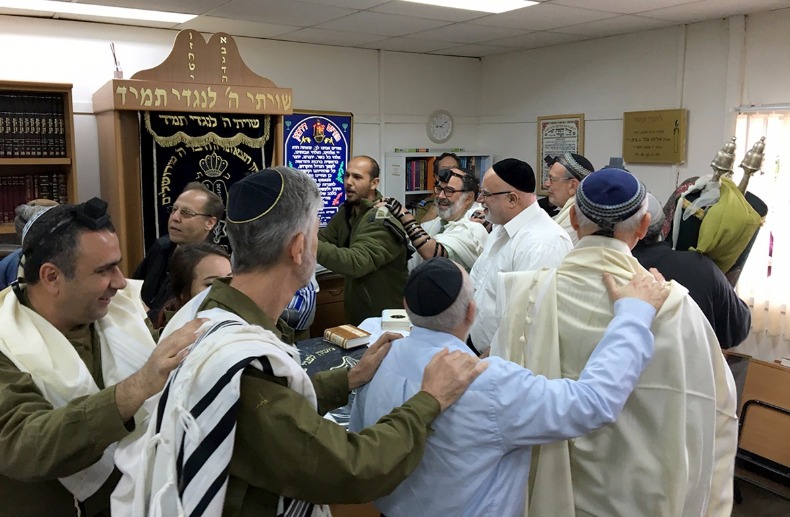
As a Soviet refugee who came to the United States in the 1970s, I have always felt a deep sense of debt to Israel. In those days, the only legal way for Soviet Jews to flee the communist regime was for “family reunification.” Israeli activists provided the formal invitations from fictitious relatives in Israel, which paved our road to freedom.
In 2007, I started looking for volunteer opportunities in Israel as a way “to give back.” As an architect, I was hoping to find something related to my profession. On the Internet, I found some Israeli enthusiasts who were building a settlement in the Negev Desert. Unfortunately, we had a communication problem. Meanwhile, a friend recommended that I call Sar-El-an organization that provides volunteer opportunities with the Israeli Defense Forces (IDF). I jumped at this chance, hoping to find my Negev contacts while in Israel.
But things turned out quite differently.
As soon as my application was approved, I bought a round trip ticket to Israel, and all other expenses-food, lodging, etc.-were covered by Sar-El. At Ben Gurion airport I was greeted by their representative and was assigned to a Navy base near Haifa.
Twelve of us slept in a military barrack-a prefab cabin with six bunk beds. Another small structure containing toilets and showers was about 30 yards away. The next morning, after breakfast and a flag raising ceremony, we were given our task for the next two weeks: to clean and reassemble Israel Navy equipment, various parts of which lay around in disarray at the base; the second Lebanon war had ended just a few months before.
We worked seven-hour work days and got three meals daily. After work, we had classes on Israeli history, geography, customs, and Hebrew. We also had the privilege of meeting General Aharon Davidi, who had founded Sar-El in 1982. Another emotional experience was a half-day excursion to the site of a British detention camp at Atlit, a coastal town south of Haifa. Tens of thousands of Jews-including thousands of Holocaust survivors-who had tried to settle in Palestine despite British restrictions, were imprisoned there between 1934 and 1948.
On weekends we would leave the base and stay with relatives, friends, or at Beit Oded in Tel Aviv-a Sar-El hostel, which was a sort of room and board facility.
I got hooked on Sar-El right away and have returned many times. As soon as I’m back home, I am already looking forward to my next volunteering trip.
Contributing to a Jewish cause and the shared experience of volunteering provide a great sense of fulfillment, pride, and delight. Volunteers have the opportunity to make a tangible contribution to Israeli society. Just Sar-El alone saves Israel hundreds of thousands shekels annually. Sar-El also makes it possible for active duty Israelis to defend Israel in more meaningful ways than the support work we perform.
One of my most memorable volunteering experiences was in March 2015. Having grown up in the Soviet Union, I never got to have a bar mitzvah. The staff at the base set about organizing one for me. I became a bar mitzvah in the presence of my fellow volunteers. The Sar-El bar mitzvah has since become a tradition in itself, just like my annual Sar-El pilgrimage.
For more information on the Sar-El program, visit the “Volunteers for Israel” website at www.vfi-usa.org/or call (888) 246-3037.
Gary Berkovich is a Chicago-area architect and the author of two books: Watching communism Fail (McFarland, 2007) and Jewish Traces in Russian Architecture (awaiting publication). He has published numerous articles on architecture and Jewish Russian history.
Other stories
-
Two local teens win national recognition
Recipients of the annual Diller Teen Tikkun Olam Awards
Read more -
Celebrating six young award winners cultivating the community
Introducing young adult award winners
Read more -