'Am I Being Too Subtle' – Sam Zell's book imparts lessons learned by a self-made billionaire
Christine Sierocki Lupella
Sam Zell isn’t known for being subtle-and the tongue-in-cheek title of his newly-released book, Am I Being Too Subtle? Straight Talk from a Business Rebel , hints at his penchant for sarcasm.
With its forthright commentary and distinctive humor, the book is akin to having a conversation with the author.
“There were a whole series of lessons that I’d learned, and I needed to find a vehicle to share them with future generations,” Zell said during a recent interview. The book is his way to mentor and motivate aspiring entrepreneurs, investors, and anyone pursuing success in business and in life.
Zell is a lifelong Chicagoan, but a global investor. His business deals have at times spurred controversy, such as when the Tribune Company went into bankruptcy a year after he agreed to steward the enterprise. But he’s started and grown dozens of companies and he’s created thousands of jobs. Moreover, his employees are uncommonly loyal, many of them working with him for decades.
“Being an entrepreneur, among other things, is generally a lonely perspective,” he said. “You’re going left when everyone else is going right.”
This sort of antithetical thinking saved his parents’ and sister’s lives. Bernard and Rochelle Zell fled from Western Poland with his 3-year-old sister in tow, in August 1939-one day before the German invasion. “My parents made numerous appeals to their brothers, sisters, and parents to leave Poland,” Zell wrote. But their family refused, and all but two members survived.
The Zells spent the next two years going through Lithuania and Russia, and then to Japan. They landed in the United States in 1941 just months before Sam was born. “They traveled on foot, by bus, by horse-drawn carts, and by cattle train,” he wrote. “Growing up, I heard many stories of the help my family received along the way, often from my father’s business associates, Jews and non-Jews alike.”
His parents’ experiences-and his own experience as a Jew growing up in a mixed environment-had a profound effect on his life. “I was always a minority. I think that always set higher standards of performance,” he said.
The family lived in Chicago, eventually moving to Highland Park. As a teen, Zell attended Camp Ramah in Wisconsin. “Camp Ramah had a very big impact on my life because it was an environment where everybody, including the younger people, was given a lot of autonomy,” he said. He added that the intersection among campers of all ages, outside the social norms of school, gave him the opportunity to discover his leadership ability. He took those experiences to heart, and created a similar culture of meritocracy over seniority in his business.
“Motivation is an extraordinarily large part of people’s success. Much larger than I think conventional wisdom suggests. And motivation and meritocracy are very connected. If there is no meritocracy, it’s hard to get motivated,” he said. When standards are fair rather than based on time served, “the overachiever is always comfortable that he or she is going to achieve in any scenario.”
Zell refuses to buy into social convention. “Early on, I realized that I had to listen to my own drummer, and that when I didn’t I was unhappy,” he said. “I gained the greatest degree of satisfaction and feeling of achievement when I thought through an issue and executed a strategy based on my own thinking.”
He wants to encourage others with a similar orientation. Zell has been a pioneering sponsor of entrepreneurship education, with programs at University of Michigan’s Ross School of Business, Northwestern University’s Kellogg School of Management, and at IDC (Interdisciplinary Center) Herzliya, a private university in Israel. The latter is making significant contributions to Israel’s future.
“My goal at IDC was to create a cadre of people who were focused on business creation and idea execution,” Zell said. “But I also wanted to create a global network that would be relevant throughout the graduates’ careers.”
In 2016, the Zell Entrepreneurship programs at University of Michigan and Northwestern joined the IDC alumni group. “Today, we have 330 alumni in 12 countries,” Zell said.
He wrote: “I believe my purpose in life is to make a difference, and I define making a difference as driving growth.” It’s not so much about the deals he has made; rather, it’s the way he has accomplished them.
He ends the book by listing his philosophies-among them, being ready to pivot, keeping it simple, keeping your eyes and mind open, doing the right thing, shem tov (a good name), being consistent with your values, and appreciating loyalty. And most important, “Not taking yourself too seriously.”
At 75, Zell has no intention of slowing down. “People ask me if I’ll retire, and I always answer, ‘Retire from what?’ I love what I do.”
Sam Zell has made a longtime commitment to Jewish education with gifts through the Zell Family Foundation to Bernard Zell Anshe Emet Day School and Rochelle Zell Jewish High School, to support a culture of academic excellence and prepare students to live their Judaism as responsible and involved citizens of the world, naming the schools in memory of his parents. These gifts were made through the Jewish United Fund/Jewish Federation of Metropolitan Chicago Centennial Campaign.
Other stories
-
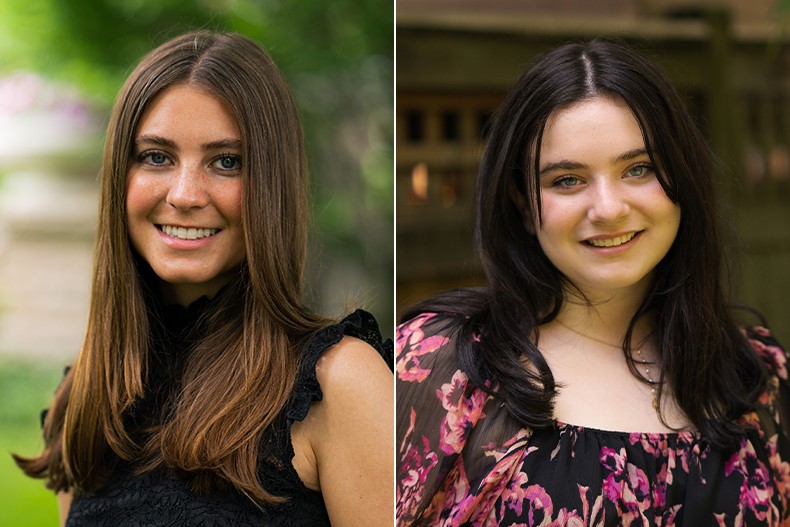
Two local teens win national recognition
Recipients of the annual Diller Teen Tikkun Olam Awards
Read more -

Celebrating six young award winners cultivating the community
Introducing young adult award winners
Read more -

Parenting in the age of social media: Focus on Netflix's '13 Reasons Why'
Jenna Cohen
Spurred by the highly controversial Netflix series 13 Reasons Why , Springboard, Teens@JUF , Jewish Child & Family Services (JCFS), and Madraigos Midwest hosted two parent programs about “Parenting in the Age of Social Media.”
Both events, hosted at Anshe Emet Synagogue in Lakeview, and then repeated at Congregation B’nai Jehoshua Beth Elohim (BJBE) in Glenview, featured a panel of experts from the Jewish community who spoke on the topics of adolescent development, and mental and spiritual health in the digital age.
Based on the 2007 novel by Jay Asher, 13 Reasons Why depicts the carefully plotted suicide of teen protagonist Hannah Baker, who, prior to taking her own life, records a series of 13 cassette tapes identifying individuals whom she deems responsible for her death. The reasons Hannah cites in her tapes range from arguments over boys, to sexual assault, to indifferent mental health professionals who ignore her when she expresses suicidal feelings.
The series, according to executive producer and actor/singer Selena Gomez, is meant to take on the topics of bullying and assault, demonstrating the cumulative and lasting effects of seemingly small, every day aggressions. However, experts argue that 13 Reasons Why conveys another, very dangerous message: that suicide is not only a reasonable answer to one’s suffering, but that through suicide, a person can gain closure and the upper hand over those who cause them pain.
Suicide is the second leading cause of death for individuals between the ages of 10-24. This message, among others, puts young adults at risk of committing “copycat suicides” and self-harmful behaviors.
Ultimately, 13 Reasons Why is an extremely grave and graphic show, with themes that most adolescents do not have the tools to process on their own. According to panelist Tracey Lipsig Kite, LCSW, social worker at Jewish Child & Family Services, the issues are particularly challenging for teens, as “adolescents have a harder time exerting cognitive control in dangerous situations” because their prefrontal cortex (the part of the brain that controls logical thinking) is at its slowest stage of development.
This leaves middle and high school students without adequate tools to address the social, academic, and hormonal stressors facing them during adolescence, putting them at risk for irrational behavior when processing their emotions.
“There is extraordinary pressure on them to succeed and achieve,” says Robin Stein, LCSW, director of Response Center, “and all of those factors can lead to stress.” Moreover, the cumulative effect of those stressors can be compounded by the ever-presence of social media; wherever a smart phone can go, school work, troubled relationships, cyberbullies and other difficult-to-process issues can follow.
In the digital age, it is especially important for parents to “set limits while still honoring their [child’s] autonomy, in age-and person-appropriate ways,” explains Lipsig Kite. Similarly, approaching the subject of 13 Reasons Why requires parents to demonstrate both authority over and respect for their children.
“If you can,” explains Dana Hirt, founder of Dana Hirt Parenting, “I believe it is the best scenario for you to watch [ 13 Reasons Why ] with your kids…even if they’ve already seen it…Take time to watch an episode at a time and explore the themes with your kids.” Pausing the show after powerful scenes, and limiting viewings to one episode at a time, allows parents to control the way in which the show is viewed while also leaving room for discussion. “Don’t be afraid to share your thoughts with your kids; be honest,” assures Hirt, “you don’t have to know all of the answers.”
“When you have a show this dynamic, this engaging, this graphic, it gives us quite an opportunity to have some very serious conversations,” says Rabbi Yehuda Polstein. “We are commanded as a people…to ‘guard your soul’…your overall mental and spiritual well-being,” continues Polstein, who believes that never before has that goal been more attainable to the Jewish people than it is today. “Every month there are more programs, more services available to our children,” to support them as they grow and develop,” he says. ‘” Lo alecha ham’lacha ligmor ‘-it is not your job to do alone.”
13 Reasons Why raises many difficult issues, and the greater Jewish community has the resources to help families address those questions together.
To view the recording of the first panel, visit: https://youtu.be/Af4kIkme35o
This event is sponsored by Springboard, Teens@JUF , Response Center, JCFS, Madraigos Midwest, Congregation B’nai Jehoshua Beth Elohim, Am Shalom, Am Yisrael, Beth Hillel Congregation B’nai Emunah, Congregation B’nai Tikvah, Darchei Noam of Glenbrook, NSS Beth El, North Shore Congregation Israel, Congregation Solel, KAM Isaiah Israel, Congregation Rodfei Zedek, Moriah Congregation, Shir Hadash Reconstructionist Synagogue, Akiba Schechter Jewish Day School, Bernard Zell Anshe Emet Jewish Day School, Chicago Jewish Day School, Solomon Schechter Jewish Day School, National Council of Jewish Women Chicago North Shore Section, BBYO, NCSY, NFTY, USY, CFJE, JCC, Moving Traditions, and No Shame on U.
Jenna Cohen serves as Grants and Planning Associate for Jewish Child & Family Services and is a freelance writer living in the Chicago area.
Other stories
-
Two local teens win national recognition
Recipients of the annual Diller Teen Tikkun Olam Awards
Read more -
Celebrating six young award winners cultivating the community
Introducing young adult award winners
Read more -
As efforts to overhaul health care move through Congress, Jewish organizations, including JUF, the Jewish Federations of North America and the Jewish Council for Public Affairs , are raising concerns over proposed massive cuts to the Medicaid program that appear in both the U.S. House and Senate bills — and urging action.
“Medicaid represents over $208 million in federal funding that comes into the Chicago-area Federation system every year,” said David Golder, chair of JUF’s Government Affairs Committee. “It is a vital program that funds health care, behavioral health services, nursing home care, and services for at risk youth and people with disabilities and must be protected.”
Concerns over the future of the Medicaid program took center stage during both JUF’s 2017 agency advocacy missions to Washington, D.C. , and Springfield , as changes to the federal health care bill will ultimately have a significant impact at the state level.
Based on nonpartisan Congressional Budget Office cost estimates, conservatively, Illinois could be facing the loss of at least $40 billion in federal Medicaid funding over 10 years under the House bill. Additionally, the Commonwealth Fund has projected that the bill passed by the House would result in the loss of coverage for 23 million nationally and a loss of 46,000 jobs in Illinois alone. Urban safety-net hospitals, such as Mount Sinai Hospital, and rural health systems are especially vulnerable to the proposed changes.
“What is being proposed by the House of Representatives includes a 25 percent cut in Medicaid over 10 years and, unfortunately, what is being proposed in the Senate’s version would be even more damaging to our community’s ability to serve our most vulnerable members,” said Emily Sweet, executive director of JUF’s Jewish Community Relations Council and Government Affairs department. “These type of cuts would be devastating not only to our affiliated agencies, such as Sinai Health System, CJE SeniorLife, Jewish Child & Family Services and Keshet, but to the millions of Illinoisans, including 1.5 million children, whose overall health and well-being depends on the Medicaid system.
“Although we recognize the economic concerns associated with the ACA, rolling back Medicaid is not the solution,” she continued. “As the number of uninsured people rises, as expected under the current proposals, states will face an even greater economic burden in the long run. The proposed cuts would also place additional strain on Federation agencies, which are already stretched due to the state’s fiscal crisis.”.
Services provided by JUF’s agencies under the Medicaid program include long-term care and community-based care services for older adults, primary care services for children and adults with developmental and intellectual disabilities, and the full range of inpatient and outpatient medical care and rehabilitation services provided by Sinai Health System.
Proposals included in the bills would have devastating effects on Illinois .
First is the rollback of Medicaid expansion. Illinois and seven other Medicaid expansion states will be hit particularly hard by the Senate version because Illinois has laws on the books that automatically remove the Medicaid expansion program if the federal government decreases what it pays towards Medicaid.
This means that 650,000 adults covered by Medicaid will be at risk should they cycle off of Medicaid, because, for example, if they got a job with health insurance, they will not be allowed to re-enter should they lose their health insurance. Approximately 50 percent of the Medicaid expansion population cycles off in a year.
Second, under the current proposal, the federal government will decrease the amount of Medicaid dollars given to Illinois, triggering the removal of the Medicaid expansion. An equally significant problem, the bill includes limiting or capping the total amount of Medicaid dollars that would go to the states every year.
Currently, in Illinois, the federal government matches a percentage of every state dollar that is put into the Medicaid pot. Under the current proposal, costs would shift to states as health care costs — and the numbers of people needing Medicaid due to our aging population — increases.
For Illinois, this would be especially problematic. With a current backlog of $14 billion in unpaid bills and a structural deficit of approximately $6 billion, Illinois is unlikely to be able to fill the gap between what the federal government pays now and what they would pay in the future under a capped funding structure.
“Whether the proposed cuts to Medicaid begin in 2020 as included in the House-passed bill or are phased out over four years as provided in the Senate bill, both proposals would have a devastating impact on our agencies and the people they serve,” said Lisa Shuger Hublitz, director of JUF’s Washington, D.C. Office.
Golder added, “This program provides vital health and behavioral health services to some of our community’s most vulnerable and we must do all we can to protect it. With such steep cuts projected, there is no way private philanthropic dollars can cover the difference.”
Other stories
-
Two local teens win national recognition
Recipients of the annual Diller Teen Tikkun Olam Awards
Read more -
Celebrating six young award winners cultivating the community
Introducing young adult award winners
Read more -
Concern over looming budget, Medicaid cuts grows for local service agencies
Meredith Leon
“The good news,” began JUF Government Affairs Committee Chair David Golder at the group’s June 19 meeting, “is that we have Tony Arnold, National Public Radio’s state political reporter and Roberta Rakove, Sinai Health System’s senior vice president for external affairs as our speakers. There is no other good news.”
Golder went on to outline the impact that two years without a budget has had on Illinois, which includes mounting debt, being downgraded to near-junk bond status, a crumbling human service infrastructure, and most recently the closure of the lottery and road projects.
Arnold discussed next steps towards resolving the budget crisis, beginning with the convening of a “special session” of the General Assembly, which began June 21. There is still much speculation about what will force the Speaker and the Governor to reach an agreement.
One possible tipping point is the recent ruling from Judge Joan Lefkow of the U.S. District Court for the Northern District of Illinois on the $2 billion in unpaid Medicaid bills. Medical providers sued the state, demanding payment; now, per the judge’s order, attorneys for the State and those representing Medicaid recipients must negotiate how payments will go forward.
Lefkow asserted that the delayed payments, now more than seven months late, are beginning to limit Medicaid recipients’ access to care, an essential part of the original court order.
“It will be interesting to see if the money that currently goes to education and pensions or the debt service will be redirected to Medicaid,” Arnold said. “Without a budget, there are no easy options.”
Attention was then turned to the proposed federal American Healthcare Act (AHCA), specifically the potential changes to the Medicaid program, which currently provides $208 million in federal funding to many of the Jewish Federation’s health and human service agencies. The changes listed in the AHCA will result in the loss of 46,000 jobs and $40 billion dollars in federal funding in Illinois over the course of 10 years, and will put many of the services currently being provided by JUF agencies at risk.
The language of the bill, released by the Senate on June 22, confirmed what Rakove has speculated: 23 million people would lose their healthcare, leaving more people without coverage than before the Affordable Care Act was passed; it would be more difficult for people with preexisting healthcare conditions to receive medical care; the lifetime cap would be reinstated; and the federal share of Medicaid dollars would decrease.
Rakove’s concerns are being echoed by other national Jewish organizations including Jewish Federations of North America and the Jewish Council for Public Affairs, which are opposing the proposed changes to the Medicaid program due to the devastating impact they would have on millions of vulnerable Americans.
The meeting then shifted to a discussion of how President Trump’s proposed fiscal year 2018 budget would impact Jewish Federation agencies and the economically disadvantaged populations Federation serves. JUF Washington, D.C. Office Director Lisa Shuger Hublitz highlighted the key areas of concern.
Under this budget proposal, by 2027, the cuts to programs and services that states and localities deliver would reach as much as a $453 billion loss, or 37 percent of state budgets. In 2027, the total cut in four major entitlement programs — Medicaid, Temporary Assistance for Needy Families, Supplemental Nutrition Assistance Program (SNAP) and the Social Services Block Grant — would reach approximately $346 billion.
“Essentially, the president’s proposed budget is a big cost shift to the states,” Hublitz said, “which would force states to significantly scale back or eliminate services for children and families, seniors and people with disabilities.”
In addition to the cuts in the Medicaid program, another funding stream at risk is the Emergency Food and Shelter Program, which is slated for elimination. This program provides emergency food assistance, temporary shelter, and rental and utility assistance to households, and is a significant source of funding to JCFS, CJE SeniorLife, The ARK, and EZRA Multi-Service Center.
Furthermore, anticipated cuts of $150 million from the Office of Refugee Resettlement will impact refugee resettlement work done through JUF’s state contract and HIAS Chicago, which funds job training, counseling and rental, food and transportation assistance for newly arrived refugees.
“Although this proposed budget is viewed mostly as a ‘messaging’ document and the starting process of negotiations, we must remain vigilant,” Golder said. “With work locally and through JUF’s Washington, D.C. office we will continue our advocacy efforts with the Illinois congressional delegation urging members to protect these vital programs.”
Meredith Leon is the JUF Lewis Summer Intern in Public Affairs.
Other stories
-
Two local teens win national recognition
Recipients of the annual Diller Teen Tikkun Olam Awards
Read more -
Celebrating six young award winners cultivating the community
Introducing young adult award winners
Read more -
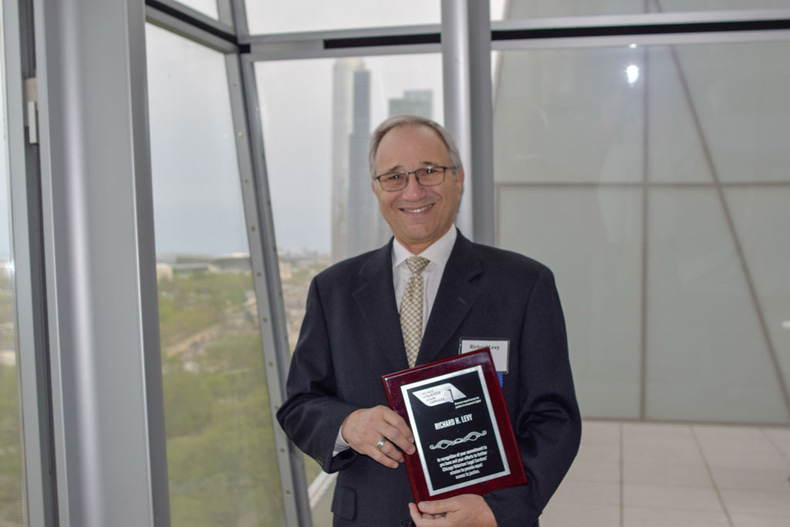
Chicago attorney Richard Levy was honored by Chicago Volunteer Legal Services (CVLS) for his “dedication and exemplary work.” An expert in real-estate law, Levy helped many people who could not afford an attorney with landlord-tenant issues, foreclosures, and evictions. CVLS’s mission is to coordinate, support, and promote voluntary, pro bono legal representation of the Chicago area’s poor.
Levy served as Vice President and General Counsel of Lexington Homes and has been a frequent lecturer on real estate and construction matters. He volunteers with JUF’s Community Legal Services (JCLS), which provides those in need of legal services with access to free, and much-needed, representation. JCLS is staffed entirely by volunteer attorneys like Levy, who donate their time to provide pro bono legal assistance in civil matters. Levy was nominated for the CVLS honor by JCLS, part of JUF’s TOV volunteer network; many of its attorneys are recruited through JUF’s Lawyers’ Division.
In nominating Levy for the honor, JCLS Director Sima Blue wrote that, “Each of his clients has come away with a deep respect and admiration for his skill, advice and compassion. The clients view him as kind, empathetic, and as easy to talk to as a member of their own family. He understands that his clients rely on him, and he feels that he owes them all the time and expertise that he can bring to their cases; he has a level of commitment to his clients that is unrivaled.”
Levy explained that the cases he takes for JCLS often involve people who cannot afford to stay in their houses or apartments due to lack of funds. He is often able to help them stay there, he said, at least until they find other places to live. Levy can also help people start over with no debt to their landlords or mortgage holders – a “clean slate,” as he put it.
He began volunteering, he said, “because the law has been very good to me, and because I felt it was important to give back to the community, especially the Jewish community.”
Levy added that he derives “a huge amount of satisfaction” from his pro bono work, saying that “helping people… during a rough spot in their lives, through no fault of their own, is enormously satisfying. It means a lot to me.”
To learn more, contact JUF Community Legal Services at (847) 568-1525 or email [email protected] for more information.
Other stories
-
Two local teens win national recognition
Recipients of the annual Diller Teen Tikkun Olam Awards
Read more -
Celebrating six young award winners cultivating the community
Introducing young adult award winners
Read more -
8 Chicago-area students picked for Jewish United Fund Israel Experience scholarships
Eight outstanding Chicago-area students have been chosen to receive 2017 Israel Experience Merit Scholarships from the Jewish United Fund of Metropolitan Chicago.
The awards – which go to high school, college and graduate students to age 23 who demonstrate significant leadership skills – are designed to encourage the development of Jewish identity, nourish greater commitment to Israel and the Chicago Jewish community, and recognize future leaders. The $1,000 scholarships can be used toward any approved Israel Experience program.
The Naftali Steinfeld Merit Scholarship recipients are:
- Tahlia Altgold, Skokie, Niles North High School
- Zev Blumenthal, Skokie, Niles North High School
- Eliana Feifel, Chicago, Hanna Sacks Bais Yaakov High School
- Nesanel Gutstein, Lincolnwood, Fasman Yeshiva High School
- Jamie Hendler, Highland Park, Washington University
- Jesse Hunt, Chicago, Fasman Yeshiva High School
- Taliah Soleymani, Skokie, Ida Crown Jewish Academy
- Ariella Zwelling, Skokie, Ida Crown Jewish Academy
The winners were selected from more than 20 outstanding, dedicated teens and young adults for their involvement in multiple activities (Jewish and secular), their leadership roles, and their ability to be role models for their peers.
Steve Schreiber, chair of the Scholarship Committee, said, “The award recipients all are inspiring young leaders who are setting examples of how to be engaged in the Chicago Jewish community and in Israel. I’m pleased to recognize each of them for their contributions and excited for what they will continue to accomplish in the future.”
For more information about the JUF Israel Experience Merit Scholarship Program, visit www.juf.org/meritscholarship .
Other stories
-
Two local teens win national recognition
Recipients of the annual Diller Teen Tikkun Olam Awards
Read more -
Celebrating six young award winners cultivating the community
Introducing young adult award winners
Read more -
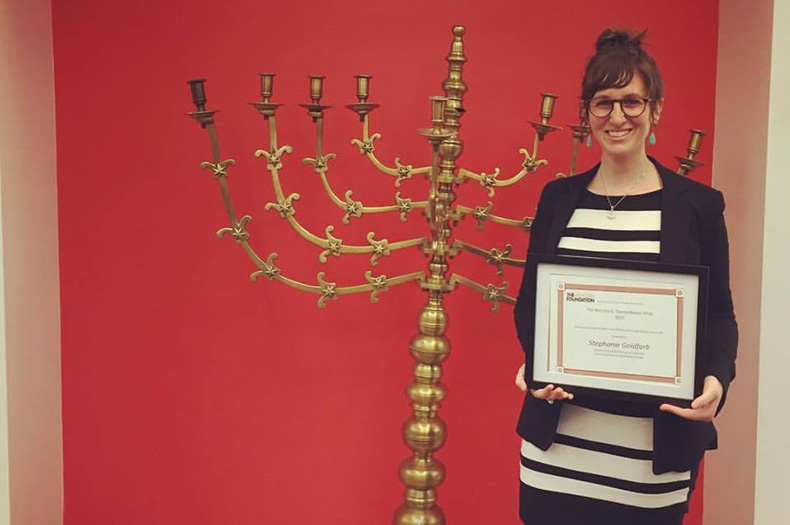
JUF’s Stephanie Goldfarb awarded Hadassah Foundation’s Bernice S. Tannenbaum Prize
Stephanie Goldfarb, JUF’s program director for youth philanthropy and leadership, has been awarded The Hadassah Foundation’s 2017 Bernice S. Tannenbaum Prize.
The national honor recognizes emerging professionals who have made innovative contributions to advance the status of women and girls in Israel and the United States.
The Foundation noted that, during seven years at JUF, Goldfarb has expanded Voices: The Chicago Jewish Teen Foundation , a philanthropy program for Jewish teens that awards more than $50,000 annually to local and Israeli non-profits, and brought the innovative feminist Research Training Internship program for Jewish girls to the Chicago region.
“As the newest Bernice S. Tannenbaum Prize winner,” Goldfarb said, “I not only feel a sense of unity with the women who recognized my commitment to social change for Jewish women and girls, I also feel as though I have an army of forward-thinking sisters behind me, pushing me to continue growing personally and professionally.”
“Stephanie Goldfarb is a talented, charismatic educator, filled with talent and passion,” said Julie Morris, chair of the Foundation. “Bernice Tannenbaum would be so proud of the Foundation’s selection.”
The prize provides $500 in general operating support to JUF, as well as $2,500 to further Goldfarb’s professional development.
In addition to her work for JUF, Goldfarb serves as a resource to other community organizations serving teens. She has run “philanthropy boot camps” at summer camps and for BBYO programs serving Jewish youth, “taste of philanthropy” programs at congregations, and provided trainings for other Jewish professionals about philanthropy, LGBTQ issues, and experiential Jewish education.
She also has run programs on Jewish cooking, which takes advantage of her experience as an award-winning chef who has appeared on multiple Food Network and NBC shows. And she created and runs the Seven Species Supper Club, a monthly underground dinner club where she prepares a unique menu and donates all proceeds to local charities.
Other stories
-
Two local teens win national recognition
Recipients of the annual Diller Teen Tikkun Olam Awards
Read more -
Celebrating six young award winners cultivating the community
Introducing young adult award winners
Read more -

Deerfield resident Jay Tcath arranged for the Deerfield High School Lacrosse Team, through Coach Chip Seiple, to donate thousands of dollars of used and surplus equipment to a just-forming lacrosse team for at-risk youth in the Israeli town of Kiryat Gat.
The equipment was delivered for the Jewish United Fund in early June by Tcath, JUF’s executive vice president, as well as Highland Park residents Michael and Ellen Steinberg and Glencoe resident Scott Bakal, among others.
Other stories
-
Two local teens win national recognition
Recipients of the annual Diller Teen Tikkun Olam Awards
Read more -
Celebrating six young award winners cultivating the community
Introducing young adult award winners
Read more -
Moishe House: Bringing Judaism home for the next generation
MIMI SAGER YOSKOWITZ
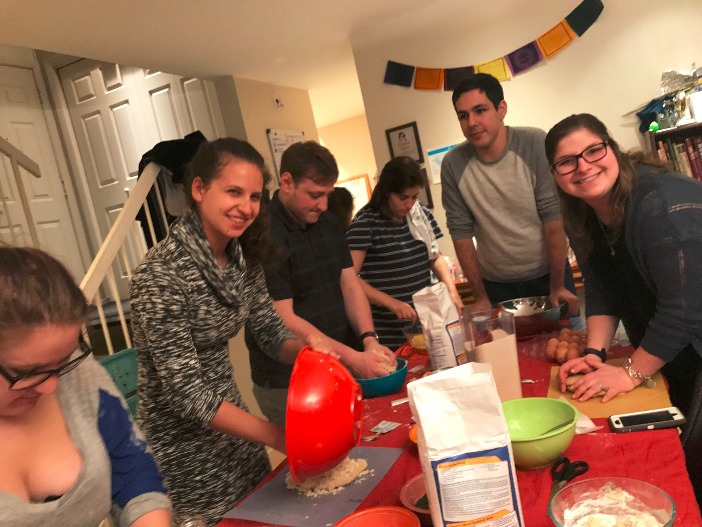
On a rainy night in spring, I joined a group of millennials in the Old Town neighborhood of Chicago to make challah.
We all came together by way of Moishe House, an organization connecting young Jewish adults through pluralistic, home- based programming. The residents of the Old Town Moishe House often host large Shabbat dinners they cook themselves. Their challah is renowned in their community thanks to Jimmy Casen, an Old Town Moishe House resident and JUF Young Leadership Division board member. It turns out he got the recipe from a member of my own suburban synagogue, highlighting the links among Jews, which is the essence of Moishe House.
“For so many young adults… if you ask them are you Jewish, they will emphatically say yes, but they don’t feel a connection to any sort of community per se,” said Larry Gast, Moishe House’s Vice President of Development. “This is why Moishe House exists: To give them a space to come to feel connected to something bigger.”
Moishe House originated in San Francisco in 2006 when its founders realized they could turn their Shabbat dinners into something bigger for young Jews all over the world. Today, Moishe House has 100 residencies around the globe.
According to an internal database, Moishe House Chicago has had more than 30,000 people in total attendance since opening its first house in 2007. Today there are five Moishe House residencies in Edgewater, Lakeview, Old Town, Wicker Park, and Lincoln Park, home to the Russian Speaking Jewish (RSJ) Moishe House.
“When we have Shabbat on Friday, you get 90 percent Russian speakers. Even the jokes are in Russian. There’s cultural things that differentiate each part of this world, and Russian people are slightly unique in what they expect and what they want to achieve,” said Ricky Lekakh, an RSJ Moishe House resident.
Each Moishe House is home for three to five residents, who receive a housing subsidy and program funding from the organization. Residents plan five to seven monthly events for their communities. Programs fall into one of the following categories: Jewish learning, Jewish culture and holidays, repair the world, or social. While Moishe House staff provide guidance as needed, their goal is to give residents the tools to be “autonomous.”
“We really want to empower them,” said Eve Lowinger, outgoing Moishe House Midwestern Regional Director. “The most important thing, and a line we like to use is, ‘it’s people, not programs.’ We invest in the residents and having quality people living in these homes who are stars.”
To become a Moishe House resident, candidates apply as individuals and as a group with those they want to live with in the Moishe House. Staff members then interview potential residents to ensure they are ready to live together and handle the responsibilities involved.
Residents find their own housing, but they may be given certain neighborhoods to choose from depending on their city’s needs and circumstances. A large common area is necessary for a Moishe House, since residents host community members frequently. Smaller events can have eight to 13 people, while Shabbat dinners can attract as many as 45 to 60 people. Before opening up a new Moishe House, the organization works to ensure that it has the necessary funding.
“Overall, any Moishe House we are operating, we like to be at least 75 percent locally supported by the community so that the house is sustainable, and that’s why we strive to have relationships with JUF,” Gast said.
A JUF Breakthrough Fund grant enabled the Wicker Park Moishe House to open last year. JUF also supported the Moishe House in Kyiv, Ukraine, from 2010 to 2015. In return, Moishe House residents attend phonothons, organize a table at YLD’s Big Event, host YLD Leads programs, and partner with JUF’s TOV Volunteer Network for community programs. This past Chanukah, the RSJ Moishe House co-hosted a party with JUF’s Russian Jewish Division.
“We care about the fact that JUF has invested in us and we want to invest back in them,” Casen said.
All five of the Moishe House locations came together this past Purim to throw a big bash for all of their different communities. Residents donated money raised from ticket sales to Maot Chitim, a JUF agency that delivers food to those in need. More than 100 Jewish young adults gathered in costume at Y Bar in River North.
“Everyone intermingled no problem. It wasn’t cliquey. It wasn’t like each little house bubble on their own. It was like one community, and it was amazing,” Casen said.
Inclusiveness is a theme I heard repeatedly from all the different Moishe House residents and community members. Even a 41-year-old reporter and mother, far outside the proscribed age range of Moishe House, was made to feel welcome. As I joined community members at the table that spring night, I felt as if I were among old friends, though I didn’t know a soul. My fellow challahmakers helped me with the various steps while we chatted about the Shamrock Shuffle. These young Jewish adults embodied the mitzvah of welcoming the stranger.
As Lekakh of the RSJ Moishe House said, “It’s truly an open door… We’ve seen people in here who we’ve never known, but we automatically feel comfortable with them because we have something in common.”
Mimi Sager Yoskowitz is a Chicago-area freelance writer, mother of four, and former CNN producer. Her work has been featured on various sites including Kveller, Brain, Child Magazine, and in the anthology, “So Glad They Told Me.” Connect with her at mimisager.com.
Other stories
-
Two local teens win national recognition
Recipients of the annual Diller Teen Tikkun Olam Awards
Read more -
Celebrating six young award winners cultivating the community
Introducing young adult award winners
Read more -
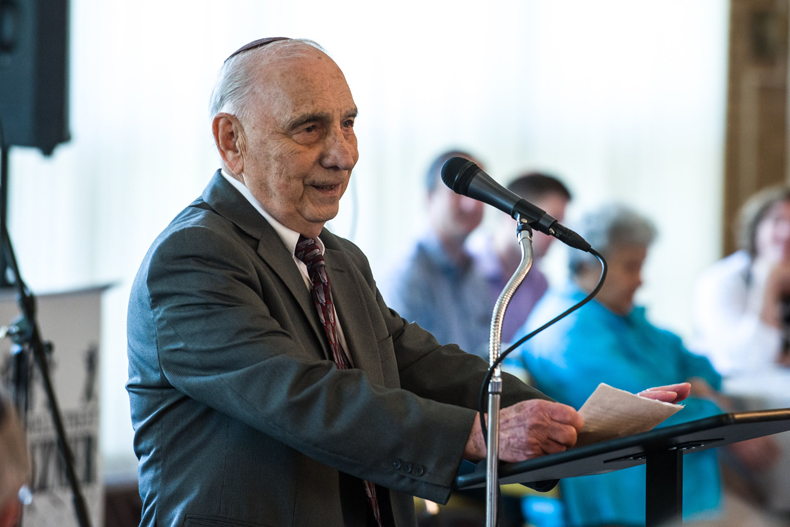
Charles Lipshitz dedicated much of his life to preserving the memory of the Holocaust, its victims, its survivors — and its lessons.
He founded Sheérit HaPleitah (literally: “Remnants of the Destruction”), the umbrella organization of Chicago-area Holocaust survivors groups, which he ran for many years. From the ashes of the Holocaust, Lipshitz and Rene — his wife of 65 years — raised a son and daughter, grandchildren and great-grandchildren.
Lipshitz died this week at age 88; interment was in Jerusalem.
“I will remember Charlie as a man of deep convictions concerning the lessons of the Holocaust and the need for a strong Israel,” said JUF President Dr. Steven B. Nasatir.
Lipshitz was born in Lodz, Poland. He remembers the Germans incarcerating the Jewish community in the ghetto in 1939, which capped his formal education at five years. In 1942, his bar mitzvah year, the Germans deported most of the children and elderly from the ghetto. Lipshitz hid in an attic. First, his father was sent to Auschwitz. Then, in 1944, Lipshitz, along with the rest of his family, was deported there when the ghetto was liquidated.
As a young teen, he and his brother survived three concentration camps, a death march, starvation, and sickness, to be liberated on April 15, 1945. Out of a family numbering more than 200 people, only his brother and a cousin survived. Lipshitz spent the next five years working in Hanover, Germany, then moved to Chicago to rejoin his brother.
Charles and Rene, also an Auschwitz survivor, married in 1952. As they raised their family, Lipshitz built his businesses, first Lipshitz Sales and then R&L Specialty, an industrial linen supply service.
“Freedom in America gave us new lives and enabled us to start again,” Lipshitz said. “We built beautiful families and we are dedicated to living good lives. We are proud to be from a group that came from so little and achieved so much. We survived the impossible, and are determined to continue. We wanted to show our enemies that, no matter how they try to hurt the Jewish people, we will come back stronger. We stand strong with our families and future generations.”
Lipshitz also became active in the community. He was honored in 1968 by Israel Bonds. He became a leader in the fight to prevent neo-Nazis from marching in Skokie in 1977. He chaired the committee to create a Holocaust Memorial in Skokie, which was dedicated in 1987 on the Skokie Village Green, on land donated by the village, and with funds donated by individuals, synagogues and JUF. Its plaque reads: “This monument will remain in perpetuity as a reminder of what hate can do to mankind if decent people are not vigilant to forestall such a calamity in the future.”
As president of Sheérit HaPleitah, he organized fundraisers for JUF among his member organizations, and twice chaired JUF Snowbird events in Florida with Rene. His family’s charitable foundation, which was established through JUF, has donated to special projects in Israel. In 2008, his family commissioned a Torah and dedicated it at a local synagogue in memory of his and his wife’s parents, who perished in the Holocaust.
“Charlie and Rene have a tremendous sense of community, which they have imparted to their children and grandchildren,” said Jeffrey Cohen, senior development advisor for JUF, who became a good friend of Lipshitz over the years. “It is remarkable how much he and so many other survivors have achieved in this country.”
Aside from the statue in Skokie, Lipshitz ensured that Sheérit HaPleitah built monuments in time. Every year since 1945, the organization held Holocaust memorial services — JUF a co-sponsor for many of them — honoring victims, survivors and liberators. These memorials have become the largest annual gatherings of Holocaust survivors in the Midwest and one of the largest in the U.S.
“This annual memorial honors the memory of our 6 million martyrs, including 1 and a half million innocent children who perished only because they were Jews,” Lipshitz explained. “Many reactionary forces are hard at work to change history and deny that the Holocaust ever happened. We must be vigilant not to allow this to occur.”
Lipshitz’s grandson, Yaakov Katz, editor of the Jerusalem Post , has spoken on behalf of JUF in Chicago and Florida and supports JUF’s fundraising efforts in Israel.
Katz, who has received a fellowship from Harvard, called his grandfather “one of the smartest people I know. He has a tremendous sense of optimism, which led him to build up in this country what was torn down in the war.”
Lipshitz, 88, was predeceased by his wife, Rene. He is survived by his children, Debbie Katz and Leon Lipshitz, and many grandchildren and great-grandchildren. Burial was in Jerusalem on Har Menuchot.
Other stories
-
Two local teens win national recognition
Recipients of the annual Diller Teen Tikkun Olam Awards
Read more -
Celebrating six young award winners cultivating the community
Introducing young adult award winners
Read more -