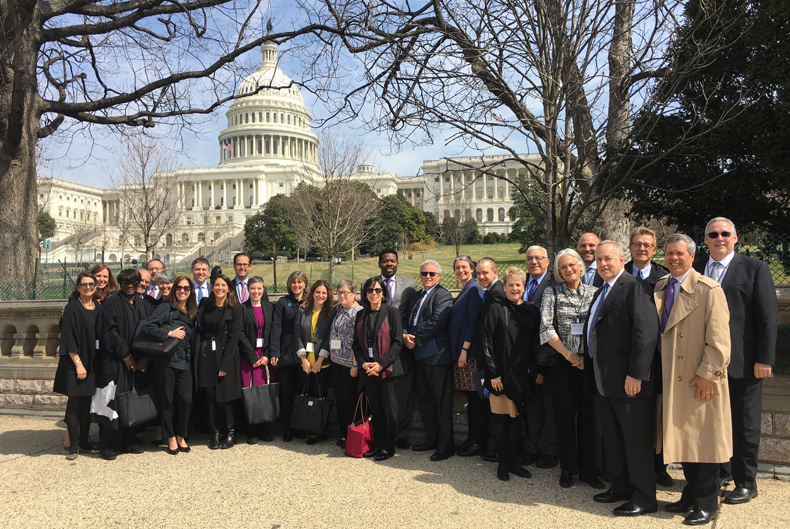
Medicaid, refugee resettlement and nonprofit security among top priorities of annual DC advocacy mission
Twenty-nine Jewish Federation of Metropolitan Chicago agency professionals, volunteer leaders, and senior professional staff participated in the annual Government Affairs Agency Advocacy Mission to Washington D.C. on March 21-22 during a particularly eventful week for Congress.
During the two-day fly-in, mission participants voiced support for pressing domestic policy issues such as Medicaid and the Refugee Resettlement Program. They also advocated for federal funding for the Nonprofit Security Grant Program (NSGP), the Holocaust Survivors Assistance Program, and the Emergency Food and Shelter Program, all of which directly impact the Jewish Federation, its affiliated agencies, and the people they serve.
Participants received briefings from policy experts and met with members of the Illinois Congressional delegation to stress the importance of protecting these safety net programs, which infuse millions of federal dollars into the Federation system each year.
Co-chaired by Government Affairs Committee Chair David Golder and Vice Chair Janna Berk, the mission also included participants from the JUF Board of Directors, CJE SeniorLife, Jewish Child and Family Services, HIAS Chicago, Sinai Health System, Keshet, and the Dina & Eli Field EZRA Multi-Service Center.
Golder said, “At a time when serious policy changes are being considered in Washington, our group of agency professionals and volunteer leaders presented a compelling narrative about the strength of our network of services and how federal dollars are vital to our ability to provide services to vulnerable children, families, and seniors.
“Our regular presence in Washington enables us to strengthen relationships with elected and appointed officials, and continue to demonstrate our ability to leverage public and private philanthropic dollars to serve our community.”
During meetings with members of the Illinois House Delegation and their staff, participants stressed how people served by the Federation agencies and throughout Illinois would be impacted by proposed policy changes.
Roberta Rakove, Senior Vice President of Government Affairs at Sinai Health System, said, “When we signed up for the mission this year, we had no idea that this would be the ground zero week for health care in Washington. During this trip we had access to the whole Illinois delegation and were able to make the case for why Medicaid must be protected at a critical moment.”
The $208 million in Medicaid funding coming into Federation’s system each year allows Federation’s affiliated health care, home and community-based services and long-term care providers to care for the most vulnerable populations in Chicago-area communities.
Another focus of the trip was on Federation’s work in the area of refugee resettlement, and the importance of federal funding for the U.S. Refugee Resettlement Program. Participants expressed support for policies that promote national security and also embody the American and Jewish values of welcoming those fleeing violence and persecution.
“The D.C. mission once again reaffirmed for me the incredible unity and teamwork that exists across our community’s lay leadership and professionals,” said Howard Sitron, President and CEO of JCFS, which includes the refugee resettlement provider HIAS Chicago. “The ultimate impact on our lawmakers is never known as we go about this work. What is crystal clear is the collective energy and commitment of our community to work together on behalf of those we come together to serve. It is always an honor to join with this dedicated group of leaders.”
Mission participants also met with Sen. Tammy Duckworth and Sen. Dick Durbin’s staff, as well as House Minority Whip Steny Hoyer of Maryland and House Homeland Security Committee Chairman Rep. Michael McCaul of Texas to learn about their priorities for 2017, including McCaul’s priorities for the Homeland Security Committee and the Nonprofit Security Grant Program.
Other speakers included Dan Berger, acting assistant secretary for the Department of Health and Human Service’s Administration for Community Living, who discussed the administration’s priorities for seniors and people with disabilities.
CJE SeniorLife President and CEO Mark Weiner said the mission was a great opportunity to convey the impact his organization is seeing on the services it provides every day.
“Government funding for Medicaid and for Holocaust Community Services has a significant impact on CJE’s ability to serve people in our community,” Weiner said, “And this Mission gives us a chance to make our perspective known.”
Some progress has already been made on one item on the mission participants’ agenda. Shortly after the fly-in, Illinois Reps. Brad Schneider, Mike Quigley, Peter Roskam, Michael Bost and Jan Schakowsky joined Reps. Dan Lipinski, Robin Kelly, Bill Foster and Danny Davis in signing a letter to the House Appropriations Committee calling for an increase in funding for the NSGP.
McCaul also sent a letter to House Appropriations Homeland Security Subcommittee Chairman Rep. John Carter (Texas) requesting an increase for the NSGP in fiscal years 2017 and 2018.
“This trip was an outstanding opportunity to make Federation’s voice heard on a wide variety of policy issues that impact our community,” Berk said. “Our group consisted of a great mix of professionals and volunteers, and represented the full scope of Federation’s system.”
Other stories
-

Two local teens win national recognition
Recipients of the annual Diller Teen Tikkun Olam Awards
Read more -

Celebrating six young award winners cultivating the community
Introducing young adult award winners
Read more -
JUF praises bomb threat arrest, says security preparedness remains a top priority
The Jewish United Fund of Metropolitan Chicago is relieved that an arrest finally has been made concerning most of the bomb threats called to Jewish institutions throughout North America during the past few months. We praise Israeli officials for making the arrest and leading the investigation.
That the suspect holds dual Israeli and American citizenship is hard to fathom; however, very little is known at this time of this individual’s motivations, whether he acted alone or with others, and other critical facts. (He is reportedly Jewish and has a brain tumor.)
Meanwhile, rising anti-Semitism and the climate of fear it engenders, cannot and must not be attributed to any single source. Vandalism of Jewish cemeteries and synagogues, and public expressions of anti-Semitism on college campuses and other venues, also are occurring — and are attributable to diverse sources motivated by hate.
In today’s environment, JUF, its agencies, and the institutions we serve, must devote serious attention to the very real threats they face, as delineated by our partners in the FBI, Department of Homeland Security, and local police, to whom we are grateful. JUF, in coordination with those partners, continues to provide extensive, security-related services — including audits of facilities and funding to enhance preparedness of personnel and sites — to all requesting, qualified Jewish institutions in the Chicago area.
JUF also thanks our elected officials for their swift response — through resolutions, legislation, and special initiatives — to the increased threats and acts of hate.
Other stories
-
Two local teens win national recognition
Recipients of the annual Diller Teen Tikkun Olam Awards
Read more -
Celebrating six young award winners cultivating the community
Introducing young adult award winners
Read more -

Two restaurants in Champaign-Urbana will receive Kosher certification from Vaad Hoeir of St. Louis this spring and summer thanks to a kashering initiative led by Illini Hillel and the Orthodox Union Jewish Learning Initiative on Campus.
On the current list of restaurants in negotiation are Cold Stone Creamery in Champaign and the Dancing Dog in Urbana, with another local restaurant hoping to start the process as well.
“We as vegans have faced the difficulty of finding restaurants that meet our ethical standards,” Dancing Dog owner Brian Behrns said. “I understand those who follow a kosher diet would like to enjoy the same pleasures and conveniences that the general population may take for granted. If becoming Kosher can be mutually beneficial by providing ease of mind to the Kosher-keeping community, we are ready for the relationship.”
This initiative, spurred by the JLIC couple on campus with support from Hillel, is one of the first efforts to strengthen the accessibility of Kosher food in the state of Illinois outside the city of Chicago. The initiative will spread the availability of kosher food to students of the University of Illinois and the broader community of Champaign County.
“Having more Kosher establishments in town will make it easier for students to keep to their religious practices,” University of Illinois senior Solomon Lowenstein said. “Keeping Kosher is an aspect of Judaism that is important to many students, and the increase of Kosher options in the neighborhood makes us feel more connected to the community.”
Kashrut certification will be under the Vaad Hoeir of St. Louis with local supervision overseen by Rabbi Shlomo Schacter and partnerships overseen by Rebbetzin Ahava Schachter Zarembski and Hillel’s Executive Director, Erez Cohen.
“Eating is one of the basic social experiences as human beings,” Zarembski said. “We, the Jewish community, are thrilled to further build infrastructure in the Champaign-Urbana community to share good food with the broader community while staying true to the uniqueness of our tradition.”
Other stories
-
Two local teens win national recognition
Recipients of the annual Diller Teen Tikkun Olam Awards
Read more -
Celebrating six young award winners cultivating the community
Introducing young adult award winners
Read more -
Nearly 200 leaders of Chicago-area synagogues, day schools, agencies, summer camps, and other institutions attended a JUF Security Summit this week to learn about current security threats and preparedness.
Participants, representing about 80 community facilities, also learned of a new JUF matching grant program, which will provide annual grants of $10,000-$50,000 to enhance security at qualifying local Jewish organizations. The details of the grants and the online application process will be follow soon, so that funding for enhanced security measures can begin this spring.
Summit participants, who had completed surveys about their institutions’ risk exposure and needs, also heard from JUF security, planning, and funding personnel, as well as from FBI and Department of Homeland Security officials.
JUF’s traditional communal security roles include facilitating security audits of local Jewish facilities; convening security seminars; sponsoring senior Chicago Police commander missions to Israel; coordinating with every federal, state, and local law enforcement agency; helping secure $14 million in capital grants from the Department of Homeland Security; Investing millions throughout the Federation network for security operational expenses (non-capital); and helping establish and fund, on the national level, the Secure Community Network, which links all 200-plus North American Jewish communities into a coordinated security alert and assistance mechanism.
JUF Executive Vice President Jay Tcath looks at today’s Jewish security concerns in the context of the past and explains how JUF is playing a role in addressing them.
Other stories
-
Two local teens win national recognition
Recipients of the annual Diller Teen Tikkun Olam Awards
Read more -
Celebrating six young award winners cultivating the community
Introducing young adult award winners
Read more -
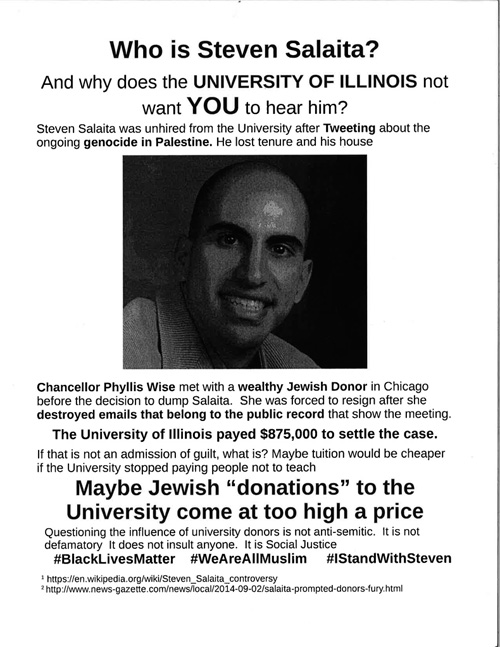
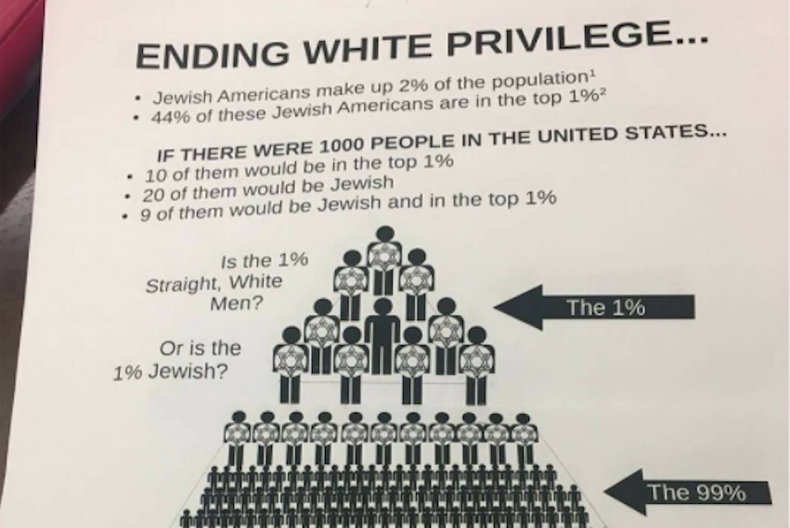
A series of fliers, comparing Zionism to Nazism, blaming Jews for oppression in America, and attacking American Jews for exercising their rights as citizens, were found on the campus of the University of Illinois at Chicago this week. The source of the messages, which included the phrase “Ending white privilege starts with ending Jewish privilege,” remains unknown.
The new messaging merges traditional, right-wing anti-Semitic tropes — that Jews control the world — with the progressive concern about oppression.
“These materials are sophisticated and show a dramatic increase in hate. They are meant to incite, create fear, and could encourage violence,” said John Lowenstein, JUF’s VP, Campus Affairs, and Executive Director, The Hillels of Illinois.

He said university administrators in Illinois and across the country have been to slow to respond.
“Their inability to recognize that anti-Zionism results in a dramatic increase in anti-Semitism is in part responsible for the increasingly hostile environment on campus for Jewish students,” he said.
Lowenstein explained that while universities have invested heavily in “diversity and inclusion” programs and departments with the best of intentions, too many efforts have mistakenly excluded an understanding of anti-Semitism.
“We need to recognize that the effort to deal with issues of race, gender, and ethnicity has paradoxically encouraged hatred of others, especially Jews. Too few universities have any training or programs to deal with anti-Semitism, and when it occurs, the perpetrators go unpunished.”
JUF’s Department of Campus Affairs regularly raises this issue with campus officials around Illinois. Lowenstein emphasized that while the messages are not a violation of free speech, they do violate university codes of conduct, and that while “just as universities have zero tolerance for racism, there should be zero tolerance for anti-Semitism.”
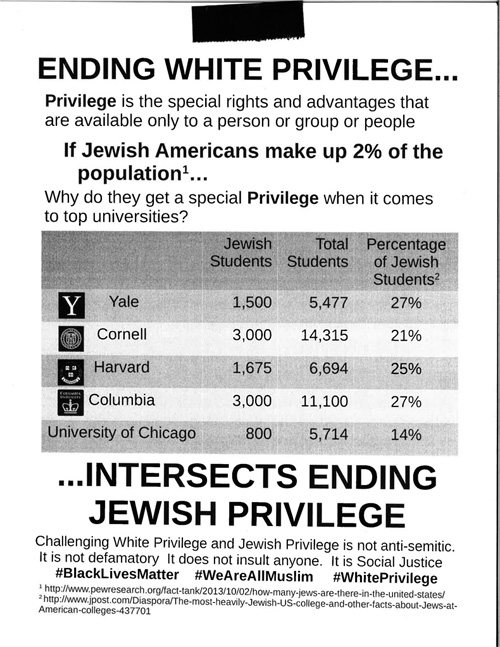
JUF and Metro Chicago Hillel praised UIC Chancellor Michael Amiridis for immediately and unequivocally calling the fliers anti-Semitic in a statement following the first appearance of the fliers this week.
“We have been warning campus officials that the Boycott, Divestment and Sanctions movement, as it becomes more aggressive, will also become more overtly anti-Semitic. We all need to recognize that BDS has the multi-faceted goals of demonizing Israel as well as all Jews,” Lowenstein said.
Lowenstein said he is not surprised at the tone and message of the posters at UIC, and expects more posters of this nature, on more campuses. “The messages represent a logical continuation of the hate we have seen both from the ‘alt left’ and ‘alt right’.”
JUF’s Department of Campus Affairs, Hillels of Illinois and Israel Education Center assist Jewish students deal with the impact of BDS on campus.
Other stories
-
Two local teens win national recognition
Recipients of the annual Diller Teen Tikkun Olam Awards
Read more -
Celebrating six young award winners cultivating the community
Introducing young adult award winners
Read more -
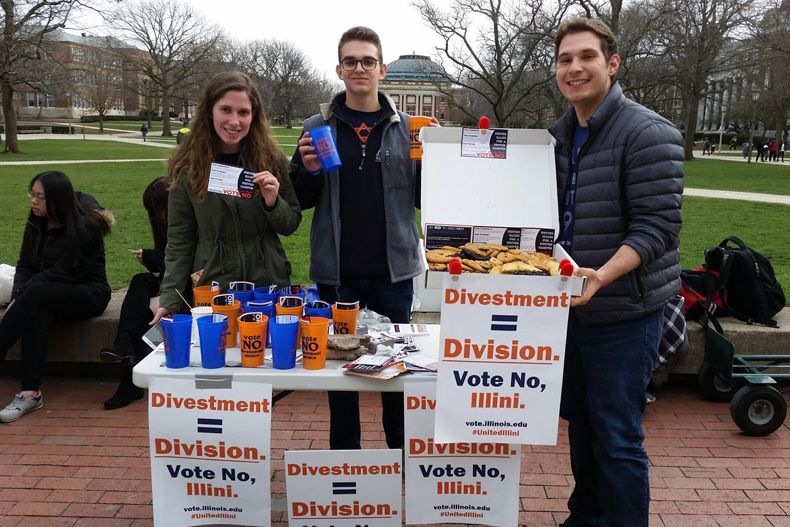
The University of Illinois at Urbana-Champaign’s student body last week rejected a referendum calling upon the University to divest from 16 companies doing business in Israel.
Last month, the UIUC chapter of Students for Justice in Palestine, in coalition with other groups, launched an aggressive campaign called “UIUC Divest,” demanding that the University divest from 16 corporations that they allege “are complicit in human rights violations.” The broader goal of the divestment campaign was to advance the Boycott, Divestment and Sanctions movement, which works to delegitimize Israel on university campuses.
Immediately after the launch of the divestment campaign, students formed the group United Illini for a United Campus to oppose this divisive effort and to promote a unified campus. Over the past month, United Illini put together an impressive, multi-pronged campaign and encouraged their classmates to vote no. Students canvassed the campus, created marketing materials, and held educational events.
Throughout the campaign, United Illini presented information in a nuanced, sophisticated way. Their efforts demonstrated that the UIUC Jewish community, though diverse, is unified in its opposition to efforts to divide their campus and delegitimize the Jewish state.
Even in the face of anti-Semitic attacks and cyber bullying, the students worked around the clock in consultation with Illini Hillel, JUF’s Israel Education Center, Israel on Campus Coalition, Israel Action Network, Hillel International, Chabad, and others to prevent the referendum from passing.
On March 7 and 8, in the hours immediately preceding the divestment vote, swastikas were spray-painted on university academic buildings, reflecting a disturbing trend in which BDS and anti-Israel activity lead to widespread anti-Semitism. Hillel and JUF are working with the University to address the increase in anti-Semitism that has infected not just U of I, but campuses across the country.
The experience inspired students to redouble their efforts to support Israel as a Jewish and democratic state within safe and secure borders, to promote peace and dialogue, and to continue to combat the deceptive and divisive efforts of the BDS campaign.
Other stories
-
Two local teens win national recognition
Recipients of the annual Diller Teen Tikkun Olam Awards
Read more -
Celebrating six young award winners cultivating the community
Introducing young adult award winners
Read more -
Anti-Semitic fliers calling for ‘ending Jewish privilege’ paper UIC campus
JTA
Fliers claiming that “Jewish privilege” is the key to social injustice in the United States were found on the campus of the University of Illinois at Chicago.
The fliers, found Tuesday and Wednesday in different locations, claim in bold letters that “Ending white privilege starts with ending Jewish privilege.” Citing survey data, the fliers then claim that 44 percent of Jewish Americans are in the “one percent,” or the top economic percentile in the United States.
“Is the 1% Straight, White Men? Or is the 1% Jewish?” the flier asks, showing a pyramid of stick figures in which the top of the pyramid is populated almost entirely with stick figures emblazoned with large Jewish stars. The bottom of the pyramid is labeled “The 99%” and “Goyim.”
Metro Chicago Hillel, which serves UIC, asked the university to investigate the fliers and convened a meeting Wednesday with the school’s dean of students. On Wednesday, the university released a statement condemning the flier and announcing that the administration will investigate.
“Today, anti-Semitic posters were found on campus that defame, insult and negatively portray Jewish members of our campus community,” the statement said. “Such actions do not reflect the values we hold as a community. Acts that invoke hatred or violence toward members of our community will not be tolerated on our campus.”
The 2009 Pew report recited in the flier, “Income Distribution Within U.S. Religious Groups,” shows that 46 percent of Jewish households have an annual income of $100,000 or more. According to some estimates, household income must be at least $350,000 to qualify for the 1 percent.
Other stories
-
Two local teens win national recognition
Recipients of the annual Diller Teen Tikkun Olam Awards
Read more -
Celebrating six young award winners cultivating the community
Introducing young adult award winners
Read more -
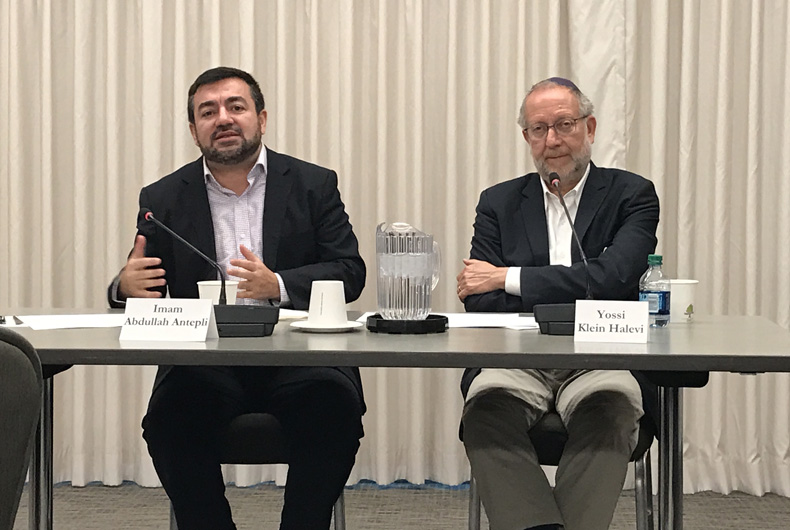
“What would it mean to have stronger, healthier relationships between American Muslims and American Jews?” That’s the question that Imam Abdullah Antepli and Yossi Klein Halevi have been asking themselves for many years.
Their answer has been the Muslim Leadership Initiative, a program of the Shalom Hartman Institute in Jerusalem that brings emerging American-Muslim leaders to Israel to explore how Jews understand Judaism, Israel and Jewish peoplehood. This summer, the number of graduates of the program will reach 100. Antepli, the Muslim chaplain at Duke University, and Klein Halevi, a journalist and author who made aliyah in 1982 from New York, co-direct the program.
The duo was in Chicago the week of March 13 to speak about the program and its potential and already-felt impact on Muslim-Jewish relations in America. They met with the editorial board of the Chicago Tribune , a group of 25 Chicago-area rabbis, Christian partners, about 50 organizational lay and professional leaders at JUF’s Jewish Community Relations Council, and also spoke to nearly 100 Jews, Muslims and others at the Union League Club on Wednesday, March 15.
MLI participants represent all the ethnic, racial and sectarian divisions among the U.S. Muslim community, Klein Halevi said. Although MLI graduates have faced backlash from their own co-religionists for participating, an increasing number of Muslim Americans also believe in the need to engage American Jews.
“Mainstream Muslims are largely ignorant of how Jews perceive themselves,” Klein Halevi said. “The same is true for Jews when it comes to understanding Muslims’ self-perception.”
While in Jerusalem, the participants study Jewish text, meet with Jewish journalists, academics and religious scholars, and explore Israel’s religious diversity. The program also includes in-depth examination of the impact on the identity of both Jews and Palestinians through the lens of the Israeli-Palestinian conflict. Participants travel to various cities in the West Bank, as well as to northern Israeli Arab communities, where they interact with Muslim religious leaders, educators, students and activists.
Reflecting on the impact of the program, MLI graduates report that the experience is often “life changing.” Challenged to confront deeply held beliefs, MLI participants gain a deeper sense of empathy for the Jewish connection to Israel.
Antepli says MLI graduates don’t come away as “Muslim Zionists.” Rather, the goal is to engage “serious people who understand the complexities of Jewish peoplehood, Judaism and Israel’s place in Jewish self-perception,” he said.
JCRC has placed a priority on creating opportunities for Chicago-area Jews and Muslims to engage each other.
“At a time when both communities are seeing a rise in bias-based incidents against them, working together is a prudent approach to combatting hate,” said JCRC Chair David T. Brown.
“The increase in anti-Semitic and anti-Muslim incidents in this country and around the world demand a clear rebuttal from our elected officials and faith leaders,” Brown said. “It also requires all of us to learn from and about one another in an atmosphere of mutual respect.”
Other stories
-
Two local teens win national recognition
Recipients of the annual Diller Teen Tikkun Olam Awards
Read more -
Celebrating six young award winners cultivating the community
Introducing young adult award winners
Read more -
City, county, state officials condemn hate, violence against Jews, others
Mara Ruff
As acts of anti-Semitism continue to rise across the country, city, county and state leaders are speaking out loudly against recent acts of hate that have targeted the Chicago metropolitan Jewish community.
Since January, over 160 bomb threats have been called into Jewish Community Centers and Jewish days schools throughout the U.S. and Canada. In the Chicago area, bomb threats have caused the evacuations at JCCs in Hyde Park and Lake Zurich as well as a Chicago Jewish Day School in Edgewater.
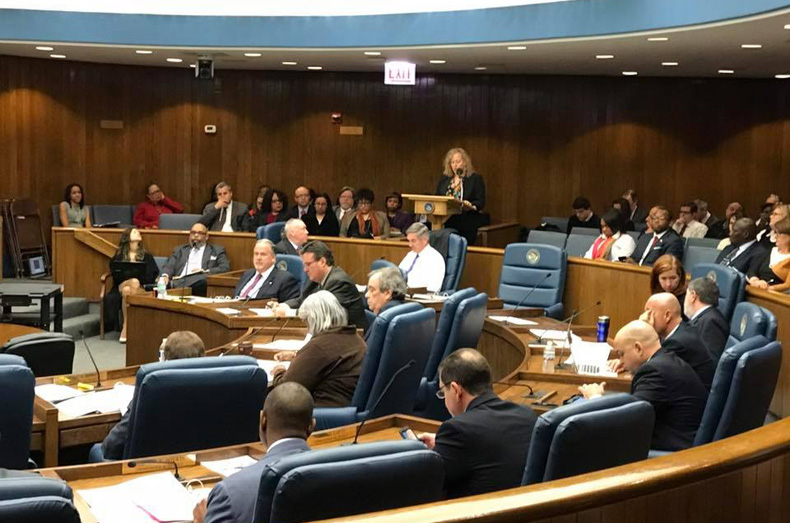
“This hate is unbelievable and unacceptable,” said Cook County Commissioner Richard Boykin, who earlier this week sponsored a resolution condemning hateful acts of violence and rhetoric directed at Jews and Muslims and reaffirming Cook County’s commitment to fighting hate.
Noting reports of increased law enforcement patrols of religious institutions throughout the county, Boykin stated that “no child, no person, should ever have to fear for their safety, and the faithful should have an absolute expectation of safety in their houses of prayer.”
Boykin’s resolution, co-sponsored by Cook County Board President Toni Preckwinkle, was introduced at the March 8 Cook County Board Meeting and fully approved by a unanimous vote. The Jewish Federation testified in support along with Anti-Defamation League, AJC, and the Simon Wiesenthal Center.
At the state level, Sen. Ira Silverstein (Rogers Park), Rep. Lou Lang (Skokie) and Rep. David McSweeny (Barrington-Cary) each filed resolutions condemning anti-Semitic crimes: S.R. 225 , H.R. 194 , and H.R. 193, respectively.
Earlier this week, Chicago Mayor Rahm Emanuel and Gov. Bruce Rauner spoke out strongly against hate and anti-Semitism at the Illinois Holocaust Museum & Education Center’s Humanitarian Awards Dinner .
“We cannot stay silent on hate,” said Rauner, who outlined a number of objectives to protect minority communities from further hate crimes, which include improving law enforcement training and response on hate crimes and expanding hate crime education in schools.
“We have to have our voices heard,” Emanuel said. “History cannot repeat itself.”
Calling for stronger hate crime laws, Illinois Attorney General Lisa Madigan organized a Hate Crime Summit on Feb. 23, which convened over 22 civil rights and advocacy organizations representing the Jewish, Muslim, African-American, refugee, LGBTQ, disability, and Latino communities.
Jane Charney, Director of Domestic Affairs for JUF’s Jewish Community Relations Council, represented the Jewish Federation on a panel of advocates, and discussed recent attacks impacting Chicago’s Jewish community. Charney highlighted JCRC’s recent Interfaith Gathering Against Hate , which was convened in response to the vandalism at the Chicago Loop Synagogue, and discussed how that gathering sent a strong message that hate has no place in Chicago.
Chicago’s City Council has also has shown strong support for the Jewish community. Over the last few months, the city responded to attacks on targeted minority and religious communities by promising to defend and protect the civil and human rights of all its residents, regardless of affiliation.
In January, the Jewish Federation testified in support of an anti-hate resolution sponsored by Ald. Ameya Pawar (Lincoln Square-North Center) that denounced anti-Semitic actions. The resolution , adopted by the full City Council, affirms support for all Chicago residents, particularly people of color, refugees, Muslims, Jews and members of LGBTQ community. The resolution specifically states, “We [Chicago] remain deeply committed to religious freedom, and will vigorously defend all Chicago residents from discriminatory treatment or persecution on the basis of their faith.”
Other like-minded city council resolutions were adopted, which include statements opposing hate and bigotry such as R2106-977 , an anti-hate resolution introduced by Ald. Scott Waguespack (Bucktown-Lakeview-Logan Square) calling for condemnation of hateful speech and violent actions directed toward Muslims, immigrants and people of color, and SB2016-908, another resolution introduced by Pawar (Lincoln Square-North Center) and backed by Mayor Emanuel, re-affirming Chicago’s support for the city’s Welcoming Ordinance.
Cook County has also opened a 24/7 Hate Crime Hotline . If you believe you being harassed or targeted based on your race, religion, nationality, and/or sexual orientation, contact (773) 674-HELP.
JUF’s Government Affairs team continues to monitor and support legislation that condemns anti-Semitic actions. For more information, please contact Mara S. Ruff, Associate Director of State and Local Government at [email protected] .
Other stories
-
Two local teens win national recognition
Recipients of the annual Diller Teen Tikkun Olam Awards
Read more -
Celebrating six young award winners cultivating the community
Introducing young adult award winners
Read more -
Spiritual Jewish community launches Holistic Wellness Center
RACHEL GRAY ALEXANDER
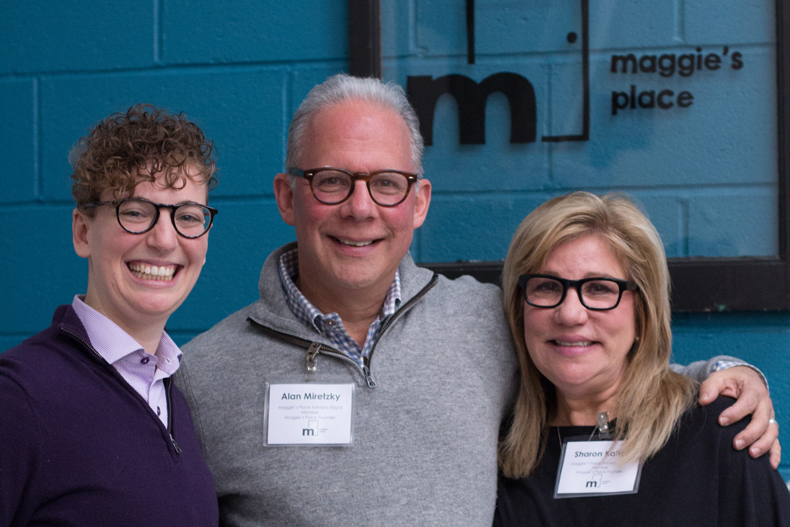
Mishkan Chicago, a non-denominational spiritual Jewish community in Chicago, launched its first ever wellness center, Maggie’s Place, at its northside Ravenswood office. Maggie’s Place, which opened in February, is dedicated to building community through a holistic approach to wellness-social, spiritual, mental, and emotional-through Jewish learning, leadership opportunities, social community, and access to social services and resources.
The center was inspired by the life of Maggie Miretzky, a young Jewish woman whose life was cut short amidst a battle with mental illness. Maggie was known for her generous spirit and worked in service to others as a practicing doula. “She would bend over backwards to help her family and friends-to make brighter the lives of those who knew her,” says Sharon Kahan-Miretzky, Maggie’s mother. Maggie’s Place was created to pay tribute to Maggie’s memory, establish her legacy and continue her life’s work of helping others.
Maggie’s family has boundless aspirations for the center. “While we are starting here at Mishkan, the idea is to inspire every community to focus on mental health and wellness,” says Kahan-Miretzky. The center will promote wellness from the inside out, providing access to support groups, meditation, yoga, themed Shabbat dinners, workshops, and social drop-in nights.
Maggie’s Place is helmed by Ellie Spitz, director of Community Engagement and Wellness for Mishkan. Spitz is a trained social worker who can provide referrals to therapists, vocational and social services, and support groups in addition to creating original programming.
While all are welcome at Maggie’s Place, the center will have a special focus on supporting mental health and wellness in young adults, who face challenges unique to their age cohort.
You don’t have to be Jewish or a member of Mishkan to visit the center. Maggie’s Place is a social hub that creates new ways to meet people, build friendships, and provide support to all people regardless of background or affiliation.
To learn more, visit www.mishkanchicago.org/get-involved/maggiesplace.
Rachel Gray Alexander is Marketing & Communications Manager for Mishkan Chicago.
Other stories
-
Two local teens win national recognition
Recipients of the annual Diller Teen Tikkun Olam Awards
Read more -
Celebrating six young award winners cultivating the community
Introducing young adult award winners
Read more -