Jewish tradition teaches that when our ancestors were slaves in Egypt, they nearly succumbed to despair–but Jewish women saved us by believing in a better future and working to make that a reality. In the merit of Jewish women, the Torah describes, our ancestors were finally able to travel from slavery in Egypt to freedom in the Land of Israel.
Each year, we retell and relive this experience at the Passover Seder with the help of symbolic foods: charoset,karpas (parsley or another bland vegetable), maror and chazeret (two kinds of bitter herbs), a roasted shankbone, and a roasted egg. The Seder plate containing these richly symbolic items is the focal point of our Seder, the setting against which we educate the next generation in our Jewish history.
In Chicago today, a new generation of Jewish women are once again re-imagining our national story, this time by creating unique Seder plates. Here are five special Seder plates made by Chicago-area women artists.
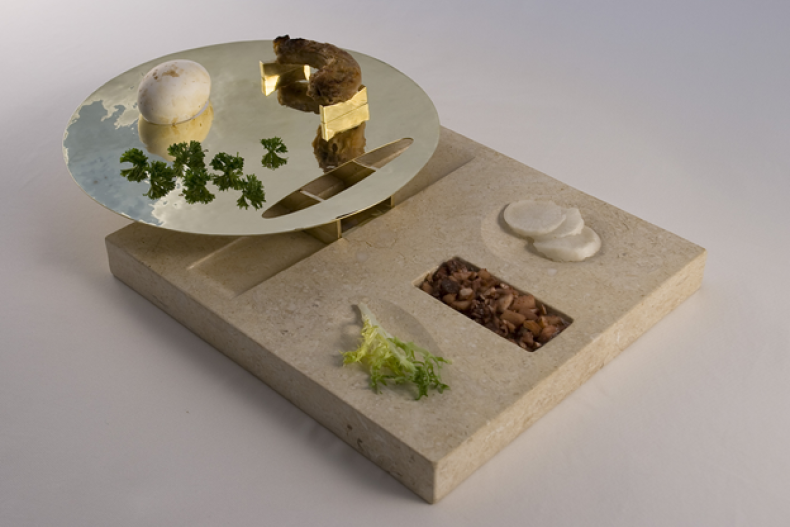
Chicago architect and artist Amy Reichert created this Seder plate for a San Francisco museum. Made of Jerusalem stone and hammered brass, it reimagines the Seder plate to “act as a more useful prop in this family drama that takes place at the Seder.” The Seder plate’s three foods that symbolize slavery– charoset , maror , and a second bitter herb–are imbedded in the heavy stone slab, while the foods symbolizing freedom–an egg, a shankbone, and parsley–seem to float on the raised metal plane. Salt water is poured into a trench dividing the two halves, recalling the Red Sea which our Israelite ancestors crossed to freedom.
Reichert also created this Japanese-inspired Seder plate in 1996. “My husband got tired of my not finding any Seder plates that I liked–he said, you’re a designer, you make one.” The result was this mahogany box with removable sterling silver inserts. “I wanted to frame this symbolic landscape” of the Seder, Reichert recalls: The entire Seder plate can be easily lifted up and carried, recalling the way our ancient ancestors carried their possessions with them as they left Egypt–its unusual shape also elicits questions at the Seder, acting as a conversation starter, much like The Four Questions. This striking plate won second prize in a contest at the Spertus Museum.
More information about Reichert can be found at amyreichertdesign.com .
Chantal Blaustein is the artist behind Broken Beauties Mosaics (brokenbeautiesmosaics.com) and is Arts Director at Ramah Day Camp in Wheeling, Ill. Born in France, Chantal now calls Deerfield home. She created this Seder plate in 2020 out of shards from ceramic plates and glass pieces. Hiddur mitzvah –making Jewish commandments beautiful–is an important consideration for Blaustein. Working with mosaics also allows her to live out the key Jewish value of saving the environment: “Upcycling is a way to make these discarded pieces beautiful again,” Blaustein explains.
Northbrook-based artist Leslie Berkowitz is the creator behind the popular gift site kidoodlesinc.com . She created a personalized Seder plate in 2018 out of tempered glass. The rich colors were added through a process called sublimation in which prints are permanently adhered to the glass.
Skokie-based artist Shikma Benmelech ( shikmapaperart.etsy.com ) created a Seder plate for her husband and her to use together after their wedding in 1994. “My husband’s family is descended from followers of the Vilna Gaon and moved to Israel in the 1830s–they have some unique Pesach customs, such as using four items only on the seder plate, and only two matzot .” Unable to find a suitable Seder plate for sale, Benmelech created this out of a wooden board which she painted. The plate’s motif echoes other family heirlooms she has made, including a matzah cover (pictured), the ketubah for her wedding, and a paper cut of the Shabbat song Yedid Nefesh that hangs over the family’s Shabbat candles. Through the years, Benmelech added to this Seder plate, incorporating an etched plastic matzah holder held up by four tiny wine goblets, recalling the four cups of wine drunk at the Passover Seder.
Yvette Alt Miller, Ph.D. lives with her family in the northern suburbs of Chicago.
Other stories
-
Two local teens win national recognition
Recipients of the annual Diller Teen Tikkun Olam Awards
Read more -

Celebrating six young award winners cultivating the community
Introducing young adult award winners
Read more -
Many Ashkenazic Jews follow the custom of naming their children in memory of those no longer with us. My parents, children of the 60s, decided to forgo that tradition altogether when it came to their first born. They opted instead to name me for one of their favorite opera characters from Puccini’s La Boheme . Though they bucked that tradition, they still wanted their children to have Biblical names. So, my birth certificate reads Miriam Ruth, but from day one they called me Mimi.
Growing up as a Jewish day school student, my teachers periodically assigned namesake projects as a way to explore our own personal histories. “What should I do if I’m not actually named for someone?” I would ask.
Most of my classmates delved into the legacies of the beloved relatives whose names they carried. I was directed to explore the meaning of the name Miriam and the Biblical heroine herself , rescuer of baby Moses, future leader of the Jewish people. I learned Miriam means both “bitter” and “queen of the sea.” I ignored the first definition, homed in on the second, and tried to connect to the Miriam of the Torah by noting we both had two little brothers.
Still, I couldn’t help but wish my parents had chosen to name me for one of the four Jewish matriarchs–Sarah, Rebecca, Leah, or Rachel. Their names were more popular, and I coveted my friends’ trendy personalized pencils and erasers. Plus, those names felt more iconic. In my schoolgirl days, Miriam seemed like a bit of an historical afterthought. Important, but nothing compared to Moses, who guided the Israelites out of Egypt; or even Aaron, who served as the first high priest.
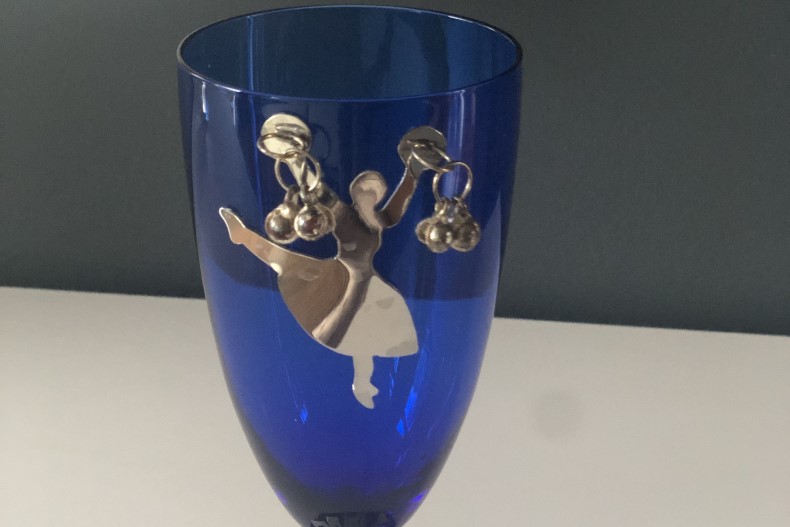
Then, just as I entered early adulthood, Miriam’s Cup entered our family Seder. And that’s when I finally gained a full appreciation for my namesake. Alongside the Cup of Elijah, a steadfast part of Seders everywhere, my mother placed a second cup. She asked me to fill it with water, a symbol connected to Miriam, and focused our Seder discussion on her significance in the Passover story. In doing all of this, my mom enhanced our Seder with a feminist sensibility. She also awakened me to the central role Miriam played in the Exodus, which somehow had eluded me, despite all my years of namesake projects.
The rabbis teach us that God provided the well of water, which sustained the Israelites throughout the desert, “in the merit of Miriam.” Pirkei Avot, The Ethics of our Fathers, goes even further, listing Miriam’s well as one of the 10 things created on the eve of the first Shabbat, and then appearing throughout the Torah.
Following the miraculous Sea of Reeds crossing, Miriam led her fellow Jews in celebration. By the waterside, they sang out loud to mark the end of their bondage and oppression. As it is written in the Torah, “Then Miriam the prophetess, Aaron’s sister, took a timbrel in her hand, and all the women went out after her in dance with timbrels.” (Exodus 15:20)
The Biblical Miriam symbolizes healing, sustenance, and rejoicing. In an effort to circumnavigate Pharaoh’s decree that all Jewish newborn baby boys would be thrown into the Nile, Miriam’s parents separated. Though only a young girl at the time, Miriam convinced them to reunite, and predicted they would bear a child who would lead the Israelites. Her prophecy proved correct, paving the way for God’s redemption of the Jews from Egypt.
This second go-round of a pandemic Passover, we see the proverbial light at the end of a very long dark tunnel. When we pour the cup of water for Miriam at our Seder tables, let us keep in mind the healing and sustenance she provided. Let’s raise up our voices and remember the light and music she brought to our people, teaching us to embrace our newfound freedom.
Mimi Sager Yoskowitz is a Chicago-area freelance writer, mother of four, and former CNN producer. Connect with her at mimisager.com.
Other stories
-
Two local teens win national recognition
Recipients of the annual Diller Teen Tikkun Olam Awards
Read more -
Celebrating six young award winners cultivating the community
Introducing young adult award winners
Read more -
Jews have kept the story of Passover alive through the traditions of the Seder dinner. The Passover story has drama enough to inspire two big screen epics ( The Ten Commandments and Exodus: Gods and Kings ) but apparently not enough for the makers of some of your favorite TV shows and movies, which have injected family dysfunction into the proceedings. We’ve ranked some Seder depictions on a scale of “plague” to “afikomen” (All are available on streaming services or On Demand).
10. Gossip Girl : “Seder Anything”
If you’re like me, then you are similarly clueless as to who Blair, Serena, Nate, Rufus, or any of the other privileged, pretty teens are in this once-popular series. But for those of us whose own Seders were largely uneventful, there may be amusement in watching a family Seder brimming with unexposed secrets, lies, and conspiracies.
9. The O.C.: “The Nana”
From the series that gave us the holiday mash-up Chrismukkah comes this Passover episode that ends at the fraught Cohen family’s self-referential Seder celebration “of freedom to join together to take responsibility for ourselves….”
8. Crimes and Misdemeanors
Martin Landau’s morally compromised ophthalmologist visits his childhood home and recalls a particularly contentious Seder dinner in which his schoolteacher aunt disrupts the ceremony by challenging “the whole moral structure of everything.” From Woody Allen you were expecting maybe a happy occasion?
7. Saturday Night Live : “Elijah the Prophet at a Seder”
In this classic SNL sketch, a family feud is interrupted by the arrival of Jerry Seinfeld’s Elijah the Prophet, who heckles the proceedings. “You know how long I’ve been standing out there? Pick up the pace, people,” he complains. (See also: “Jacob the Bar Mitzvah Boy Explains Passover with His Dad,” featuring Billy Crystal).
6. Curb Your Enthusiasm : “The Seder”
Have yourself a Larry little Seder. In this season five episode, the unwanted guests around Larry David’s Seder table include a neighbor Larry suspects is stealing his newspapers, a kid who may have cheated to find the afikomen, and a recent arrival to the neighborhood who Larry befriends and invites to the Seder before learning he is a sex offender.
5. 700 Sundays
Not for nothing does Billy Crystal end his Tony-winning one-man show (also adapted into a book and HBO special) with a picture of his family around the Seder table, because it’s as much about family as it is about the limited time he got to spend with his father before he died of a heart attack. Seders don’t play a large role here, but I include it because it’s such a welcome break from the angst and disrespect found in most Seder dramatizations. One memorable bit: Billy’s grandmother asks guest Louis Armstrong(!), “Louie, have you ever tried just coughing it up?”
4. Sports Night : “April is the Cruelest Month”
In this episode of Aaron Sorkin’s “canceled too soon” dramedy, the on- and off-air staff of a network sports-highlights show find reconciliation and repair fractured relationships around the Seder table.
3. Shalom Sesame: “It’s Passover, Grover”
This episode of Israel’s version of Sesame Street is a clever and creative Passover primer for preschoolers. There is a Les Miserables parody song, “Matzah in the House.” Now if only Jake Gyllenhaal can remember where he hid the afikomen.
2. Rugrats : “Passover”
The Jewish family equivalent to A Charlie Brown Christmas , this animated special has become a holiday perennial. As Grandpa Boris regales his toddler audience with the story of Passover, the babies imagine themselves as Biblical figures in the story, with their tormentor Angelica in the role of Pharaoh.
1.“A Taste of Passover”
This is what Passover is all about. Theodore Bikel presides over this stirring and joyous concert observance of Passover history and traditions. Bikel sings, performs dramatic readings, and reminisces about the “taste of the overly sweet red wine that my father poured for me.” The only dysfunction centers around his debate with Yiddishist Harriet Chasia Segal over what constitutes the perfect matzoh ball.
Donald Liebenson is a Chicago writer who writes for VanityFair.com , LA Times , Chicago Tribune , and other outlets.
Other stories
-
Two local teens win national recognition
Recipients of the annual Diller Teen Tikkun Olam Awards
Read more -
Celebrating six young award winners cultivating the community
Introducing young adult award winners
Read more -
March 8 is International Women’s Day, which is dedicated to the importance of championing equal rights and opportunity for women. It’s also a day to celebrate the leaders in our own community who bring passion, focus, and fortitude to their work every day. In Chicago’s Jewish community, we are uplifted by so many fierce female leaders working together for good, while inspiring the next generation. We’re proud to bring you the words of five incredible women–the leaders of JUF’s largest affiliated agencies and the women who hold the top lay leadership positions at JUF. They are each united in their commitment to and gratitude for the communities they serve.
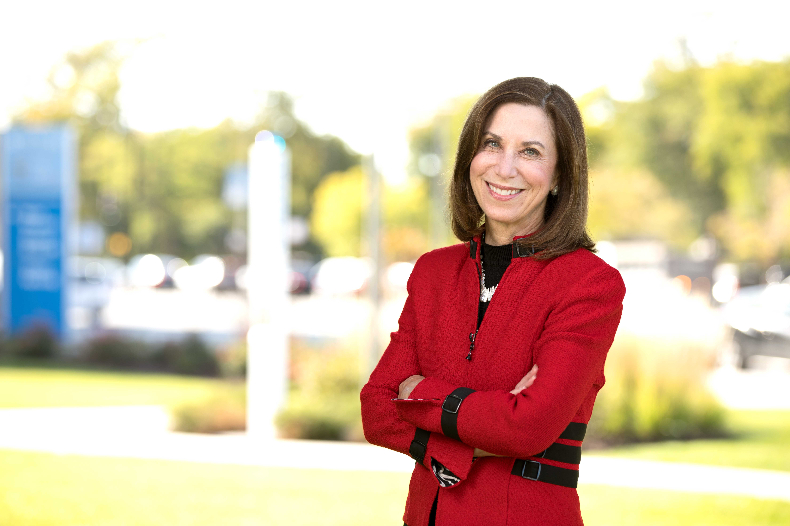
Karen Teitelbaum, President & CEO, Sinai Chicago
Where do you find inspiration?
“Working for Sinai Chicago is so meaningful. Everybody here is important. The transporters, the people passing food, the case management workers- every single person makes a difference.
“Every donor who showed support this past year inspires me. This includes children who made get well cards for patients who could not have loved ones with them, people who delivered meals for caregivers, the person who helped with dry cleaning for health care workers, and people who donated miles so our frontline workers could stay in hotels rather than risk bringing the virus home during the early days of the pandemic. JUF purchased PPE, beyond what we had, for every single person who works in the hospital.”
When you look at our community, what makes you hopeful?
“This year, we saw so many examples of how people stepped up. We saw tremendous generosity. Sinai serves the most vulnerable in Chicago. This is what we do as Jews– tikkun olam.
Helping our brothers and sisters is in our roots. This is who Sinai Chicago is, this is how we started. Our DNA has not changed since our founding 100 years ago.”
Addie Goodman, President & CEO, JCC Chicago
Who in your own life has inspired you?
“As the single child of a single mother, I appreciated my mother’s can-do approach to life. She got her master’s degrees while teaching full time, installed parquet floors and a mirrored wall (it was the 80s), and could always fit one more thing in a suitcase. She had incredible grit and determination, and as a young mother she instilled in me an innate understanding that I could do all the things I wanted do, and more.”
Those who have come before you have helped pave the way for your leadership. How would you like to see the next generation pay it forward?
“Women leaders are role models for both women and for men. As a working parent with a daughter and three sons, demonstrating the power and impact of women in the workforce has been a constant in our home. While they may comment about my hours and how hard I work, I want them to see and recognize that reality. Our kids are growing up in a much less hierarchal society and are more open to the thinking that anyone can accomplish anything. As a community and country, I see us moving towards a society that recognizes the person and their contributions being less about gender and more about capability.”
Pam Szokol, JUF Board Chair
What drives you in your work for the community?
“I am inspired by the opportunity to be a part of evolving change–the environment we are working in, the way services and essentials are distributed to people who need them, and how we, as an organization, are looking for opportunities to grow our impact. When I listen to the next generation, and how passionate they are about Jewish life, I feel so much hope and a great sense of pride in the values of our Jewish community and seeing the roots continue to grow. We need to keep expanding the roots of this tree.”
What are your hopes for the next generation?
“I have been blessed to work with many outstanding community leaders, all of whom share a true sense of passion and responsibility. I am hopeful that the next generation will rival this and address the myriad of challenges ahead with renewed energy, imagination, dedication, and with a mindset of inclusion.”
Stacey Shor, President/CEO, JCFS Chicago
Who has inspired you?
“I am very inspired by my cousin who has developmental disabilities. He is the most social, most engaged person I know. I am inspired that he has built a community around him. I see what he can do and what a community can do. This is a big part of our work at JCFS Chicago.
“The thing that always inspires me about the work is connecting people who want to help with people who need help. The work is hard. Between staff, donors, board members, volunteers, and partners in the community, it’s truly remarkable how people step up for people they don’t even know.”
What is your advice to people looking to make the world a better place?
“There are lots of ways to lead and lots of ways you can help. It doesn’t have to be your career that allows you to make your community what you want it to be. You have to be able to marry the ideas of passion and vision, but to do it in a way that brings other people in versus shutting people out. That’s the way to lead.”
Kim Shwachman, General Campaign Chair, JUF
What advice would you give to young people becoming leaders now?
“There has never been a better time to get involved. Bring your ideas and your passion, but be empathetic and listen to others. Immerse yourself in the work. Get out there to really hear and experience the stories of where the needs are. I think, ultimately, it’s about stretching yourself and getting out of your comfort zone. You may think something ‘isn’t you’ but there is no telling what you can achieve if you remain open to the possibilities. If you aren’t yet involved, the next time you are invited to participate–say ‘yes.’ Even if you are not 100% sure it’s for you, just jump in–and you will never look back with regret.”
What gives you hope when you look at Jewish life today?
“I feel hopeful and optimistic. I see young Jewish families choosing Jewish playgroups and Jewish preschools and I know we are building community and securing our Jewish future. I see many young people choosing to get involved, giving of their time and resources to make things better. I am filled with hope that when our world was turned on its ear during the pandemic, people wanted to help. I am inspired because during the pandemic JUF was able to turn on a dime and respond by pushing critically needed dollars out to our agencies so they could serve their clients in this crisis. Our resilience and determination to care for one another fills me with so much pride and tremendous hope for our future.”
Elizabeth Abrams is the Assistant Vice President of Communications for the Jewish United Fund of Chicago.
Other stories
-
Two local teens win national recognition
Recipients of the annual Diller Teen Tikkun Olam Awards
Read more -
Celebrating six young award winners cultivating the community
Introducing young adult award winners
Read more -
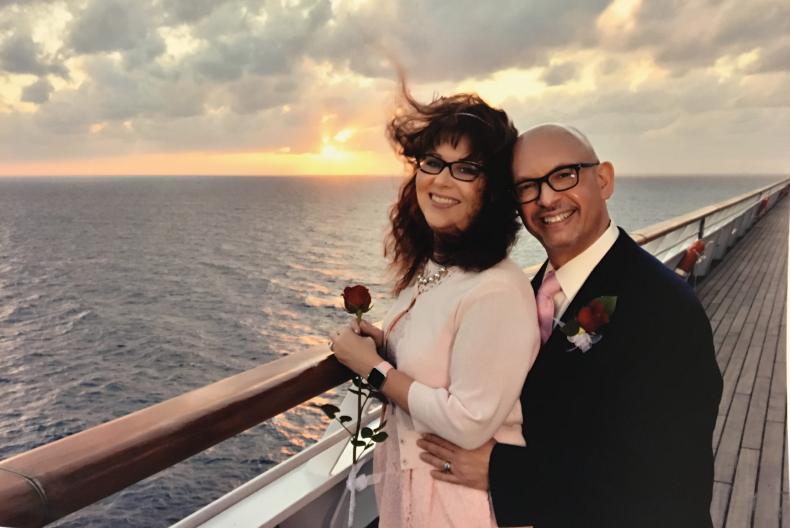
Members of the Chicago Jewish community told us their “meet cute” stories–sweet stories of how they met their spouses and significant others. Read on to find out what launched the relationship for each of these couples! Enjoy!
My husband Jon and I met at Rabbi Asher Lopatin’s Shabbos table in Lakeview!
Andrea Lesch Weiss, Skokie
Howard and I had both been widowed; his wife, a year earlier, my husband, about a year and a half. World-famous shadchan Tova Weinberg, one of the founders of “Saw You at Sinai,” came to Chicago from Pittsburgh for a family wedding and happened to spend Shabbat with a good friend of mine, who insisted I walk over to meet her. After five minutes, Tova said to me, “I have someone to introduce you to. I don’t know him so well, but he’s the most important Jew in North America.” “What’s this guy’s name,” I asked skeptically. Turns out, he was the most important Jew I had never heard of. He had been the president/CEO of the Jewish Federation of Pittsburgh, then the president/CEO of Jewish Federations of North America. A few months later I married him.
Beverly Siegel, West Rogers Park
We dated briefly in junior high and reconnected via Facebook in early 2010. After few months of dating, I moved in with him and [my now-stepson] Anthony. Right before Thanksgiving 2012, he proposed; we were married a year later! And then a year and a half later, our daughter was born.
Diana Van Dusen, Skokie
Our parents–shamefully, our parents–met years after we had left home, so we didn’t grow up knowing each other. Kind of Bridget Jones-like in that I had NO interest when we first met…like ZERO, ZILCH, NONE! We’ve been married for 28 years.
Lauren Bondy, Northbrook
Andy and I met at Weber Grill Restaurant. I was working as a host and he was a manager in training. We had a special of black-eyed peas with chicken at the time. Chicken is great, but all I wanted was a bowl of black-eyed peas with cornbread. If you’re from the South, then you understand. I ordered the peas on my lunch break and waited and waited but they never came. The kitchen thought my order was a mistake; apparently northern folks don’t eat bowls of black-eyed peas. I had to take matters into my own hands! I walked over to the kitchen line and asked a new and friendly face to please give me the bowl of black-eyed peas I had ordered. When he did? It was electric. It sounds silly, but when he handed me my peas, it changed my life. I knew instantly we’d spend our lives together. The rest, as they say, is history.
Jeremy Owens, Chicago
Ultimate ‘Jewish’ story: We met as Neilah ended at our childhood synagogue Yom Kippur services, walking out next to our families. But there is a long backstory: Our parents have known each other for years and my mom was my now-wife’s fourth grade teacher. So many connections, but we had only met many years later. I understand that is traditionally when young couples used to meet–during Yom Kippur dances, right?
Kenny Stolman, Deerfield
Henry’s brother, who was a good friend of mine, kept urging him to come check out Mishkan and reboot his Jewish life. He finally showed up in August 2014, and we went on our first date in November. He spent the next year carving his place in my heart by carrying my guitar around and helping me schlep things from one place to the other–and we were engaged by August 2015. In the early days of Mishkan, when it was a lot of young singles, I told people that I don’t date congregants–to keep things simple. So, I told Henry that he was not allowed to be officially a congregant ’til it was ‘official.’
Rabbi Lizzi Heydemann, Chicago
I was at the Rogers Park JCC and ran into an old friend. He asked if I was busy that Friday night and I said ‘no.’ He said, ‘see you then.’ When I got home, I was tempted to call him and bow out, as he was not my type. However, when he picked me up on Friday night, there was his best friend, Jack Cantor, as my date. We fell head over heels for each other, were engaged six months later, and got married four months after that. We celebrated our 59th wedding anniversary last December, shortly before Jack’s death. We were blessed with two daughters and three grandsons.
Audrey Cantor, Northbrook
I met my husband at a Makor dinner at the JCC on Melrose. The ironic part was I was not looking to meet or date anyone and he was there to help one of his friends find someone. I don’t know how I got so lucky that I found him! Best gift I got from the Chicago Jewish community!
Allison Leviton, Chicago
Short version: I was fixed up with a date my first month at the University of Illinois. After dinner, he asked if I minded if we went to Timpone’s, which then was a beer joint, to celebrate his pledge brother’s 18th birthday. We went. I married the first guy, we were divorced after 25 years, met up with the second guy five years later, and then married him.
Sandee Holleb, Wheeling
Technically, we first met at a mutual camp (OSRUI) friend’s party before Darin left for a year on a kibbutz in Israel. When he returned, he reached out to me; the first time we could find to get together was to meet up at the matzoh ball, the big Jewish singles party on Dec. 24. An interesting place to have a first date! That was 1999. We’ve spent almost every day together since.
Alexandra Argentar, Buffalo Grove
Reuben and I met when we were in high school in Eastern Pennsylvania Region USY. The region was really spread out and we were in different chapters so we didn’t see each other often. In our graduation yearbooks for USY, we each wrote that we wish we had gotten to know each other better and that we hoped that one day we would meet again on the street. And that was the end of that since there was no Facebook then. Six years later, we had both graduated from college and were in grad school in Philadelphia and we bumped into each other on the street in West Philadelphia…and the rest is history. We will be married 36 years in August.
Tami Warshawsky, Deerfield
A JUF volunteer called to remind me about the phonothon I had signed up for. I thought he was very charming. I went to the phonothon and when it was over, I asked him for a ride home. I didn’t like him at first because he drove like a maniac; I thought he was trying to show off. But he was persistent and kept asking me out. How many times can a person say no? We have been married 27 years.
Lila Weiland, Highland Park
At the beginning of my sophomore year at Brandeis, my roommate and I threw a party in our room and looked through the student handbook–a.k.a. the “meat” (meet) book–to find cute girls to invite. Laura was one of the naive freshmen who showed up. Soon, after Rosh Hashanah services, dinner, and a stroll around campus, we became a couple. Twenty-plus years, a dog, and two kids later, we have the “meat” book to thank.
Steve Wander, Northbrook
My wife, Shari, was sitting in the flute section of the now-gone North Side Symphony during a summer outdoor rehearsal. We were playing the Beethoven 3rd Symphony and the clarinets had a long rest, so I lit up my pipe–in those days, people did smoke outside; it was 1975. Shari is allergic to smoke so she turned around and said: “Would you put that smelly thing out?”. Not only did I comply–and never smoked again, BTW–I asked her out to dinner for that weekend. She said yes, and the rest is history…. we got engaged in December and we married in May 1976.
Howard Green, Buffalo Grove
I met my husband at Lollapalooza at the dance tent. [It] was pretty fitting, given that my parents met at a discotheque. The apple did not fall far from the tree.
Lisette Zaid, Chicago
Other stories
-
Two local teens win national recognition
Recipients of the annual Diller Teen Tikkun Olam Awards
Read more -
Celebrating six young award winners cultivating the community
Introducing young adult award winners
Read more -
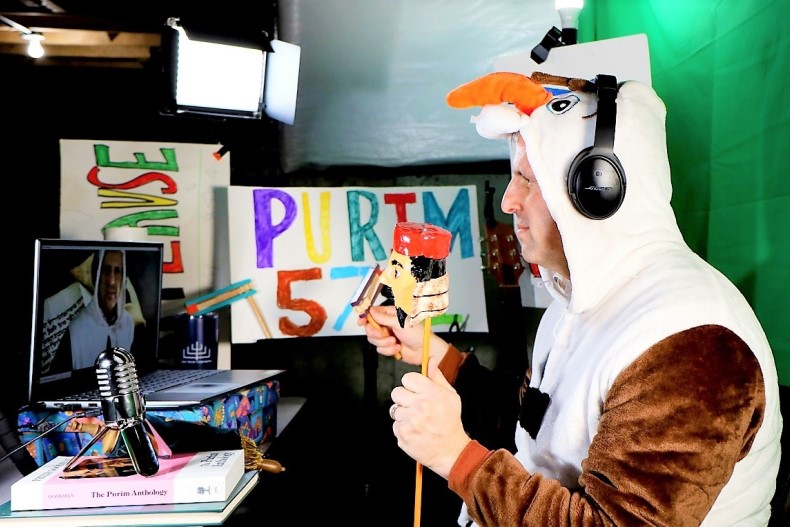
Recently I discovered an artifact in the trunk of the family minivan: a tattered script from last year’s Temple Purim Spiel.
Remember Purim 5780? Just 12 lunar months ago but it seems oh so long, long ago.
So much has changed.
Last spring, synagogue sanctuaries were crowded with noisy revelers. We belted out “ Chag Purim” and we boisterously booed Haman. There were handshakes, hugs, hamantaschen, and hilarity. Children, dressed as Esther and Mordechai, played Purim carnival games and what a grand time it was for all.
Back then, we had heard about COVID-19, but the virus was a vague, distant threat. “Just like the flu,” we said. “Just wash your hands, you’ll be fine!” In Israel, school children celebrated Purim by dressing up as doctors sporting surgical gowns, gloves, and masks. Who could have ever guessed that an entire year later, the masks Israelis children wore in jest, would be the same masks we wear every day for safety!
In a way, Purim this year reminds me of a past spiel , which was a mash-up of the Esther story and Disney’s Frozen . Like the events in the popular movie, today we all find ourselves stuck in a strange reality, a Purim loop of sorts; a drama re-lived each day which keeps the scary parts and leaves out the humor.
Just as Megillat Esther opens with depictions of great prosperity, so too did 2020 open as the United States experienced a booming economy with a record low unemployment.
In Persia, unreasonable and unenforceable proclamations were sent throughout the land as a response to Queen Vashti courageously disobeying her husband, the King: “Every man should wield authority in his home.” (Esther 1:22) Last year, days after Purim, in Illinois and throughout the country, reasonable precautionary health and safety proclamations were issued, but not embraced by all.
In the capital, Shushan, the insidious virus of antisemitism found a host in Haman and replicated throughout the Empire, endangering Jews. Last spring, a contagious novel virus suddenly became a modern-day pandemic threatening the lives and livelihoods of people worldwide. At the same time, antisemitism has also been on the rise.
Purim tells of the unmasking of that which was hidden: Haman’s hatred, Esther’s identity, and God’s saving power. Events of 2020 likewise have revealed societal problems previously present but unseen: socio-economic disparities, job, food and shelter insecurities, racial injustice, flaws in our health care systems, and deep divides of opinions. Concurrently, less visible issues such as mental health and domestic abuse have grown in severity under the stress of the current circumstances.
There is a bright side: Esther, aware of the danger, told Mordechai to assemble the Jews and ask them to fast. This was a show of communal solidarity. Our Jewish community has likewise come together to address critical needs unlike ever before. JUF’s response to this pandemic has been inspirational and exemplary. Local synagogues and Jewish organizations have designed new and innovative ways to serve spiritual needs. We have drawn strength from one another and found resilience through faith, Jewish rituals, Shabbat, holidays, and traditions.
Purim is all about heroism. Esther takes a risk and stands up for her people. This year we have witnessed countless examples of courageous and selfless acts; health care professionals, first responders, essential workers, community leaders, and many others who extended themselves to lessen the burden of COVID-19. We are especially grateful to the brilliant scientists who worked tirelessly to bring forth a vaccine in record time.
Ultimately, Purim is a story about hope. The holiday reminds us that fasting will give way to feasting. Grief will give way to healing. One day we will blot out the memory of this time and yet never forget.
In due time there will be “lots” to celebrate. We will again enjoy festive public gatherings, hugs, singing, and joyous laughter. We will continue to care for those in need and stand up for the oppressed. We will hand deliver shalach manot to our friends, and in crowded sanctuaries we will yell “BOO” for Haman and for COVID. Yes, there will be happiness again, perhaps as soon as this month!
As the Talmud declares: “When Adar enters, joy increases.” May we all experience such joy soon! Chag Purim Sameach!
Rabbi Taron Tachman is the Rabbi of Beth Tikvah Congregation in Hoffman Estates.
Other stories
-
Two local teens win national recognition
Recipients of the annual Diller Teen Tikkun Olam Awards
Read more -
Celebrating six young award winners cultivating the community
Introducing young adult award winners
Read more -

Three years ago, activist and award-winning filmmaker Beverly Siegel produced the documentary Driving West Rogers Park. The film chronicled the neighborhood’s Jewish culture, and detailed plans for retaining its Jewish vitality.
Now, Siegel, who grew up there, updated the film to reflect the neighborhood’s renewal.
Siegel’s half-hour love letter to the neighborhood first premiered in 2017, at the 40th anniversary of the Chicago Jewish Historical Society, which helped fund the film.
Alongside archival materials, the documentary interviews residents, rabbis, historians, and community leaders like Dr. Steven B. Nasatir, then JUF President.
“Federation doubled down on the neighborhood, adapted to its needs, and made many investments here,” Siegel said.
West Rogers Park’s story is special, according to Siegel. “In many other Chicago neighborhoods, Jewish residents left and never came back,” she said. “West Rogers Park uniquely defies this pattern. Now, there are twice as many shuls here as in its former heyday.”
When the film first debuted, such progress was just beginning. The updated documentary reflects the neighborhood’s revitalization through the efforts of the Jewish Neighborhood Development Council, an organization of Chicago-area residents who advocate on behalf of West Rogers Park and its surrounding neighborhoods. Siegel is president of the Council; her husband, Federation leader Howard Rieger, is its president emeritus.
“It is personally very important for me to know that vibrant Jewish life continues to thrive in this neighborhood,” said Ellen Doppelt, the Council’s executive director. “Professionally, it is very gratifying to have a role in strengthening it.”
While she grew up in nearby Hollywood Park, Doppelt has memories of weekends “shopping at Carol Corr, bowling at Shavely’s, going to Thillens Stadium, and having pizza at Gigio’s” with her friends.
The Council’s successes include Bernard Stone Park at McCormick and Devon. “It had one tree when we started,” Siegel laughed. “Now, people ride their bikes through it.” She credits the help of 50th Ward Ald. Deborah Silverstein in making this park a reality.
Park 538, another success, is a replanted strip of land along the Chicago River, now used for nature walks and field trips; also using it is the nearby Bernard Horwich JCC. This land is being reclaimed for nature in partnership with the Chicago Park and Water Reclamation districts, the Audubon Society, and the Peggy Notebaert Nature Museum.
Another major coup for the Council is the Northtown Branch of the Chicago Public Library at Pratt and Western. “In the first version of the video, you can only see architect’s renderings,” Siegel said. “Now, it’s full of people.”
The Council also has been promoting neighborhood businesses and helping local shops move from the basements to storefronts. “We have sparked this movement,” Siegel said, “and now we want to continue to promote economic vitality. We are connecting start-up businesses with city-funded incubators and mentorship.”
While working to preserve Jewish life there, the Council also celebrates West Rogers Park’s status as one of the most diverse neighborhoods in America, and reaches out to its neighbors. “Who knows?” Siegel said. “Maybe we’ll get a kosher Indian restaurant someday.”
For more information about the Jewish Neighborhood Development Council, and to see Driving West Rogers Park, visit jndcchicago.org.
Other stories
-
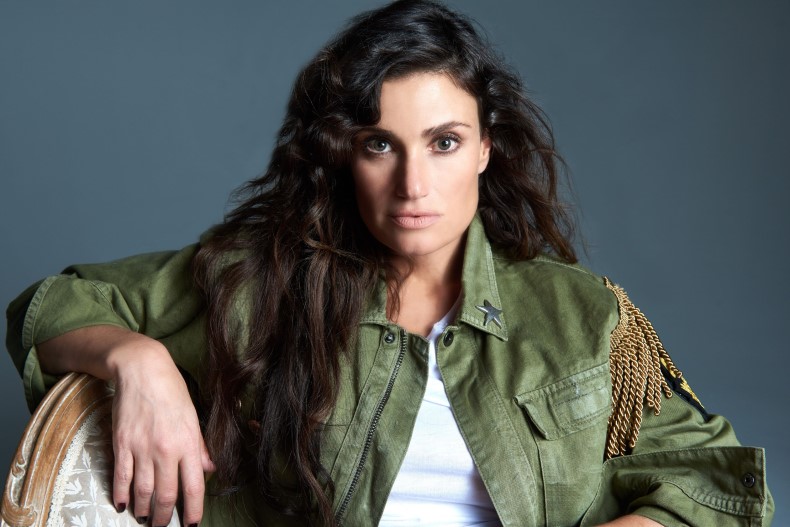
JUF Women’s Division Spring Event to feature singing superstar Idina Menzel
Renowned singer and actress Idina Menzel will be the featured speaker at the JUF Women’s Division Spring Event 2019.
Read more -

Fourth Annual JCC Chicago Jewish film festival kicks off March 9
The Fourth Annual JCC Chicago Jewish Film Festival opens March 9 and includes an Academy Award nominee and an exclusive special showing of a star-studded film prior to its national debut.
Read more
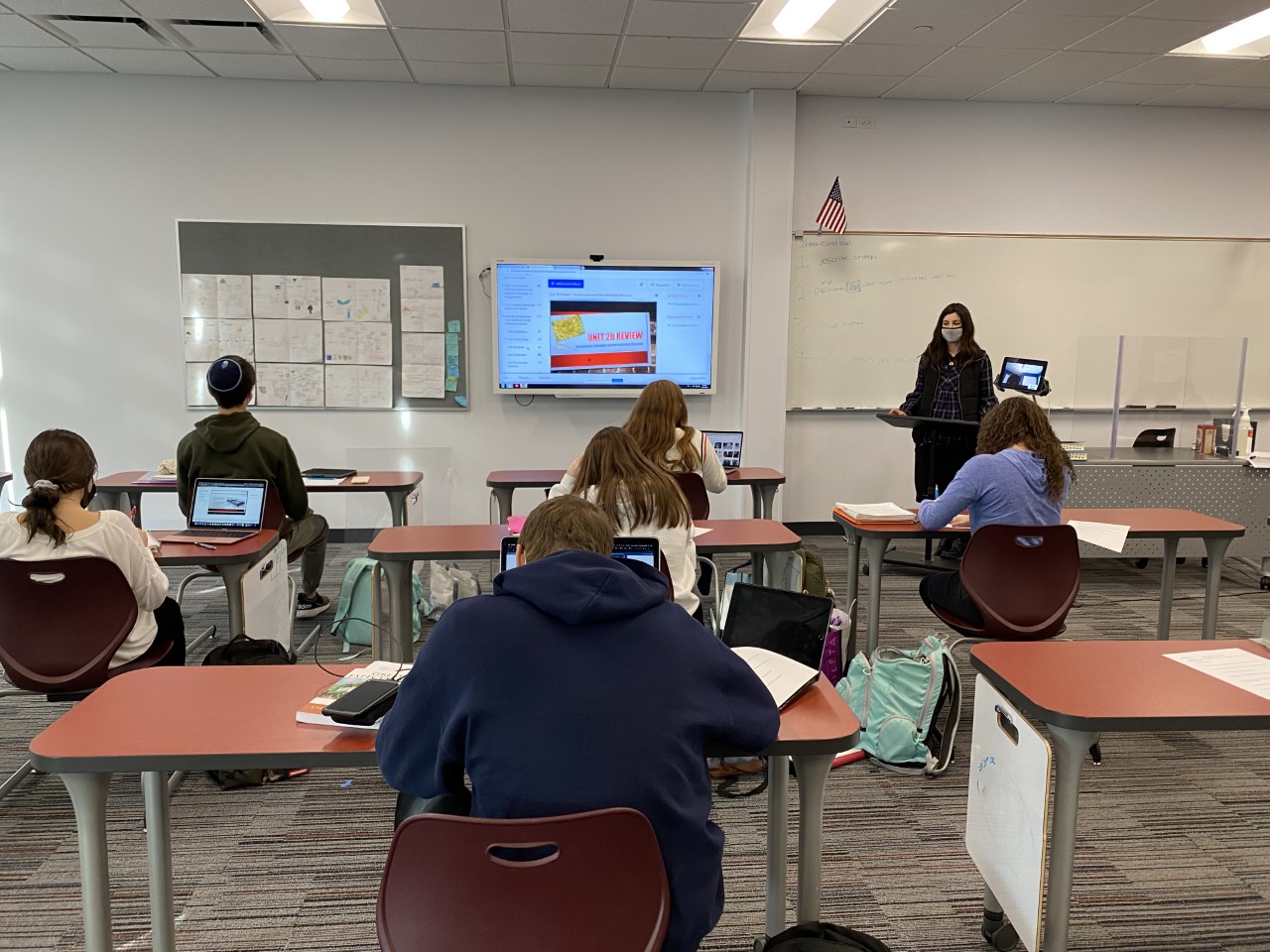
Plexiglass, social distancing, and masks are not considered a part of an ordinary classroom, but having them in place means that teachers like Alissa Zeffren, a faculty member at Ida Crown Jewish Academy in Skokie, can carry on with in-person instruction during a year that has been anything but ordinary.
Following the outbreak of COVID-19 this past March, Ida Crown pivoted to remote learning for the remainder of the spring 2020 semester. The school only decided to open its doors this past fall after the implementation of strict health protocols, which also include regular temperature checks. Now, with a recent surge of cases of COVID-19 in Illinois, it appears that Zeffren and other educators will be adhering to these rigid standards for many months to come. Fortunately, said the 10-year Ida Crown veteran, who teaches Jewish history and Torah, she has adapted with relative ease.
“It is way more manageable” than she had anticipated, she said. That’s because Ida Crown was already tech-savvy, which enabled the school to provide remote instruction for students who cannot attend in person due to preexisting conditions or health concerns. Likewise, she added, it has allowed some of her peers to teach remotely. None of this is ideal, she said, conceding that concurrently managing two sets of students-those in the classroom and those attending through a Zoom platform-“changes the way group work” functions. Nevertheless, it is keeping everyone safe.
There has also been an unexpected fringe benefit to Zoom learning, noted Zeffren. As the advisor to the Student to Student club, she works with Jewish students in schools throughout the region to educate those in school districts with few Jews about Jewish history, practices, and culture. In years past, she and her students would schlep to remote parts of the Chicago metropolitan area to provide in-class instruction, often racking up hours of travel time. With the pandemic barring in-person experiences, she and her students can now reach more students, in more distant locales, through Zoom.
“Logistically, it is a lot easier,” said Zeffren, whose Student to Student participants recently met remotely with peers from a central Wisconsin school.
Another Jewish teacher, Mardi Caminer, grew up in Chicago’s Lincoln Square neighborhood. She has also become, at 24, an old hand at remote instruction. A special education teacher in a Title I Washington, D.C., public elementary school-so designated because it receives federal dollars to close educational gaps experienced by large concentrations of low-income students-Caminer said that teaching under COVID-19 is not a 9-to-5 endeavor.
“It is nonstop, every hour of the day,” said Caminer, who provides reading and math instruction through Zoom and whatever technology students and families can access, including mobile phones. It is, she said, a humbling, as well as eye-opening, experience.
“You get to see the whole family-you can hear the background noise,” she said.
To keep in touch with students in a more personal way, “I sent postcards to my kids in the spring,” she said. She also worked hard to win a grant that provided funding for summer books for her students and basic household needs for them and their families.
In addition to her teaching responsibilities, Caminer serves as an instructional coach to peers and a soccer coach for her school. Asked how she coaches soccer online, Caminer said that “virtual soccer practice involved focusing on fancy footwork.”
Caminer said teaching has been a lifelong dream, “ever since first grade,” and that it became more of a reality while she was in high school. She was working as a teacher’s assistant at her family’s synagogue, Anshe Emet Synagogue, helping children with learning disabilities learn Hebrew. The teacher, Anne Johnston, observed Caminer’s rapport and joy with the students and suggested that she consider teaching as profession, Caminer recalled. It was, for her, an “aha” moment. The light bulb turned on, and it continues to shine to this day.
Other stories
-
Two local teens win national recognition
Recipients of the annual Diller Teen Tikkun Olam Awards
Read more -
Celebrating six young award winners cultivating the community
Introducing young adult award winners
Read more -

Beth Perkel has always been fascinated by positive psychology, the popular branch of psychology that uses scientific understanding to help achieve a satisfactory life. In fact, she focused much of her psychology major on the subject during her undergraduate years at the University of Pennsylvania.
Now Perkel is out with a new book, Light at the Beginning of the Tunnel: Wiring Our Children for Happiness, (Mosaica/Feldheim) that explores the intersection between positive psychology and parenting.
She points to famed UPenn professor, Martin Seligman, considered the father of positive psychology, as the inspiration for her book. “He published Authentic Happiness in 2002, when I was a freshman,” said Perkel, a Chicago native. “This was the beginning of the emergence of the field and its efforts to scientifically explore human potential. The focus is not on repairing weaknesses but bolstering strengths. Not about what’s wrong, but about what works.”
A writer, teacher, mediator, and rebbetzin, Perkel has written for periodicals ranging from Newsweek to the Times of Israel; Light at the Beginning of the Tunnel is her first book.
Positive psychology is “about more than happiness,” she said. “It is important to be well-adjusted-to be contented, not fleetingly happy. Because life isn’t only about happiness.”
As a new graduate, she married and temporarily moved to Israel for her husband to study for Rabbinic ordination in 2006. They eventually moved back to Chicago, where she devoted time to lecturing on the Jewish circuit about the intersection between lessons of the Torah and manifold positive psychology concepts such as mindfulness, self-esteem, and grit. She weaves these into the book, with an entire section devoted to parents applying the positive psychology concepts to themselves in order to work on happiness as a family-wide endeavor.
When she became a mother-she now has four children ranging in ages from 5 to 13-she added a third thread to the tapestry, applying her combination of psychology and Torah to parenting.
“I began to write what became a popular blog on teaching children happiness,” she related. Her blog focused on “positive psychology for parenting, through the prism of Torah.”
Throughout the book, Perkel alternates between-and stitches together- scripture and science. In the book, Perkel tries to define the skills children need to create “a light at the beginning of the tunnel” for their life’s journey, she said. These skills run from delaying gratification to expressing gratitude, from “embracing the now” to becoming immune to the notion of “failure.” Also important: “emotional agility,” harnessing the power of habits in a positive way, and resiliency.
One surprising skill kids need? “How to complain better!” Being able to be specific, she explained, about what is wrong can help bring about positive changes.
Perkel counsels against “helicopter parenting,” a term coined to describe overly meddlesome parents that hover overhead. After all, she said, parental guidance should resemble “a harness, not a straight-jacket.”
Light at the Beginning of the Tunnel can be purchased on mosaicapress.com , feldheim.com and Amazon.com or by emailing [email protected] . It will also be available at local Jewish bookstores in the coming days.
Other stories
-
Two local teens win national recognition
Recipients of the annual Diller Teen Tikkun Olam Awards
Read more -
Celebrating six young award winners cultivating the community
Introducing young adult award winners
Read more -
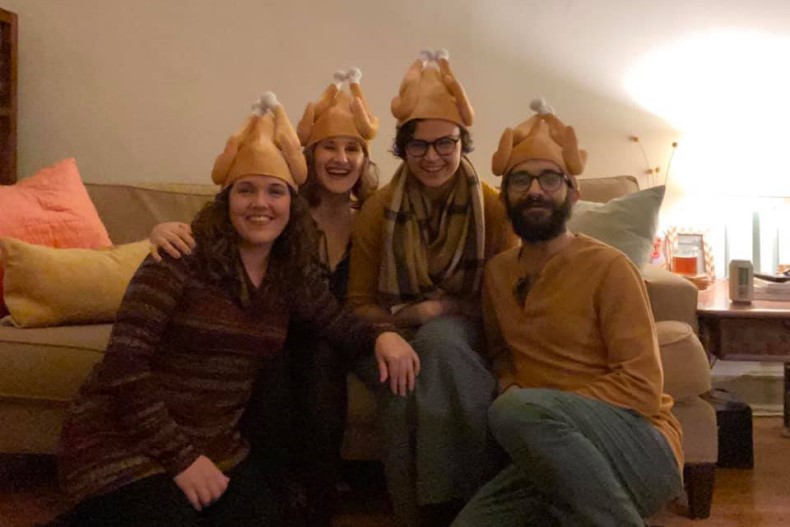
“So no one told you life was gonna be this way”
It’s the intro to one of the best sitcoms of all time, Friends* (created by David Crane and Marta Kauffman)–but I feel that, in a lot of ways, it’s also a fitting anthem for the bizarre, terrible, and wonderful year that was 2020.
“Your job’s a joke, you’re broke / Your love life’s DOA.”
March of 2020 sucked. I had just lost a job that I loved due to pandemic-induced downsizing. I was living on unemployment and taking on more freelance work than I could reasonably handle. My mental health was not at its finest–and my craft closet was overflowing with art projects (i.e., coping mechanisms). Even with my carefully curated distractions, there was no escaping it–I was “stuck in second gear.” It was not my day, my week, my month, or–you guessed it–even my year.
I passed the hours going for long walks, picking dried tie-dye pigment out from under my fingernails, and crying on the phone to my parents about how life as I knew it was over. (Oy! Sorry, Parents). But in a way, I was right. My life had irrevocably changed, but little did I know it was going to be for the better.
“I’ll be there for you / (When the rain starts to pour)”
It started with a happy hour. In May and June of 2020, I noticed some new folks moving into my apartment complex. By virtue of living in Chicago, new tenants weren’t uncommon. But something felt different about these people. Eager to find out what it was, I made invitations for a socially distant gathering, stuck them on each person’s door, and hoped for the best.
The night of the happy hour, we showed up on the communal back porch with masks, wine coolers, and craft beer in tow. At first, it was kind of awkward–it had been a while since any of us had spoken to anyone besides our pets. We were very much out of practice with the whole socializing thing.
But then we started talking…and talking…and five hours later, we were still talking…and six months later, we’re still talking.
We talk while we cook dinner for each other; while we decorate each other’s homes for the holidays; on weekend hikes and getaways and excursions to the beach. We talk about our hopes and dreams; our fears and frustrations. We’ve consoled each other in times of loss, and toasted each other in times of triumph. And slowly, together, we have begun to find our mooring in these–I’m gonna say it–unprecedented times.
“I’ll be there for you / (‘Cause you’re there for me too)”
Like some kind of made-for-TV sitcom, we have become a chosen family–with all the antics and oddities that entails. I could script an actual sitcom detailing all the ways in which these amazing people and our unique circumstance have uplifted me in this difficult time. But, instead I’ll say that–thanks to my pandemic pod–home has never been a more inviting place.
* Theme song, “I’ll Be There for You,” by The Rembrandts
Jenna Cohen is a marketing and development professional living in Chicago.
Other stories
-
Two local teens win national recognition
Recipients of the annual Diller Teen Tikkun Olam Awards
Read more -
Celebrating six young award winners cultivating the community
Introducing young adult award winners
Read more -