Jewish Federation’s Holocaust Community Services receives funds for groundbreaking Holocaust survivor program
The Jewish United Fund/Jewish Federation of Metropolitan Chicago’s Holocaust Community Services program has been awarded a $105,000 matching grant from the Jewish Federations of North America’s new Center for Advancing Holocaust Survivor Care.
The Jewish Federations of North America launched the Center for Advancing Holocaust Survivor Care in 2015, following an award from the U.S. Department of Health and Human Services for up to $12 million over five years to advance innovations in person-centered, trauma-informed services for Holocaust survivors in the United States. These grants mark the first time in history that the U.S. government has provided direct funding for Holocaust survivor programming.
Holocaust Community Services’ Outreach Program will promote physical and emotional well-being and increase service accessibility by bringing services to survivors in their primary language and locations. The Outreach Program will include three components: 1) community-based health education programming; 2) in-home mental health counseling; and 3) companionship programs with trained volunteers. The program targets two significantly under-served survivor populations: survivors from the former Soviet Union and isolated, home-bound survivors who struggle with accessibility.
Of the more than 100,000 Holocaust survivors in the United States, nearly one-quarter are aged 85 or older, and one in four lives in poverty. Many live alone and are at risk for social isolation, depression and other physical and mental health conditions stemming from periods of starvation, disease and torture.
Chicago’s Holocaust Community Services program is an inter-agency program founded by the Jewish United Fund/Jewish Federation of Metropolitan Chicago in 1999 to provide safety-net services to local Holocaust survivors — especially those who are living in poverty. The program is currently administered by CJE SeniorLife, in partnership with Jewish Child & Family Services and HIAS Chicago, and receives significant funding from the Conference on Jewish Material Claims against Germany. As the demand for services has skyrocketed, HCS has added partnerships with additional Jewish communal agencies, including The ARK, Maot Chitim and EZRA Multi-Service Center. In 2015, the program served nearly 900 survivors, one in two of whom received financial assistance.
“Now is the opportunity to make an enormous difference in the quality of the lives of our local Holocaust survivors, lending them support and understanding of their unique needs and challenges,” said Yonit Hoffman, Ph.D., Holocaust Community Services Program Director.
“Taking care of Holocaust survivors, ensuring that they have their physical and emotional needs met, is of the utmost importance and a fully attainable goal if we continue to work together,” said Mark Wilf, chair of Federations’ National Holocaust Survivor Initiative.
The Center for Advancing Holocaust Survivor Care and its partner organizations, the Association of Jewish Family & Children’s Agencies and the Claims Conference on Jewish Material Claims Against Germany, are working together to promote such innovative service delivery models. The grant money is a combination of federal dollars and philanthropic dollars raised by Jewish Federations as part of JFNA’s National Holocaust Survivor Initiative, which seeks to raise $45 million to support the survivor community.
Other stories
-
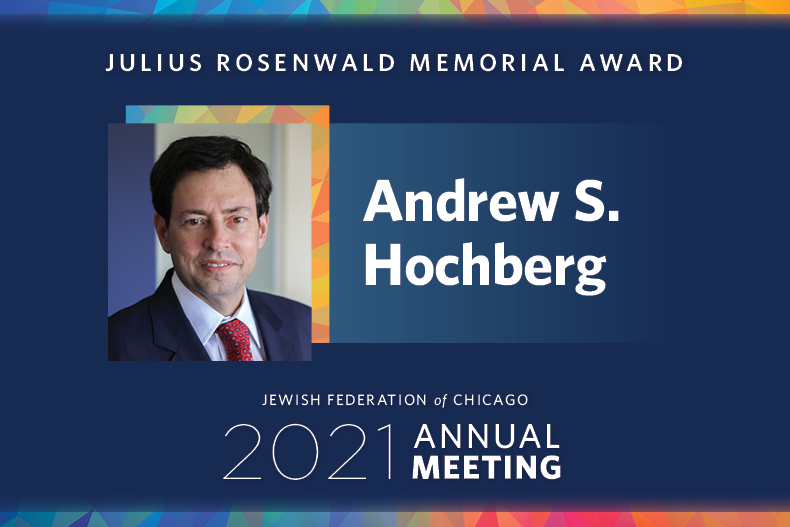
Meet Andrew S. Hochberg, 2021 Julius Rosenwald Memorial Award recipient
Celebrate Andy Hochberg at the virtual Annual Meeting on Sept. 14
Read more -
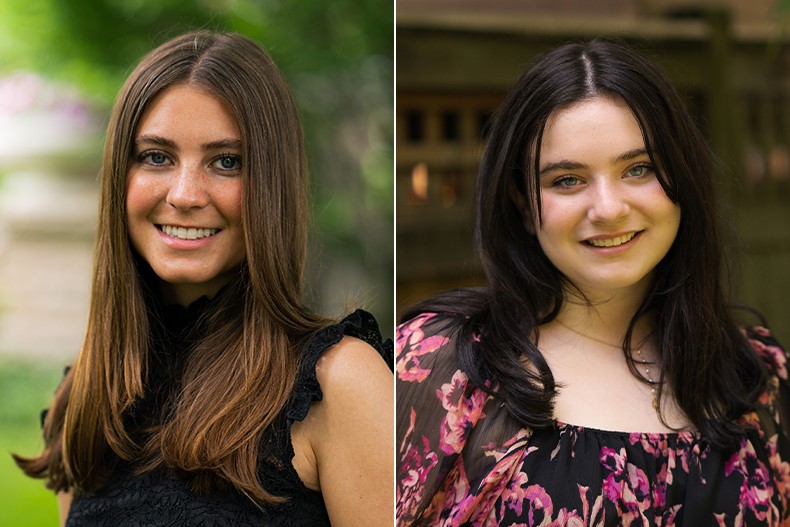
Two local teens win national recognition
Recipients of the annual Diller Teen Tikkun Olam Awards
Read more -
Celebrating six young award winners cultivating the community
Introducing young adult award winners
Read more
Sixteen vibrant organizations taking Jewish life in Chicago in new directions, many of them offered or supported by the Jewish United Fund, are profiled in the latest edition of TheSlingshot Guide , an influential national guide for philanthropists focused on innovative Jewish non-profits.
“Chicago has emerged as a bustling center of innovation … a vibrant community that is anything but traditional,” wrote Slingshot Executive Director Stefanie Rhodes.
JUF’sjBaby Chicago and REACH are among the programs featured in a special Chicago supplement to the 11th edition of the guide, which was released today.
JUF’S jBaby Chicago connects Jewish and interfaith new and expectant parents to Jewish life and resources – and each other – through a wide range of play groups, events and other programming. JUF created the outreach effort after its research revealed that 71 percent of Chicago-area Jewish parents of young children were not as connected to the Jewish community as they wanted to be. They were particularly interested in meeting other families, participating in Jewish programming, and exploring Jewish life as a new family.
REACH, which also was highlighted in last year’s Slingshot Guide , provides a central resource that helps local Jewish day schools better meet the academic, social-emotional and physical health needs of students with special needs. REACH is a collaborative effort of JUF, the Associated Talmud Torahs and Jewish Child & Family Services.
” The Slingshot Guide’s focus on so many remarkable Chicago programs is a powerful endorsement of the creativity and vitality of our Jewish community,” JUF President Steven B. Nasatir said.” And JUF enthusiastically nurtures that innovation because that’s how we keep individuals and families engaged in Jewish life, no matter their background, interests or stage of life.”
One way JUF does that is through its Breakthrough Fund, a special grant program launched in 2014 to encourage smart, strategic growth and creative program development in Chicago’s Jewish community. Half a dozen programs highlighted by The Slingshot Guide have received support from the fund in the past two years. One is REACH. The others are:
- Bayit Afterschool, a daily after-school program bringing together a diverse community that echoes the summer camp experience;
- Interfaith Family/Chicago, which supports interfaith families exploring Jewish life and community;
- Jewish Council on Urban Affairs, which brings Jewish and other diverse communities together to create positive social change that combats racism, discrimination and anti-Semitism;
- Mishkan Chicago, which engages and inspires people through dynamic experiences of Jewish prayer, learning and community building, with a particular focus on engaging those still seeking their place in the Jewish community; and
- Moishe House, which creatively redefines Jewish life for twentysomethings through a peer-led model of connection, leadership and engagement.
Other Chicago programs highlighted by Slingshot are Avodah, a leadership network promoting social justice and fighting domestic poverty; Bnai Mitzvah Revolution, which creates engaging models of preparation and celebration for b’nai mitzvah; Big Tent Judaism: Chicago, which welcomes less-engaged Jews and unaffiliated intermarried families; Hands of Peace, which develops peacebuilding and leadership skills in Israeli, Palestinian and American teens; Jewish Enrichment Center, which promotes seriously creative text study; KAHAL: Your Jewish Home Abroad, which creates transformative experiences for Jewish study-abroad students; Keshet, which provides integrated educational, recreational and vocational programming for individuals with intellectual and developmental disabilities; Orot: Center for New Jewish Learning, a pluralistic home for mindful Jewish learning and practice; and SVARA: A Traditionally Radical Yeshiva, dedicated to serious study of Talmud and committed to the queer experience.
The Slingshot Guide was created to help philanthropists identify the most innovative, effective organizations, programs and projects in the North American Jewish community. Some 230 organizations were evaluated on their innovative approach, the impact they have in their work, the leadership they have in their sector, and their effectiveness at achieving results.
The latest edition includes the Chicago-centric supplement focusing on initiatives reshaping the way local Jews connect with their community and identity.
For listed organizations, recognition in The Slingshot Guide often is a critical step toward obtaining much needed new funding and expanding their work. Selected organizations are eligible for grants from various Midwest peer-giving networks of young donors that are identifying, highlighting and advancing causes that resonate with the next generation of philanthropists. The guide is a frequently used resource for donors seeking to support organizations transforming the world in novel and interesting ways.
Publication of the Chicago supplement was supported through a generous partnership with The Crown Family Philanthropies and the Jack and Goldie Wolfe Miller Fund.
“I am delighted to be able to showcase the amazing potential and impact of these 16 projects,” said Bethany Shiner, trustee of the Jack and Goldie Wolfe Miller Fund. “Jewish innovation in Chicago is bustling – it is at the forefront of entrepreneurial Jewish programming in the Midwest.”
“Introducing a Slingshot Guide focused specifically on Chicago is another step in the flourishing field of Jewish innovation,” said Slingshot’s Rhodes. “It allows us to give these organizations the recognition they deserve and boost their presence among donors and volunteers in their local communities.”
Other stories
-
Meet Andrew S. Hochberg, 2021 Julius Rosenwald Memorial Award recipient
Celebrate Andy Hochberg at the virtual Annual Meeting on Sept. 14
Read more -
Two local teens win national recognition
Recipients of the annual Diller Teen Tikkun Olam Awards
Read more -
Celebrating six young award winners cultivating the community
Introducing young adult award winners
Read more
Hillel International has announced an ambitious new project that seeks to strengthen the talent pipeline for Jewish organizations through new positions for recent college graduates on campuses across the country.
The Springboard Fellowship will train cohorts of young Jewish professionals in highly-valued skillsets and place them at local Hillel campuses for two years. The Springboard Fellowship is a reimagining of the Steinhardt Jewish Campus Service Corps Fellowship, which Hillel ran from 1994 to 2008 and trained a generation of emerging Jewish communal leaders through their roles in Jewish student engagement.
Seeking to build the next generation of Jewish professionals and equip them with broadly applicable skills, this new fellowship hopes to serve 500 fellows in its first five years. The Springboard Fellowship comes as part of Hillel International’s Drive to Excellence and its efforts to recruit and maintain top-level talent, essential to increasing Hillel’s levels of student engagement on college campuses.
“One of Hillel’s key roles is to build and grow the next generation of Jewish talent, both for our own movement and the broader Jewish world,” said Eric D. Fingerhut, president and CEO of Hillel International. “Through the Springboard Fellowship, we can build on the relationships we develop with young Jews on campuses across the country and around the world to provide college graduates with innovative education and skills training while serving our communities.”
In the early 1990s, Hillel International recognized that wide swaths of the Jewish community on campus were not engaging in Hillel programming and launched the Steinhardt Jewish Campus Service Corps. For 14 years this program trained young Jewish leaders to spearhead campus Hillel’s outreach efforts and to build inclusive and diverse communities. The Springboard Fellowship seeks to build on the success of the JCSC, placing young leaders on college campuses and training them in the critical skills – design thinking, innovation, and digital strategy, among others – that our campuses need.
“I am so proud of the hundreds of young leaders trained by the Steinhardt Jewish Campus Service Corps, many of whom continue to serve the Jewish community in so many ways today,” said Michael Steinhardt, chair of the Steinhardt Foundation for Jewish Life. “The Springboard Fellowship is an innovative way to build on the JCSC legacy, engaging a new generation of young Jews at this critical moment for the Jewish community.”
The Springboard Fellowship will seek to attract bright, talented young leaders and train them in critical, widely sought after skills while simultaneously steeping them in Jewish tradition and community. Promising competitive salaries, unique opportunities for innovative and entrepreneurial thinking and strong mentorship and peer education, the fellowship strives to attract a wide range of emerging Jewish leaders, including those who may have never considered Jewish professional work. In doing this, Hillel International hopes to build a pool of young talent that has both Jewish knowledge and the skills that Jewish organizations desperately need, while simultaneously equipping the next generation of young Jews to lead Jewishly and to be excellent professionals, wherever they go in their careers.
The fellowship will begin in the fall of 2016 with a pilot, or “Aleph,” year with 20 fellows. Hillel aims to grow the program to classes of nearly 100 fellows once it is fully implemented. The initial participants will choose between specialty areas in Innovation and Social Media. As the program grows, participants, local Hillels and Hillel International leaders will identify other critical areas of work for fellows to undertake.
The fellowship is spearheaded by Hillel International’s Chief Talent Officer, Mimi Kravetz, who came to Hillel last year after serving several years as an executive at Google. “In speaking to Hillel leaders and Jewish professionals across the country I noticed that the skills their organizations urgently needed — innovation, design thinking, digital strategy and social media — were the exact skills young people want and need to thrive in today’s marketplace,” Kravetz said. “Our new fellowship hopes to build a broader pool of young, well-qualified professionals with top-notch skills and a deep commitment to Jewish community.”
Fellowship participants will be jointly funded by Hillel International and by the local Hillel campuses that they serve. The fellowship launch is made possible in large part by a generous gift from the Pittsburgh-based Beacon and Shapira Foundations. Recently named Chair of Hillel International Board of Governors, David S. Shapira has helped to guide Hillel International’s strategic vision for change through working to develop the Drive to Excellence . The Foundations’ support for the Springboard Fellowship demonstrates their commitment to ensuring that the Hillel movement attracts and maintains talented and highly qualified staff needed to fuel innovation and growth. Hillel International is engaging with other programmatic and funding partners to support future Springboard classes and specific tracks of work.
For more information about the Springboard Fellowship visit: http://www.hillel.org/springboard
Other stories
-
Local campus administrators convene on hate speech, bias
JUF and ADL brought together 17 student safety, diversity and inclusion and student affairs administrators and Hillel representatives from various Illinois campuses to discusses issues of hate speech and bias.
Read more -
Engaging students about Israel on campus
Too often we hear about difficulties facing Jewish college students on Illinois campus, but to focus solely on the politics gives only one piece of the complex narrative that is Jewish life on campus.
Read more -
Anti-Israel protests disrupt, threaten Palestinian human rights speaker on local campuses
Bassam Eid is a Palestinian human rights activist and outspoken critic of the BDS movement against Israel.
Read more
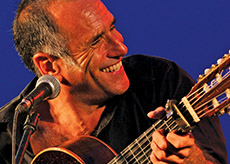
Israeli singer-songwriter David Broza and singer and activist Peter Yarrow of Peter, Paul and Mary are among the line-up of performers and VIPs who will dine among guests and lead Chicagoans in City Winery’s interactive Passover Seder dinner hosted by City Winery founder Michael Dorf.
The fourth Downtown Seder, set for Monday, April 18, will feature guests seated at long family-style tables, each set with the traditional accoutrements, including Seder plate and matzoh.
Performers, seated with guests throughout the room, will expound on various sections of the Passover Haggadah, which has been specially developed for this night. In an approximately 90-minute program, all of the customary traditions will be followed, including drinking of four glasses of wine (produced by City Winery), discussing the four children, reciting the four questions, and eating a kosher-style or vegetarian meal prepared by City Winery Executive Chef Andres Barrera.
What makes the Downtown Seder different from all other Seders is the addition of artists-local and national-each offering their unique interpretation of the important lessons from the timeless Exodus story-the universal message of going from slavery to freedom.
“The Downtown Seder is specifically being held four days prior to the start of Passover so that guests might bring the inspiration into their homes and make their own Seder dinner more relevant,” said Dorf.
Only 300 tickets for the City Winery Seder are available, priced at $70, $110, $125 and $145 (based on location). Vegetarian and kosher-style meal is included, with a Kosher option available for an additional $25.00/person.
Visit www.citywinery.com/chicago/ for more information.
Other stories
-
Meet Andrew S. Hochberg, 2021 Julius Rosenwald Memorial Award recipient
Celebrate Andy Hochberg at the virtual Annual Meeting on Sept. 14
Read more -
Two local teens win national recognition
Recipients of the annual Diller Teen Tikkun Olam Awards
Read more -
Celebrating six young award winners cultivating the community
Introducing young adult award winners
Read more
The JUF/Federation Board of Directors approved a $5,000 grant to the Flint Michigan Jewish Federation’s Water Fund. In response to the ongoing water crisis in Flint, the Jewish Federation of Flint established a fund for immediate short term needs over the next 6 – 24 months. Unlike other funds being established in the community for long-term concerns, this fund will be used to help individuals and families deal with the additional costs associated with living with this burden.
It is estimated that 100 Jews live within Flint, but not all of them have been affected. The Flint Federation serves the broader community, to which the bulk of the fund’s resources will be devoted.
Other stories
-
Meet Andrew S. Hochberg, 2021 Julius Rosenwald Memorial Award recipient
Celebrate Andy Hochberg at the virtual Annual Meeting on Sept. 14
Read more -
Two local teens win national recognition
Recipients of the annual Diller Teen Tikkun Olam Awards
Read more -
Celebrating six young award winners cultivating the community
Introducing young adult award winners
Read more
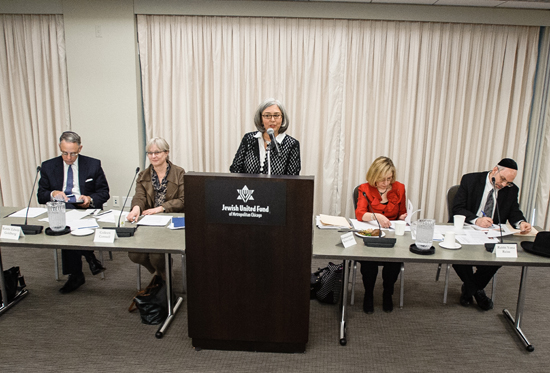
Nancy Kohn, advocacy chair of the Jewish Women’s Foundation, introduces a panel of experts on Religious Refusal Laws: (from right) Rabbi Edwin Goldberg of Temple Sholom, Colleen Connell of the ACLU, State Rep. Robyn Gabel and Rabbi Yona Reiss of the Chicago Rabbinic Council. (Photo by Robert F. Kusel)
Religious Refusal Laws and the implications for the Jewish community was the focus of a Feb. 29 joint meeting co-sponsored by the Jewish Women’s Foundation, JUF’s Jewish Community Relations Council and JUF’s Government Affairs Committee.
A panel of distinguished leaders including Colleen Connell, executive director of the ACLU of Illinois; State Rep. Robyn Gabel (18th Dist); Rabbi Edwin Goldberg of Temple Sholom; and Rabbi Yona Reiss of the Chicago Rabbinic Council, briefed a packed room on the varying nature of religious freedom laws, and how they intersect with civil liberties and Jewish law.
Connell and Gabel began the conversation by discussing a proposed amendment to the Healthcare Right of Conscience Act, which is pending in the Illinois General Assembly. The act currently allows healthcare professionals the right to refuse providing medical care to a patient if such care violates their religious or moral beliefs.
The proposed amendment to the bill (S.B. 1564) (SA3) upholds the rights of health care institutions and individual providers to assert their religious or moral objections, but would require that in such instances, medical providers would be required to inform patients of all available treatment options and provide referrals to other practitioners.
The amendment has passed the Illinois Senate, but is awaiting its third reading on the House floor. The Roger Baldwin Foundation of the ACLU, a current grantee of the Jewish Women’s Foundation, works tirelessly to improve litigation and develop legal and public health strategies to advance legislative efforts.
Goldberg discussed the paradox that exists within some versions of religious refusal laws, and stated that “religion should never be used to limit the civil rights of others.”
Reiss, Av Beth Din of the Chicago Rabbinical Council, spoke about how Jewish law applies to healthcare professionals, and the importance of striking a balance between the individual practitioner’s religious beliefs with the rights of patients.
“It is important that we preserve freedom of religion in our society while also upholding the freedom of individuals to access treatment and information on health care options,” he said.
In closing, Reiss said that “it’s nice to live in a country that provides us with a Constitution that affords us with an expanded sense of freedom of religion, something which the Jewish community never really had in its previous existence” in the diaspora.
Other stories
-
Meet Andrew S. Hochberg, 2021 Julius Rosenwald Memorial Award recipient
Celebrate Andy Hochberg at the virtual Annual Meeting on Sept. 14
Read more -
Two local teens win national recognition
Recipients of the annual Diller Teen Tikkun Olam Awards
Read more -
Celebrating six young award winners cultivating the community
Introducing young adult award winners
Read more
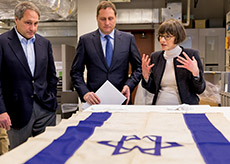
In 1947, a ship called the Exodus left France for pre-state Israel. Aboard were over 4,500 Jews- including 1,000 children-all displaced persons (DPs) or survivors of the Holocaust. Intercepted by the British, the ship was towed to Haifa-but its passengers were sent back to displaced persons camps in Germany. The story was retold in a book by Leon Uris, which was then made into a film starring Paul Newman.
The Exodus sailed under a familiar flag, with a distinctive Jewish star and sky-blue stripes. Now that very flag is in the hands of the United States Holocaust Memorial Museum, thanks to two brothers from Chicago: Bill and Tom Silverstein.
The Museum called Bill and asked if he could purchase the flag-going up for auction in Israel last December-for the Museum. As it happened, he already knew the flag was being auctioned, since Tom, an avid collector of early-Israel memorabilia, had shown him that auction’s catalog. Tom flew to Israel and obtained the flag, which had been kept in private homes for nearly 70 years.
Once they had the flag, they noticed that its border had been written on by one Mike Weiss, who had labeled it as having flown on the Exudus [sic]. The brothers were worried that this would damage the value of the flag, but the Museum said this actually proved the item’s provenance. They already knew that Mike Weiss, an American crewman on the fateful voyage-the Exodus was initially an American ship-had secured the flag before the ship was returned to Europe.
Bill, currently serving as JUF’s Chairman of the Board, found the flag’s sudden reappearance timely. “There is an international conversation now about immigration, refugees, and resettlement.” The flag’s story shows, he said, “These are not new concepts.”
For Bill, having the flag available for public viewing again is “very gratifying.” He said that it has “different layers of meaning” depending on who views it, but that it “humanizes” the event for all who see it. “I think it would be very moving for a young person to see this flag,” he added, “because it creates a human spark.”
“It would be a loss for it to go to a private individual,” agreed Tom. The refugees on the Exodus were part of an effort to create “a new nation, a new home, from all over the world. It’s a pioneer story, one of perseverance.”
In addition to the flag’s historical value, Bill added that the act of giving itself creates a ripple effect. “I want people to examine how they think about giving,” he explained. “Giving can influence others to give.”
Other stories
-
Meet Andrew S. Hochberg, 2021 Julius Rosenwald Memorial Award recipient
Celebrate Andy Hochberg at the virtual Annual Meeting on Sept. 14
Read more -
Two local teens win national recognition
Recipients of the annual Diller Teen Tikkun Olam Awards
Read more -
Celebrating six young award winners cultivating the community
Introducing young adult award winners
Read more
For nearly 20 years, the Jewish Women’s Foundation of Metropolitan Chicago has brought women philanthropists together to transform the lives of Jewish women and girls through grant-making to further social change and strengthen families and communities.
Ellen Carmell, JWF Executive Director, talked about the Foundation’s history during JWF’s Annual Meeting on Jan. 25. “From the very beginning, JWF had a bold vision and an ambitious agenda-to expand opportunities and choices for Jewish women and girls, and to position women in our community as philanthropic leaders and decision-makers. As we prepare to embark on our 20 th anniversary celebration in 2017, we continue to think big and bold.”
“The founders’ vision of a giving circle in which women have a hands-on role in grant-making became a national model,” said Gerri Kahnweiler, JWF Chair. “We have the firm belief that philanthropy can effect positive social change. When you invest resources in women and girls, you create ripple effects throughout society.”
With over 315 trustees and a nearly $9 million endowment, JWF has awarded over $3.2 million in grants since its inception. Trustees represent numerous backgrounds and age groups. “We truly are a diverse multigenerational group,” Carmell said.
Through its grant-making, JWF helps fund programs affecting Jewish women and girls in Chicago, Israel and other countries, focusing on economic security, legal reform, education and leadership development, health and well-being, and violence prevention. “Our grants are changing lives,” Carmell said.
In addition, JWF provides opportunities to enhance women’s leadership roles and skills. This past year, JWF sponsored its first mission to Israel. “This connected us in new ways,” Carmell said, noting that participants personally saw the impact of JWF’s funding in Israel while experiencing Israel from a feminist perspective. As a direct outgrowth of the mission, JWF focused on women’s philanthropy and social change at the 2016 Annual Meeting.
The keynote address was presented by Hamutal Gouri, executive director of the Dafna Fund, the first and currently only Israeli feminist fund; founder of Consult4Good, a consulting firm committed to promote social justice and gender equality; and recipient of the National Council of Jewish Women 2015 Outstanding Israeli Feminist Award.
Gouri said collaboration between organizations is critical for creating change in the lives of women and girls. Since its inception, JWF has consulted with Gouri about projects throughout Israel. Those grants address human trafficking in Israel; promote women’s rights by filing precedent setting lawsuits in Israeli civil courts to address discriminatory policies decided by Israeli’s rabbinic courts; work to change discriminatory divorce laws in Israel; and empower Israeli women to become politically active in their communities.
“Women are critical for a world that is just and inclusive,” Gouri said. “No single sector or organization can solve difficult problems. It takes partnership and coordination if you really want to make a difference for women and girls … Leadership is important. We need to train and empower women to be effective agents of change. This is what you’re all doing here.”
For more information on the Jewish Women’s Foundation, call 312-357-4850 or visit www.jwfchicago.org .
Alona Anspach honored as multigenerational trustee at 2016 Annual Meeting
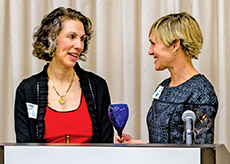
Gerri Kahnweiler, Jewish Women’s Foundation Chair, presents Alona Anspach with a Miriam’s Cup at the JWF Annual Meeting, held Jan. 25 in the Jewish United Fund Conference Center.
Almost 20 years since its founding, the Jewish Women’s Foundation of Metropolitan Chicago remains committed to expanding and improving opportunities for Jewish women and girls through strategic grant-making and empowering Jewish women as leaders, funders, and decision-makers.
Alona Anspach served as the Foundation’s first chair. In recognition of her new commitment as a multigenerational trustee, Anspach received a Miriam’s Cup on Jan. 25, during the JWF Annual Meeting. The Miriam’s Cup is a feminist symbol and new ritual object named for Miriam the Prophet in the Exodus and used during the Passover Seder to highlight the contributions of women throughout Jewish history.
Anspach is among 42 multigenerational trustees who have secured lifetime involvement on the JWF Board of Trustees for themselves and their immediate female family members, in perpetuity. “I’m very fortunate to have five daughters,” she said. “I became a multigenerational giver because of them. It’s really for the next generation that we do this work.”
Other stories
-
Meet Andrew S. Hochberg, 2021 Julius Rosenwald Memorial Award recipient
Celebrate Andy Hochberg at the virtual Annual Meeting on Sept. 14
Read more -
Two local teens win national recognition
Recipients of the annual Diller Teen Tikkun Olam Awards
Read more -
Celebrating six young award winners cultivating the community
Introducing young adult award winners
Read more
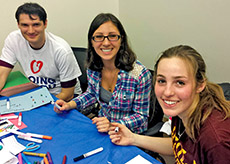
JUF’s “Together for good” tagline isn’t just a catchphrase-it’s a commitment. So when the organization’s Tikkun Olam Volunteer (TOV) Network had the opportunity to get involved with Good Deeds Day-a global movement born in Israel that now unites over 61 countries in the spirit of community service-it was a natural fit.
“We are so excited to once again be joining forces with the global Good Deeds Day movement,” said Marissa Comin, TOV’s Assistant Director. “As one of the largest volunteer networks in the community, we’re proud to be able to lend a hand with the coordination and planning of this special day-and we’re also looking forward to literally getting our hands dirty and pitching in at service sites across Chicagoland!”
Good Deeds Day is a large-scale, community-wide event that will engage hundreds of volunteers in a variety of projects at agencies throughout the city and suburbs. The event first launched in Chicago last year with the support of TOV and JUF’s Israel Education Center, as well as six local Hillels.
This year, the movement gained even more momentum with the sign-on of the Jewish Teen Alliance of Chicago and BBYO, who will merge their annual JServe day of service with the April 10 event.
“This community-wide program is a new approach to the Jewish day of youth service. BBYO will be gathering teens from all across Chicagoland to lend a hand, do a mitzvah, and serve the community,” said Celia Livshin, senior regional director of BBYO’s Great Midwest Region.
Event organizers expect some 500 volunteers of all ages to turn out for more than 30 projects spanning 27 sites across Chicago. Activities run the gamut from sorting food at local pantries, to hosting Bingo with senior citizens, cooking and serving meals for the homeless, designing a mosaic, playing games with children with special needs, and everything in between, with opportunities for every interest and skill level.
Volunteers are also invited to an open house at the Bernard Weinger JCC in Northbrook from 1-5 p.m. (doors open at 12:30). All ages are welcome to join for hands-on service projects (such as making sack lunches, assembling pediatric hospital care packages, decorating cards for cancer fighters, and making sleeping mats for the homeless), a blood drive, and open swim and a song session for younger helpers.
TOV serves as JUF’s connection point for people who want to give back through hands-on volunteering. In accordance with tikkun olam , the Jewish concept of repairing the world, TOV connects members of the Jewish community with rewarding volunteer opportunities that best meet their interests and needs.
“People are looking for opportunities to make an impact that they can directly touch,” said Marisa Mandrea, TOV volunteer and Good Deeds Day event chair. “Good Deeds Day is so exciting because it gives people of all ages and opportunity to take part in a service project that speaks to them.”
For more information on TOV opportunities throughout the year, visit juf.org/tov .
Chicago’s Good Deeds Day is made possible in part by JUF’s Breakthrough Fund, which supports innovative and leading-edge local programs.
To register for Good Deeds Day, visit juf.org/tov/GoodDeedsDay.aspx . For more information, contact [email protected].
Other stories
-
Meet Andrew S. Hochberg, 2021 Julius Rosenwald Memorial Award recipient
Celebrate Andy Hochberg at the virtual Annual Meeting on Sept. 14
Read more -
Two local teens win national recognition
Recipients of the annual Diller Teen Tikkun Olam Awards
Read more -
Celebrating six young award winners cultivating the community
Introducing young adult award winners
Read more
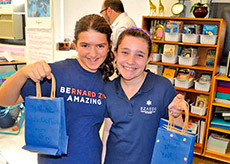
Six hundred elementary students used their knowledge, energy and skills in a cooperative effort pairing their classes with helping organizations in Chicago and Israel. Students and faculty alike were filled with excitement as Bernard Zell Anshe Emet Day School held its second annual Day of Service in late 2015.
It’s an event created in memory of former Head of School Dr. Alyson Horwitz’s late husband, Judd Horwitz; one where the entire school comes together to honor Mr. Horwitz’s passion and tireless dedication to those less fortunate with acts of loving kindness of their own. Classes tied their mitzvah projects to specific social-justice issues, matching their efforts with organizations that have similar missions.
The Jewish United Fund’s TOV volunteer network helped coordinate activities with service agencies and organizations. In addition, the effort was supported by JUF’s Breakthrough Fund. “With power and passion, all can help make the world a better place,” Dr. Horwitz said at the opening presentation. She urged students to “be bold, be compassionate, and be caring… not only about our families and friends, but also about others.”
Students received additional inspiration from cancer survivor and Imerman Angels founder Jonny Imerman, who started a program through which other survivors can personally provide emotional support for people dealing with similar cancers. Brielle Collins, a Bernard Zell graduate, spoke about United Hatzalah, an Israeli emergency response network of 3,000 medics.
Head of School Noah S. Hartman noted, “At Bernard Zell, we strive to create the foundation of an engaged Jewish life-each of our students know that they have the capacity to make the world a better place. On the Day of Service, these ideals become actions which reflect our deep commitment to humanity and truly define the spirit of our school.”
From planting flowers to making blankets, students participated in a variety of mitzvah projects that integrated with the school’s curriculum. Led by eighth-graders, the nursery school students and junior kindergartners planted flowers in window boxes and flowerpots. Later, fifth-graders delivered the flowers to residents of The Selfhelp Home.
Senior kindergartners made blankets for baby sloths orphaned by deforestation, an issue they studied in class. “Baby sloths don’t have much fur, so they need help getting warm,” explained Max Golding, 6, of Lakeview. The blankets help the sloths “feel like their mom and dad are there.”
First-graders painted wooden “buddy benches” for the EZRA Multi-Service Center, the Under the Rainbow youth outpatient program at Sinai Health Systems, and Lozano Elementary School. Georgie Gell, 6, of Lakeview, said that buddy benches were places for shy students to sit as a way of telling other kids they wanted to be invited to play.
Second-graders made lunches that included healthy sandwiches and hand-made placemats for Inspiration Corporation, which helps people who are homeless become more self-reliant. Meanwhile, sixth-graders were wrist-deep in kneading “no bake” cookies-combining oats, dates, sunflower seeds, and cinnamon-for Temple Sholom’s Night Ministry to distribute to homeless teens.
Charlie Cohen, an 11-year-old from the Gold Coast, said, “It’s good to know we’re making people happy.” Classmate Lucy Gold, 12, of Lakeview, added that the class studied homelessness, imagining what it would be like to survive on $5 a week. They also studied food justice with Pushing the Envelope Farm.
Also focusing on homelessness were the fourth-graders who made blankets, and the third-graders who facilitated a toiletry drive for The ARK. Fifth-graders packed gift bags with toiletries and candies-plus origami figures and greeting cards they made-for the Little Brothers-Friends of the Elderly. Josie Stahl, 11, of Lakeview, said that she had received gift bags at birthday parties, “but never this good!”
Barbara Applebaum, fifth grade humanities teacher, praised TOV for helping the school pair the classes with organizations, adding that these would become ongoing relationships for each grade. “We want to make (service) authentic and meaningful,” she said. “The teachers are just as passionate about this day as the students are. The joy in the building today is amazing.”
Other stories
-
Meet Andrew S. Hochberg, 2021 Julius Rosenwald Memorial Award recipient
Celebrate Andy Hochberg at the virtual Annual Meeting on Sept. 14
Read more -
Two local teens win national recognition
Recipients of the annual Diller Teen Tikkun Olam Awards
Read more -
Celebrating six young award winners cultivating the community
Introducing young adult award winners
Read more