Masquerades, dramas, and costumes are well-known in TaNaKh , the Bible. Our ancestor Jacob dresses up as his brother Esau to deceive his father Isaac. Jacob gives Joseph a coat of many colors so that he can portray himself as the favored son and heir apparent. Joseph masquerades as an Egyptian vizier in the royal clothing given to him by Pharaoh.
The grandest of all masquerades is the Royal Ball organized by King Achashverosh to choose his next queen, and Esther emerges as the winner of the competition with only her natural beauty to commend her to the king. Out of this emerges the classic Purim Play, which turns everything sacred on its head, just for one day a year. Actors in costume and masquerade poke good fun at all that is sacred.
Thus, it should come as no surprise to us that many Jews turn to theater and then to film to grapple with and understand the clash between traditional Jewish life and modernity. This impulse drove many Jews to Hollywood more than a century ago. The same impulse enchanted many a young Jewish man or woman to seek the silver screen or the theatrical stage. These media became the ways in which Jewish outsiders critiqued their new host culture. These media became the ways in which many young Jewish men and women sought to meld Jewish society and community and enter popular culture.
Enter Marjorie Morningstar, a.k.a. Morgenstern. She was born in 1916 in the Bronx, the child or grandchild of Jewish immigrants from Eastern Europe. Her family came to America as part of the wave of nearly 2.5 million Jews fleeing oppression and poverty from the Polish-Lithuanian Commonwealth and Austro-Hungarian Empire. Their aspiration was to become Americans. They succeeded, and marvelously so.
The Jewish immigration was not that much different than its sister immigrations of Irish, Italians, Poles, et cetera. Those with the most to lose by staying, and the most to gain by coming, were the first wave of immigration. In but a generation or two, the children and grandchildren of these East European Jewish immigrants climbed from the lowest rungs of the socio-economic ladder to the highest rungs of entrepreneurial, professional, and educational achievement.
In the process of Americanization, this generation came to be known by American Jewish sociologists as the “Lost Generation.” Jewish identity and affiliation declined. It was to this generation that the post-World War II Conservative, Reform, and Orthodox movements devoted their genius in presenting Jewishness and Americanness as compatible.
Marjorie Morningstar is the main character and the title of a novel by Herman Wouk (his first book, The Caine Mutiny , was a sensation). Her family, after achieving moderate success, moves from the Bronx to Manhattan’s Upper West Side, a veritable Garden of Eden for Jews in the outer boroughs of New York. She changes her name from Morgenstern to Morningstar because she wants to become an actress and needs a non-Jewish-sounding name. The character of Marjorie is consistent with the trend during that era for children and grandchildren of immigrants to shed their old-world identities and lives.
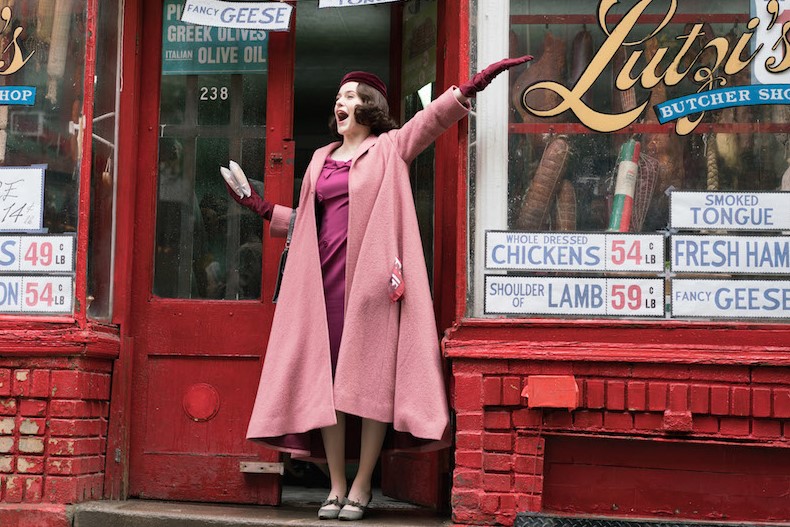
Now, let’s consider another famous 1950s-era Jewish character also trying to make it as a star. Midge, a.k.a. Miriam Maisel, is portrayed on the current smash TV show The Marvelous Mrs. Maisel , created by Amy Sherman Palladino. Midge, meet Marjorie Morningstar, who preceded you by many a decade, in the imagination of a great American Jewish writer.
Herman Wouk wrote Marjorie Morningstar to hold a mirror up to the face of American Jewry, many of whom were going the way of Marjorie Morningstar-changing their names, seeking to trade in their Jewish identity for all the goods that come from being a full-fledged American.
In response to this, Herman Wouk wrote the book This is My God, which, in its time in the 1950s, was one of the greatest books about Judaism written for Americans. The book, a manifesto for traditional Judaism, became a bestseller in both the Jewish and broader society. It was written in an American idiom. It was such a sensation that it made the cover of Time Magazine, September 5, 1955. Herman Wouk wrote this book because he understood who the grandchildren of Marjorie Morningstar and Miriam Maisel were going to become.
Sherman Palladino and Wouk present one story with two different purposes. Sherman Palladino is engaged in nostalgia, which in German is translated into heimweh, quite literally, homesickness. There is a good deal of homesickness today in some segments of the American Jewish community. Wouk, on the other hand, wrote Marjorie Morningstar to alert the American Jewish community to the consequences of superficial ethnic identity and its willingness to pay a high price for American acceptance.
Happily, large segments of the American Jewish community have moved way beyond Marjorie Morningstar and Miriam “Midge” Maisel, both of whom are emblematic of a period of serious decline in American Jewish life. The Marvelous Mrs. Maisel is a period piece that takes us back to the lost generation. It comes as a timely alert to take a look at the author of a similar book with a very different purpose, and to possibly re-read Herman Wouk’s, This is My God.
Rabbi Yehiel E. Poupko is Rabbinical Scholar of the Jewish United Fund.
Other stories
-

Two local teens win national recognition
Recipients of the annual Diller Teen Tikkun Olam Awards
Read more -

Celebrating six young award winners cultivating the community
Introducing young adult award winners
Read more -