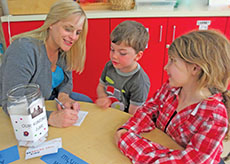
The colorful plastic jar used to hold jellybeans. Now, it holds something even sweeter–acts of kindness done by children.
The Junior Kindergarten class at the Bernard Zell Anshe Emet Day School began using what they call “The Kindness Jar” in December. Every time a students see another child acting in a kind way, they tell their teachers, Sheila Schraber and Ann Schneiderman. The teachers write the act down on a slip of paper-in the student’s own words-and place it in the jar, which the children decked out with hearts, stars, and flowers.
“The notes get read each day at lunch,” said Schraber, “and we then talk about how it felt to be both the giver of the thoughtful act as well as the recipient.
“We came up with the idea to use a Kindness Jar as a way to make the idea more tangible for the children,” Schraber said. “Not only is it helping to reinforce the idea of being kind, but it helps teaches them to recognize the kindness in others as well,” she said. Often, both Ann and I catch children doing wonderful things for each other and we write those in the jar as well. They love the surprise of hearing their name called out when they didn’t know anyone saw what they did.”
“We’re striving to create a culture of kindness” in the classroom, Schneiderman explains, by “emphasizing kindness among friends.”
“Young children start with open hearts and open minds,” Schraber said, “So we have to model kindness for them, and teach them to look for kindness.”
The effort is paying off, she says. “We are sensing more of a community feeling in class.” Schneiderman reports that the students have started putting Kindness Jars in their own homes as well.
Some examples of kindness from the classroom’s jar include: Hannah brought in enough tzedakah so that all of her classmates had some to put in the tzedakah box; Noah invited Emme to play with MagnaTiles with him when he saw she didn’t have any; Eden helped Henna to roll up her sleeves so they would not get wet when she was washing her hands; Henna took out Abby’s rest mat for her simply so she didn’t have to.
Aside from a very real kindness jar and tzedakah box, the class also learns about the metaphorical invisible bucket. “For the past several years, all three of the Junior Kindergarten classes have used the book Have You Filled a Bucket Today? by Carol McCloud as a means to reinforce kindness and thoughtful actions,” Schraber said. “The idea is that everyone has an invisible bucket that holds our thoughts about ourselves. You can ‘fill’ a bucket when you say or do something kind. By making someone feel special, you fill your own bucket as well.”
Other stories
-

Meet Andrew S. Hochberg, 2021 Julius Rosenwald Memorial Award recipient
Celebrate Andy Hochberg at the virtual Annual Meeting on Sept. 14
Read more -

Two local teens win national recognition
Recipients of the annual Diller Teen Tikkun Olam Awards
Read more -

Celebrating six young award winners cultivating the community
Introducing young adult award winners
Read more