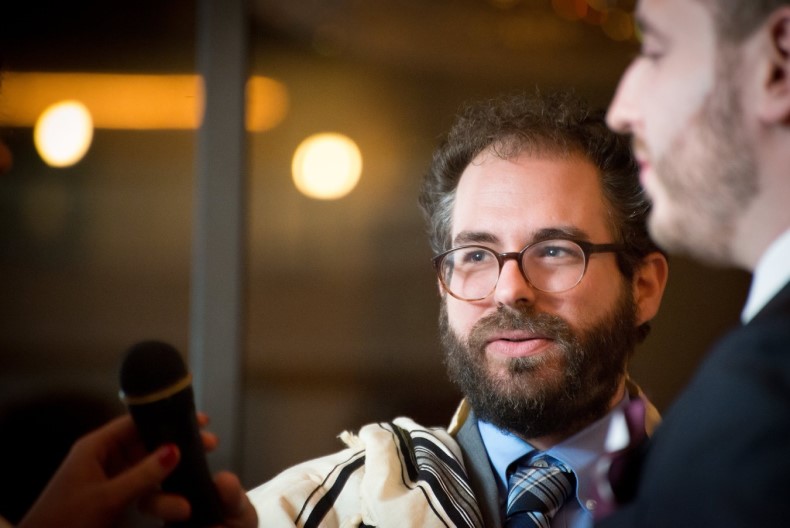
During a pandemic that has separated us, Rabbi D’ror Chankin-Gould has been focused on bringing his Lakeview-based Anshe Emet Synagogue congregation together and keeping them connected and engaged.
“It has been a trying time,” said Chankin-Gould, 37, Rabbi and Interim Grodzin Director of Educational Innovation at Anshe Emet. “It has required a lot of ingenuity to stay connected to the people to whom we’ve been so close and providing support, services, and education in new ways.”
Chankin-Gould, a member of the 36 Under 36 Class of 2016, embraced the honor as a foundation on which to expand outreach initiatives and “continue to have impact,” he said. “The year has challenged us to re-think things we’ve taken for granted. Everyone’s preference is to be together in person, but for the first time we have been providing virtual services. We are learning how to be more flexible and in doing so, we’re touching people who we haven’t touched in the past.”
From bar and bat mitzvahs to baby namings, there is little that the pandemic has not impacted in the services and programs Anshe Emet offers its congregation and the outlying community. “We’ve tailored our offerings depending on what the best medical advice is in the moment,” he said. “I’ve worked very closely with our health and safety committee so depending on the moment in the pandemic, some folks have had small in-person gatherings with a handful of friends and family while others held outdoor celebrations with masks. Some have gone entirely virtual and found ways to connect with family that cannot travel.”
While Chankin-Gould feels “such sadness” that family celebrations have had to be curtailed or canceled outright, he has seen that “people are finding out what matters most. This moment calls on us to figure out how can we be creative in connecting with our deepest values and with cherishing those above all else.”
Among the out-of-the-box programs Chankin-Gould instituted during the pandemic is reaching out to older immigrant congregants for whom English is not a first language and who are disconnected from technology.
Another challenge Chankin-Gould has found “exciting to oversee” is navigating what religious school looks like in a virtual world. “We’ve pivoted to a system of simultaneous tracks that I’m very proud of,” he said. “We offer an in-person option with social distancing and masks which a third of our students took up. The rest are involved with virtual learning.”
The synagogue has “gotten more flexible in meeting families where they are and tailoring our resources to them,” he explained. “If that means sending materials home so kids are better supported, then we’re doing that. If it means finding a tutor to work one-on-one with virtually or at home, then we’re doing that. We’re opening up a wide box of opportunities to make sure every kid is getting their needs met.”
In his seven years at Anshe Emet, Chankin-Gould, a Jewish leader in the LGBTQ community, said he has seen “great strides in LGBTQ outreach and inclusion.”
The pandemic has also not slowed his efforts to work with Keshet to “develop the training and resources dedicated to helping people be their best selves,” he said.
Anshe Emet’s tagline–“We are more than a building”–has served as a signpost for Chankin-Gould and his congregation during this health crisis. “That insight in and of itself is so profound,” he said. “We’re a family and we’re a community that supports each other, learns together, works together, and cares for each other. There is also something very heartening in realizing that the value of our community transcends the physical space.”
Donald Liebenson is a Chicago writer who writes for VanityFair.com , LA Times , Chicago Tribune , and other outlets.
Other stories
-
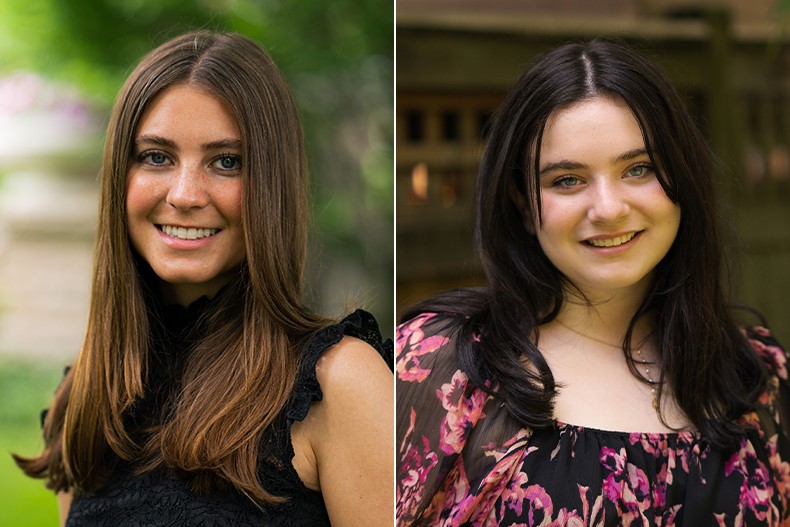
Two local teens win national recognition
Recipients of the annual Diller Teen Tikkun Olam Awards
Read more -

Celebrating six young award winners cultivating the community
Introducing young adult award winners
Read more -