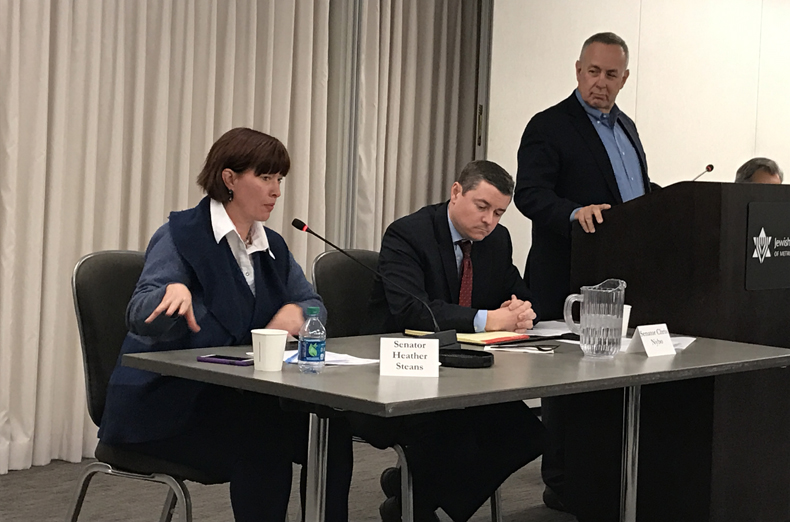
JUF’s Government Affairs Committee convened a discussion with State Sens. Julie Morrison, Heather Steans and Chris Nybo, and Secretary of the Illinois Department of Human Services James T. Dimas on Dec. 12 about Illinois’ new vision for serving individuals with behavioral health needs, state budget negotiations and options for moving forward.
In recent years, Illinois has struggled to meet the mental health and substance abuse needs of people served by the Departments of Healthcare and Family Services, Human Services, Corrections, Child and Family Services, Juvenile Justice and Public Health. After a year-long collaboration among all the directors — with input from community stakeholders including the Jewish Federation — the state submitted an 1115 waiver request to the Federal Government, the entity that would pay for the new program.
“With no state budget and prospects for getting one dim, this is a gusty undertaking,” Dimas said.
The waiver program allows states to apply for Medicaid funding for demonstration projects or pilot programs. If successful, the waiver could bring in roughly $2.7 million in Federal funds to help care for people with mental illness or in need of substance abuse treatment, and will integrate DHS with other departments providing health care, criminal justice, public health and child welfare services. Slated to start next July 1, Dimas said he is hopeful that the Federal government will approve the waiver in the coming months.
Steans, who represents Chicago, and Nybo, who represents Elmhurst, then talked about possible options for a budget resolution. To the dismay of many, the General Assembly and Office of the Governor continue to fail in agreeing on a budget. Now 18 months with no state budget, Steans expressed frustration at lack of progress and urged the public to stop being polite and to start holding General Assembly members accountable.
“A budget is a moral document and we need to determine if we live in a moral state,” Steans said.
Nybo, on the other-hand, is encouraged that a resolution on the budget crisis is coming soon. Citing recent bipartisan efforts that led to passing the controversial state energy bill, Nybo believes the capacity to make hard decisions exists. “A template for a successful negotiation is one when no one gets everything they want,” he said.
Nybo said his focus this session is on improving the process over substance. He believes process reform will mend broken relationships and help rebuild trust between leadership and the administration. When asked how to improve the process, Nybo said open communication is the key to maintaining healthy relationships.
In closing, Government Affairs Committee Chair David Golder stressed the importance of coming together as a community to engage in open dialogue with key officials, which he said is so crucial to the work the Jewish Federation does in Springfield and Washington, D.C.
“As we are fast approaching the end of the state’s temporary spending plan Dec. 31, the grim reality of our state’s fiscal health is near, where spending outstrips revenues by more than $7 billion and where the state owes more than $10 billion in unpaid bills,” Golder said.
Golder highlighted the upcoming Government Affairs Committee 2017 advocacy missions as a critical opportunity to continue the dialogue with elected official. The missions will take place in Washington, D.C. March 21-22 and in Springfield May 9-10.
Other stories
-

Two local teens win national recognition
Recipients of the annual Diller Teen Tikkun Olam Awards
Read more -

Celebrating six young award winners cultivating the community
Introducing young adult award winners
Read more -