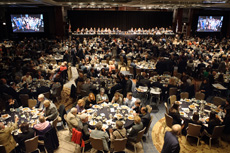
Some 1,300 people hear message of hope for peace and partnership at Federation Annual Meeting
CINDY SHER
After a summer of hardship for the Jewish people in Israel and around the world, the Jewish Federation of Metropolitan Chicago’s 114th Annual Meeting held Thursday at the Hyatt Regency Chicago, reflected the community’s commitment to Jewish life and Israel in the past year—and looked ahead to hopes for peace, light, and partnership in the Jewish year ahead.
Chicago Archbishop Francis Cardinal George, OMI, a longtime friend to the Chicago Jewish community, delivered the keynote address. The Federation also recognized Max “Skip” R. Schrayer, with Federation’s highest honor, the Julius Rosenwald Memorial Award. (View photos from the Annual Meeting.)
The luncheon featured the State of the Federation address by Dr. Steven B. Nasatir, president of JUF/Federation, and the viewing of the 2014 JUF year-in-review. (Read about the morning business meeting.)
David T. Brown, chairman of the Jewish United Fund/Jewish Federation of Metropolitan Chicago, completed a two-year term as Federation chairman. Brown passed the gavel to Bill Silverstein, incoming chairman of the JUF/Federation Board.
Lee Miller received the Shofar Award for his work as chairman of the 2014 JUF Annual Campaign and Sara Crown Star was recognized as the incoming chairman of the 2015 annual campaign. Jodie Berkman chaired the Annual Meeting, while Rabbi Vernon Kurtz, spiritual leader of North Suburban Synagogue Beth El in Highland Park, gave the invocation.
More than 1,300 people attended the luncheon, including city, state, and U.S. official representing all branches of government, as well as local members of law enforcement, a United Way representative, human service colleagues, including a special mention of colleagues from the Refugee Social Service Consortium of the State of Illinois, of which the JUF/Federation is the coordinating agency.
Also in attendance were diplomats in Chicago serving their home countries from Bulgaria, Burundi, Canada, Chile, Dominican Republic, France, Greece, Haiti, Hashemite Kingdom of Jordan, Italy, Japan, Macedonia, Netherlands, the Phillipines, Spain, and Ukraine, and, of course, the Jewish community’s very own Roey Gilad, Israel’s Consul General to the Midwest.
Students from area Hillels as well as from the Bernard Zell Anshe Emet Day School, Chicago Jewish Day School, Chicagoland Jewish High School, Ida Crown Jewish Academy, and Solomon Schechter Day School also attended the luncheon. In addition, students from area Catholic high schools also joined, as well as students and staff from Newman House at the University of Illinois at Chicago.
A Catholic-Jewish friendship
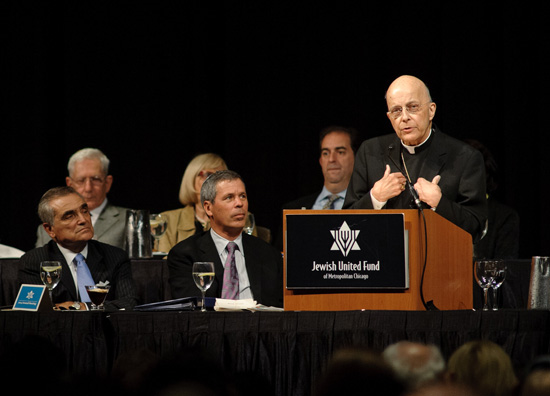
Francis Cardinal George delivers the keynote speech at the Federation Annual Meeting.
Francis Cardinal George, Archbishop of Chicago, was introduced by Chicago Jewish leader and humanitarian Lester Crown.
The Cardinal, who has served as the city’s archbishop since 1997, has dedicated himself to enriching the Catholic-Jewish relationship in the Chicago area and is an ardent supporter of the Catholic-Jewish Scholars Dialogue.
In his remarks, he discussed the growth of friendship and understanding between the Catholics and Jews, especially in Chicago, and the fostering of new beginnings led by popes of the last 50 years. (Watch the Cardinal’s speech.)
The Cardinal outlined the Second Vatican Council—which took place between 1962 and 1965—and shaped the direction of the Catholic Church in modern times. Vatican II passed a number of declarations, focusing on themes of reconciliation. He discussed Nostra Aetate, the declaration that lays out Jewish/Catholic relations, passed at Vatican II.
Cardinal George referred to the array of projects, all stemming from Nostra Aetate, that the Chicago Jewish and Catholic communities have partnered in, such as Israel education, Holocaust education, and work with Hillels on campus.
Catholic High School students and teachers have participated in two Federation sponsored program—one, an ongoing interfaith dialogue between students from Chicagoland Jewish High School, and the other, a project that brought 24 Catholic high school teachers to Israel, who are teaching today about Israel in their classrooms.
“What I’ve learned from Vatican II and from my 17 years as Archbishop of Chicago is that the narrative of Catholic/Jewish relations is best written if we write it together,” said Cardinal George. “This will only happen if we deepen our relationships…you get relationships right and everything else will follow. After the death of Pope John Paul II, [JUF’s] Rabbi Yehiel E. Poupko shared what he was looking for in a new pope and he said simply: ‘Someone who knows us.’ Relationships come first.”
First third-generation Rosenwald honoree
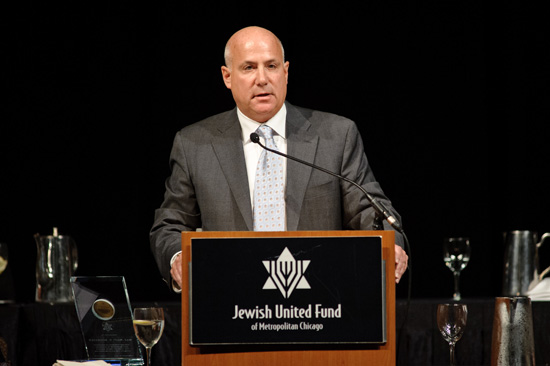
Max “Skip” R. Schrayer accepts the 2014 Julius Rosenwald Award.
Max “Skip” R. Schrayer is the 51st recipient of the Rosenwald Award, named for the iconic Chicago business leader and philanthropist of the early 1900s, and presented annually to a person who has demonstrated a lifetime of exemplary service to the Jewish community. (Watch Skip Schrayer accept the Julius Rosenwald Award.)
The award was presented to Schrayer by his dear friend, David T. Brown, the Chairman of the Federation. “He’s the Skip who sends out “Shabbat Shalom” messages nearly every week. Who follows me and my family on Facebook—and “likes” nearly everything we post. He’s the Skip who…went to school plays to see other people’s kids, when his own children weren’t even in the show,” Brown said. “…He approaches every situation with intelligence, sincerity, kindness, and sensitivity. He truly is a treasure to me, and to our community.”
Schrayer is the first third-generation recipient of the Julius Rosenwald Memorial Award, following in the philanthropic and leadership footsteps of his grandfather, Max, and father, Robert. In his remarks, Schrayer talked about carrying on the legacy of his grandparents and parents to make the world a better place through his work in the Jewish community. “Our dinner conversations were pepped with discussions of who was taking active roles in our community and who were making meaningful gifts,” he recalled. “My sisters and I were taught to admire people of means who shared their bounty and time—as opposed to people who just made a lot of money.”
Schrayer—who runs his family insurance business—has been a leader in the Federation community for more than three decades, serving a variety of roles, including chairman of the board, chairman of the 2006 Annual Campaign, the current chairman of JUF’s Jewish Community Relations Council, as well as key posts with national and international Jewish humanitarian and communal organizations. Abroad, for instances, in 2002, he co-founded the Federation’s Nachshon Mission, which annually travel to Israel other countries where JUF provides support and service. He has held roles with the Jewish Federations of North America, the National Conference on Soviet Jewry, and the American Jewish Joint distribution Committee. Closer to home, he’s been an active supporter of Solomon Schechter Day School, Chicagoland Jewish High School, and North Suburban Synagogue Beth El.
He spoke to the wisdom that he’s learned along his journey so far, including balancing life in terms of family, work and community; walking the walk; the power of the Jewish people to take care of each other; and the power of the collective and federated giving. “Our world is changing from the collective to individuals,” he said, “but we need to remind ourselves that we do things collectively that we cannot accomplish individually.”
A president calls for a global partnership to ‘defeat evil’
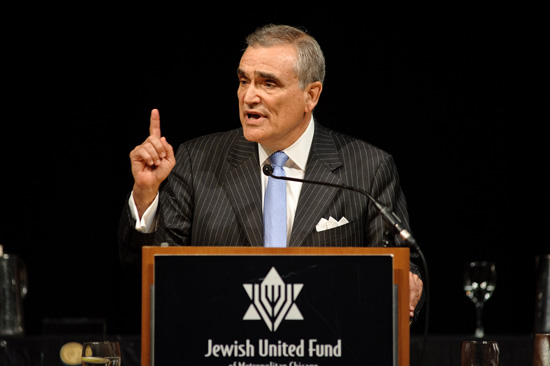
JUF/Federation President Dr. Steven B. Nasatir delivers his annual State of the Federation address.
In his state of the Federation address, Nasatir reflected on the vital work that the Federation and its agencies have done this past year, during a year of challenges in Israel and around the world. (Watch the State of the Federation address.)
This work is all possible thanks to an increased JUF annual campaign, which last year raised $81.54 million. This past year, the Federation board allocated $193 million from all sources to create Jewish experiences, build community, and help Jews in need here, in Israel and around the world.
Here in Chicago, among the many accomplishments was the new Breakthrough Fund, in which JUF invested $1 million into 17 cutting-edge local programs and initiatives in the Jewish nonprofit sector. The Day School Guarantee Trust Fund continues to provide extra dollars into day schools on top of the funds that come through the Annual Campaign. The Community Foundation for Jewish Education is under new leadership and the JCFS and JVS have created an alliance, and the JCCs are expanding, and the reach of CJE SeniorLife to the elderly and Holocaust survivor community is widening its service. “Everywhere you look in this community, we are uplifting the lives of children, families, young adults, and seniors, helping peopled express their American values with rich Jewish context,” Nasatir said.
Beyond our shores, the JUF/Federation is helping to repair a very broken world. In Ukraine, our community is helping to provide a safety net to the nearly 200,000 Jews living there. And Russia is by no means the only trouble spot.
Israel dominated the Jewish world’s focus this past summer. Nasatir recalled being in Israel in June when the three boys were abducted by Hamas. “I witnessed an entire country come together as one mishpacha—one family—to search, to pray, and to resolutely protect their children from harm,” he said.
JUF/Federation raised more than $9 million raised in emergency aid to Israel, as Hamas put civilians in the line of fire to sway public opinion. Nasatir said that the goals of Hamas are clear—to wipe Israel, and the Jews, off the map.
He blamed the western media for doing little to convey “the true nature of Hamas” and the context of the Gaza conflict. “Let me be clear, the death of innocents troubles everyone of conscience,” he said. “No country in the world at time of war does more than Israel to protect innocents. They and we believe all life is sacred. But, let the blame go where it belongs…”
The threat to Israel is the same poison that threatens America, said Nasatir. “…The reality of the threat that Israel faces from Hamas and Hezbollah is the exact same threat that America and the world faces from the likes of ISIS and Al Quaeda, and all the other theocratic, genocidal groups,” he said. “They all hate America and Israel because both are free, democratic, liberal and respectful of all religions.”
He suggested that there is something different about this conflict, which was expressed in an explosion of anti-Semitism around the world—particularly in France as well as Germany, England, Sweden, Belgium, and throughout much of Europe—where action and rhetoric changed from anti-Israel to anti-Jewish.
Anti-Jewish sentiment isn’t limited to Europe. Here at home, the demonization of Israel plagues Chicago streets, and anti-Semitism is reaching a boiling point on college campuses, just kicking off a new school year.
But it’s not only Jews, he said, persecuted for their religion. The Vatican, he said, reported that 100,000 Christians were killed worldwide, including in Syria and Iraq, because of their faith, with hundreds of thousands more persecuted and driven from their homes.
He recognized Cardinal George and other Catholics in the audience and talked about the growth in friendship and understanding between the two communities. “Your Eminence, you personify, as does Pope Francis, the essence of good relations between our communities,” Nasatir said. “You are a great friend in word and in deed.”
Then Nasatir suggested that the relationship between Jews and Catholics in Chicago serve as inspiration for a model between Jews, Christians, and Muslims, and others of goodwill who face the threat of religious radicalism.
As he prays for a peaceful new year ahead, he sounded the call for a new kind of global partnership—starting in Chicago—to forge a religious coalition to take on brutal radical terrorists. “Together, let us confront the resurgence of anti-Semitism,” Nasatir said. “Together, let us act on the shared values of our faith traditions and tell those who are threatened that they will not be abandoned. Together let us insist that the world protect the innocent and defeat the evil that endangers decency in our time…Let us pray for peace.”
Other stories
-
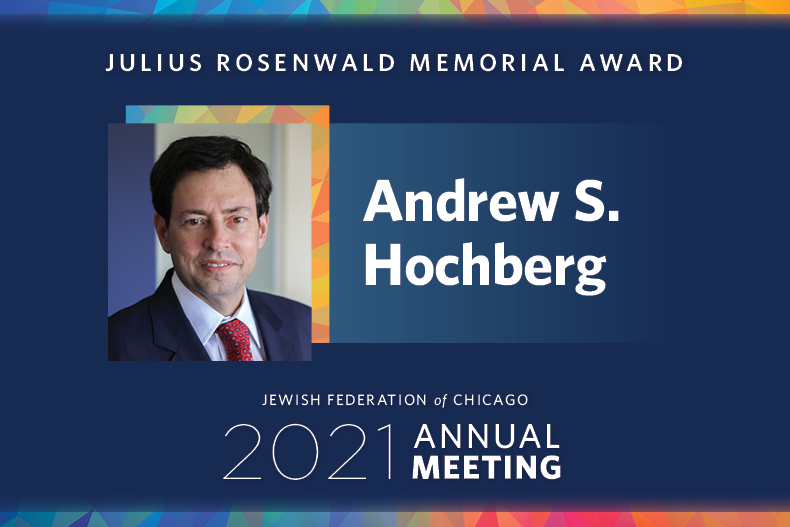
Meet Andrew S. Hochberg, 2021 Julius Rosenwald Memorial Award recipient
Celebrate Andy Hochberg at the virtual Annual Meeting on Sept. 14
Read more -
Two local teens win national recognition
Recipients of the annual Diller Teen Tikkun Olam Awards
Read more -

Celebrating six young award winners cultivating the community
Introducing young adult award winners
Read more