Springfield stand-off creates deep uncertainties for JUF human service agencies
SUZANNE STRASSBERGER
The potential impact of the state budget stand-off on many of those served by JUF partner agencies is greater than most realize.
The state is the largest provider of designated grant funding for most of JUF’s healthcare and human service organizations. Such earmarks, in the form of state contracts, provide almost 45 percent of total operating expenditures for Jewish Child & Family Services and CJE SeniorLife.
“Understanding this reliance, I only see harm coming to those most vulnerable people that our agencies support if the budget impasse continues and the budget reductions proposed by both parties are implemented,” Golder said.
A shrinking state budget is not new to the leadership teams of JCFS and CJE Seniorlife. They responded to the decline in funding for human services – 29 percent between FY2009 and FY 2013 – by asking staff to do more with less and relying upon additional dollars provided by JUF’s J-HELP initiative.
What is different this time is the seriousness of the challenge. In late June, human service providers signed contracts with no guarantee that the grant amounts listed would be honored or that program rules – such as client eligibility – would remain the same. Rate reductions were included on some contracts. The providers were told that they will not be paid until the budget is signed, meaning that the agencies had to ask their banks for extended lines of credit. There is a possibility that state offices will close because state workers will not be paid, so functions like certifying client eligibility for nursing home care will cease. Lower wage workers, such as home health care workers, will lose access to state subsidized child care services.
JCFS is a nationally recognized leader in residential treatment for children who are victims of abuse and neglect , guiding troubled adolescents towards a successful adulthood.
“There is a real possibility that we will have to close our five group homes if the State of Illinois reduces reimbursement by 10 percent as indicated in our new contract or if those in the age group 18-21 are denied DCFS services as was originally proposed,” said Dan Wander, chair of the JCFS Board of Directors. “Through charitable giving, we contributed well over $500,000 last year to subsidize the group homes and we just don’t have the discretionary resources to fill the new gap created by the state cut.”
“What parent would turn out their adolescent who had just turned 18? Yet that is exactly what the State of Illinois is proposing to do to these wards of the state, all of whom have a traumatic history of abuse and neglect,” said JCFS CEO Howard Sitron. “These kids need and deserve additional support – not less — if they are to become productive adults.”
Since 1972, CJE SeniorLife has provided community and residential care to Jewish older adults, regardless of income. Its business model recognizes that some older adults start with CJE economically secure, then deplete their savings and need subsidized services.
“The changes being contemplated by the state creates havoc for CJE’s budget,” said Steve Sandler, chair of CJE SeniorLife. Sandler asked the leadership team to build five budget scenarios in case any one of the proposals is implemented.
“I wake up worrying about those who depend on CJE and will now no longer qualify for help because of new income limits or stricter eligibility requirements,” said CJE SeniorLife CEO Mark Weiner. “About 38 percent of our Community Care program participants will be disqualified as well as 50 percent of those living in one of our senior residences. This will result in premature entrance into nursing homes, which is more costly to the state and deprives people of their independence. ”
Government Affairs Committee Vice Chair Steve Greenbaum said he is certain that both Governor Rauner and the General Assembly leaders believe they are taking appropriately strong positions, but he hopes they “don’t lose sight of the fact that as a result of the impasse, and the current uncertain conditions, many community human service providers may be unable to help those most in need.”
In the meantime, JUF will continue to advocate with Springfield on behalf of its agencies and the people they serve.
Other stories
-
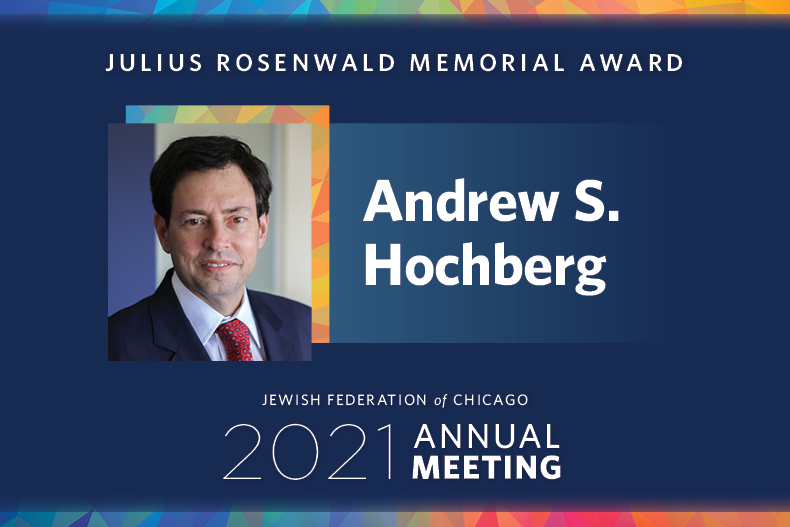
Meet Andrew S. Hochberg, 2021 Julius Rosenwald Memorial Award recipient
Celebrate Andy Hochberg at the virtual Annual Meeting on Sept. 14
Read more -
Two local teens win national recognition
Recipients of the annual Diller Teen Tikkun Olam Awards
Read more -

Celebrating six young award winners cultivating the community
Introducing young adult award winners
Read more