
Stepping off the Sidelines: The Jewish Women’s Foundation tackles gender-based violence
ELLEN CARMELL, SARA KALISH, and MARY E. THOMAS
It’s hard to imagine a pair of more unlikely allies than the National Football League and the Jewish Women’s Foundation of Metropolitan Chicago. Two years ago, when America was shocked by the video of Baltimore Ravens running back Ray Rice punching his fiancé and dragging her unconscious body from an elevator, the NFL had to confront the issue of violence against women. Because of the popularity of professional football and its celebrity players, America began to focus its attention on gender-based violence. What had previously been considered a “women’s issue” took center stage in the national conversation.
Though there had been prior incidents of such violence in professional football, this high profile case pressured the NFL to implement an anti-domestic violence initiative. But violence against women in our society continues–in sports, the military, on university campuses, and in homes every day. It has never been clearer that gender-based violence knows no boundaries. Indeed, this crisis pervades every country, community, and culture–including the Jewish community.
For nearly two decades, the Jewish Women’s Foundation has led Chicago’s Jewish community on this issue. As the only local organization using both a gender and Jewish lens in our work, JWF is uniquely positioned to tackle this problem for Jewish women and girls in a long-term, systemic way. Through bold innovative grantmaking and advocacy, our trustees have been directly addressing this and other pressing issues for almost 20 years.
While it is difficult to measure violence against women in the Jewish community, according to the Bureau of Justice Statistics every 52 seconds in America, a woman is victimized by physical or sexual violence. This poses such a devastating barrier to the overall status of women and girls that JWF has dedicated a large portion of our total grant allocations to projects that address gender-based violence.
Together, JWF and The Ellie Fund at the Jewish Women’s Foundation of Chicago* have invested more than $1.3 million in women and girls’ security, safety, and well-being by awarding 113 grants to organizations and programs working to end gender-based violence.
Twenty years ago, when the issue of violence against women was not yet publicized in the media, JWF began forging alliances between two key groups committed to changing the landscape for Jewish women and girls–our trustees, who decide which projects have the biggest potential for impact, and our grantees, who work to end violence against women. In this way, JWF empowers Jewish women as leaders, funders, and decision-makers.
Operating as a large giving circle, JWF’s social change philanthropy focuses on the root causes of problems that lead to inequality. This approach is unlike many traditional charities which work through direct services to ameliorate the symptoms of societal problems. At JWF, we concentrate on systemic change because we believe it’s the most effective way to improve the lives of women and girls today and tomorrow.
Violence against women exists in many forms, so JWF funds organizations and projects that approach the issue on a variety of fronts, both locally and internationally. We’re proud that many of our grantees are creating social change for women and girls right here in the Chicago area.
For example, SHALVA , the oldest independent Jewish domestic violence agency in the United States, addresses domestic abuse in Chicago Jewish homes and families. JWF funds SHALVA’s Legal Liaison Program which provides legal information and support to women who are engaged in lengthy legal battles with the men who abused them, and educates divorce attorneys and judges on the differences between a contentious divorce and a divorce involving an abuser. This crucial post-separation assistance promotes the long-term safety of Jewish women impacted by domestic abuse.
Jewish Community Abuse, Resources, Education & Solutions (JCARES), a program of Jewish Child & Family Services, educates, advocates, and collaborates with Chicago’s Jewish community to address many forms of abuse, including child abuse, domestic abuse, and elder abuse. Partnership for Safer Synagogues , a groundbreaking educational initiative of JCARES, engages clergy, staff, lay leaders, and congregants of local synagogues. Through this partnership, Jewish Child and Family Services helps them recognize and proactively respond to abuse across the lifespan and create safer spaces in our community.
In seeking to create change at a systemic level, JWF trustees understand that violence against women must be viewed as a public policy issue. Along those lines, the Chicago Metropolitan Battered Women’s Network* established the Medical Response Collaborative to shift the medical system’s response to domestic violence. Bringing together service providers in partnership with hospitals, Medical Response Teams advocate for doctors and nurses to treat domestic violence as a public health issue. This gives medical personnel an essential, proactive role in reducing future violence by properly screening and referring victims. The Medical Response Collaborative is currently working with four local hospital systems, including Mt. Sinai.
Policy change is often the result of shifting hearts and minds. Using this principle, Chicago Alliance Against Sexual Exploitation* (CAASE) works to change the way we think about and understand prostitution and domestic sex trafficking by shifting the criminal focus away from the women involved to those who perpetuate the industry (i.e. traffickers and “johns”). CAASE also enlists young men as allies against sexual exploitation through a high school- based prevention program. In a series of workshops, young men gain a personal understanding of how sexual violence affects them and their communities-with the objective of deterring their potential involvement as consumers of the sex industry.
Likewise, University of Chicago’s Center for Interdisciplinary, Inquiry, and Innovation in Sexual and Reproductive Health (Ci3)* is committed to empowering young people. Their Game Changer Chicago Design Lab developed Bystander , a web-based, interactive narrative that allows young people to explore the responsibility of witnesses to sexual harassment and violence. The ultimate goal is to invoke intervening behaviors for sexual assault situations. Response Center , a program of Jewish Child and Family Services, is partnering with Ci3 to implement this intervention. Together they are launching a revolutionary game-based approach to prevention education.
Earlier this year, a real-life bystander intervention captured America’s attention when two bicyclists saved a woman being raped by a Stanford swimmer. The powerful letter written by the brave survivor to her attacker and the controversial sentence handed down by the judge resulted in a proliferation of outrage on social media. And our nation was shocked into awareness of the epidemic of rape on college campuses.
Again, JWF’s trustees were engaged in this issue by funding Jewish Women International’s project with Fiedler Hillel at Northwestern University and Newberger Hillel at University of Chicago. This program empowers Jewish students to change a campus culture of ignorance and victim blaming to one of understanding, intervention, and support; a new paradigm shifts consent from a “no means no” to a “yes means yes” framework.
As pioneers in the Jewish community who began working on the problem of gender-based violence nearly 20 years ago, JWF trustees are pleased that this conversation is gaining more public attention throughout the U.S. We also recognize the ongoing need to leverage our combined resources, form strategic partnerships, and build momentum on this and other key issues impacting Jewish women and girls.
JWF is transforming the lives of individual Jewish women and girls through grantmaking and advocacy to further social change and strengthen families and communities. We are building a future where all Jewish women and girls are equally valued partners in every aspect of the Jewish community in Chicago, Israel, and around the world.
The NFL may not know of our existence, but we consider them an important ally in this work. After all, we are both advancing the quality of life for women and girls by investing in their security, safety and well-being, and overall potential.
In 2017 JWF will celebrate 20 years of bold, innovative grantmaking. We hope you’ll join us to help frame the future for Jewish women and girls.
For more information about JWF and our other funding priorities, visit jwfchicago.org .
Ellen B. Carmell is executive director of Jewish Women’s Foundation of Metropolitan Chicago.
Sara Kalish is senior program officer for Jewish Women’s Foundation of Metropolitan Chicago.
Mary E. Thomas is program associate for Jewish Women’s Foundation of Metropolitan Chicago.
*An Ellie Fund grantee.
The mission of The Ellie Fund is to support causes, issues, initiatives, and programs that promote safety, security, equal rights, equal voice, and equal opportunity for girls and women.
Other stories
-
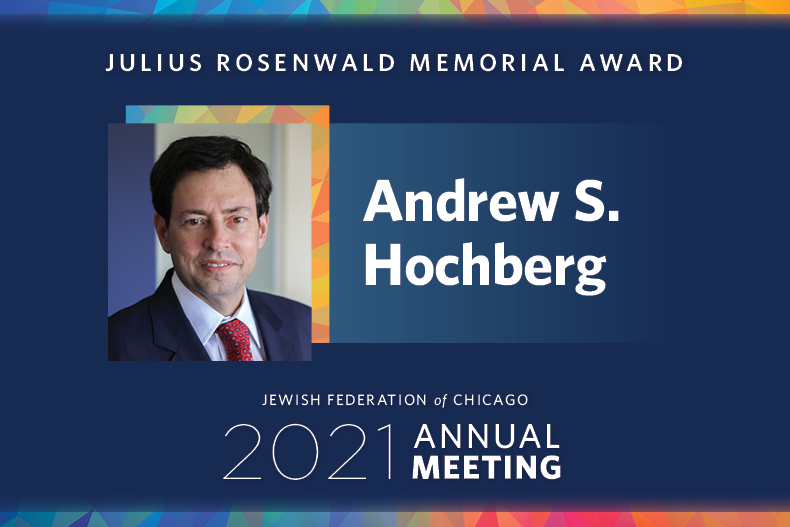
Meet Andrew S. Hochberg, 2021 Julius Rosenwald Memorial Award recipient
Celebrate Andy Hochberg at the virtual Annual Meeting on Sept. 14
Read more -

Two local teens win national recognition
Recipients of the annual Diller Teen Tikkun Olam Awards
Read more -

Celebrating six young award winners cultivating the community
Introducing young adult award winners
Read more