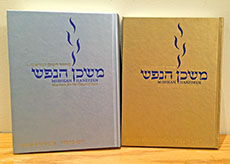
“Machzor” means “Jewish holiday prayer book.” The root means to “return” but also to “review.” Now, the Central Conference of American Rabbis (CCAR) has reviewed, and renewed, the Reform movement’s High Holiday prayer experience.
The result is a two-machzor set-one for Rosh Hashanah, one for Yom Kippur-titled Mishkan HaNefesh , loosely, “Temple of the Soul.” The title Mishkan HaNefesh aligns the work with the CCAR weekly prayer book called Mishkan T’filah .
This effort marks the first completely new North American machzor since the Union Prayer Book (UPB) was created in the 1890s; Mishkan HaNefesh replaces Gates of Repentance , a 1970s update of the UPB .
The first North American, from-scratch Reform machzor in a century, Mishkan HaNefesh is the result of a seven-year effort involving dozens of rabbis, scores of congregations, and thousands of congregants. From 2011-14, over 300 congregations, Hillels, and day schools participated in piloting opportunities. This is a machzor made by, and for, the collective Reform Movement.
Mishkan HaNefesh is also available digital and large-print versions. Additionally, there is a collection of accompanying music, Shirei Mishkan HaNefesh , created by the American Conference of Cantors.
The Mishkan HaNefesh text is in Hebrew, English, and transliteration. The text is gender-free and LGBT-inclusive. It offers options for Torah readings, as well as new commentary, study texts, poetry, alternative readings, meditations, and abstract illustrations.
Even the title is significant: “Mishkan” (sacred dwelling) evokes communal prayer; “HaNefesh” (the soul) reflects individual repentance.
Rabbi Hara Person, of CCAR Press, the publisher, says the book serves to “embrace the rich liturgical voices of the Jewish past and the aspirations of our people today.” For example, Leonard Cohen’s song “Who by Fire?” is printed alongside the passage that inspired it, “Unetaneh Tokef” (liturgical poem in Rosh Hashanah and Yom Kipper services).
Rabbi Edwin Goldberg, senior rabbi at Temple Sholom of Chicago, served as managing editor for Mishkan HaNefesh ; he was joined on the editorial staff by colleagues from across the country: Rabbis Janet Marder, Sheldon Marder, and Leon Morris, with Rabbi Elaine Zecher, Cantor Evan Kent, and Rabbi Peter Berg. “The editors consulted many different machzorim (prayer books), noting variants in the text,” explained Rabbi Goldberg. “Each of their choices reflects the desire to render the most faithful version of the tradition.”
Goldberg, who also serves on the President’s Rabbinical Council of the Hebrew Union College-Jewish Institute of Religion, continued that Mishkan HaNefesh encourages choice on the user’s part as well. “What matters is not doing everything, but deciding what matters most for you and your congregation, and employing the machzor in that endeavor. We encourage personal engagement with the material in Mishkan HaNefesh , and hope that everyone will find something within the covers that will pique their curiosity or stir their soul. There will never be a ‘just add water’ prayer book.”
A unifying approach pervades the entire project. “We want worship that is complex rather than complicated,” Goldberg said. “We seek an integration of tradition and innovation, prayer and music, speech and silence, the struggle with God and the struggle with being human.”
“We are not creating a book, so much as a sacred tool.” he said. “What do we hope to have realized by the worshippers at the end of Neilah (Yom Kippur concluding service)? How will their lives have changed? Our machzor will be designed to lead the worshiper through a process in which painful truths are realized, change is adopted, and the individual leaves with a plan for self-improvement.”
There was great diversity in the sources that went into Mishkan HaNefesh , but Goldberg believes that what emerged was Reform at heart: “We believe the Reform nature will be evident in its commitment to the equality of men and women; in its faithfulness to the ethical dimension of Judaism and, perhaps most of all, in its effort to deal with the tension between the historical theology of the High Holy Days and more contemporary beliefs,” he said.
On a personal note, Goldberg recalled, “Shortly after beginning work on the machzor, I came across my great-grandfather’s original 1895 UPB . I imagine Lewis Wessel praying with this book on the Upper West Side. Our new book will be different, but it will seek to solve the same problem: How do we return to our sacred path in a world that seduces us away from the work that we must do?”
Other stories
-
Meet Andrew S. Hochberg, 2021 Julius Rosenwald Memorial Award recipient
Celebrate Andy Hochberg at the virtual Annual Meeting on Sept. 14
Read more -

Two local teens win national recognition
Recipients of the annual Diller Teen Tikkun Olam Awards
Read more -

Celebrating six young award winners cultivating the community
Introducing young adult award winners
Read more