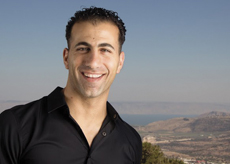
Dr. Thaier Kizel is an Israeli teacher who specializes-and innovates-in the teaching of Modern Hebrew. He is a winner, in fact, of Israel’s Outstanding Teacher award. And he has served in the Israel Defense Forces. But he’s not Jewish. He’s a member of the Druze community, one of some approximately130,000 living in Israel today.
Like his parents and grandparents, Kizel was born in Maghar, a town near Tiberias. “It’s a mini-Israel,” Kizel joked, referring to its mixture of Jewish, Christian, Muslim, and Druze inhabitants. Today, he lives and teaches in Haifa.
Recently, Kizel visited Chicago and New York to share what he has learned, and to learn more about how Hebrew is taught in America. Here, he met with ambassadors of the Jewish Agency for Israel, Friends of the IDF, and parents of the Diller Teen Program. He also met with students of all ages, from Hillel Torah Day School and Chicago Jewish Day School, Chicagoland Jewish High School and Niles North High School, and even a JCC “Say It in
Hebrew” ulpan.
“Everyone in Israel speaks Hebrew,” Kizel explained, adding that this gives minorities a sense of belonging. Even in his own village, which is largely Druze, he prefers to speak Hebrew. In Israel, Kizel adds, there is a high motivation for learning Modern Hebrew, while in America, “you need a reason.”
Aside from Hebrew, Arabic, and English, Kizel can also get by in German and can read Aramaic. He learned Dutch to read a book for his doctorate, which he received from the University of Haifa, on the Arabic influences on the poetry of Abraham ibn Ezra.
Today, Kizel teaches Hebrew to future teachers, and also does work for Israel’s Ministry of Education. He was nominated for Outstanding Teacher by his students, and was one of six winners out of a field of 2,000. The award, now in its sixth year, is given by the Outstanding Teacher Project, run by El Al Airlines, the Yediot Achronot newspaper, and the Jewish Agency for Israel, which receives support from JUF. Winners are chosen by a panel of high-ranking public officials.
Kizel is a pioneer of Hebrew-language teaching. He teaches in “immersive” style, using only Hebrew while class is in session. His goal is to make the language useful for students, so his lessons involve music videos and popular TV shows; Kizel also encourages students to use their smart phones. For homework, Kizel may assign the students to read and report on a Hebrew website. He only turns to books for advanced students.
But the tone of the lessons are important, too, Kizel continued; he often thinks about his own education and what he enjoyed about it. He feels that a sense of humor is important, and does not issue tests for the first four months of the school year. Empowering the students, he allows them to choose the topics of their oral presentations and give feedback to each other. He focuses on speaking skills first, then reading, then writing, as he feels that “students should experience success” early and often.
As to why he chose to dedicate himself to teaching Hebrew, he said, “Language has the power to change something within us.” And-he would no doubt agree-between us.
Other stories
-
Meet Andrew S. Hochberg, 2021 Julius Rosenwald Memorial Award recipient
Celebrate Andy Hochberg at the virtual Annual Meeting on Sept. 14
Read more -
Two local teens win national recognition
Recipients of the annual Diller Teen Tikkun Olam Awards
Read more -

Celebrating six young award winners cultivating the community
Introducing young adult award winners
Read more