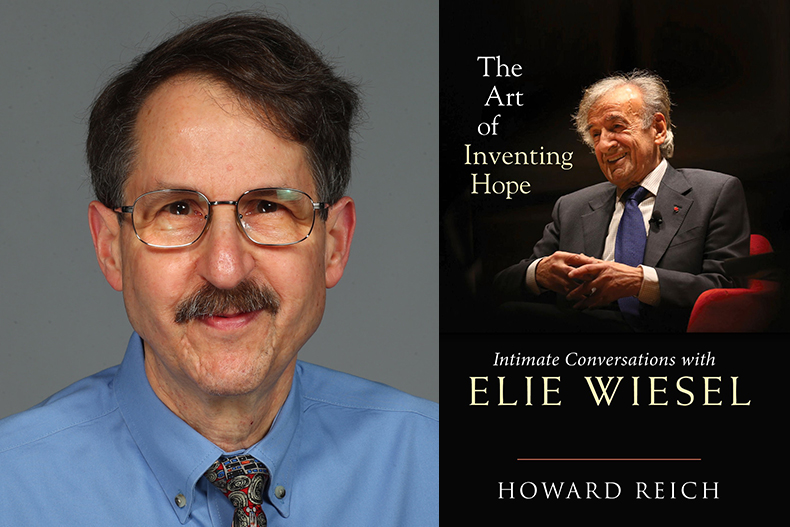
In 2001, Howard Reich’s mother, then 69, ran out of her Skokie house insisting someone was trying to kill her. There was no intruder-the culprit was late-onset PTSD. She was reliving childhood memories from the Holocaust.
That experience prompted Reich, an award-winning journalist, to investigate his mother’s story. His reporting became a Chicago Tribune feature, an acclaimed book, and an internationally distributed film.
Later, on assignment, Reich met survivor and Nobel Peace Prize Laureate Elie Wiesel. An incredible friendship emerged. In his new book, The Art of Inventing Hope, Reich shares his conversations with Wiesel about life, family, and the importance of telling our stories.
“My previous book was about what happened to my parents,” said Reich, whose father was also a survivor. “This book is about trying to understand.”
Below, Reich shares behind-the-scenes insight in advance of his Jewish Book Month talk at Spertus Institute on Dec. 15.
Let’s start with the obvious question: What was it like to meet Elie Wiesel?
I was awestruck. I had no idea what to expect. In all my years as a journalist, I had never had an interview experience like the one I was about to have.
We became friends after about four minutes. I think part of it was timing; it was the right time, for him and for me. He was in his 80s, a time when people look back and reflect. I was looking for answers to the questions I couldn’t ask my parents.
Sometimes I still can’t believe it. Our connection was a profound privilege.
Before your mother’s health issues, you describe being almost “allergic” to engaging with Holocaust issues. What advice would you give to children and grandchildren of survivors who share that hesitation?
I spent the first four decades of my life trying to avoid the Holocaust. The situation with my mother forced me to confront it. And it was terrifying.
I had nightmares before I went to Eastern Europe to find out my mom’s story. I had red splotches all over my body from stress when I wrote the story-that’s how visceral the experience was. But afterward, I knew. There’s something powerful about that.
Once I got the story out, my head was in a different place. Now, a subject that I wouldn’t even whisper about, is something I go around the world talking about. This whole experience has transformed my life.
What does it mean to talk about the Holocaust today, as survivors are dwindling? How do we tell the story in a way that matters?
Wiesel called himself an active pessimist-which means you don’t give up. Our job is to speak about these subjects of concern to us. If people aren’t listening, you talk more. If you don’t protest, who will?
There’s no place I visit where someone doesn’t share an anecdote about the time they heard Elie Wiesel speak. He was out there talking to people around the world. And the focus was often students. What we do by speaking is teach. When I can speak to classes… that is one of the most precious audiences. That is where we make the biggest impact. Speak to students so they won’t just have read a book, but will have heard a speaker. That’s what they’ll remember.
I love the part of the book where you and Wiesel discuss the title principle: the art of inventing hope. Can you share more about that?
This is not a book about the Holocaust-it’s a book about finding hope where there isn’t, whether that’s the Holocaust, the pain of losing a child, or the suffering that comes from an illness. Wiesel felt that it is our duty as Jews to seek hope no matter what.
People have said they feel peaceful after reading Wiesel’s words in this book. There is a measure of peace you get from hearing this great, brilliant man sharing what he learned through such a hard-fought life. It transcends far beyond the Holocaust-he’s speaking to us about how we live.
Wiesel was a humanist. He had great love for humanity in spite of what [was] done to him and to the Jewish people. If he could hold on to hope after all he had been through…we can, too.
Hear Howard Reich at Spertus Institute for Jewish Learning and Leadership, December 15 at 2 pm. He will be interviewed on stage by Alison Pure-Slovin, Midwest Director of the Simon Wiesenthal Center. A book signing will follow the program. Tickets $8 for students and $18 for the public. Purchase tickets at spertus.edu.
Spertus is a partner with JUF in serving our community.
Jessica Leving is Communications and Community Relations Manager for Spertus Institute for Jewish Learning and Leadership.
Other stories
-
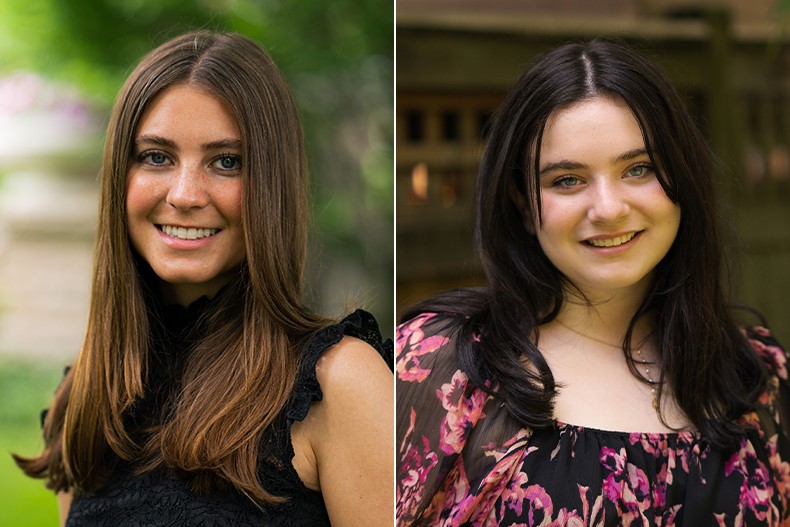
Two local teens win national recognition
Recipients of the annual Diller Teen Tikkun Olam Awards
Read more -

Celebrating six young award winners cultivating the community
Introducing young adult award winners
Read more -