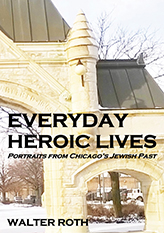
History only retains its meaning when it records the lives of people from all walks of life, so that those who tell the tale and those to whom it is told recognize it as their own story.
This is the driving philosophy behind the latest book of acclaimed author and former president of the Chicago Jewish Historical Society, Walter Roth The book, titled Everyday Heroic Lives: Portraits from Chicago’s Jewish Past, gives new life to Jewish voices of Chicago’s vibrant history. Proving that Chicago Jewish history extends far beyond delicatessens and tailor shops, the book reveals the impressive degree of Jewish involvement in the businesses, movements, and events that shaped both the city of Chicago and the nation at large during the late 19 th through 20 th centuries.
In Everyday Heroic Lives , Roth details the personal lives and accomplishments of some of Jewish Chicagoland’s distinctive local personalities, celebrating everyone from “the leaders who made a difference” to “the ne’er-do-wells who left an imprint.” In this way, Roth-also author of An Accidental Anarchist and Looking Backward: True Stories from Chicago’s Jewish Past -compiles for the Jews of Chicago, “a history that is as diverse as we are.”
The Chicago Fire of 1871, Roth explains, was a crucible for change in the Chicago Jewish world. After losing the synagogues that formed the core of their community, the Chicago Jewish population moved west of the Chicago River-to what is now called South Shore-to rebuild. At the time of the Chicago Jewish migration, South Shore already boasted a strong African-American community and was rapidly becoming a major destination for Irish, German, and other European immigrants, including countless Jews escaping war and pogroms.
In this new and diverse environment, American-born and immigrant Jews alike quickly became leaders in local industries and movements. From this developing Jewish community came renowned Stockyard tycoons like Nelson Morris, early union organizers like Ralph Helstein, and idolized athletes like Ike “Kid” Bernstein, all of whom Roth introduces in his book. Also featured are influential individuals such as Rosika Shwimmer a prominent Suffragist, Moses “Moe” Annenberg, a Jewish cultural contributor to the 1933 World’s Fair, and David Cantor, a Civil Rights activist who marched with Dr. Martin Luther King Jr.
While the achievements of these individuals are extraordinary, what makes their stories especially remarkable is the humanity afforded them through Roth’s expert storytelling. Instead of purely focusing on a person’s accomplishments, Roth takes special care to also celebrate the details that characterize them as individuals. It is Roth’s inclusion of seemingly ordinary details-synagogue attendance, family dynamics, and academic careers-that make his biographical portrayals truly rich and make the reader feel as though they are part of a greater Jewish family.
Furthering this theme of interconnectedness, Roth concludes Everyday with a glimpse into his own family history via an interview between himself and his stepmother, Toni. They reminisce about life in Germany and reflect on the difficulties faced by families seeking refuge in the United States, discussing the hardships of starting from nothing in a new country, the pain of leaving behind the familiar-a reality to which so many Jewish families can relate.
“[My] parents were not well-known or influential in the Chicago Jewish community of their time,” writes Roth. However, “they led heroic lives and their story is important to tell and remember.” As is evident in each chapter of his book, “from the story of one family [or individual] one can learn so much,” and Roth’s Everyday Heroic Lives has much to teach.
The book Everyday Heroic Lives: Portraits from Chicago’s Jewish Past is available through Amazon for $15.
Jenna Cohen is a freelance writer currently living in Israel.
Other stories
-
Meet Andrew S. Hochberg, 2021 Julius Rosenwald Memorial Award recipient
Celebrate Andy Hochberg at the virtual Annual Meeting on Sept. 14
Read more -

Two local teens win national recognition
Recipients of the annual Diller Teen Tikkun Olam Awards
Read more -

Celebrating six young award winners cultivating the community
Introducing young adult award winners
Read more