Jewish tradition teaches that when our ancestors were slaves in Egypt, they nearly succumbed to despair–but Jewish women saved us by believing in a better future and working to make that a reality. In the merit of Jewish women, the Torah describes, our ancestors were finally able to travel from slavery in Egypt to freedom in the Land of Israel.
Each year, we retell and relive this experience at the Passover Seder with the help of symbolic foods: charoset,karpas (parsley or another bland vegetable), maror and chazeret (two kinds of bitter herbs), a roasted shankbone, and a roasted egg. The Seder plate containing these richly symbolic items is the focal point of our Seder, the setting against which we educate the next generation in our Jewish history.
In Chicago today, a new generation of Jewish women are once again re-imagining our national story, this time by creating unique Seder plates. Here are five special Seder plates made by Chicago-area women artists.
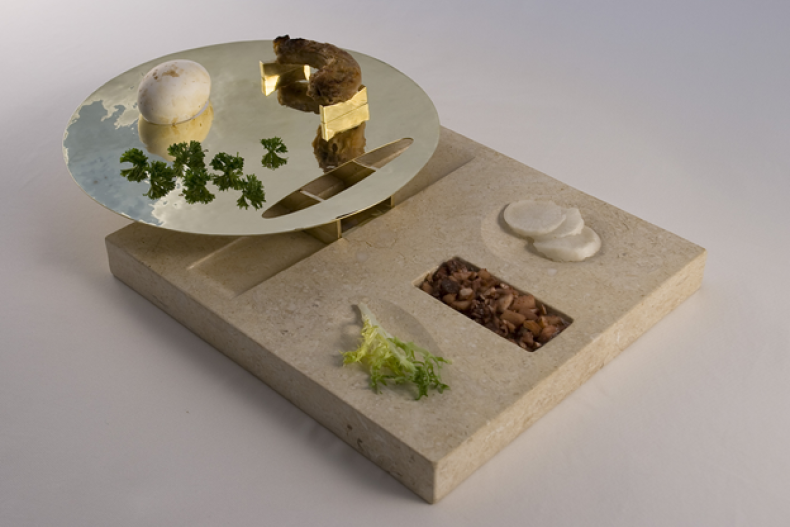
Chicago architect and artist Amy Reichert created this Seder plate for a San Francisco museum. Made of Jerusalem stone and hammered brass, it reimagines the Seder plate to “act as a more useful prop in this family drama that takes place at the Seder.” The Seder plate’s three foods that symbolize slavery– charoset , maror , and a second bitter herb–are imbedded in the heavy stone slab, while the foods symbolizing freedom–an egg, a shankbone, and parsley–seem to float on the raised metal plane. Salt water is poured into a trench dividing the two halves, recalling the Red Sea which our Israelite ancestors crossed to freedom.
Reichert also created this Japanese-inspired Seder plate in 1996. “My husband got tired of my not finding any Seder plates that I liked–he said, you’re a designer, you make one.” The result was this mahogany box with removable sterling silver inserts. “I wanted to frame this symbolic landscape” of the Seder, Reichert recalls: The entire Seder plate can be easily lifted up and carried, recalling the way our ancient ancestors carried their possessions with them as they left Egypt–its unusual shape also elicits questions at the Seder, acting as a conversation starter, much like The Four Questions. This striking plate won second prize in a contest at the Spertus Museum.
More information about Reichert can be found at amyreichertdesign.com .
Chantal Blaustein is the artist behind Broken Beauties Mosaics (brokenbeautiesmosaics.com) and is Arts Director at Ramah Day Camp in Wheeling, Ill. Born in France, Chantal now calls Deerfield home. She created this Seder plate in 2020 out of shards from ceramic plates and glass pieces. Hiddur mitzvah –making Jewish commandments beautiful–is an important consideration for Blaustein. Working with mosaics also allows her to live out the key Jewish value of saving the environment: “Upcycling is a way to make these discarded pieces beautiful again,” Blaustein explains.
Northbrook-based artist Leslie Berkowitz is the creator behind the popular gift site kidoodlesinc.com . She created a personalized Seder plate in 2018 out of tempered glass. The rich colors were added through a process called sublimation in which prints are permanently adhered to the glass.
Skokie-based artist Shikma Benmelech ( shikmapaperart.etsy.com ) created a Seder plate for her husband and her to use together after their wedding in 1994. “My husband’s family is descended from followers of the Vilna Gaon and moved to Israel in the 1830s–they have some unique Pesach customs, such as using four items only on the seder plate, and only two matzot .” Unable to find a suitable Seder plate for sale, Benmelech created this out of a wooden board which she painted. The plate’s motif echoes other family heirlooms she has made, including a matzah cover (pictured), the ketubah for her wedding, and a paper cut of the Shabbat song Yedid Nefesh that hangs over the family’s Shabbat candles. Through the years, Benmelech added to this Seder plate, incorporating an etched plastic matzah holder held up by four tiny wine goblets, recalling the four cups of wine drunk at the Passover Seder.
Yvette Alt Miller, Ph.D. lives with her family in the northern suburbs of Chicago.
Other stories
-
Two local teens win national recognition
Recipients of the annual Diller Teen Tikkun Olam Awards
Read more -

Celebrating six young award winners cultivating the community
Introducing young adult award winners
Read more -