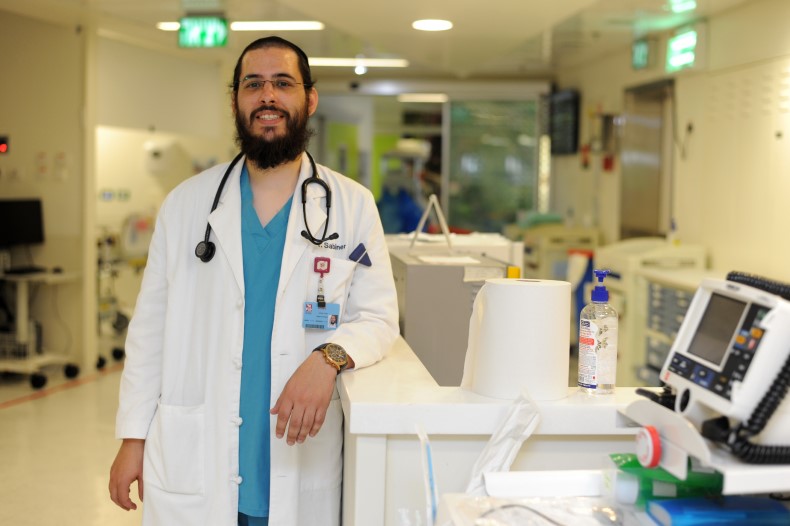
Yehuda Sabiner first remembers going to a doctor when he was 4 years old. He’d never met anyone like this physician, and the experience stayed with him throughout his childhood.
“My pediatrician was compassionate and professional,” Sabiner recalls. “Later, I saw the meaning of the job– that I could help a lot of people.” Now, at 29, Sabiner is the first Israeli-born Haredi doctor.
His road to a medical degree was challenging. HIs yeshiva education had given him the fortitude to study complex topics for hours at a time; however, his schoolwork did not include much math, physics, or English–which he spoke at home with his Brooklyn-raised mother, but never learned to read. He needed to be proficient in those subjects to be accepted to medical school.
Sabiner’s smarts and determination, however, led the Technion (Israel Institute of Technology) to take a chance on him. In 2011, at age 20, he was accepted to their mechina , an 18-month academic boot camp that brings promising students up to speed. Sabiner was among only 17 of 67 students to complete the course and bridge the academic gap.
He was accepted into Technion in 2013, earned his bachelor’s degree in 2016, and completed medical school last summer. He soon begins his six-year internship at Israel’s largest hospital–Sheba Medical Center in Tel Aviv.
While he first considered pediatric surgery, Sabiner decided on internal medicine. “I enjoy the big picture aspect of it, and how it’s multi-disciplinary.”
Even before he began his odyssey, Sabiner had to win approval from his wife, Rachel, and his community. Medical school required a formidable time commitment. The couple would have to relocate to Haifa from Bn’ei Brak with their three young children. And he would have to convince his community’s leaders that he would not assimilate into the secular world.
Sabiner is especially appreciative of his wife’s support during his studies. Rachel was working on her own certifications in architecture and interior design, yet they both stayed up late to finish his homework. They were up at all hours anyway, she explained, as their third child had just recently been born.
Now, Sabiner’s goal is to pay his community back.
“My dream,” he said, “is to be a professional doctor in a hospital and also work in public health in my community. We need more preventive medicine–vaccinations, mammograms and colonoscopies.” Today, only half of Haredi women over age 40 receive regular mammograms for early detection of breast cancer.
To help others follow his footsteps, Sabiner established Haredim in Medicine. He hopes to foster the ambitions of future Haredi doctors and solve the medical, cultural, and halachic problems of Haredim that impact their health.
Other stories
-
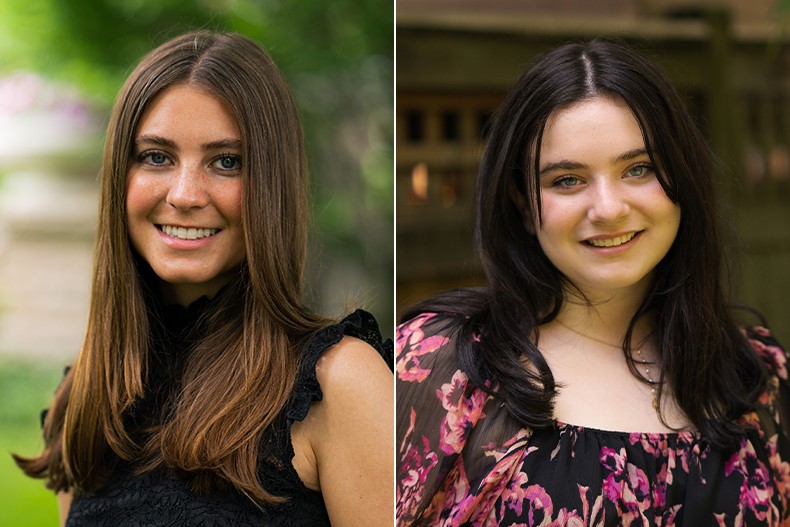
Two local teens win national recognition
Recipients of the annual Diller Teen Tikkun Olam Awards
Read more -

Celebrating six young award winners cultivating the community
Introducing young adult award winners
Read more -