Will final state budget harm people served by JUF-funded programs?
SUZANNE STRASSBERGER
The State of Illinois just ended its fourth month without a budget. This does not mean the State has stopped spending money.
Constitutional rules, court orders, and the signed education appropriations bill require payments for debt service, local government allocations, pensions, K-12 education, child welfare and Medicaid. That represents about 90 percent of all state spending. Though reimbursement is delayed by three months or longer, at least these programs are seeing some funding. Compare this to social service providers like JUF-funded agencies who have signed contracts-and therefore must deliver services-but are receiving no reimbursement. It is a dire situation, but actually only a part of the state budget crisis.
The other part is the mismatch between spending and revenues, with spending exceeding revenues by over $5 billion on a base of $37.14 billion. Any actual budget may well include additional funding reductions, revenue enhancements, and further delays in bill payments.
The following examples illustrate what all this means for JUF-funded agencies and more importantly, the people they serve.
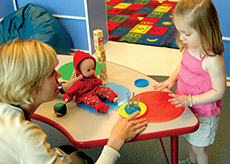
“Mild to moderate developmental delays in toddlers is often easy to fix,” explains Marlies Gramann, who supervises the Jewish Child and Family Services Early Intervention program. “But if you wait until the child enters preschool or kindergarten, chances are that the delay will have increased and the child will need special education for much longer than if he had used early intervention service like speech and the occupational therapy.” Proposed policy changes limiting service eligibility to children delayed 50 percent or more, as opposed to current guidelines of 30-50 percent delayed, will push Illinois into the category of being the third most restrictive state in the nation.
Much research documents the success of CJE Seniorlife Adult Day Services Program in keeping older adults facing cognitive, physical, and emotional challenges engaged in community and providing respite and support for their family caregivers. CJE Seniorlife has supplemented the gap between the costs of the program and the government subsidy with private fundraising. However, if the rate reductions being threatened by the Governor and General Assembly are implemented, CJE may be forced to seriously consider restricting admission to only private pay clients. “This doesn’t make sense,” said Melissa Gelfand, director of Adult Day Services. “If this program goes away for the government funded clients, caregivers will be forced to quit jobs or place the clients in nursing homes. How much will that cost the state?”
“There is real danger ahead because State spending far exceeds tax revenues,” said David Golder, chair of the JUF Government Affairs Committee. “We are worried that the Governor and the General Assembly will cut spending on tremendously cost-effective programs such as community care for seniors and supportive housing for people with disabilities, so they can avoid the more difficult decisions required for a long term fix to the State budget. The JUF Government Affairs Committee is continually advocating to keep these investments in the final budget and to keep the eligibility rules for these important programs at current effective levels.”
Suzanne Strassberger is associate vice president of Government and Community Partnerships for the Jewish Federation of Metropolitan Chicago.
Other stories
-

Meet Andrew S. Hochberg, 2021 Julius Rosenwald Memorial Award recipient
Celebrate Andy Hochberg at the virtual Annual Meeting on Sept. 14
Read more -

Two local teens win national recognition
Recipients of the annual Diller Teen Tikkun Olam Awards
Read more -

Celebrating six young award winners cultivating the community
Introducing young adult award winners
Read more