Pillars of the community
BRITTANY FARB GRUBER
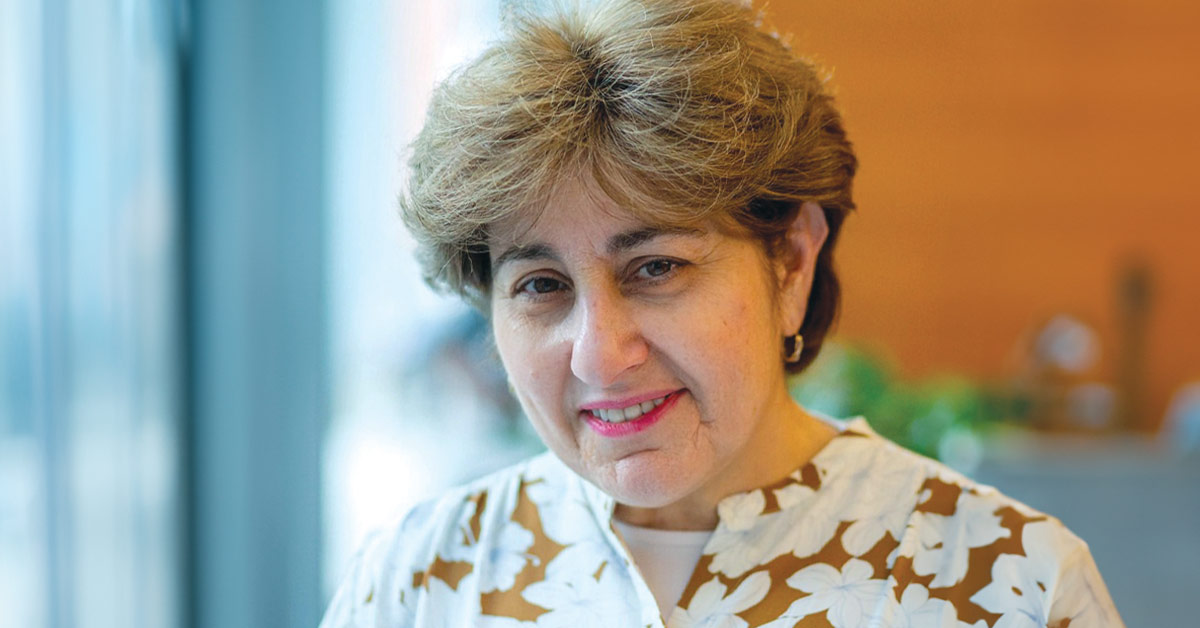
When Elizabeth Walder, President and Executive Director of the Walder Foundation, met with Lonnie Nasatir soon after he became President of JUF in 2019, she was especially impressed with his warmth, and his understanding of the Orthodox community and its role within Chicago’s Jewish society.
The Walder Foundation had recently opened its doors, and many of its priorities were aligned with those of JUF, including increasing security for local Jewish day schools and synagogues, combating antisemitism, improving mental health, and ensuring high quality, affordable Jewish education.
JUF’s relationship with the Walder Foundation has continued to flourish. Jewish Chicago recently spoke to Walder about the foundation’s partnership with JUF, Israel emergency efforts, and more.
Q. Can you share the Walder Foundation’s story?
A: The Walder Foundation is a private family foundation based in Skokie that my husband, Joseph, and I established a little over five years ago. Our mission is to champion Chicago in five key areas: Jewish life, science innovation, environmental sustainability, performing arts, and migrant and immigrant communities. These pillars are extensions of our lifelong passions, interests, and personal and professional experiences. Our grantmaking is guided by our Jewish values of humility, optimism, unity, collaboration, trust in G-d’s plan, and commitment to give back.
Since the foundation opened its doors, we have committed more than $70 million to Jewish organizations, with nearly $30 million earmarked to capital projects in the Chicago Jewish community.
How did your journey lead to where you are today?
I grew up in a performing arts household, and my childhood love of music led me to study at Juilliard. After earning my law degree, I began my law career traveling to consulates around the world, representing immigrants whose visas to the United States had been denied. Later, I founded and built my own immigration practice, representing scientists and performing artists as they navigated new pathways to American citizenship.
How has Walder Foundation’s focus changed since October 7?
Soon after October 7, we made a commitment of $3.6 million in Israel emergency grants, which is over and above our regular grantmaking. The foundation has already awarded an initial round of more than three dozen grants, totaling $1.15 million to provide emergency medical and humanitarian assistance.
We’re also homing in on strategic priorities in Israel that are war-related, including mental health and trauma and working with our partners in Israel on evolving needs. Locally, we are increasing our efforts–and dollars–to combat antisemitism and increase security.
It’s very important that none of the U.S organizations we support suffer financially due to our commitment to Israel. We are maintaining our Chicago-based giving at the same level.
JUF: What inspired Walder Foundation to give to JUF’s Israel emergency efforts?
EW: We granted $360,000 to JUF to provide general Israel emergency funds and quickly assist JUF partners on the ground in Israel, including Leket Israel, Latet Humanitarian Aid, and HIAS. The foundation has also supported advocacy for the hostages and their families through Bring Hersh Home. JUF’s ability to mobilize quickly and strongly during this crisis has been invaluable.
JUF has boots on the ground in Israel–they’ve built decades-long partnerships with Israeli nonprofits. We have confidence in JUF and know that they will steward the funds in a productive manner.
JUF: In addition to Israel emergency efforts, how has the Walder Foundation partnered with JUF?
EW: The foundation granted $1 million to JUF’s COVID-19 Initiative for emergency financial aid and food assistance for those in need during the pandemic. Much of our grant supported local Jewish day schools to help them continue to provide students with quality education.
We helped fund JUF’s 2020 Metropolitan Chicago Jewish Population Study. JUF offers a unique window into the big picture of the Jewish community, which, in turn, provides a lot of insight and helps guide our work.
We also supported JUF’s efforts to strengthen security for the entire Jewish community, a top priority for both organizations. We agree that, to have a resilient community, people need to feel safe.