Basic Law—and disorder
OFER BAVLY
For the past eight months, Israel has been in the throes of a constitutional level crisis, partly born from the fact that Israel does not have a constitution. Our Supreme Court’s most recent session marked a milestone in this crisis–reflecting and fueling that crisis, but also taking a step towards deescalating it.
Immediately after the Netanyahu government took office ten months ago, Justice Minister and Deputy Prime Minister Yariv Levin declared the intention to enact some 200 “judicial reform” laws, sparking the country’s longest and most widespread protest movement.
Hundreds of thousands have taken to the streets for nearly 40 weeks in a row, and counting. Under that internal pressure, magnified by global pressure, the government applied the (emergency) brakes, passing but a single law. Netanyahu, who recently acknowledged the original set of proposals “was bad,” has vowed to restart the judicial overhaul when the Knesset returns from its fall recess.
Important to note: There is also widespread support among Israelis for judicial reform. Of course, the devil–and the distrust–lies in the details.
The law that was passed abolishes the Supreme Court’s ability to overturn decisions made by the government and ministers based on the so-called “unreasonableness clause.” That clause enables the courts to declare that a governmental action is “blatantly unreasonable” and thus void. The Knesset designated its override of the reasonableness clause a “Basic Law,” making it both a part of a possible future Constitution and–significantly–insulating it from judicial review.
Several organizations and individuals petitioned the Supreme Court, asserting that: 1) the law dangerously weakens the courts 2) the law is itself “unconstitutional” (in the absence of an actual Israeli Constitution, meaning “contrary to governing ideals”), and 3) the government elevated it to a Basic Law to insulate it from judicial review.
The government argues that the law addresses the courts’ inordinate power over the democratically elected Knesset and government–and that, since their law has the status of a Basic Law, the Supreme Court has no jurisdiction to review it.
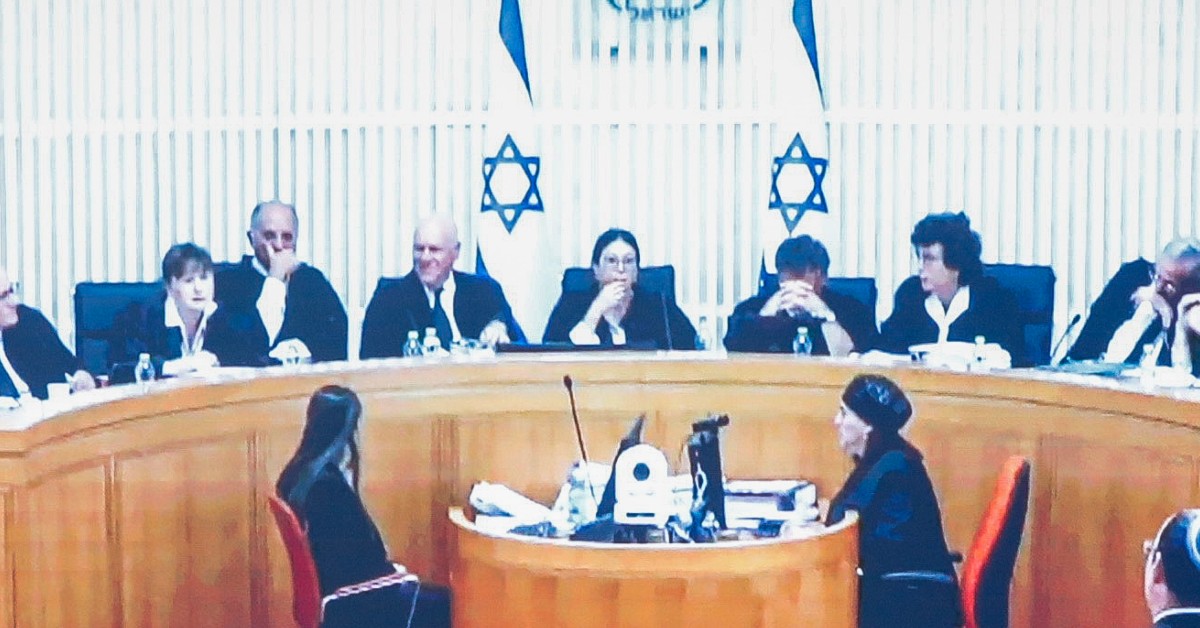
When the Supreme Court deliberated on the issue, its president, Esther Hayut, ruled that, given the importance of this case, for the first time in history, all 15 Supreme Court judges would hear the case and rule. The most, well, basic question before the Court: Does it have jurisdiction over a Basic Law? By convening the Court, President Hayut effectively responded in the affirmative.
The hearing took 14 hours; all petitions were heard along with the government’s position. The government, always represented by the attorney general, was represented in this matter by a private attorney, as the attorney general said she could not defend its position.
The televised deliberations center on the Court’s authority to strike down a Basic Law as well as the merits of the law itself. Government ministers and Knesset members from the coalition have been declaring that–since the Court should have no jurisdiction over a Basic Law–they will not abide by the Court’s ruling. Those precedent-setting declarations add another incendiary element to a smoldering crisis.
In accordance with Israeli law, Hayut is set to retire in October on her 70th birthday. The Court will not reach a decision by then, but Hayut may delay her final ruling by up to three months after her retirement.
Other proposed parts of the judicial overhaul will invariably be brought to the Supreme Court too, leading to further Constitutional crises and making her last months on the bench the most momentous in our (brief) history.
The crisis is yet another proof of the vibrancy– and messiness– of Israeli democracy. Its results will ultimately define what we look like for the next hundred years.