An appreciation of Pope Emeritus Benedict
Rabbi Yehiel E. Poupko
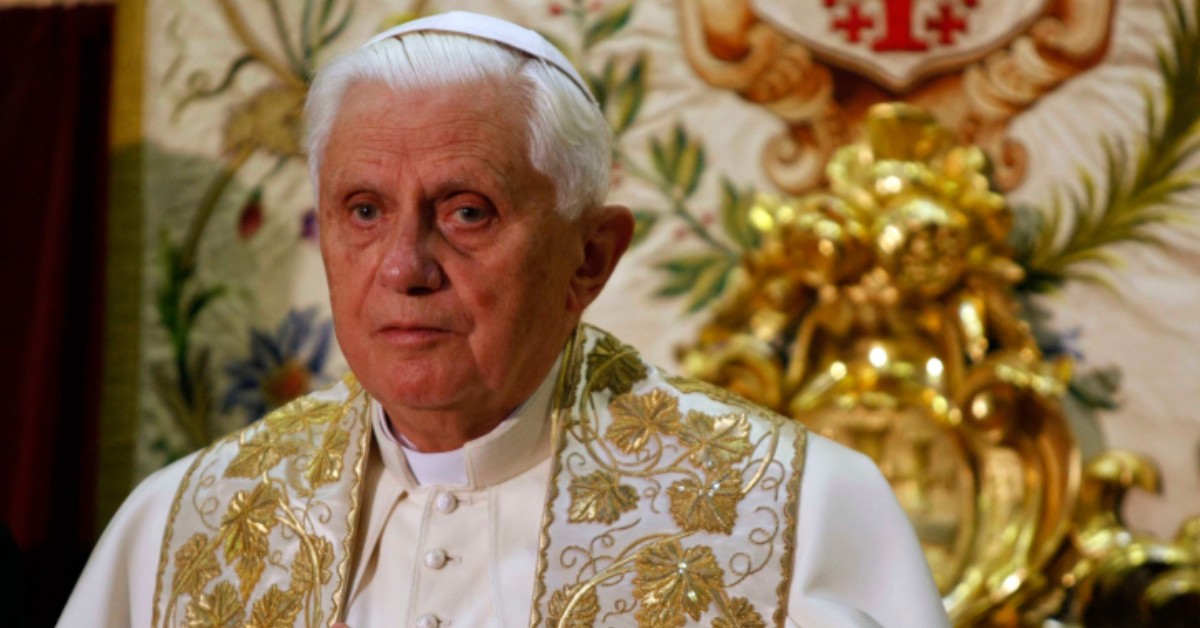
Pope Emeritus Benedict XVI, formerly Cardinal Joseph Ratzinger of Munich, Germany, died on December 31, 2022. He was the leader of the world’s 1.2 billion Catholic faithful.
As Rabbi Soloveitchik taught, in relationship to the Roman Catholic Church, we and they must never forget that the Catholic Church is the community of the many and–with a world population of 15.1 million–we, the Jewish people, are the community of the few. While the community of the few must be vigorous in identifying and defining itself, the community of the few needs the understanding, respect, and kindnesses of the community of the many. It is only recently that the community of the many has come to treat the community of the few in this way.
After the destruction of European Jewry, the Roman Catholic Church had to reexamine nearly 2,000 years of the Church’s teaching of contempt for Judaism and the Jewish people. It did so in one of the most remarkable theological changes in all of Christian thinking and belief. As a very young priest, Joseph Ratzinger was one of the theological experts and consultants at Vatican II in 1963, which brought about these sweeping changes in Catholic teaching about Judaism and the Jewish people.
When he came to Rome in 1981, he was appointed Prefect of the Congregation for the Doctrine of the Faith, one of the closest theological advisors to Pope John Paul II, and played a critical role in the now legendary prayer that John Paul II placed in the Western Wall on his visit to Jerusalem in 2000.
The most remarkable phrase in this prayer is the designation of the Jewish people as “the people of the Covenant.” In this short, prayerful phrase the Pope rejected supersessionism–the notion that with the coming of Christianity, Judaism and the Jewish people had been superseded and replaced–and affirmed the Catholic teaching that the Covenantal promises made by God to Abraham and the Jewish people at Sinai are sacred, because the promises of God are irrevocable. This short prayer expressed the Church’s convictions, the commitments of Pope John Paul II, and the theological thinking of soon-to-be Pope Benedict.
Yet, there was a far more theologically revolutionary idea to come from Pope Benedict XVI. In 2006, he made a memorial pilgrimage to Birkenau, the mass killing center at Auschwitz. Like Pope John Paul II, Pope Benedict XVI paused in front of the Hebrew memorial inscription to the more than one million Jews murdered in Birkenau and said:
“The rulers of the Third Reich wanted to crush the entire Jewish people, to cancel it from the register of the peoples of the earth. Thus the words of the Psalm: “We are being killed, accounted as sheep for the slaughter” were fulfilled in a terrifying way… Those vicious criminals, by wiping out this people, wanted to kill the God who called Abraham, who spoke on Sinai and laid down principles to serve as a guide for mankind, principles that are eternally valid. If this people, by its very existence, was a witness to the God who spoke to humanity and took us to himself, then that God finally had to die… By destroying Israel, by the Shoah, they ultimately wanted to tear up the taproot of the Christian faith…”
In this theologically revolutionary statement, Pope Benedict XVI declared that the genocide of the Jewish people was unique among genocides. It was a deicide; an attempt by the Nazis to murder not just the Jewish people, but (if one dare utters it) to murder God Himself. Benedict affirmed that God dwells in Israel’s midst. To annihilate the People Israel is the attempt to annihilate God’s presence on earth by annihilating God’s people.
It is impossible to overstate the theological significance of Benedict’s statement. Benedict gave witness to the world that 2,000 years after the Jewish people did not accept Christianity, the Church holds that God’s Presence is manifest in this world in the People Israel.
For as long as Israel endures, Benedict XVI will be remembered for good.
Rabbi Yehiel E. Poupko is the Rabbinic Scholar of the Jewish United Fund.