Film preserves ‘Three Minutes’ in life of Polish village on eve of Holocaust
DONALD LIEBENSON
Bianca Stigter’s Three Minutes – A Lengthening , opening in Chicago on Aug. 19, is one of the most unique and haunting documentaries ever made about the Holocaust.
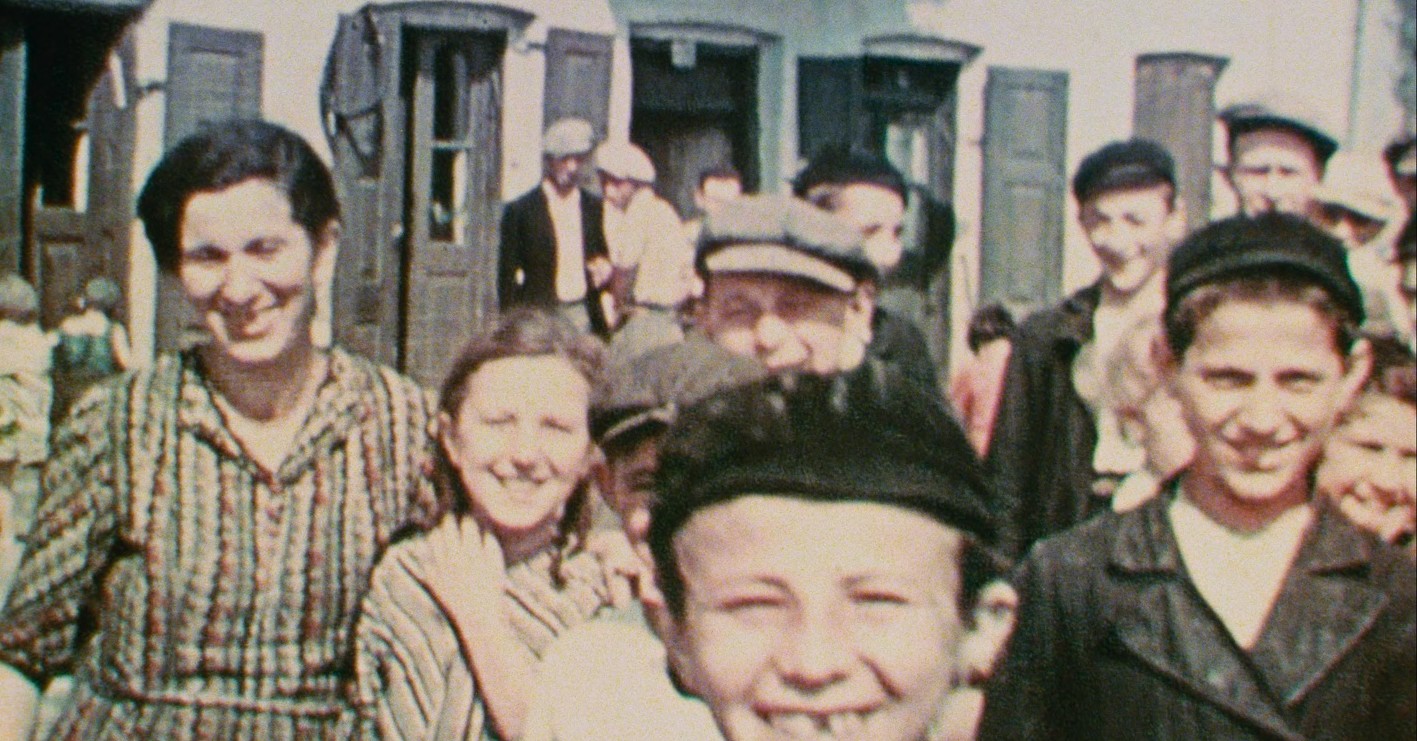
It takes its title from three minutes of 16mm footage shot by Glenn Kurtz in 1938 in Nasielsk, a town in Poland about 30 miles northwest of Warsaw. It was part of a filmed record of a trip to Europe that Kurtz made with his wife. Nasielsk was his hometown. Almost half of its 7,000 residents were Jews.
On Dec. 3, 1939, a bell rang at 7:30 a.m. All Jewish men, women, and children were given 15 minutes to gather in the town square. A terrible and violent chaos arose. Ultimately, the entire Jewish population was rounded up and were mostly deported to the Treblinka concentration camp. Only about 100 of the residents survived.
The three minutes of footage depicts the bustling Jewish community. Youngsters are especially entranced by the camera and jostle for prime position in front it. People are seen leaving a synagogue. There is a glimpse of a café.
Kurtz’s grandson, Glenn, found the reel of footage in his parents’ closet in 2009. Badly decomposed, the celluloid was reported to be a month from completely disintegrating. Kurtz donated the can of film to the U.S. Holocaust Memorial Museum, where the footage was restored, digitized, and posted on its website.
This is where Stigter saw it. A producer ( 12 Years a Slave ) and former film critic, she was fascinated by the footage. “I was very touched because the footage, for the most part was in color, and most of the film and photos from that time are in black and white,” she said. “To see it in color gives it a very contemporary feel and brings it closer to you. I thought, ‘Wouldn’t it be great to keep this past in our present for a bit longer. Couldn’t we extend this footage in some way?”
Five years in the making, Three Minutes unfolds as something of a detective story. The location was initially unknown. Once established, Stigter was faced with seemingly insurmountable questions. Who were these people? What was that shop? Even what kind of trees and flowers lined the streets? She considered herself more of an archeologist than a director, she said.
And then, a miracle: A woman in Detroit watching the footage on the Holocaust Museum website recognized a face in the crowd: her grandfather, Maurice Chandler. He was one of the 100 who survived. Now in his 90s, he provides commentary on the documentary’s soundtrack.
Chandler and Glenn Kurtz’s voices are heard in Three Minutes , but the documentary never strays from the three minutes of footage, which is rewound, replayed, freeze-framed, and zoomed in on to capture specific details. “I wanted that footage to be the center stage,” Stigter said. “I wanted viewers to feel like they were inside this footage. If we had added talking heads, that would have broken the spell.”
Stigter, born in 1964, is not Jewish. She grew up in Amsterdam, site of the Anne Frank House Museum. The Holocaust, she said, “was always discussed in my home. We lived in a city where almost a tenth of the population had been taken away. My mom had a friend who published a lot of books about the Holocaust, and I read them. This was something that happened in my street, around the corner of my school.”
She hopes that Three Minutes will further help to “take the abstraction out of talking about the statistics of the Holocaust,” she said. “Here, you can see a few of the people who had their own lives. They look like you, like me.”
What is striking about the footage are the comical scenes of those mugging for the camera. “They wanted to be seen,” Stigter said. “The world needs to see them now.”
Three Minutes – A Lengthening was featured earlier this year at the JCC Chicago Jewish Film Festival at the Illinois Holocaust Museum and Education Center. The documentary opens in theaters in New York and Los Angeles on Aug. 19. For updates on Chicago’s theatrical release, visit threeminutesfilm.com.
Donald Liebenson is a Chicago writer who writes forVanityFair.com, LA Times, Chicago Tribune, and other outlets.