‘What is Lost’
PAUL WIEDER
A Jew in Treblinka said: “We need a new alphabet.”
A poet responded by suggesting “an alphabet of ashes.”
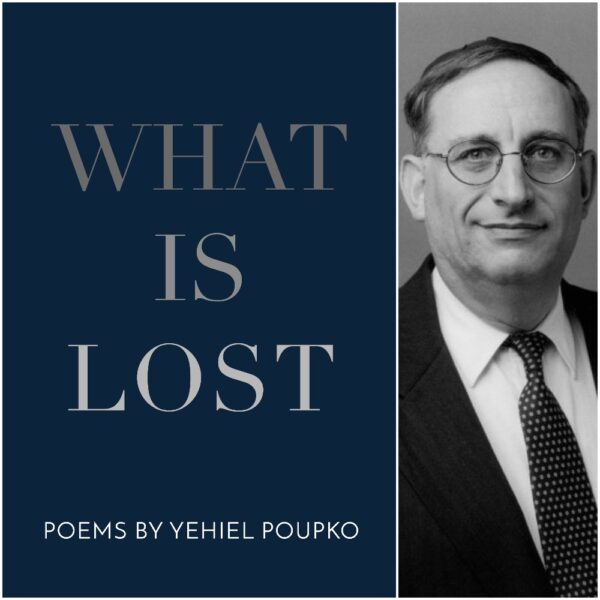
That poet is Rabbi Yehiel E. Poupko, the Rabbinic Scholar of JUF. This intergenerational exchange takes place in the pages of What is Lost , a book of the rabbi’s poetry published in the fall.
What is Lost (Finishing Line Press) uses spare language to confront the violence of death and the evil that humanity inflicts upon itself. The collection incorporates Jewish and Christian imagery to rage against the horrors of human chaos and to insist on the power of memory.
“The book is about loss, but it is also about memory and continuity,” Poupko said. “These poems are written so that memory may bridge the abyss between the silenced storm and life.”
While some of the poetry traces Jewish suffering back to Abraham and Sarah, most of the volume’s poems are cries of anguish for the Jewish losses incurred during the Holocaust and before. The book’s title comes from its poem “Ukraine 1919-Epitaph” which reads: “what was is no more/ and what is lost/ will not return.”
Poupko’s personal familiarity with loss is evident in the two poems that comprise the prologue of the collection, one dedicated to his granddaughter, who died at just 27 months of age, and the other to his late mother.
It was, in fact, his mother who sparked in him an early love of poetry. “She had a deep sense of the poetry of the Torah and Haftarot,” he said. “And she familiarized me with Bialik, Amichai, and Leah Goldberg.”
At the core of What is Lost are forgotten names-the names of the millions of Jews who lived through the centuries without ever becoming an Abraham or an Amichai, names that Poupko refers to as “ashes and names, unknown, uncalled, unwritten.”
The book is edited by Jill Baumgaertner, Poetry Editor of The Christian Century , the leadership magazine of mainline Protestantism-that has published some of Poupko’s poetry in the past. The two became friends because of Poupko’s interfaith work in the Christian community. At one point, he mentioned to her that he wrote poetry, and she asked if she could see some of it. At first reluctant, he soon obliged and turned over his collection to her, which would become the basis for the book.
The irony of Jewish poems being published in a Christian magazine is not lost on Poupko. “Where else but in America would the poems of an Orthodox rabbi be edited by a traditional Lutheran… and then published in a Protestant magazine?” he mused.
“[His poems] are reminders of the memories of what could be but cannot be lost,” Baumgaertner said, “…The memories of those who lost everything except their souls saturate every line and word.”
“What is Lost” can be ordered from Finishing Line Press by visiting www.finishinglinepress.com/product/what-is-lost-by-yehiel-poupko.