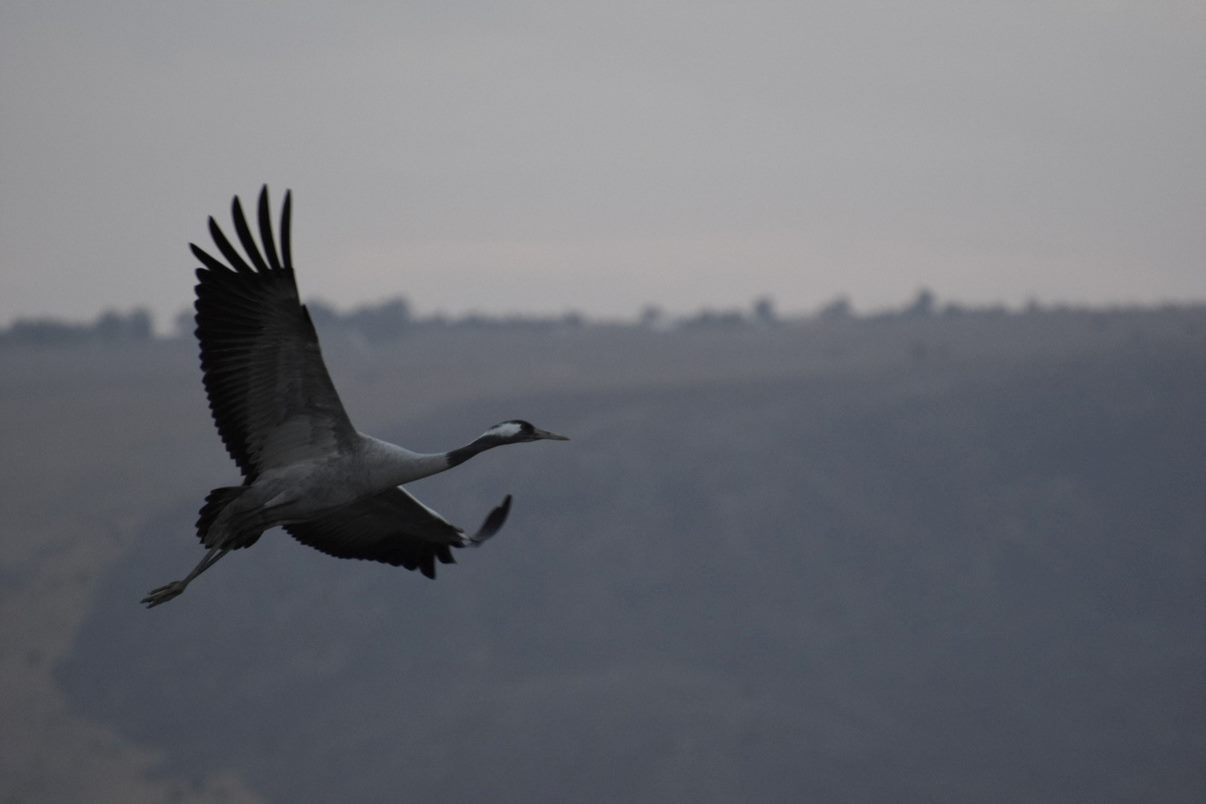
The height of tourism season in the Hula Valley
OFER BAVLY
In pre-COVID years (for those of us who remember), Israel’s tourism industry was booming. With a rise of 11% relative to the previous year and 55% over the previous three years, 2019 was a record year with over 4.5 million incoming tourists (compare that with the total size of our population of nine million).
But there is one population that arrives in Israel twice a year, in autumn and in spring, and it is a hundred times more numerous: The bird population. Close to half a billion birds of many different species and varieties head south from Europe and northern Asia seeking the warmth of Africa- and they all fly over tiny Israel. In the spring, the birds return to Europe and Asia, paying us a second visit. And their favorite stop happens to be in the Hula Valley, north of the Kinneret.
The valley is part of the Syrian-African rift which includes the Jordan Valley, the Dead Sea, and the Red Sea. It is a natural reservoir formed by the sweet-water tributaries of the Jordan River. For millennia, the valley was made up of a small lake of 3,500 acres, surrounded by marshland about twice that size. Every winter, the valley would flooded with rain and spring waters, prohibiting farmers from harvesting the scarce land. The swamp also brought with it an annual wave of flies, mosquitoes, and other unwanted guests which populated the Galilee region, bringing malaria to its inhabitants.
In the 1950’s, the Israeli government decided to drain the Hula Valley and turn it into agricultural land. But the project caused an animated public debate pitting farmers against ecologists, who claimed that draining the Hula marshland would alter the area’s ecosystem, and deprive Europe’s migrating birds of their important watering hole. Additionally, many indigenous flora and local animals disappeared when Hula was drained.
In the ensuing years, it turned out that the Hula land was not suited for harvest and could not, in fact, be used for profitable agriculture. In the absence of a water reservoir in the valley, organic matter and minerals could not be absorbed in the land and flowed into the Kinneret, Israel’s main source of drinking water at the time.
In the 1990’s, authorities started to flood the Hula Valley in a controlled manner, re-instituting its forgotten lake and allowing the migrating birds to return to our land. Today, half a billion pelicans, herons, storks, and cranes arrive in huge flocks, joined by a variety of birds of prey and other birds.
The Hula Valley is a paradise not just for birdwatchers but for anyone interested in seeing a unique phenomenon of hundreds of thousands of birds landing on the small lake at sundown during migration season. The Hula National Park allows visitors to walk to the shore of the lake, rent a bicycle, or ride in a large covered wagon which hides the humans from the birds and lets us get to within 10 or 20 feet of them.
Seventy years after draining the Hula Swamp, we now realize that it was a mistake and an example of how human intervention in nature can sometimes be destructive. In 2009, the BBC Wildlife Magazine declared the Hula Lake one of the 10 most important bird observation locations in the world. Today, the Hula Lake is home to a unique and world-renowned ecosystem that highlights a flourishing relationship between humans and wildlife, attracting both tourists and (many) birds.
Ofer Bavly is the Director General of the JUF Israel Office.
In this issue
-

-

-

Catching up with Gold
Actor, writer, and comedian Judy Gold is known for her edgy wit and sharp timing
Read more