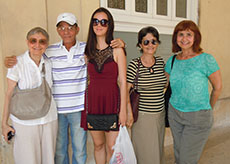
We’d been anticipating the visit for months, years, really. What interest would our native land hold for us after a 56-year absence? Cuba had sheltered our 20-something German Jewish father when the United States turned him away late in 1938. And in 1924, it became home to our young mother and her family after they left Lithuania. Our parents, Gerardo and Emma met through the Jewish community in Havana and married in 1946. My sister Clara Basch Stone, our brother Ricardo, and I lived in Havana until our family immigrated to Chicago in 1960.
This spring, Clara and I joined a cultural tour to Havana, Cienfuegos, and Trinidad, with Los Cantantes del Lago, a singing group of mostly American and Canadian expatriates based in the Guadalajara, Mexico area. Los Cantantes’ director, Timothy Ruff Welch, Clara’s acquaintance, arranged the tour.
While in Havana, an important priority for Clara and me was to visit The Patronato at Havana’s main synagogue, Templo Beth-Shalom in the Vedado neighborhood, where for many years our maternal uncle, Abraham Marcus Matterin (our Tio-Uncle Abraham), worked at the community’s library and as vice-president of the congregation.
Our maternal aunt, Tia Anita, immigrated with her family to the New York City area a couple of years before our own family left. Tia Anita kept us connected to the widely dispersed members of our Lithuanian family and its history. We thought all of our maternal grandfather’s family had left Cuba. Yet, a few days before our departure to Cuba, we learned that two cousins remained in Havana. And the daughter of one of those cousins worked at Beth-Shalom. Clara and I had an appointment with Adela Dworin, Beth-Shalom president, and we arranged to meet cousin Anay Vega there, too.
When we arrived at The Patronato, Adela and Anay were waiting for us in the Library, named in memory of our Tio Abraham who devoted his life to literary and intellectual pursuits. Using a list provided by the American Jewish Joint Distribution Committee-one of JUF’s overseas arms- Clara and I brought many items requested for the needs of the Jewish and other Cuban community, including vitamins and supplements, bottles of aspirin and ibuprofen, audio CDs to help Spanish speakers learn Hebrew, and clothing.
Adela’s father had been on the same ship as our mother’s family, Adela told us, and, although he was 10 years older than our Tio Abraham, the two became good friends. Jewish emigre families usually lived in the second floor apartments in La Habana Vieja, Adela explained, but our mother’s family lived in a large apartment on the first floor. Eventually, many Jewish families, including Adela’s, moved to the Vedado neighborhood to live close to the main conservative synagogue. Adela has lived in the neighborhood for some 60 years, she said. Our Tio Abraham and our bubbele stayed in the same apartment in La Habana Vieja until their deaths. When our bubbele died, she was mourned at the funeral home Caballero which had a Jewish chapel, Adela said.
With fascination, we learned parts of Adela’s story in connection to Tio Abraham. When Adela was a girl, he asked her to work with him at the Patronato’s Library, beginning in 1970. In 1975, a couple of years after Adela started working fulltime at that library, Tio Abraham started writing a history of the Jews in Cuba. He had almost completed that history when he died in 1983 at age 67. But after Abraham died, his life-long residence was emptied of all its possessions, including his extensive personal library, and his manuscript of his history of Jews in Cuba vanished. His books ended up in the possession of the government of Cuba but his history of Jews in Cuba, “which would have been the best history,” Adela said, was never found. Even the historian for the city of Havana, Eusebio Leal Spengler, whose help Adela enlisted, was unable to locate the manuscript.
“I learned a lot from him,” Adela said about Tio Abraham. “I was not a librarian and he did not have a trained librarian’s methods,” but it all worked. Tio Abraham hosted many literary and intellectual conferences here, Adela explained. “He knew a lot of important intellectuals,” including Ernest Hemingway, the Chilean poets Pablo Neruda, and Gabriela Mistral. At one time, he had his own printing press and published a magazine named Israelia .
Our meeting with Adela concluded; then we visited briefly with Anay. I learned she trained for many years at Cuba’s famed National School of Ballet, but an injury sidelined her. She now teaches the youngest children at The Patronato and dances in the young adult group. Anay arranged a meeting for us with the Vega Osin family, her father, Ramon, and her aunt Hilda. Their mother, Anna, was our mother’s cousin.
We are so very grateful to have been able to reconnect with our long-lost familia in Cuba and look forward to getting to know each other better. I wish this beautiful country continued progress so that we can all visit freely together again.
Other stories
-
Chicago to Israel to Kenya
A family’s story of living Jewishly on three continents Michelle Cohen World May 28, 2021 Avital, Tzofia, and Netanel Kaszovitz outside their home in Nairobi on Yom HaAtzmaut. When Avital Kaszovitz prepared to be a Modern Orthodox shlicha (emissary) to the Jewish community in Ke
Read more -
New exhibit spotlights the experience of ‘Shanghai Jews’
Explore a new Illinois Holocaust Museum and Education Center exhibit
Read more -
Europe’s brave new teachers of the Holocaust
Teaching the Holocaust in the modern era has its difficulties and rewards.
Read more