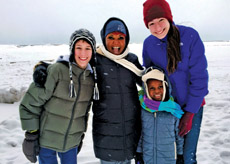
“And then the soldiers came and attacked our village and then they took my father,” said Pau, a young refugee from Burma who now lives in Chicago. His story begins, like so many others do, with war, terror, persecution, and death.
There is Khadijeh from Afghanistan, who when she couldn’t afford to pay the hospital bill a stranger offered to buy her newborn son.
And Said. He is an Assyrian Christian who worked as an interpreter for the American forces in Iraq. After the U.S. pulled out, he was called a traitor and received death threats. His life was in danger.
The Torah tells the Jewish people to welcome the stranger because we were once strangers in the Land of Egypt. For more than 35 years, the Jewish United Fund/Jewish Federation of Metropolitan Chicago has been living up to this ideal. Since the late 1970s, Federation has been welcoming refugees, like Pau, Khadijeh, and Said, who are fleeing to the Chicago area through administering the Refugee Resettlement program on behalf of the State of Illinois. The $4.2 million program is funded entirely with state and federal dollars and ensures that refugees receive the basics they need to thrive in their new homes.
But JUF/Federation brings more than just an understanding of the problem, said Marc Adelman, Assistant Vice President of Refugee Social Services for JUF. It brings a profound expertise in program administration that allows us to ensure that resources are being used appropriately and that people’s lives are better because of the services that have been provided. The Federation’s public-private partnership has made Illinois a model for resettlement programs around the country.
Thirty-five years ago, JUF/Federation was a the table to help draft the 1980 federal Refugee Act, which recognized the country’s imperative of giving refuge to people in danger and changed the way refugees were welcomed to the U.S.
To qualify as a refugee, a person must exit the border of his or country, be able to prove a well-founded fear of persecution, and be unable to safely return to their country of origin. The first to arrive were the Vietnamese, with more than 100,000 resettled in Chicago within the first few years of the law’s passage. Ultimately more than 35,000 Jews arrived from the Former Soviet Union through the statewide program. Today, a maximum of 70,000 refugees are admitted to the United States each year. Currently, most of the refugees are from Iraq, Myanmar/Burma, and Bhutan and many have spent multiple years in refugee camps awaiting processing by United Nations High Commissioner for Refugees (UNHCR) and the State Department. As civil unrest and war grows in the Congo and Syria, more refugees are expected to arrive from there in the future.
JUF/Federation contracts with partner agencies. Many of which are faith-based organizations while others are non-profit organizations that have a cultural understanding of the populations that the programs serve. Many of their staff members are former refugees themselves.
Last year alone, JUF/Federation, though its partner agencies, helped 2,680 refugees from 25 different countries. Services included Employment, English Language Training, Cultural Adjustment, mental health counseling, senior support, and help for refugee youth in the public school system.
“The refugees are so eager to make a place for themselves among us,” said Susan Sperry, Director of Refugee Services for World Relief in DuPage County, “where they can thrive, contribute and succeed.” They want the same things as all American want, she said, like stability, integration, and a better life for their children. “We pick them up from the airport, lease them a home and fill it with everything they need,” said Sperry. “We take them to the doctor for a health screening and explain to them what life looks like in the United States. Our employment services help refugees find their first job in the U.S., and then help them upgrade into new jobs and get on a career path.”
A total of 57 percent of clients through the program found jobs, which is a tremendous achievement, Adelman said, given that some of the refugees arrive illiterate in their own language, many are single moms and may have not worked before, and almost all have undergone severe trauma.
The programs help parents enroll their children in school and in after-school programming. “It’s a challenge for parents who don’t speak English to understand the school system here.”
Adelman said the refugees have been tremendously successful, in part because of the soft landing Federation’s partner agencies provide but mainly because of their incredible strength and perseverance. Like the rest of us they pay taxes and many will ultimately become citizens.
“These are people who have survived persecution. They cannot go home,” said Melineh Kano, Executive Director of RefugeeOne, one of the organizations JUF/Federation has chosen to provide services under the state resettlement program.
Kano herself is a refugee. An Armenian-Christian born in Iran whose family did not feel safe after the 1979 Iranian Islamic Revolution and fled to the United States.
“Refugees are survivors ,” she said, “and given the right opportunity they will get back on their feet. This program gives a second chance to people who otherwise would not have a future.”
In June, Federation and its Chicago partner organizations will celebrate World Refugee Day and the 35 th anniversary of the passage of the U.S. Refugee Resettlement Act with other celebrations occurring outside Chicago throughout the summer. On Monday, June 15, there will be a program celebrating World Refugee Day in Daley Plaza which will feature music, information, about refugees and the agencies that welcome and assist them. Then, on Saturday, June 20 th , the actual World Refugee Day, there will be a soccer tournament, youth activities, and a potluck picnic at Foster Beach beginning at 11 a.m. Both events are open to the public.
Lisa Pevtzow is a freelance writer living in the Chicago area.
One refugee’s harrowing story
By NGOAN LE
Thirty-five years ago, the waves of refugees from Southeast Asia catalyzed the United States to pass the historic Refugee Act of 1980.
This Act establishes a system for resettling refugees in the U.S. so that refugee admission is no longer treated as a one-time crisis requiring only a short-term emergency response. The U. S. Department of State and Office of Refugee Resettlement are the two key federal agencies working with state governments and hundreds of non-profits across the country to resettle more than 3 million refugees since the passage of the Refugee Act. Congress must approve the annual number of refugees allowed to be admitted to the U.S.
The fact that refugee admission could no longer be treated as a one-time crisis is indeed a sad reflection on our world. Today, there are 51.2 million displaced people globally. It is a historic high number, based on the report of the United Nations High Commission on Refugee (UNHCR). About half of all refugees are children under age 18 and the average stay in the refugee camps increased from nine years to 17 years by 2013.
The UNHCR was created 60 years ago to help refugees displaced from World War II. UNHCR now operates in 200 countries seeking to find durable solutions for refugees. For some refugees, it means being able to repatriate back to the homeland. For others, it could mean becoming residents of their first place of refuge in neighboring countries. For a very small number, it is the opportunity to be resettled permanently in another third country. Only 70,000 of the 52.1 million would be lucky enough to be offered resettlement in the U.S.
Forty years ago, I was in a refugee camp on Wake Island off the coast of the western side of the Pacific Ocean. My family arrived there after having fled Vietnam on April 30, 1975. The departure from Vietnam was harrowing. Our hometown had already been taken by the advancing communist troops a month earlier. My father abandoned the successful business he built and searched for a passage out of Vietnam. In the final hours before the fall of Saigon, following a rumor about an escape route, we pushed our way through the chaotic crowd onto a barge. We had no idea where the barge might take us.
Eventually, we were picked up by a rescue ship and brought to a refugee camp in the Philippines. After a few days of living in tents, we were transported to Wake Island, another refugee camp. We shared cramped quarters with two other families. We accepted the humility of having to stand in line for food. Sometimes, when the food supply ran out, we learned to cope with hunger. We tried to make our lives productive by organizing classes for the children. Mostly, we spent time worrying about what happened to other family members left behind and what may become of us.
After another stay at a third refugee camp in Arkansas, my family was offered to be resettled in Normal, Ill. The Wainscotts, who sponsored my family, gave us shelter in their home while helping us to find a place to stay and jobs to rebuild our lives in the U.S. The children learned English and adapted quickly to their new world. The adults took whatever jobs they could find, including working as a janitor, painfully reconciling with their proud past of being successful professionals.
Like my family, some 2,500 refugees who come to Illinois annually will begin to rebuild their lives. They will struggle with the survival guilt, trauma of the escape, and sadness from leaving their home and loved ones. They will feel grateful for the assistance provided by the resettlement agencies and volunteer sponsors to help them learn English and find their first job. In the quiet moments of the day, they will reflect on their fortune of being among the lucky few who can now live in peace and have a second chance in life.
JUF/Federation has partnered with the Bureau of Refugee and Immigrant Services over three decades to help resettle different waves of refugees coming to Illinois. Since 1975, Illinois has welcomed over 140,000 refugees from all over the world, including Jews from the former Soviet Union who came in the 1990s.
Last year, the Illinois refugee resettlement program was ranked fourth among the top ten states with the most successful records of helping refugees to gain economic self-sufficiency. This recognition is indeed a proper tribute to the 1980 Refugee Act that has enabled the outstanding work of the local resettlement agencies who help refugees make the most of the opportunities given to them in Illinois.
Ngoan Le is the Illinois State Refugee Coordinator.
Other stories
-
Chicago to Israel to Kenya
A family’s story of living Jewishly on three continents Michelle Cohen World May 28, 2021 Avital, Tzofia, and Netanel Kaszovitz outside their home in Nairobi on Yom HaAtzmaut. When Avital Kaszovitz prepared to be a Modern Orthodox shlicha (emissary) to the Jewish community in Ke
Read more -
New exhibit spotlights the experience of ‘Shanghai Jews’
Explore a new Illinois Holocaust Museum and Education Center exhibit
Read more -
Europe’s brave new teachers of the Holocaust
Teaching the Holocaust in the modern era has its difficulties and rewards.
Read more