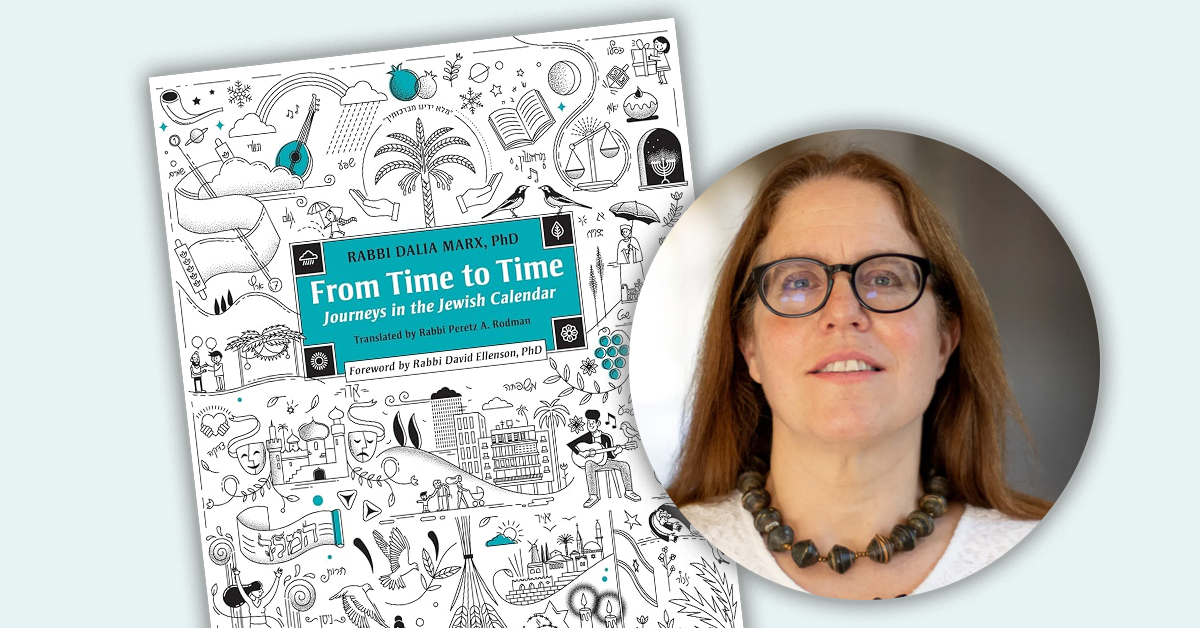
'From Time to Time'
Cindy Sher
Time is precious. While our possessions are replaceable, no moment in time can be regained. While time is a universal concept, Judaism sanctifies time in a special way.
Rabbi Dalia Marx, Ph.D., explores the Jewish calendar and the sanctity of time in Judaism in her book From Time to Time: Journeys in the Jewish Calendar (Reform Judaism Publishing, a division of CCAR Press). Her book, first published in 2018 in Israel, was translated into English and other languages in 2023, then updated to include reflections on the October 7 attacks.
The book blends pluralistic perspectives voices from various religious streams, and from the ancient to the contemporary. In each chapter–a deep dive into the 12 months of the Jewish calendar–Marx discusses each month’s special “character, flavor, and aroma” and features illustrations, poems, meditations, and songs unique to that time of year.
A Jerusalem native, Marx serves as the Rabbi Aaron D. Panken Professor of Liturgy and Midrash at Hebrew Union College-Jewish Institute of Religion’s Taube Family Campus in Jerusalem. She is a scholar, an author, and an editor in Reform liturgy and prayer, who served as the lead editor of the 2020 Israeli Reform siddur (prayerbook), Tfillat HaAdam.
During her recent travels to Chicago, I had the privilege to sit down with Marx to discuss the gift of time.
Q. Why is the concept of time intriguing to you?
A. On one hand, time is clear, and measurable; we know when the sun rises and sets. At the same time, it’s a big mystery, and a lot of life is trying to figure out how to deal with the passage of time. Everything we do is grounded in time-we look backwards and forwards. No moment in time ever repeats: You and I sitting here is a one-time thing. Even if we meet here next year in the same spot, we will be different. If you combine these two systems of time- the cycle of the year and the linear line [of a life]- then you get a spiral, and that is what ascribes meaning to everything.
What makes the Jewish relationship with time special?
The great 20th Century thinker Rabbi Abraham Joshua Heschel said: ‘Jews build cathedrals not in space, but in time.’ If you think about Jewish history, Jews were persecuted, deported, and exiled, so they could not always trust space. But the one thing they could always depend on is time. We build cathedrals in time-Shabbat is our fortress in time that nobody can destroy. Even our fiercest enemies cannot touch time, because we can observe [our holidays] wherever we are.
Is picking a favorite time on the Jewish calendar like picking a favorite child? What is your favorite holiday?
Yes, my favorite holiday is the ‘next holiday.’
You say that our holidays “speak” to each other. How so?
No festival is an island. Every festival has a linkage with others. The High Holidays have a clear linkage-there is a conversation between Rosh Hashanah and Yom Kippur. Really, though, the linkage is everywhere. Pesach is the festival of freedom where we celebrate going out of Egypt and through the wilderness. Seven weeks later, we celebrate Shavuot which is the reception of the Torah, which made us a people. There’s a whole web of meanings between the different chagim (festivals).
What do you hope readers take from the book?
The stronger and fuller your time, the more meaningful your life. Marking time makes our days rich and meaningful. Every day, and everything, is to be seen with new eyes. I included a poem by the poet Lea Goldberg in the book. “Teach me, my G-d,” Goldberg writes, “to bless and to pray over the secret of the withered leaf, on the glow of ripe fruit… lest my day become for me simply habit.”
In this issue
-
-
-
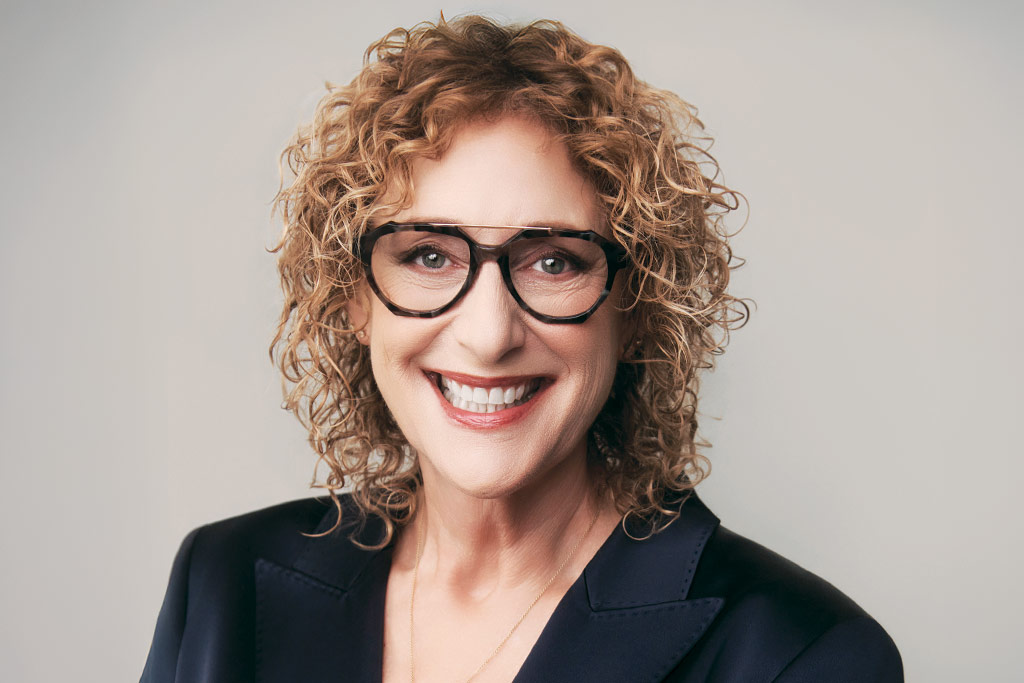
Catching up with Gold
Actor, writer, and comedian Judy Gold is known for her edgy wit and sharp timing
Read more