London’s bridges to its Jewish community
ROBERT NAGLER MILLER
Every Friday night at London’s 10 Downing Street, British Prime Minister Keir Starmer enjoys Shabbat dinner with his family. No, Starmer isn’t an observant Jew-he is nominally Christian, having grown up, like most of his compatriots, in the Church of England-but because his wife, the former Victoria Alexander, and their children are Jewish.
Many of the 200,000-plus Jews of Greater London view the Starmers’ Shabbat observance with great satisfaction. Yet that’s merely one of countless points of pride for the community. For four centuries, London’s Jews have contributed immeasurably to the vitality of their city.
Tesco, Great Britain’s ubiquitous supermarket chain, was founded by Londoner Jack Cohen. Benjamin Disraeli, a 19th century Prime Minister and writer, was born to a Jewish family before they left to join the Anglican church. Today, no fewer than 11 Jews are Members of Parliament, many representing constituencies in Greater London, and London’s Jews are well represented among supporters of the city’s major arts institutions.
My husband, Arnold Friedlander, and I knew many of these factoids. But on a return trip to the city this past autumn, we gained an insider’s view of Jewish life in London, which dates back to the middle of the 17th century-when Oliver Cromwell invited Jews back to England following their expulsion in 1290.
We benefited from the expertise of our guide, Stephen Burstin, a Jewish native son, who runs Jewish London Walking Tours. Burstin took us through the streets of East London’s Aldgate and Spitalfields neighborhoods, entry points for the 150,000 Jewish immigrants who arrived at England’s shores from Eastern Europe from 1881 through the early 1900s-a period of time paralleling Jewish immigration to America.
These neighborhoods, only blocks away from the docks along the River Thames, offered cheap housing to the immigrants, who worked as tailors, pressers, button-hole makers, and other related trades in local sweatshops. Barely making ends meet, they relied on the noblesse oblige of the 50,000 mostly German and Sephardic Jews, including the Mocatta, Montefiore, and Rothschild families, who had settled in London generations earlier. As Burstin pointed out, “The Lord will provide,” came to be understood as referring to “Lord Rothschild.” In fact, said Burstin, all charity for the newly arrived Jews was private: “No Jews petitioned the government for assistance.”
Our tour took us past the venerable Bevis Marks Synagogue, the oldest Jewish congregation in Great Britain. Built in 1701, it remains a vital religious institution. Prime Minister Disraeli’s grandfather was a president of the great synagogue, and Daniel Mendoza-Britain’s 18th century prizefighting champion-was a member.
As we traversed East London’s streets, Burstin regaled us with rich and colorful tales of London’s Jews of yesteryear. The narrative only turned dark when he recounted the deadly deeds of Jack the Ripper, who, some suggested, was Jewish, since he carried out his crimes in East London. While there has never been any evidence to suggest that he was, such speculation precipitated a wave in antisemitism.
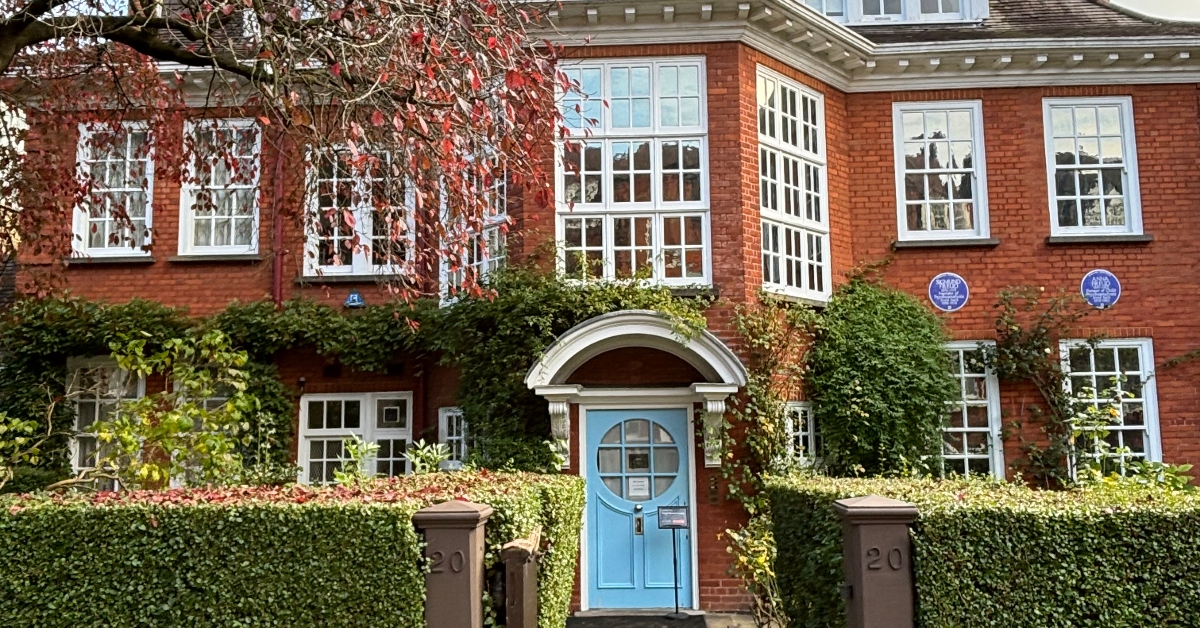
Beyond Burstin’s fascinating tour, Arnold and I found many other sites of Jewish interest. We toured the home of Sigmund Freud, who fled to London’s Hampstead neighborhood, an enclave for German and Austrian Jews escaping Fascism. Already ill, Freud lived there but a year before he died in 1939. However, his daughter, Anna Freud, the esteemed child psychoanalyst, spent many decades there.
A London monument pays tribute to the children of the Kindertransport, the refugee program that brought 10,000 Jewish youngsters to Great Britain-mostly to London-to shield them from Nazism.
Arnold and I also took in several theatrical productions with Jewish themes, including a revival of The Lehman Trilogy , which was first produced in English at London’s National Theatre.
After a week in London, we departed with love in our hearts for the great city-and the hope of discovering more Jewish gems on our next trip there.
Robert Nagler Miller is a journalist and editor who writes frequently about arts- and Jewish-related topics from his home in New York.
In this issue
-
-
-
Catching up with Judy Gold
The actor, writer, and comedian is known for her edgy wit and sharp timing
Read more