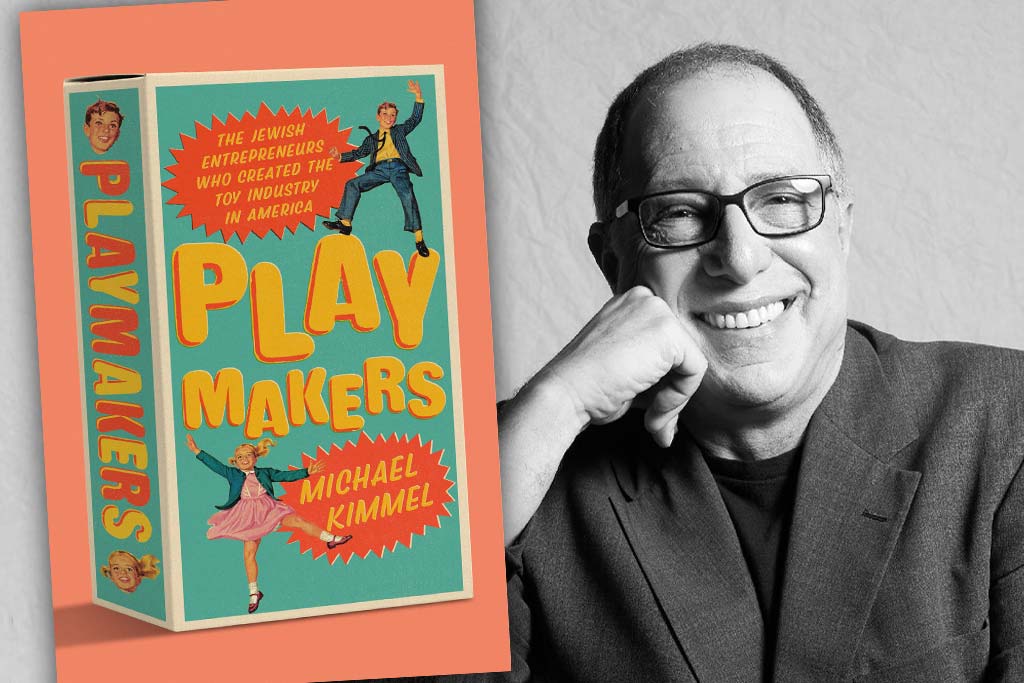
In his new book, author Michael Kimmel examines America’s largely Jewish toy industry.
You may not recognize the names of Morris Michtom, Joshua Lionel Cowan, or Ruth Moskowicz and her husband Elliott Handler. But if not for them, your childhood would have been much less playful and far less wondrous. They are, respectively, the creator of the teddy bear, the inventor of the electric toy train, and the founders of Mattel.
They were Jewish—poor, often Yiddish-speaking, tenement-dwelling children of immigrants from Russia and Eastern Europe who, as Michael Kimmel writes in his entertaining and enlightening book, Playmakers: The Jewish Entrepreneurs Who Created the Toy Industry in America, “imagined a world where other children could have the experiences they lacked—and, in so doing, they transformed America. They invented the 20th century American childhood.”
As Kimmel chronicles, America’s toy industry was largely Jewish. They were kindred spirits with Hollywood’s studio founders, who put on the screen images of an idealized America from which Jews felt largely excluded. This makes Playmakers an ideal complement to Neil Gabler’s essential An Empire of Their Own: How the Jews Invented Hollywood.
Playmakers was originally conceived as a family memoir. Morris Michtom was Kimmel’s great-great-great uncle. He created the Shirley Temple doll (a framed photograph of Michtom with the beloved child star graced the Kimmel family’s piano) and went on to found the Ideal Toy Corporation, makers of Mouse Trap, the Betsy Wetsy dolls, and the Rubik’s Cube.
However, what really put them on the map was the teddy bear, created in the back room of the Michtoms’ Brooklyn candy store in 1902. It’s the quintessential story of American gumption: Michtom was inspired by a Clifford Berryman Washington Post cartoon immortalizing an incident in which President Theodore Roosevelt compassionately spared the life of a wounded bear cub. “The Czar was never that humanitarian,” Michtom said.
He suggested to his wife that she create a replica of the bear out of whatever materials she could find on hand—mohair and wood shavings. Their creation was put on display in the window, labeled—so family legend goes, with the president’s blessing—Teddy’s bear.
As Kimmel writes, Jews have profoundly impacted American popular culture and the toy industry is no exception. Consider Hot Wheels, hula hoops, and tiddlywinks—or iconic characters such as Archie, Superman, Curious George, and Barbie. Each was born of Jewish imagination.
Kimmel uses the family lore about the Michtoms as a springboard to examine why so many of what the author calls “the cultural and professional arbiters of the new childhood”—inventors, marketers, toymakers, sellers, artists, writers and scholars—were Jews. And why did this happen only in America?
Playmakers is brimming with under-told stories of Jewish innovation and enterprise. But Kimmel frames these stories in historical context to explore how these toys and characters changed the zeitgeist. Once upon a time, he writes, “childhood was about work, not play.… Children were economic assets; their value in labor offset the costs of housing and feeding them.”
These children went to work at an early age, and these struggles fostered a vision for what childhood might look like, “a vision,” Kimmel wrote, “borne out in the toys they made, the stores they ran, the comics they drew, and the books they wrote.”
Playmakers is more than just a nostalgia trip for readers of a certain age. It is a celebration of the “men and women who channeled the promise of the American Dream into a new way of thinking about childhood, even as they were haunted by the privations of their own pasts.”
Donald Liebenson is a Chicago writer who writes for VanityFair.com, The Washington Post, and other outlets.