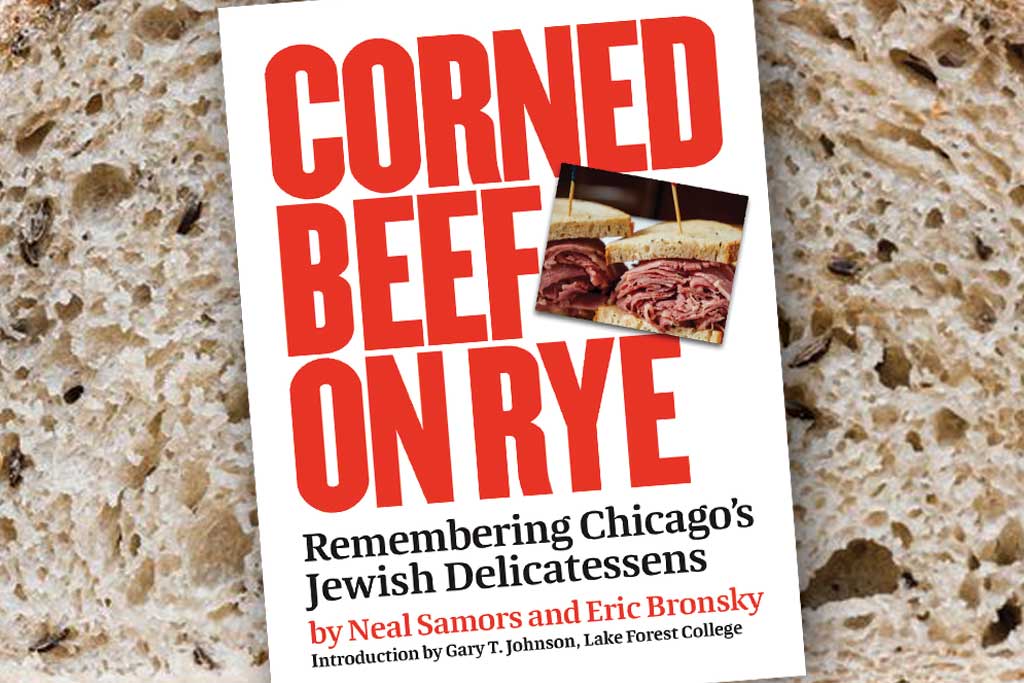
What’s in a name? Everything—if you’re a lifelong Chicagoan of a certain age and an aficionado of delicatessens.
Neal Samors and Eric Bronsky’s Corned Beef on Rye: Remembering Chicago’s Jewish Delicatessens is brimming with stories and recollections by iconic names that will resonate with the local corned-beef-and-pastrami crowd and set stomachs rumbling: Ashkenaz, Manny’s, Braverman’s, Finkel’s, Ricky’s, DB Kaplan’s, and many more—too many now gone, but never forgotten. This mouthwatering history celebrates these and other neighborhood havens for good food, even better company, and unforgettable characters.
Samors is the award-winning author, co-author, and publisher of 39 books about Chicago. Chicago’s Jewish delis are a particular lifelong passion. He writes of his Rogers Park childhood, riding his Schwinn on Sunday mornings to Ashkenaz to buy lox, bagels, and cream cheese for the family breakfast. He recalls his paternal grandmother Bessie as a “take-charge” kind of lady who thought nothing of going behind the counter at Ashkenaz to point out the specific piece of smoked fish she wanted.
The book, Samors said, was inspired by a 2023 exhibition at the Illinois Holocaust Museum, I’ll Have What She’s Having: The Jewish Deli. He enlisted fellow deli enthusiast Bronsky, a collaborator on previous books, to help interview an A-list roster of restauranteurs, including Richard Melman, Larry Levy, Marc Schulman, Ken Raskin, Ina Pinkney, and more, along with celebrated deli lovers such as local radio legend Bob Sirott and New Colony Sixer Ronnie Rice.
This book begs for the scratch and sniff treatment with its odes to the “gloriously sensory experience” of visiting old-school Chicago delis.
“As you entered, the aroma—a mélange of dill pickle brine, latkes frying on the griddle, cured meats, chicken broth, and an occasional whiff of pickled herring—was only the preview,” wrote the authors. “The front part of the store was in essence a small, specialized grocery whose centerpiece was a large refrigerated display case chockful of meats, ‘K’ foods (knishes, kishka, kasha, kneidel, kreplach, and kugel), blintzes, stuffed cabbage, smoked fish, chopped liver, salads, and cylinders of halvah. Dangling from hooks behind the counter were salami chubs in varying lengths, ranging from smooth to comically wrinkled.”
Are you hungry yet?
Just as there is an ongoing debate over the merits and demerits of Chicago vs. New York pizza, so the battle rages over Chicago vs. New York delis. You can guess where Samors and Bronsky weigh in. Samors loves the food, the service, and perhaps most of all, the “down-to-Earth Midwest attitude” that defines the Chicago deli. “There was a deli called Braverman’s,” he reflected. “They would give you a corned beef sandwich with what seemed like a pound of corned beef, and there was a sign that said, ‘Don’t ask for extra bread.”
Talking to first- and second-generation deli owners gave Samors an added understanding of “how complex it is to keep a deli running successfully over the decades.” “The ongoing challenge for multi-generational delis is to keep traditions alive and standards up while incorporating business practices that acknowledge changing eating habits and today’s healthier lifestyles,” he explained.
Samors and Bronsky optimistically note in the book that people will continue to open new delis. One driving force is the nostalgia of Jews and non-Jews alike for the comfort foods and memorable dining experiences of youth, now shared with succeeding generations who have heard stories about the delis of old and want to experience that for themselves.
“I hope [readers] get an appreciation of the history, the personalities, and why they’ve devoted their lives to delis,” Samors said. “Then, I hope they say, ‘I’m going out to get a corned beef sandwich.’”
Donald Liebenson is a Chicago writer who writes for VanityFair.com, The Washington Post, and other outlets.
In this issue
-
-
-

The least Jewish of Jewish holidays
Rosh Hashanah inspires the Jewish people to live in the balance
Read more