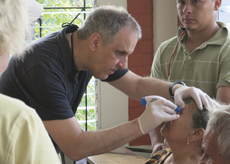
Dr. Stuart Sondheimer has three offices in the Chicago suburbs–in Skokie, Park Ridge, and Deerfield. But in a way, the whole world is his office. This ophthalmologist has practiced everywhere from Central America to the Far East, bringing sight to those in desperate need.
For the past four years, Sondheimer, who is Jewish, has performed cataract and other eye surgeries from Vietnam to Honduras. His most recent trip, in February, was a return to El Salvador.
Volunteering for the less fortunate is something he has wanted to do for a long time, he says, but admits he waited until “after the kids were grown.” After that, “I recruited myself,” he laughs.
He works through Eye Care International. This organization is like Doctors Without Borders, but it focuses on eye health and restoring vision. The doctors are all volunteers who pay their own way, for travel, food, and lodging.
But much of the medical equipment is donated by American manufacturers. Even if some of this equipment is considered slightly outdated in the US, “our garbage is their gold,” Sondheimer says. Eye Care International also raises some of the necessary funds.
Blindness is rampant in the developing world, he explains, because so many of the medical realities we take for granted-prevention, sanitation, checkups, early intervention, and the latest eye-care technology, as well as insurance to help pay for all of that–simply do not exist in poorer countries.
If such resources do exist, they are found only in their major cities. And even then, they may be rare. One city in Honduras, he notes, has three eye surgeons for one million people. Meanwhile, “My Skokie practice has some 80 patients,” he says.
As a result of the scarcity of care, what would be healed in an outpatient visit here can lead to total blindness elsewhere. “There is a tremendous need,” Sondheimer says. “There is an epidemic of blindness in the world.”
In El Salvador, the Eye Care International team saw 6,000 patients at 10 stations, which offered everything from reading glasses to invasive surgeries. The teams worked from 8:00 a.m. to 9:00 p.m. Patients’ conditions were caused by many factors: illness, genetics, accidents, malnutrition, or even side effects of other medical interventions. But mostly, they were degenerative, due to overexposure to the Sun or industrial pollution.
Part of what Eye Care International doctors donate is their own fee. Cataract surgery in the US costs $2,000-$6,000, even after insurance, due to safety and legal concerns. But he charges only $2.00 to his Central American patients. And some can’t even afford that, paying him in homemade food or handicrafts. But all are appreciative. “One even said, ‘I have nothing to give, but I will pray for you.'” he recalled.
Sondheimer spends time training with the outmoded equipment and techniques he uses in disadvantaged countries. In the US, he would use lasers, ultrasound, and topical anesthetics. There, he uses infusion bottles and syringes.
Sondheimer does not foray into foreign lands alone. On every trip, he is one of many doctors from, possibly, the US, Canada, Europe, Australia, or Israel. There were 80 people on his February trip. Sometimes his wife, who has learned how to dispense reading glasses, joins him.
Communication barriers are overcome several ways. Some of the doctors are bilingual, some volunteer translators travel with them, and sometimes local residents or Peace Corps volunteers assist.
Local and national governments, he said, were sometimes helpful, but sometimes a hindrance. He credits Eye Care International for handling much of the bureaucracies and paperwork involved. “Officials, even if they are on our side, have procedures they must follow.” He likened one attempt get all of their unusual-looking equipment and medicines past various customs offices to “a scavenger hunt.”
But it is all worth it for his patients, Sondheimer says. “Their lives are not all that different from ours. They just have less.” Now they have him, too.
Other stories
-
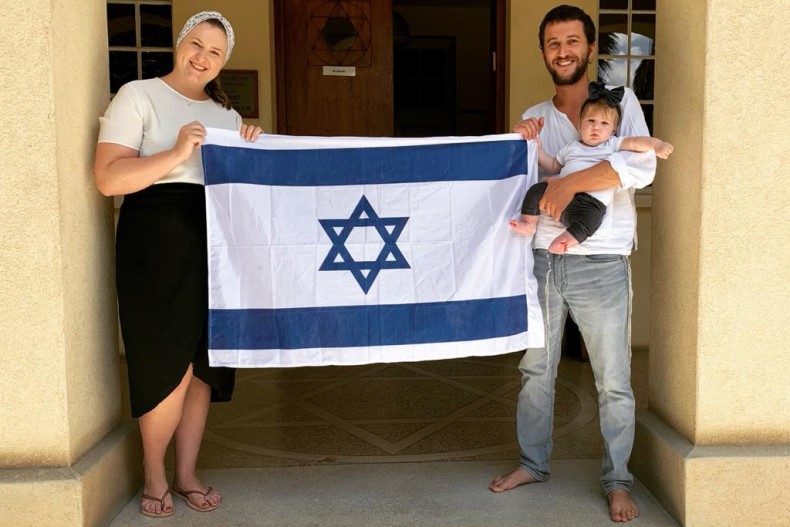
Chicago to Israel to Kenya
A family’s story of living Jewishly on three continents Michelle Cohen World May 28, 2021 Avital, Tzofia, and Netanel Kaszovitz outside their home in Nairobi on Yom HaAtzmaut. When Avital Kaszovitz prepared to be a Modern Orthodox shlicha (emissary) to the Jewish community in Ke
Read more -
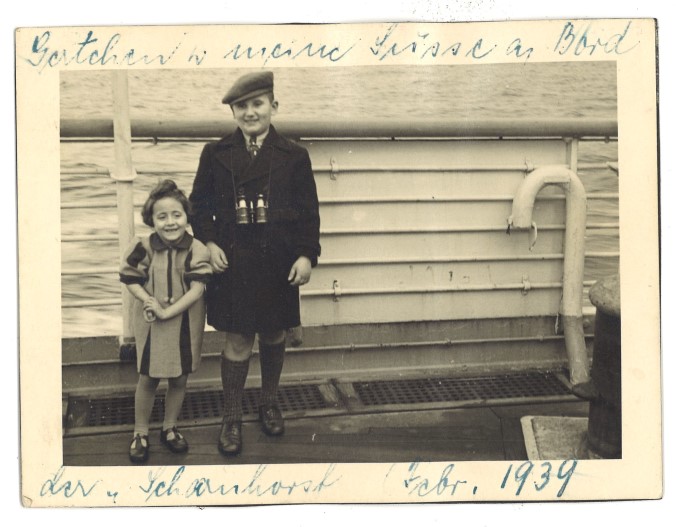
New exhibit spotlights the experience of ‘Shanghai Jews’
Explore a new Illinois Holocaust Museum and Education Center exhibit
Read more -

Europe’s brave new teachers of the Holocaust
Teaching the Holocaust in the modern era has its difficulties and rewards.
Read more