I look around in sadness and bewilderment at the bleak predicament that faces world Jewry today. In Europe, in particular, Jews haven’t seen darker times since World War II. The April 2015 issue of The Atlantic promptly asked, “Is It Time for the Jews to Leave Europe?” The Atlantic article observed that, “In 2014, Jews in Europe were murdered, raped, beaten, stalked, chased, harassed, spat on, and insulted for being Jewish. Sale Juif -‘dirty Jew’-rang in the streets, as did ‘Death to the Jews,’ and ‘Jews to the gas.'” French emigration to Israel doubled in 2014 and one study reported that 75 percent of French Jews reported that they were considering leaving.
A ‘missing generation’
To show solidarity with European Jews, I recently joined 85 members of Jewish Federations of North America (JFNA)’s National Young Leadership Cabinet in a mission to Hungary and Romania. JFNA distributes overseas funds through JUF’s main global partners-the American Jewish Joint Distribution Committee (JDC) and the Jewish Agency for Israel (Jewish Agency).
Approximately 75 percent of Hungary’s 742,000 Jews, and approximately 50 percent of Romania’s 757,000 Jews were murdered during the Holocaust. Nearly half the Jews killed in Auschwitz were Hungarian Jews. During approximately 10 weeks starting on May 14, 1944, approximately 440,000 Hungarian Jews were deported, mostly to Auschwitz-Birkenau, and 320,000 of them were sent directly to the gas chambers (that’s approximately 1.1 times the number of Jews in metropolitan Chicago). Romanian Jews ended up in mass graves, died during deportation, or perished in ghettos and death camps of Transnistria in Western Ukraine.
My great-great-grandfather, Baruch Teplitsky, was born in Bessarabia (Russia) in 1889 and perished in the Holocaust with his son, Shimon, and his daughter, Krein (Romania controlled Bessarabia in 1917-1940). After the war, approximately 70 percent of Hungary’s survivors and approximately 98 percent of Romania’s survivors emigrated.
Only 100,000 Jews remain in Hungary and only 7,000 remain in Romania. The Jews who remained in these communist countries were denied the right to practice their religion, forced to assimilate, and forbidden to practice any form of Zionism. Hence, those Jews who grew up in Central and Eastern Europe in the 1950s through the 1980s are considered by some European Jewish studies experts as a “missing generation.”
A renaissance among young Jews
While today’s Hungary suffers from political anti-Semitism, a renaissance is taking place among young Jews-the children of the “missing generation.” The Jewish Agency is actively working to support aliyah (immigration to Israel), provide social welfare, and increase engagement through the Taglit-Birthright heritage trip to Israel. JDC’s Camp Szarvas provides many of its 1,500 campers from 25 countries with their first Jewish experience. Budapest’s old Jewish neighborhood recently welcomed the opening of the Mazel Tov pub where patrons can enjoy hummus, kebabs, and modern Israeli music.
In Romania, the highlight of our trip was the opportunity to visit Holocaust survivors in Bucharest. I met with Francisc Rosenberg who was born in 1928, suffered during the war, and was liberated by the U.S. Army. He then worked as a cartographer, but continued to face pressure at the workplace due to his last name. Rosenberg is 87 and suffers from Parkinson’s disease. Due to JDC’s support, Rosenberg receives cash assistance, medicine, winter relief, Pesach relief, and weekly home care. Our trip also included a solemn stop to Romania’s Holocaust memorial. There, I saw remnants of tombstones from the cemetery in Odessa, a Ukranian city close to where my grandfather, Boris Teplitsky, was born.
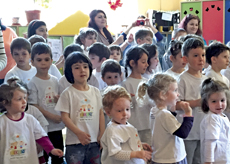
Today, Romania maintains good relations with Israel and the Jewish kindergarten which we attended in Bucharest serves as a memorial to the once-great Jewish community there.
Our brother’s keeper
JDC’s Camp Szarvas in Hungary is one example of JUF’s mission to make a positive impact in support of the Jewish renaissance in Central and Eastern Europe. Theodor Herzl, the Hungarian-born founder of modern political Zionism, said that “If you will it, it is no dream.” By giving to JUF, we help make it possible for Jews of Europe to sing ” Shalom Aleichem ” and dance the ” hora ” in Chicago, in Israel, and in Hungary and Romania. This is a global fight for what is most fundamental, and we must all be our brother’s keeper to remain vigilant in the face of ever increasing threats and provocations.
Michael Teplitsky is a member of JFNA’s National Young Leadership Cabinet and is the current Campaign Chair of the JUF Trades, Industries, and Professions Financial Services division and a former Campaign Chair and board member of the Young Leadership Division.
Other stories
-
Chicago to Israel to Kenya
A family’s story of living Jewishly on three continents Michelle Cohen World May 28, 2021 Avital, Tzofia, and Netanel Kaszovitz outside their home in Nairobi on Yom HaAtzmaut. When Avital Kaszovitz prepared to be a Modern Orthodox shlicha (emissary) to the Jewish community in Ke
Read more -
New exhibit spotlights the experience of ‘Shanghai Jews’
Explore a new Illinois Holocaust Museum and Education Center exhibit
Read more -
Europe’s brave new teachers of the Holocaust
Teaching the Holocaust in the modern era has its difficulties and rewards.
Read more