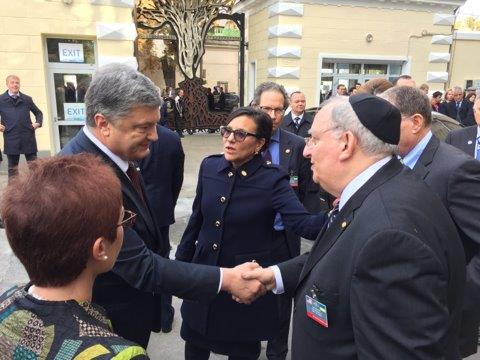
(Left to right) Ukrainian President Petro Poroshenko greets Chicagoans U.S. Secretary of Commerce Penny Pritzker and JUF Rabbinic Scholar Rabbi Yehiel Poupko the day of the Babi Yar commemoration.
On June 22, 1941, the Germans invaded the Soviet Union. Two days later, the mobile killing units, the Einsatzgruppen, followed the Wehrmacht in a line running from the Baltic sea in the north to the Black Sea in the south. Their purpose was to murder the Jewish people of Estonia, Latvia, Lithuania, Belarus, Ukraine, and Western Russia. They murdered 1.7 million Jews in the summer and early fall of 1941.
In this phase of the destruction of European Jewry, the murderers came to the murdered, and murdered them where they lived, in the sight of — and with the collaboration of — their friends and neighbors. The largest such urban mass-murder site was at the ravine called Babi Yar, in Kyiv (formerly spelled “Kiev”).
On September 19, 1941, Kyiv was captured by the German Army. The Jewish population was 160,000. Of these, 100,000 managed to flee before the Germans took the city. As they fled, the NKVD — the Soviet Secret Police — sabotaged a large numbers of buildings in the center of the city; many Germans were killed in the explosions.
On September 26, the Germans decided to retaliate by killing all the Jews of Kyiv. On September 28, notices were posted for Jews to appear the following morning at the corner of Melnick and Dekhtyraev streets for resettlement to new locations. As in so many other cases throughout Europe, many Jews thought this was good news — they would be sent away from the conflict area.
The next day, September 29, 1941, masses of Jews arrived at the appointed corner. They were directed to the existing Jewish cemetery, part of which was a natural ravine named Babi Yar. Jews were forced to hand over their possessions, to take off their clothing, and to move to the edge of the ravine in groups of 10, where they were shot, and fell into the ravine.
According to the reports of the Einsatzgruppen, 33,771 were murdered that day and the following day — Erev Yom Kippur. Thus, Kyiv became home to the largest urban mass murder site in all of Europe.
This led to the infamous conference at Gross-am-Wansee, on January 20, 1942. Babi Yar was deemed too messy; too much evidence was left behind, soldiers could not be expected to shoot large numbers of civilians without negative consequence for their morale. This led to the decision to implement the “Final Solution,” by bringing the Jews to be murdered in German death camps hidden away in Polish forests.
On September 29, 2016, Ukraine commemorated the 75th yahrtzeit, or anniversary, of the massacre at Babi Yar. Present at the commemoration were: Ukranian President Petro Poroshenko, German President Joachim Gauck and president of the European Council of the EU, Donald Tusk.
President Obama sent a presidential delegation to represent him and the U.S. led by Secretary of Commerce and Chicagoan The Honorable Penny Pritzker, and included the U.S. Ambassador to Ukraine, a member of the National Security Council, the chair of the U.S. Holocaust Memorial Council, and JUF Rabbinic Scholar Rabbi Yehiel Poupko.
Secretary Pritzker’s great-grandfather, Nicholas Pritzker, fled Kyiv at 10 years old along with his family in 1882, in the wake of a wave of Russian pogroms. Four generations later, in what is surely an “only in America” story, his great-granddaughter, representing the President of the United States, stood at Babi Yar and memorialized the 33,771 Jews murdered there 75 years ago. She gave voice to the silent. To murder is to erase, to allow the murdered to slip into silence is to erase them a second time.
Secretary Pritzker invoked the immortal summons of the Torah, when God said to Cain, “The voice of your brother’s blood cries out to Me from the earth.” Noting that this massacre took place on Erev Yom Kippur, a day devoted to the Jewish capacity for renewal, she inspired all in attendance to ever seek that renewal that is an affirmation of human dignity.
( Read Pritzker’s full remarks from the commemoration. )
Other stories
-
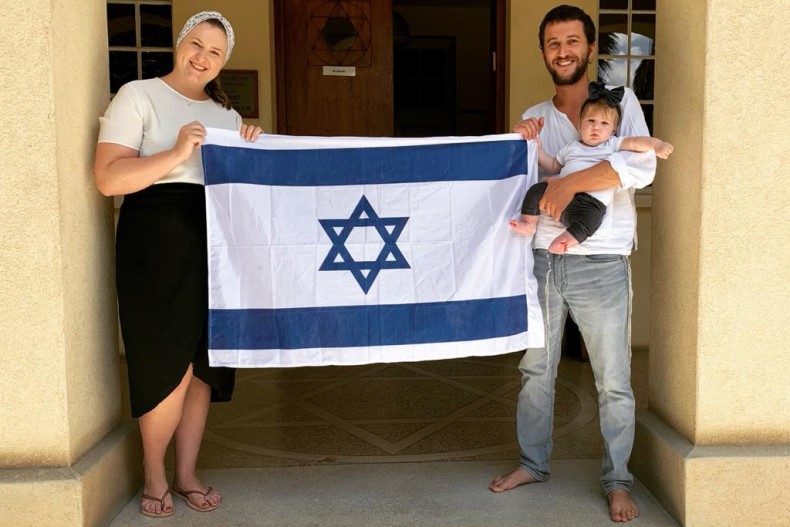
Chicago to Israel to Kenya
A family’s story of living Jewishly on three continents Michelle Cohen World May 28, 2021 Avital, Tzofia, and Netanel Kaszovitz outside their home in Nairobi on Yom HaAtzmaut. When Avital Kaszovitz prepared to be a Modern Orthodox shlicha (emissary) to the Jewish community in Ke
Read more -
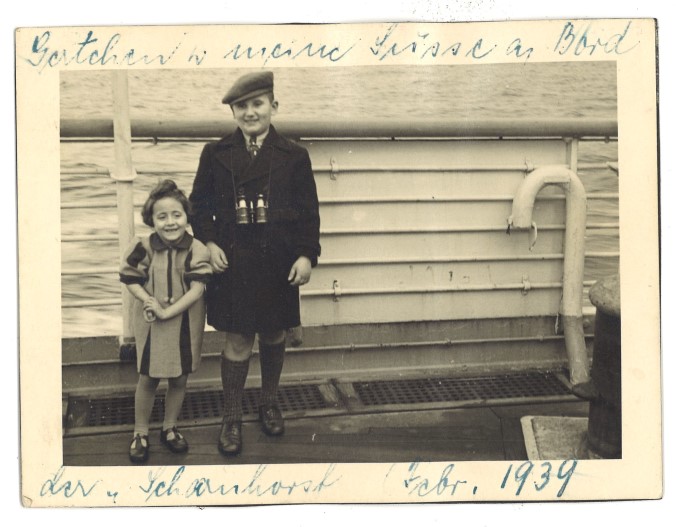
New exhibit spotlights the experience of ‘Shanghai Jews’
Explore a new Illinois Holocaust Museum and Education Center exhibit
Read more -
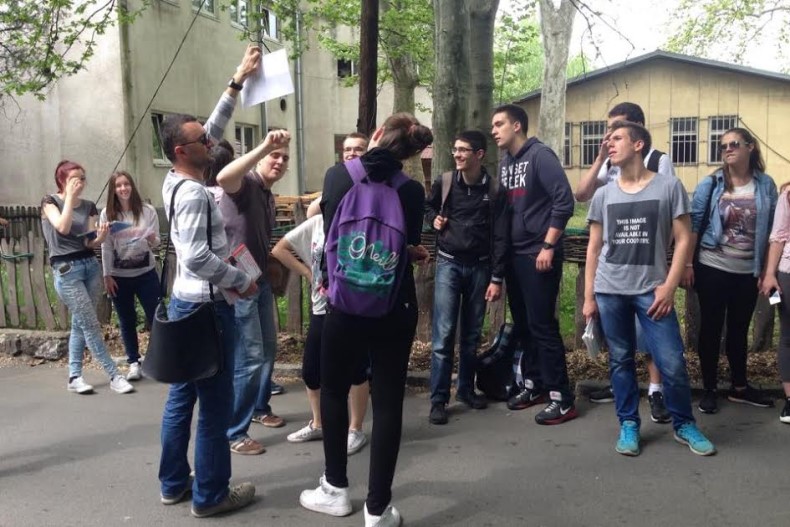
Europe’s brave new teachers of the Holocaust
Teaching the Holocaust in the modern era has its difficulties and rewards.
Read more