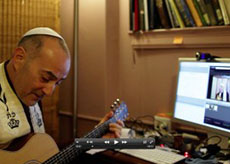
A “Sim” videogame, like Sim City , is one that “simulates” real life. But there is nothing simulated about Sim Shalom, the online synagogue. The services are live- if electronically transmitted- and the rabbi, Steven Blane, is a very real person.
Even a cyberspace house of worship must have some basis in real space, and Sim Shalom is based in Brooklyn. Blane had a congregational building whose infrastructure was crumbling when it occurred to him that, with the Internet, a physical building’s limitations could be eliminated.
So, in 2009, he started Sim Shalom, an online synagogue. He recently signed up the 150 th member. Most are American, but others live in South America, the United Kingdom, Germany, Portugal-as far away as Tokyo. Still, all are as near as their closest computer. Even without a building fund or membership dues, Sim Shalom has expenses, and is fueled by donations.
This year, Sim Shalom will be streaming its High Holiday services from the legendary Bitter End jazz nightclub, on Bleecker Street in Greenwich Village. Blane is a jazz musician, and so the service’s melodies are taken from the Tin Pan Alley songbook; most of these melodies were written by Jewish composers in any case.
Blane recently released Sim Shalom’s Live Jazz High Holidays on CD; it was recorded at other New York jazz clubs and is available for download at the CD Baby website.
Sim Shalom holds services every weeknight at 7:00 p.m. EST and twice monthly on Shabbat morning at 10:00 a.m..
Blane leads on Shabbat- he also has a jazz Friday night service-and other rabbis take weeknight services. The services can be participated in live with other congregants, via UStream. Instead of flipping pages in a prayerbook, worshippers scroll through a slideshow presenting the text, in Hebrew, English, and transliteration.
But services are only one of the services Sim Shalom offers. Blane has converted several people to Judaism and has more than a dozen more now in process. As part of the conversion process, congregants must visit synagogues near them, of as many different Jewish denominations as possible. Blane also performs weddings, but prefers to do so in person. And anyone can use Sim Shalom’s website to sell their chametz (leavened food forbidden on Passover).
Blane also ordains other rabbis, through his Jewish Spiritual Leaders’ Institute, of which he is founder and dean. It’s a rabbinical school, and like his synagogue, it happens online. The Institute recently ordained its ninth class of rabbis and cantors, for a total of 90 ordinations so far. Many of his students are between 40-70 years old.
While describing the synagogue as “apolitical,” its stance on Israel is clear: “We lovingly support Israel as our ancient and modern homeland. We continue to pray for peace.” It is non-denominational, describing itself as “Universalist- liberal in thought and traditional in liturgy.”
Rabbi Blane received his smicha (ordination) in 2001 at Rabbinical Seminary International and has held several traditional pulpits, mostly in New York and New Jersey.
But he is also a cantor, beginning his studies in 1990 and leading High Holiday services from Buffalo, N.Y. to Biloxi, Miss..
As befits a spiritual leader of a synagogue without walls, Blane is very open-minded and open-hearted. His congregation follows suit: “We are an unaffiliated and pluralistic Jewish community, evolving and organically growing,” he said. “…’No’ is not in God’s vocabulary.”
Other stories
-
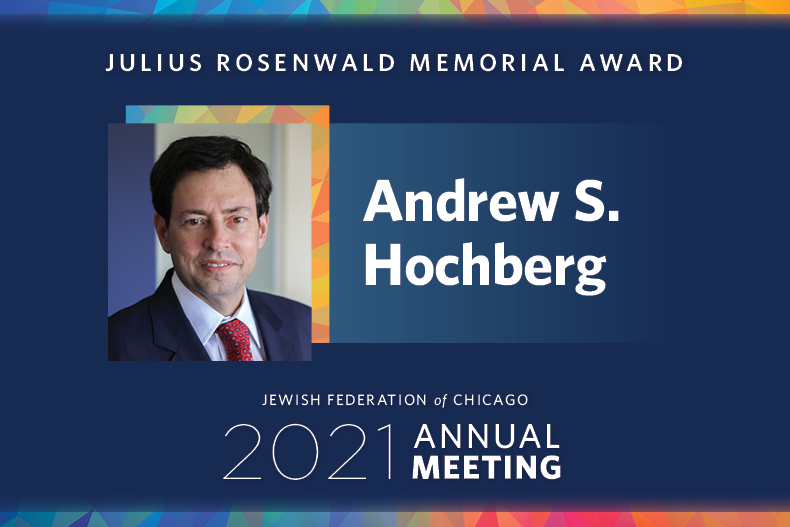
Meet Andrew S. Hochberg, 2021 Julius Rosenwald Memorial Award recipient
Celebrate Andy Hochberg at the virtual Annual Meeting on Sept. 14
Read more -
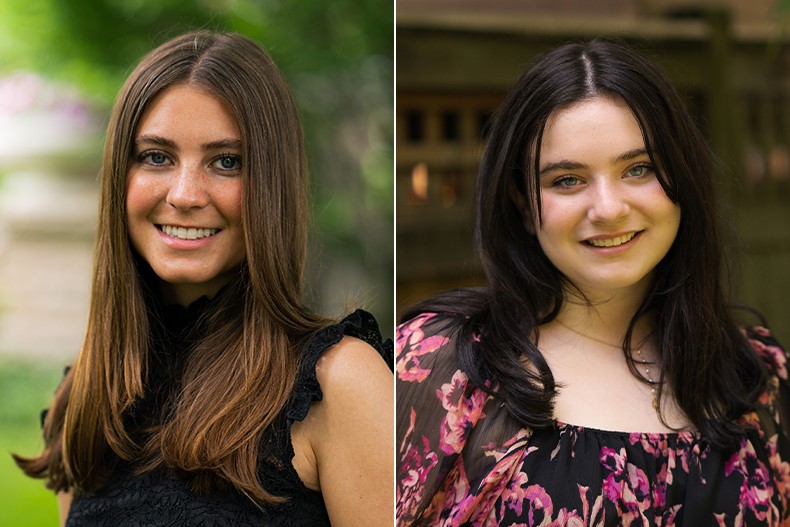
Two local teens win national recognition
Recipients of the annual Diller Teen Tikkun Olam Awards
Read more -
Celebrating six young award winners cultivating the community
Introducing young adult award winners
Read more