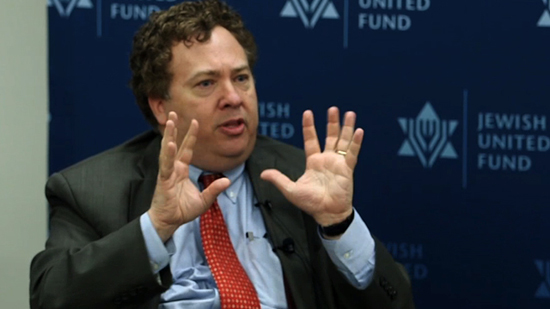
David Makovsky.
What really went on during the U.S.-brokered negotiations between Israel and the Palestinians, which consumed much of Secretary of State John Kerry’s time and President Obama’s political capital during 2014, but ultimately failed to produce an agreement?
What concessions were the parties to the conflict willing to make? And where do they now stand, at a time when the Palestinians—and the American administration—both seem willing to bypass bilateral negotiations and leave the case to international bodies?
Members of JUF’s Jewish Community Relations Council received an insider’s perspective this week when renowned Middle East expert David Makovsky provided a wide-ranging briefing. (Watch the video of Makovsky’s remarks.)
Makovsky, who is the Ziegler distinguished fellow at The Washington Institute and director of the Project on the Middle East Peace Process, offered insights on topics ranging from regional tensions arising from Iran’s hegemonic and nuclear aspirations, to the current state of bilateral relations between the United States and Israel.
Prior to the JCRC briefing, JUF brought together Makovsky and the editorial board of the Chicago Tribune, and arranged presentations at the University of Chicago and DePaul University through JUF’s Israel Education Center.
“There are few cities that care so much about Israel as Chicago. You feel it in your bones here,” Makovsky said to a packed audience of JCRC lay and professional leaders and more than a dozen diplomats from Egypt to Canada.
Referencing the Iran nuclear talks and the Palestinian peace process, Makovsky explained, “You have twin issues that are distinct but both run through US-Israel relations and the Obama-Netanyahu nexus. They’re both coming to a head. A lot of decisions have been deferred; kicked down the road, and now…the rubber is hitting the road this year.”
On a potential agreement to restrict Iran’s nuclear weapons program, Makovsky laid out the shifts in approach the Administration has gone through from a “goal to eliminate their nuclear program, to managing the program.”
“Iran hasn’t come clean with their potential military program, and [it] raises the questions, what was their program like in the past? Will they do no R&D? How good is access to snap inspections? Do they have a full nuclear infrastructure at their disposal? And what are the consequences if they violate the agreement?”
In addition to focusing on the terms laid out in an agreement, Makovsky also reiterated that it is important to view any agreement through the impact it will have throughout the region.
“Israel and the Sunni states will worry that this is becoming a political change of balance in the Middle East. And the biggest concern is, not only are we prepared to help these countries in the wake of an agreement, but [how]? Will it be a containment policy when we say our policy is prevention? The Arab states and Israel will wonder if they can count on us.”
On the stalled Israel-Palestinian peace talks, Makovsky speculated that the Administration might launch an initiative in the UN Security Council.
“It’s going to start getting turbulent because in my view the Administration thinks it has one move left—to go to the Security Council and do a ‘new [Resolution] 242’ (to outline a final status agreement) that gets into specifics about borders, Jerusalem, etc. But this risks blowing past the red lines of both sides. The Israelis don’t want to hear about Jerusalem, and the Palestinians don’t want to hear about the refugee issue or about having to recognize Israel as a Jewish state.”
“Neither side wants this (UN) [resolution]. So what are they willing to do if they don’t want the US to take this to the Security Council?”
“The tie breaker might be for Israel to say it would align its settlement policy with the two state solution, and not build new settlements beyond the separation barrier. The irony is, for the most part Israel is building within the barrier.”
Makovsky gave the audience a look under the hood of the negotiations. “When I was hired by Kerry, they said the Secretary wants to do a deal in nine months. I said just take the core five issues…. Jerusalem, refugees, land, Jewish state/mutual recognition, security arrangements. I said we should focus on these, and if we can get a breakthrough on the core five, we can have the technicians do the details. But if we don’t get anywhere on these five we won’t get anywhere, so we should stay focused like a laser on them.”
“In the end, Netanyahu was much more forthcoming on the territory issue than most Americans would ever imagine. And Abbas was much more forthcoming on the refugee issue. But on the other three issues, we had to close the gap.”
“The hardest issue turned out to be what originally looked like the simplest issue, the security arrangement. What changed was the ‘Arab Spring’; countries have melted away, and Israel feels like it’s on a volcano.”
In closing, Makovsky touched on the importance of Israel remaining a bipartisan issue in the U.S.
“There should always be bipartisanship on the US-Israel relationship,” he said. “That has been genius. That’s been core for Zionism. It’s going to be an uphill struggle. I would beg people in this room, let’s keep a big tent, keep our eyes on the big picture.”
Other stories
-
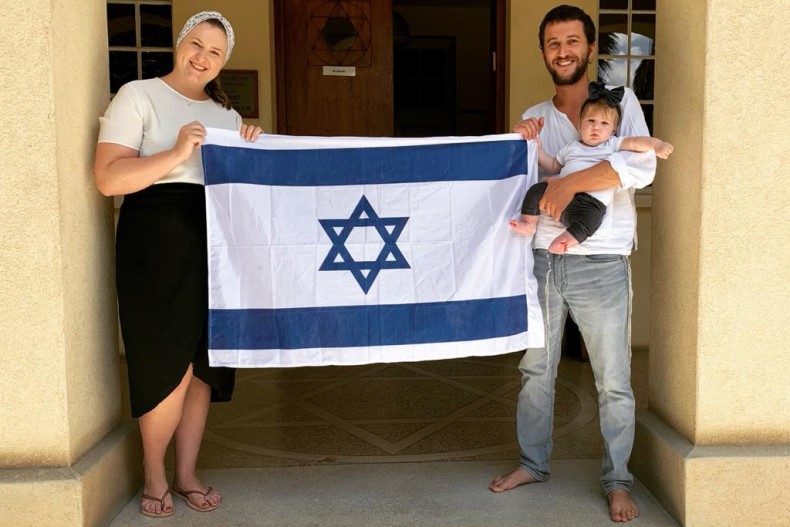
Chicago to Israel to Kenya
A family’s story of living Jewishly on three continents Michelle Cohen World May 28, 2021 Avital, Tzofia, and Netanel Kaszovitz outside their home in Nairobi on Yom HaAtzmaut. When Avital Kaszovitz prepared to be a Modern Orthodox shlicha (emissary) to the Jewish community in Ke
Read more -
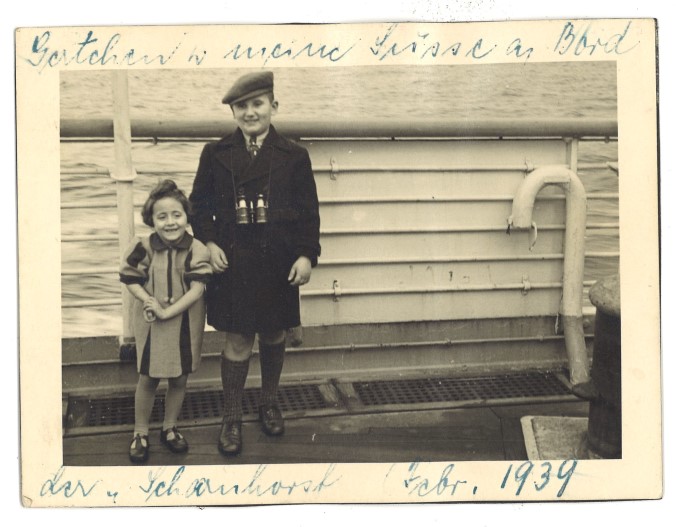
New exhibit spotlights the experience of ‘Shanghai Jews’
Explore a new Illinois Holocaust Museum and Education Center exhibit
Read more -

Europe’s brave new teachers of the Holocaust
Teaching the Holocaust in the modern era has its difficulties and rewards.
Read more