National, state and local experts on the global refugee crisis visited JUF on Jan. 26 to brief members of the Government Affairs Committee and Jewish Community Relations Council on the current state of the crisis and its international impact.
Speakers at the meeting included the Honorable Herbert Quelle, Consul General of the Federal Republic of Germany; Kelly Gauger, deputy director of the Office of Refugee Admissions at the U.S. State Department; Ngoan Le, Chief, Bureau of Refugee and Immigrant Services, Illinois Department of Human Services; Melineh Kano, executive director of Refugee One; and Michael Masters, immediate past executive director of the Department of Homeland Security and Emergency Management for Cook County.
“Our goal was to shed light on the context and impact of this crisis on the international, national and local levels from both a humanitarian and security perspective,” said David Golder, chair of the Government Affairs Committee. “Given the magnitude and complexity of the current crisis, and given our Federation’s historical role in providing refugee resettlement services, it is important our community has up to date information on current admission policies, screening practices, and challenges.”
While there are millions of refugees from countries all over the world, panelists focused their remarks on Syrian refugees. Approximately 10,000 of the roughly 4 million refugees who have already fled Syria since the civil war began will be admitted into the U.S. in fiscal year 2016.
Acknowledging heightened security concerns after the terrorist attacks in Paris and San Bernardino, Gauger and Masters outlined the extensive screening process for people wishing to enter the U.S. as a refugee, a process that can take up to two years or more to complete. Both stated that refugees are subjected to the highest level of security screening of any person coming into the country, with Masters adding that the more significant risk comes from people entering the country through the temporary visa program.
Consul General Quelle outlined the unique challenges the refugee crisis poses in Europe and the differences of opinion within the European Union. Over 1.1 million refugees and migrants entered Germany in 2015.
As for Illinois, Le reported that 2,500 to 3,000 refugees come to Illinois every year from a wide variety of countries, and Kano said that some of the biggest service needs include mental health counseling and job training and placement. Kano also said that while there is an estimated 60 million refugees worldwide, less than one percent will be formally resettled in a third country in a given year.
“Given our long history of persecution and dislocation, the Jewish people well understand the plight of refugees” said JCRC Chair David T. Brown. “The information shared today underscores the complexity of the current refugee crisis, and highlights the need for ethical and secure resettlement policies, which uphold America’s fundamental values while also ensuring the security of our citizens.”
Other stories
-
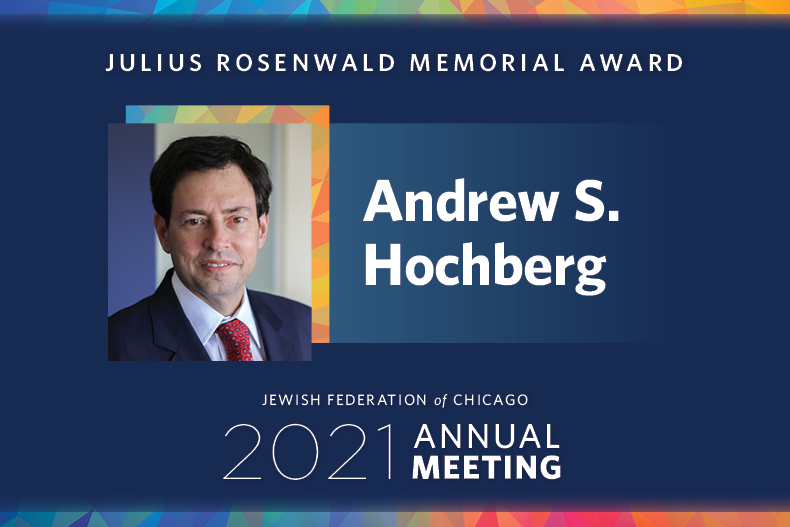
Meet Andrew S. Hochberg, 2021 Julius Rosenwald Memorial Award recipient
Celebrate Andy Hochberg at the virtual Annual Meeting on Sept. 14
Read more -

Two local teens win national recognition
Recipients of the annual Diller Teen Tikkun Olam Awards
Read more -

Celebrating six young award winners cultivating the community
Introducing young adult award winners
Read more