A Chicago writer, with a heart in Houston
Robert Nagler Miller
Because S.L. Wisenberg has been gracing the local writers’ scene for four decades with her wry and self-effacing essays and her incisive and insightful journalism, a reader just discovering her work might assume she is a Chicago native with roots in the Jewish community; a topic she has chosen to focus on in much of her work. Could she be a Hyde Parker, North Sider, Evanstonian (she is, after all, an alum of Northwestern’s Medill School of Journalism), or a product of the North Shore?
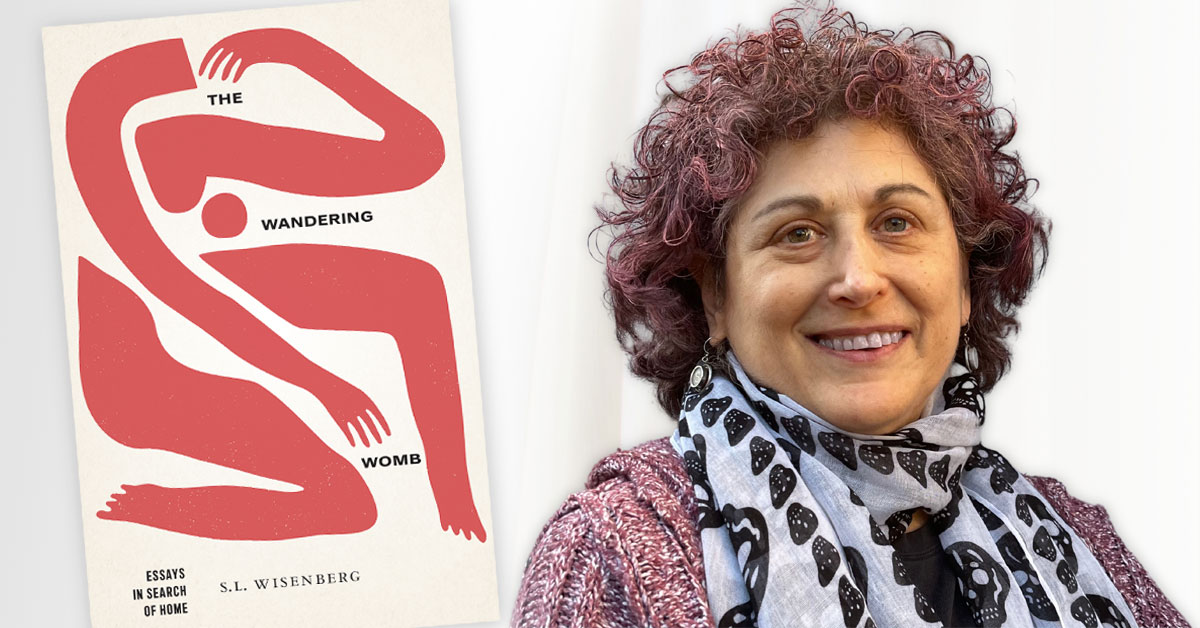
No. None of the above. As Wisenberg writes at length in her just-released collection, The Wandering Womb: Essays in Search of Home , published by the University of Massachusetts Press, which just awarded her its Juniper Prize for Creative Nonfiction, she is a proud fourth-generation Jewish Texan, having been raised in a heavily Jewish neighborhood in Houston. Wandering Womb includes pieces on Wisenberg’s experiences growing up in Houston and her family’s journey across the Southern landscape– namely, Mississippi, Alabama, and Georgia–but many are centered in Chicago, where she writes, teaches, and works as a writing coach. More than a handful of her essays, penned over the past three decades, were originally published in the Chicago Reader , where Wisenberg’s byline appeared frequently, particularly in the 1990s.
Jewish Chicago recently talked to Wisenberg about her work and her life.
Q: You write of your childhood identification with Anne Frank. How did that come about?
A: When I was a kid, I wanted to be a writer [like Anne Frank]. I had identified with Louisa May Alcott before Anne Frank. I was an advanced reader and read Anne Frank’s diary when I was about 8. She was a role model. She had an older sister. I have an older sister.
Your descriptions of your childhood in Houston are vivid–the trips to Neiman Marcus, your family’s midcentury modern home, your high school newspaper friends, your neighborhood. Would you talk a little more about that neighborhood, Meyerland, and what it represented for Jews in the city?
When I was growing up in Houston, there were just enough Jews to live in one place in the city. At that time, most of us lived close to the major Conservative synagogue. I had the belief that I knew everybody there… When I was a child, I thought that most of my classmates were Jewish, but when I looked at a yearbook some years ago, I saw that maybe one in four of us was Jewish.
The Jews who migrated to the South had a very different experience than, say, Jews of New York, Chicago, or Los Angeles. You’ve done a lot of research into your forebears. What was it like for your family to be part of such a tiny portion of their communities?
The South was defined by white and Black, and Jews were considered white. My grandfather Sol, who lived in Laurel, Mississippi, was invited to become a member of a Baptist society. When he reminded them that he was Jewish, they said, ‘Oh, Sol, we don’t consider you a Jew.'”
You’re very candid about your foibles. Looking back at your adolescence, you describe yourself as a “sleep-defying wonder.” You hated going to bed and liked to work through the night on your school paper. Do you still burn the midnight oil?
Yes, I still like to write at night… [but] I fight it so much. I fight it to this day. The other day, I stayed up to 3 a.m.
Wisenberg will be reading from her book on Sunday, May 21, 2 p.m., at Chicago Loop Synagogue, 16 South Clark Street. She will be joined by poet Dina Elenbogen, who will also be reading from her latest book. Both writers will have books available for purchase and signing.