A Jewish family tale playing in Chicago
PAMELA S. NADELL
After six weeks at sea, Heyum Lehman, soon to be called Henry, weeks shy of his 22nd birthday, stepped, on September 11, 1844 onto a New York dock. He had been dreaming of America for years. Born in the German state of Bavaria–the unification of Germany lay in the future–he and his brothers Emmanuel and Mayer were among 150,000 Jews immigrating to America between 1820 and 1880.
The brothers were typical Jewish immigrants. They were young, single men, searching for a life and a living. Letters from America to Bavaria had extolled this fine country where Jews could thrive and remain bound by religious traditions. Sons of a cattle merchant, the Lehman brothers spoke Yiddish at home and with Jews, and German with Christians.
Henry had been dreaming of America, not only because of its golden reputation but because Bavaria, like many German states, imposed harsh laws on its Jews. They paid heavy taxes. Villages and not only limited the number of Jews permitted to reside but even how many could marry. They kept lists, and a young Jewish man would have to wait until someone died and his name rose to the top before he could wed. Often by the time that happened, he had grey hair, or, like the Lehman brothers, he had left.
Henry followed two shipmates to Alabama, where, like almost all of this era’s Jewish immigrant men, he started out as a peddler, selling farmers’ wives crockery and cloth. By the time he reached Montgomery a year later, he had saved enough to open the H. Lehman general store. In time, after Mendel, who became Emanuel, and Maier, who became Mayer, arrived, its sign read Lehman Brothers.
******
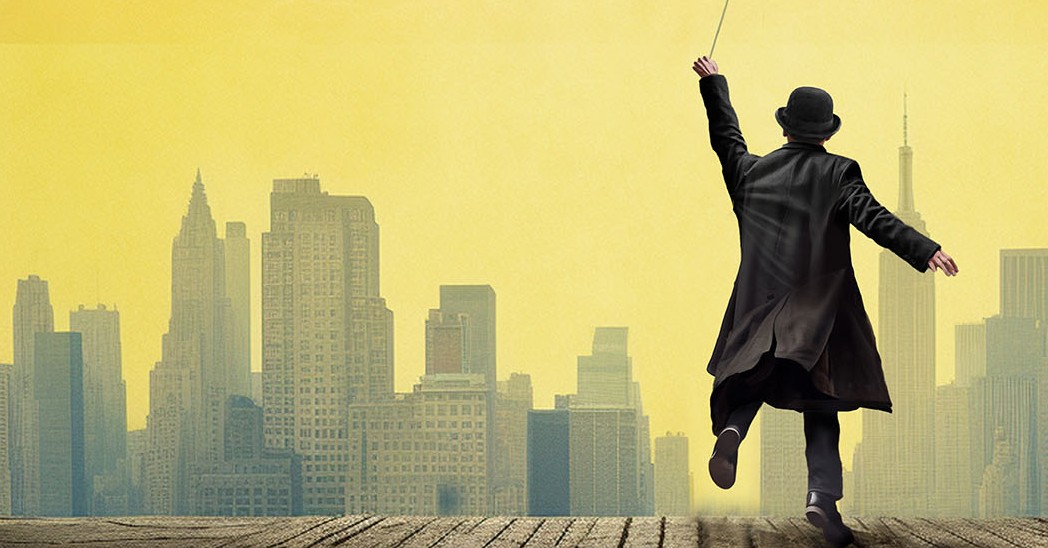
Stefano Massini, The Lehman Trilogy ‘s playwright, imagined the Lehman brothers and their descendants. He has taken colorful threads from moments in their lives and braided them into a play that mixes fact and fiction. Three themes are woven throughout–the Lehman brothers’ world of business, their family relations, and their religious lives.
Jewish tradition infused their world but that tradition changed in the generations that followed. From the moment we meet Henry, a “circumcised Jew,” he blesses God– Baruch HaShem , literally Blessed be the Name–for his safe arrival. At his shop, he has nailed a mezuzahon its doorpost as Deuteronomy commands. On Shabbat , he closes that shop, opening instead on Sundays. Perhaps he could do that in Alabama, but, back then, many states’ Sunday laws decreed that no store, even one owned by Jews, could do business on the “Lord’s Day.”
The brothers observed Jewish holidays. Lighting the Chanukah candles, Henry chants the Hebrew blessing–our playwright uses the dialect Jews speak today; Bavarian Jews spoke a different dialect.
Deaths in the play bring the mourners’ Kaddish prayer. In 1855, yellow fever stole the life of Henry, just thirty-three years old. Emanuel and Mayer follow all the rules as they would have done in Rimpar. For the week after the burial, their store is shuttered. On wooden benches, they sit shiva, Hebrew for the number seven. That they do not shave, that their suits are torn signal that they are in mourning. Morning, noon, and night, they recite the Kaddish. The few score Jews then living in Montgomery, who have already established a synagogue, follow the custom to bring them meals and words of comfort. At the end of seven days, the brothers leave the house. Yet they remain in mourning, not only during the sheloshim, thirty days after burial, but, as befits the death of a relative as close as a brother, for eleven months. When Emanuel goes to knock on the plantation owners’ doors, his beard is still long.
Gradually, the tradition loses its powerful hold. When Mayer dies, almost half a century after Henry, Emanuel decrees that the family will follow all the rules of mourning just as they did in Rimpar, but only for three days. By the time Philip, Emanuel’s son, dies in the mid-twentieth century, no mourners rip their suits. The Lehman Brothers stays open. No one sits shiva or recites the Kaddish . Instead, they observe for the man, who had tracked the women he courted by the Hebrew months, three minutes of silence.
America had worked its wonders. The Lehman Brothers had not only made a living, they had launched an empire. Then, just as the traditions they had brought from Rimpar crumpled, so too did the empire, cultivated over decades, collapse.
The Lehman Trilogy runs Sept. 27 – Oct. 29 (with previews Sept. 19 – 26) at the Broadway Playhouse, 175 E. Chestnut St. For tickets, visit timelinetheatre.com.
American University Professor Pamela S. Nadell is the author of America’s Jewish Women: A History from Colonial Times to Today , winner of the 2019 National Jewish Book Award’s “Jewish Book of the Year.” Currently writing a history of American antisemitism, she is serving as the play’s Jewish studies consultant.
In this issue
-

An ‘awesome’ new fellowship for teens
AKLA Chicago will be a free, five-week experiential experience for ages 12–14
Read more -
-