A lifetime of self-portraits, and a music-filled winter
Hedy Weiss
Every work of art–whether in the form of a painting, a piece of music, a work of choreography, a novel, or a poem–is in some way, shape, or form a self-portrait that suggests the life, and times, and emotional history of the artist who has created it.
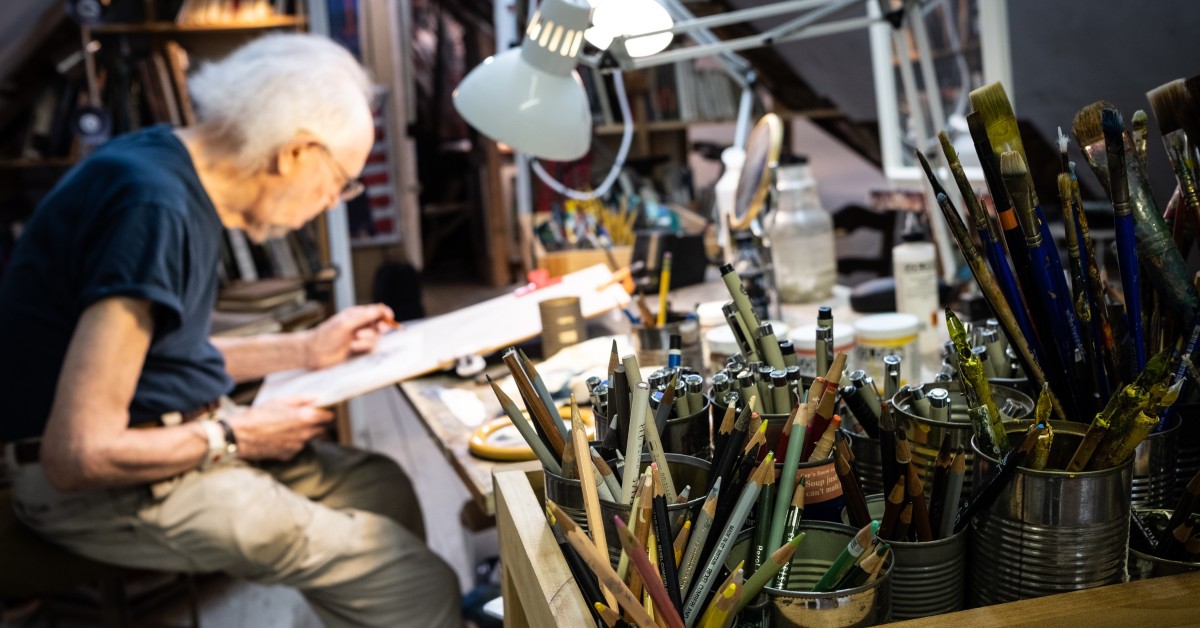
In the case of the Chicago-bred artist Leo Segedin, who is now 94 years old and as fully engaged with his work as ever, self-portraits have been a particular obsession (he has made hundreds of them), along with his fascinating, highly dramatic streetscapes of Chicago with its brick buildings, elevated trains, and working-class crowds of the 1940s and ’50s.
And while over the years Segedin has had more than 60 solo and group exhibitions, the exhibit that just completed its run at Oakton Community College’s Koehnline Museum of Art in Des Plaines marked the first to focus entirely on his multi-faceted self-portraiture.
As for music, the “life stories” suggested by the work of the composers and performers to be heard in a number of upcoming concerts and musicals are many and varied. So, feel free to interpret their intriguing musical “self-portraits” as you wish.
Here is a closer look at these visual as well as sonic treats:
Leo Segedin’s decades of facing his face
When asked if he remembers the first self-portrait he made, Leo Segedin does not hesitate.
“I have memories of being about 15 years old and doing a drawing of myself in Prismacolor [colored pencils] that greatly pleased my mother,” he said, as he chatted by phone from his home in Evanston. “She framed it, and I still have it, and I also remember her telling me that art was okay as a hobby, but I couldn’t make a living at it.”
Segedin’s early gift for drawing led him to classes at the Art Institute of Chicago, but as a student at the University of Illinois at Urbana-Champaign he initially studied for a career in either chemical or aeronautical engineering. It was not to be. In his junior year art took over as the focus of both his undergraduate and master’s degrees. And after teaching drafting at the U.S. Army Engineer School in Virginia from 1952 to 1954 (while also exhibiting, and winning prizes for, his work at the Art Institute and the Corcoran Gallery in Washington D.C.), he returned to Chicago and began teaching. He would eventually spend more than 30 years at Northeastern Illinois University until he retired in 1987, was named Art Professor Emeritus, and began devoting himself entirely to painting.
Along the way Segedin raised twin sons with his wife of 45 years, who died in 2005 (and with whom he served as a theater usher for years, and even hosted productions in their living room). Along the way he also was a member of the Chicago Society of Artists, served as president of the American Jewish Art Club, and was a prolific essayist and lecturer.
“As for the artists who have influenced me–well, Breughel has always been very important, and Rembrandt, and the detail in the early works of Durer is beyond belief,” Segedin said. “And I’ve just finished a series of paintings inspired by a W. H. Auden poem about the fall of Icarus, because I came to realize that everyone thinks of Icarus’ fall, but no one pays attention to what his father Daedalus must have felt when he lost his son.”
“Now my subject is the issue of old age,” Segedin said, noting that the exhibit at the Koehnline Museum was not arranged strictly by chronology, but by the way its various gallery spaces lent themselves to displaying his work which often deals with themes of mythology and games in which his own image can be found amidst a crowd.
“My last several paintings were drawn out in pencil and painted with faster-drying acrylics,” said the artist. “I’ve also worked with graphite on glass panels. For most of my self-portraits I use mirrors to get a close-up view. Early on, when I did street scenes from the Chicago El, I used a little Kodak camera, and instead of just following the horizontal line of the tracks, I tried to capture the curves to the left and right.”
Now at work on a memoir about how he became an artist, Segedin says his motto comes courtesy of Mel Brooks: “Just keep breathing.”
Defrost with the help of music
Whether it’s classical music at Orchestra Hall and beyond, or musical theater classics and revues, there is much to choose from in the next couple of months. Here are a few highlights as the 2022 season begins:
Chicago Symphony Orchestra:
Casablanca : On Feb. 13, the CSO will perform the film score of Casablanca , composed by Max Steiner, the Austrian-born American whose hundreds of Hollywood film scores led to his being dubbed “the father of film music.” (But note: The movie’s iconic song, “As Time Goes By,” is by Herman Hupfeld.)
Philip Glass : The CSO will perform Feb. 17-19 the Chicago premiere of composer and pianist Philip Glass’ “Symphony No.11.” He wrote the symphony to celebrate his own 80th birthday, which debuted at Carnegie Hall in 2017. Glass, now 84, has composed such operas as Einstein on the Beach and Akhnaten , and is renowned for his use of repetition. He is of Lithuanian Jewish heritage and has described himself as “Jewish-Taoist-Hindu-Toltec-Buddhist.” (Also on the program will be Beethoven’s “Piano Concerto No. 4,” featuring renowned pianist Mitsuko Uchida.
For tickets visit cso.org .
The Simon & Garfunkel Story
At the CIBC Theatre, Broadway in Chicago presents The Simon & Garfunkel Story (Feb. 22-27), a music-filled revue about the life and times and remarkable 1960s era folk-rock songbook created by two guys who first met in a Queens, New York elementary school.
For tickets visit broadwayinchicago.com .
West Side Story
West Side Story (Feb. 2-March 27), the Leonard Bernstein and Stephen Sondheim masterwork, will be seen in its “original” form at the Marriott Theatre in Lincolnwood–and just in time to serve as a comparison study with Steven Spielberg’s new film version.
For tickets visit MarriottTheatre.com .
Defiant Requiem
Finally, on Feb. 15, the Illinois Holocaust Museum and Education Center will present a virtual presentation titled Defiant Requiem: Creative and Spiritual Resistance in the Terezin Ghetto , which explores the remarkable story of how conductor Rafael Schachter managed to recruit 150 fellow prisoners, and teach them Verdi’s “Requiem.” They performed the work 16 times before they were sent to their death in concentration camps.
For information visit ilholocaustmuseum.org .
Hedy Weiss, a longtime Chicago arts critic, was the Theater and Dance Critic for the Chicago Sun-Times from 1984 to 2018, and currently writes for WTTW-TV’s website and contributes to the Chicago Tonight program.
In this issue
-
An ‘awesome’ new fellowship for teens
AKLA Chicago will be a free, five-week experiential experience for ages 12–14
Read more -
-