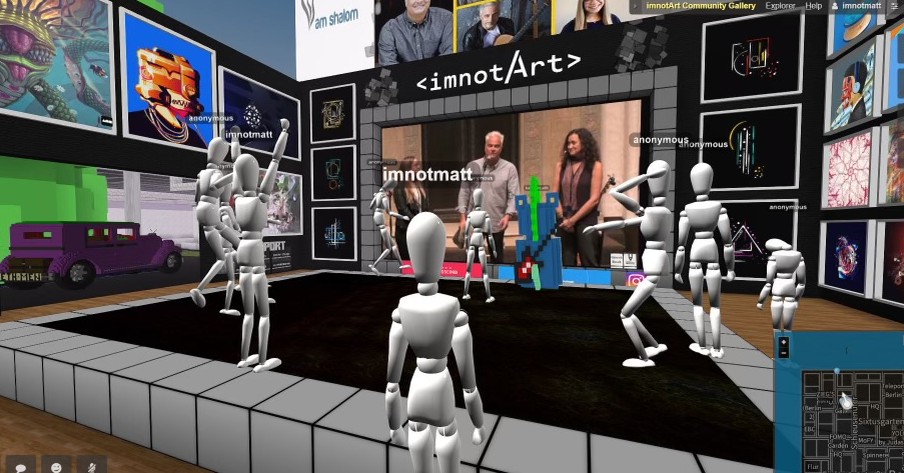
Am Shalom boldly going where no synagogue has gone before—the metaverse
Rabbi Steven Stark Lowenstein can remember a time in the early ’90s when the uniform template for a rabbi’s resume did not allow space for cell phone numbers and email addresses.
What a difference 30 years makes: Lowenstein, spiritual leader of Am Shalom–a Glencoe-based Reform synagogue–is leading an effort to make the synagogue the first in the metaverse. “We’ve always been on the cutting edge,” he said. “I’ve always believed in using technology to help get our message out there.”
This began a decade ago when Am Shalom was on the leading edge of streaming services. Lowenstein, beginning his third decade as rabbi at the synagogue, instituted this innovation to accommodate congregants who lacked the mobility to attend services in-person. From one video camera in the back of the congregation. Am Shalom now employs a team to oversee its seven-camera production feed for the High Holidays, and installed multi-cameras and screens in the sanctuary for Shabbat and b’nai mitzvah services.
As the country emerges from the pandemic, Lowenstein has taken the second step with regards to technology by continuing to offer both a live stream of services as well as an in-person presence. “It’s just the world we are living in,” he said.
Expanding into the metaverse is Lowenstein’s newest technological exploration. The metaverse is a network of 3D virtual worlds where visitors can work, play, shop, and socialize. And-when Lowenstein’s venture comes to fruition–pray.
Lowenstein was encouraged to explore the faith-based possibilities on the metaverse by a congregant attending a High Holiday service. “Out of the blue, he said to me that Am Shalom should be the first congregation in the metaverse and that he would fund it,” Lowenstein said.
Last fall, Lowenstein attended a dinner party where he was seated next to a man who happened to have an art gallery on the metaverse. “He became my advisor and mentor,” Lowenstein said.
The next step was to learn about cryptocurrency, which is the coin of the realm in the metaverse. With limited funds, the rabbi invested in cryptocurrency and registered with the Giving Block, which facilitates cryptocurrency fundraising for charities, universities, and faith-based organizations.
Now able to accept cryptocurrency donations, Lowenstein has been able to establish a presence on the Crypto Voxels platform where he bought a piece of virtual property on the island of Scarcity. There, a virtual synagogue is currently being designed and constructed.
This past winter, Lowenstein and his congregation mounted a live concert at his friend’s metaverse art gallery, imnotArtChicago (it is also Chicago’s first physical NFT gallery, according to its website). “Streaming it to the metaverse opens ourselves up to other people who like dabbling in the metaverse,” Lowenstein said. “We are extending our reach even further.”
Last Chanukah, Lowenstein ushered in this new era by presenting his staff, including rabbis, administrators, and cantors, with Oculus virtual reality headsets.
“Today’s metaverse is akin to yesterday’s flip phone,” he said. “I have no idea what the metaverse is going to look like one year, two years, five years, 10 years from now. I do know people a lot smarter than I am are going to continue to develop and explore and help us find ways to connect and communicate, and I want to be a part it.”
Am Shalom envisions being able to link its Oculus headsets to cantors and other rabbis to hold virtual services together. “It’s not your grandparents’ or even your parents’ temple anymore,” he said. “Judaism in 2022 needs to be willing to take risks and be able to explore and find new ways to express ourselves and engage with each other. The world that we live in is different from the world I’m leaving to my kids and grandkids. Everything is adapting and changing. Judaism needs to as well.”
Donald Liebenson is a Chicago writer who writes for VanityFair.com , LA Times , Chicago Tribune , and other outlets.
In this issue
-

This Passover, four more questions
The youngest guests at our seders will likely ask the four traditional questions, but here are four other questions to chew on over matzah this holiday.
Read more -
New Stephen Sondheim biography details the towering figure
‘Walking encyclopedia of musical theater’: New Stephen Sondheim biography details the towering figure
Read more -

Celebrating spring and a crop of new productions
A celebration of Passover, warmer weather, and a crop of new productions
Read more